RESEARCH ARTICLE
Relationship Between Self-Compassion and Mental Health Among Final-Year Female Students Working on Their Thesis
Human Psychology & Behavior|Vol. 1, Issue 1, pp. 12-17 (2025)
CC BY 4.0-2025 Authors
Views
Downloads
Shares

Received
Jul 22, 2025Revised
Oct 20, 2025Accepted
Nov 20, 2025Published
Nov 24, 2025
Abstract
Final-year female students often experience psychological challenges during the thesis-writing process, such as emotional instability, academic stress, and self-doubt, which can negatively affect their mental health. This study examined the relationship between self-compassion and mental health among female students completing their undergraduate theses. A total of 66 participants were selected using purposive sampling from students enrolled in the Islamic Guidance and Counseling program at UIN KH Achmad Siddiq Jember. Data were collected using validated questionnaires on self-compassion and mental health, and analyzed with Pearson’s Product-Moment Correlation. The results showed a statistically significant and strong positive correlation between self-compassion and mental health (r = 0.698, p < 0.001), indicating that higher self-compassion is associated with better mental health. Conversely, students with lower self-compassion reported more frequent mental health disturbances. These findings highlight the importance of integrating self-compassion training and mental health support into higher education programs to help female undergraduates manage academic stress and maintain psychological well-being.
Introduction
Mental health issues among university students have become a growing concern worldwide (1-3). In particular, final-year female students often face substantial psychological strain during research or examinations, a period characterized by academic pressure, emotional instability, and reduced social support (4, 5). Rather than attributing these differences to inherent gender traits, research increasingly emphasizes the influence of social expectations, role strain, and unequal emotional labor, which can heighten psychological distress among female students in academic settings (6, 7).
Julian F. et al. (2023) reported that one-third of 589 Ph. D. students at a public university in Germany were above the cut-off for depression, with thesis-related stress being a major contributor (8). In Indonesia, anecdotal and observational data similarly reflect the high prevalence of emotional distress among students completing final projects, often manifesting as decreased motivation, mood swings, and negative self-perceptions (9-11). Despite the academic system's expectation of resilience, many students struggle silently, leading to impaired psychological well-being and, in some cases, delayed graduation.
While psychological counseling and peer support groups are currently available, they are often underutilized, stigmatized, or insufficient in addressing the specific emotional patterns experienced by final-year female students (12-14). One promising but underexplored psychological resource is self-compassion, the ability to treat oneself with kindness and understanding during times of failure or stress. Research suggests self-compassion is positively correlated with emotional resilience, reduced anxiety, and enhanced well-being (15, 16). However, its role as a protective factor specifically within the thesis-writing context remains under-investigated, particularly among Indonesian female students.
This study was conducted in the Islamic Guidance and Counseling program at UIN KH. Achmad Siddiq Jember, which integrates Islamic values with modern psychological counseling. The program fosters a humanistic and spiritually grounded environment, making it well-suited for exploring self-compassion. In the Islamic perspective, compassion (rahmah) and self-reflection (muhasabah) are central to emotional balance and personal growth (17, 18). These values encourage individuals to respond to failure and stress with empathy and acceptance rather than harsh self-criticism, aligning closely with the psychological construct of self-compassion (19, 20). With approximately 145 female students enrolled between 2015 and 2018, it offers a focused context for examining mental health challenges in young women under academic pressure. By situating this research within an Islamic educational framework, the study also highlights how spiritual and cultural values may shape coping mechanisms and psychological resilience.
Although self-compassion has been linked to mental health, its role as a protective factor during the thesis-writing stage remains under-researched, especially among Indonesian female students. Addressing this gap, the study used a quantitative approach and purposive sampling to survey 66 final-year students. The Self-Compassion Scale (SCS) and the Mental Health Inventory (MHI-38) were used to assess psychological well-being. The findings aim to inform targeted mental health strategies in higher education.
Methodology
Study Design and Rationale
This study employed a cross-sectional quantitative design to investigate the relationship between self-compassion and mental health among final-year female university students. A correlational approach was chosen to examine the strength and direction of associations between the two primary psychological constructs. A cross-sectional design was selected due to time and logistical constraints related to participants’ academic schedules. Longitudinal or experimental designs were considered but deemed impractical, as students were in different phases of thesis completion and extended tracking could disrupt their academic progress. Moreover, the study aimed to identify associations rather than causal effects, making the correlational design suitable for the research objectives.
Population, Sample, and Sampling Technique
The target population comprised female undergraduate students from the Islamic Guidance and Counseling Program at Universitas Islam Negeri KH. Achmad Siddiq Jember, Indonesia, who were actively engaged in writing their final thesis at the time of the study. Using purposive sampling, 66 participants were recruited based on three inclusion criteria: (1) enrollment in the Islamic Guidance and Counseling undergraduate program, (2) current engagement in thesis writing, and (3) willingness to participate voluntarily. All participants were part of the 2018 cohort and were drawn from two academic class sections (BKI 1 and BKI 2). Students with previously diagnosed psychiatric disorders were excluded. The total student population from the 2015–2018 academic years was approximately 145 individuals, from which the 66 participants were selected based on the aforementioned criteria.
Instruments and Measures
This study employed two standardized self-report instruments that have been validated for psychological research. The first was the Self-Compassion Scale (SCS) developed by Neff (2003), which was culturally adapted for use in the local context. The SCS comprises 26 items divided into six subscales: self-kindness, self-judgment, common humanity, isolation, mindfulness, and over-identification. Participants responded using a 5-point Likert scale, ranging from 1 (“almost never”) to 5 (“almost always”).
The second instrument was the Mental Health Inventory (MHI-38) developed by Veit and Ware (1983), which measures psychological well-being and psychological distress. For this study, the MHI-38 underwent item reduction following a reliability analysis to produce a modified version more suited to the target population. Responses were recorded on a 6-point Likert scale, from 1 (“all of the time”) to 6 (“none of the time”).
Instrument Validation and Item Structure
Validity testing was conducted for both psychological constructs: self-compassion and mental health. For the Self-Compassion Scale, corrected item-total correlation coefficients ranged from 0.315 to 0.702, indicating that all items met the minimum validity threshold of 0.30. The instrument comprised six dimensions: self-kindness, self-judgment, common humanity, isolation, mindfulness, and over-identification. Each dimension was operationalized through multiple indicators, as shown in Table 1. A total of 28 items were retained as valid.
| Dimension | Indicator | Item Numbers | Item Count |
|---|---|---|---|
| Self-Kindness | Self-acceptance | 5, 23, 26, 27, 29 | 5 |
| Empathy toward self | 12, 19, 28 | 3 | |
| Self-Judgment | Self-denial | 21 | 1 |
| Self-criticism | 8, 11, 16, 31 | 4 | |
| Common Humanity | Connection with others | 7, 15 | 2 |
| Acceptance of human imperfection | 10 | 1 | |
| Isolation | Feeling isolated | 4, 25 | 2 |
| Feeling helpless | 13, 18 | 2 | |
| Mindfulness | Objective self-observation | 9, 14 | 2 |
| Acceptance of reality | 17, 22 | 2 | |
| Over-Identification | Over-focusing on problems | 2, 24 | 2 |
| Loss of emotional control | 6, 20 | 2 | |
| Total | 28 | ||
Similarly, the Mental Health Inventory demonstrated corrected item-total correlation coefficients ranging from 0.243 to 0.861, indicating good item validity. The scale measured two main constructs: psychological distress and psychological well-being. Psychological distress included indicators of anxiety, depression, and loss of emotional control, while well-being comprised positive affect, emotional connectedness, and life satisfaction. A total of 24 valid items were identified across both categories, as summarized in Table 2.
| Construct | Indicator | Item Numbers | Item Count |
|---|---|---|---|
| Psychological Distress | Anxiety | 3, 35 | 2 |
| Depression | 2 | 1 | |
| Loss of emotional control | 8, 18, 44 | 3 | |
| Psychological Well-being | Positive affect | 4, 5, 7, 12, 17, 22, 26, 31, 34, 37 | 10 |
| Emotional connectedness | 10, 23, 39, 42 | 4 | |
| Life satisfaction | 1, 40, 41, 43 | 4 | |
| Total | 24 | ||
The validity results from both instruments confirmed that all items included in the analysis met the criteria for psychometric adequacy, ensuring that the scales were reliable measures of the constructs under study.
Data Collection Procedure
Data were collected using an online questionnaire distributed through Google Forms starting on March 30, 2022. The survey link was shared individually with eligible participants through private WhatsApp messages to ensure confidentiality. Participant eligibility was confirmed through records obtained from the administrative office of the Faculty of Da'wah at UIN KH. Achmad Siddiq Jember. A total of 66 valid responses were submitted and met the inclusion criteria. All responses were anonymized and securely stored to maintain respondent privacy. Prior to data collection, ethical clearance was obtained from the Research Ethics Committee of Universitas Islam Negeri KH. Achmad Siddiq Jember (Approval No. B/Un.22/6.a/PP.00.9/2022). All participants provided informed consent electronically before completing the questionnaire. They were assured of voluntary participation, confidentiality, and the right to withdraw at any stage without penalty.
Data Analysis
Prior to hypothesis testing, the dataset was screened for missing values and assessed for normality, linearity, and homoscedasticity. The collected responses were exported from Google Forms into Microsoft Excel for initial organization and cleaned prior to statistical processing. Each item on the instruments was subjected to validity testing using item-total correlation, followed by reliability analysis via Cronbach’s alpha. Data were then analyzed using SPSS version 26. The Pearson product-moment correlation coefficient was used to examine the relationship between self-compassion and mental health. Statistical significance was determined at p < 0.05.
Results
Reliability and Psychometric Soundness of Instruments
Cronbach's alpha was used to assess the internal consistency of both instruments. The Self-Compassion Scale yielded a Cronbach's alpha coefficient of 0.896, while the Mental Health Inventory demonstrated a higher reliability coefficient of 0.940. These results indicate strong internal consistency for both instruments, exceeding the commonly accepted threshold of 0.70.
Descriptive Overview of Variables
Before conducting inferential analysis, a descriptive overview of the two main variables was carried out. This included summarizing participants’ overall distribution of scores and categorization levels for both self-compassion and mental health. The results show that most respondents were in the high category for both variables, suggesting that the participants generally possessed a positive psychological profile.
In this study, the theoretical (ideal) mean and standard deviation were applied as reference benchmarks to classify the categorical levels of self-compassion and mental health. These theoretical values served as interpretive guides rather than empirical statistics, which were derived directly from participants’ scores. This clarification ensures transparency in how descriptive classifications were established.
Descriptive Categorization of Variables
Descriptive analysis included the computation of the ideal mean (M) and standard deviation (SD) using Eq. 1 and Eq. 2.
Key to Eq. 1: M = ideal mean, Jav = total number of valid items, nt = highest item score, nr = lowest item score.
Key to Eq. 2: SD = ideal standard deviation, Jav = total number of valid items, nt = highest item score, nr = lowest item score.
For the Self-Compassion variable, the ideal mean was calculated as 84 and the ideal standard deviation as 18.67. Based on these values, participants were categorized into five levels. The results are summarized below:
Most participants (54.5%) were categorized as having a high level of self-compassion. For the Mental Health variable, the ideal mean was 72 and the ideal standard deviation was 16. The resulting category breakdown is presented in Table 3. Half of the participants (50%) reported high levels of mental health, while 19.7% were categorized as very high.
| Category | Score Range | Frequency | Percentage |
|---|---|---|---|
| Very High | X > 117.60 | 5 | 7.6% |
| High | 95.20 < X ≤ 117.60 | 36 | 54.5% |
| Moderate | 72.80 < X ≤ 95.20 | 20 | 30.3% |
| Low | 50.40 < X ≤ 72.80 | 5 | 7.6% |
| Very Low | X ≤ 50.40 | 0 | 0.0% |
Cross-tabulation of Self-Compassion and Mental Health
A cross-tabulation was conducted to examine the association between self-compassion and mental health levels among female students completing their undergraduate thesis. Figure 1 summarizes the distribution.
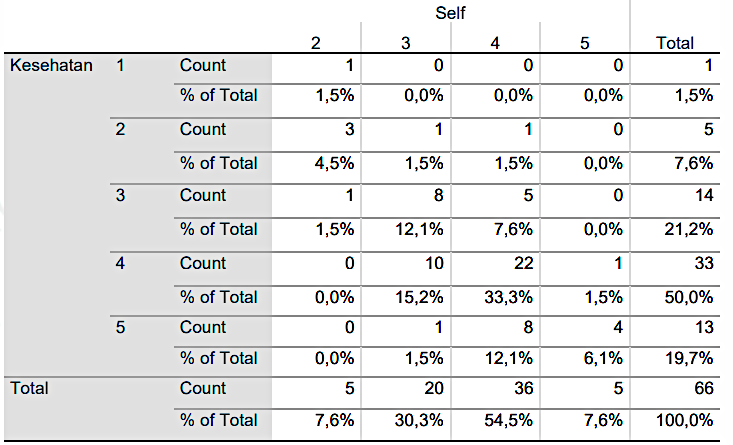
Based on Table 4, which displays the cross-tabulation between self-compassion and mental health among final-year female students, the majority of participants exhibited high levels of self-compassion. Similarly, the most frequently observed category in mental health was also high, with 22 participants (33.3%) falling into this group. This finding suggests that students who exhibit higher self-compassion also tend to report better mental health. While self-compassion does not completely eliminate academic stress, it appears to play a protective role by helping students manage their emotions more effectively during thesis completion.
| Category | Score Range | Frequency | Percentage |
|---|---|---|---|
| Very High | X > 100.8 | 13 | 19.7% |
| High | 81.6 < X ≤ 100.8 | 33 | 50.0% |
| Moderate | 62.4 < X ≤ 81.6 | 14 | 21.2% |
| Low | 43.2 < X ≤ 62.4 | 5 | 7.6% |
| Very Low | X ≤ 43.2 | 1 | 1.5% |
Assumption Testing and Hypothesis Testing
Normality Test
A Kolmogorov-Smirnov test was conducted using SPSS version 26 to examine data normality, appropriate for samples under 100 participants. The test yielded an asymptotic significance value of 0.091, which exceeds the threshold of 0.05, indicating that the dataset is normally distributed.
Linearity Test
Linearity was assessed through ANOVA analysis in SPSS. The significance value for the “deviation from linearity” was 0.616, which is greater than 0.05. This confirms the presence of a linear relationship between the independent variable (self-compassion) and the dependent variable (mental health).
Hypothesis Testing
Pearson's product-moment correlation test revealed a statistically significant and strong positive correlation (r = 0.698, p < 0.01) between self-compassion and mental health. This result supports the study hypothesis, demonstrating that higher self-compassion is associated with better mental health outcomes. The positive direction of the relationship implies that students with higher levels of self-compassion are likely to experience stronger psychological well-being, while those with lower self-compassion tend to report poorer mental health.
Discussion
The findings of this study were obtained through Pearson's Product-Moment Correlation test, which yielded a significance value of 0.000. The Pearson correlation coefficient was 0.698, indicating a moderate positive correlation (21). This suggests that higher levels of self-compassion are associated with better mental health among female students, while lower self-compassion relates to poorer well-being.
Participants with high self-compassion showed acceptance and reduced self-blame (22), whereas those with low self-compassion reported low self-esteem and frequent self-criticism. These results align with the crosstabulation patterns, where more than half of the participants demonstrated high levels of both self-compassion and mental health. This overlap indicates that self-compassion acts as a psychological resource for maintaining well-being during academic stress.
Participants with high self-compassion demonstrated behaviors such as recognizing that their abilities need not match those of others, showing self-acceptance, and refraining from self-blame. In contrast, students with low self-compassion exhibited behaviors such as low self-esteem, irrational emotional pain, a sense of misfortune, and frequent self-criticism, all of which negatively impacted their mental well-being. These correlation results are consistent with the patterns shown in the crosstabulation table between self-compassion and mental health among female students completing their undergraduate thesis.
These quantitative results correspond to the categorical findings, in which more than half of the participants demonstrated high levels of both self-compassion and mental health. This overlap reinforces the conclusion that self-compassion functions as a psychological resource that helps students sustain well-being amid academic stress. Hence, integrating self-compassion practices into counseling or mentoring programs could be an effective preventive strategy for final-year students experiencing thesis-related distress
Recent research further supports the critical role of self-compassion in regulating emotions and enhancing psychological well-being. Sharma and Sharma (2025) emphasized that self-compassion significantly predicts resilience and emotional stability among college students, helping them cope effectively with academic stress (16). Similarly, Han & Kim (2023) demonstrated that individuals with higher self-compassion display lower levels of anxiety and depression due to their greater ability to respond mindfully to failure and criticism (23). These findings strengthen the argument that self-compassion acts as a protective emotional mechanism, especially for female students who often experience heightened stress sensitivity and self-critical tendencies.
The mechanisms of self-compassion namely mindfulness, self-kindness, and common humanity have been revisited in recent literature. Mindfulness allows individuals to recognize distress without over-identifying with it, self-kindness encourages acceptance rather than judgment, and common humanity helps individuals realize that suffering is a shared human experience (24). These dimensions collectively support adaptive emotion regulation and contribute to improved mental health outcomes among students.
From a cultural and spiritual standpoint, Islamic values provide a complementary framework that aligns closely with the principles of self-compassion. Contemporary psychological perspectives highlight that rahmah (compassion), muhasabah (self-reflection), and tawakkul (trust in divine decree) cultivate emotional equilibrium and self-awareness, functioning in ways comparable to self-compassion practices (25, 26). Within Islamic educational settings, these values guide individuals to face academic challenges with patience, humility, and acceptance, fostering resilience and inner peace (27). Consequently, Islamic spirituality not only reinforces self-compassion but also offers a culturally grounded paradigm for promoting psychological well-being among Muslim female students
The results also align with previous research by Ainaini Shofiyah (2021) on the relationship between self-compassion and emotional regulation in mothers of children with autism (28). Her study concluded that individuals with high self-compassion were better able to accept life circumstances by fostering understanding and self-care despite their challenges. The key difference between this study and Shofiyah’s lies in the research subject. This study focuses on female students, as women tend to have lower emotional regulation than men. This is supported by Murdhiono W. R. et al (2022) also argued that female students experiencing stress and negative emotions are more likely to face academic and health-related consequences (29).
This study found that 54.5% (36 respondents) of participants had high levels of self-compassion. Meanwhile, 50% (33 respondents) experienced significant mental health disturbances while working on their thesis. This indicates that many of the participants faced mental health challenges during this period. According to interviews conducted, students reported frequent difficulties during thesis writing, such as trouble finding literature, unstable moods, and demotivation.
In line with the findings of Leila B. et al (2016) and Matin M. A. et al (2017), thesis work is often perceived as highly stressful, resulting in challenges like lack of confidence, difficulty finding literature or informants, and insufficient academic skills (30, 31). These factors may lead female students to blame themselves, focus excessively on their mistakes, and fail to take constructive actions, consistent with Kristin Neff’s theory on the three negative aspects of self-compassion (32). Therefore, when a student’s self-compassion is high and positively oriented, it supports the development of better mental health by helping them manage stress, communicate effectively, and make sound decisions.
Limitations
This study has several limitations. The cross-sectional design limits causal interpretation between self-compassion and mental health, while the use of self-report questionnaires may introduce social-desirability and response biases. In addition, the sample consisted solely of female students from a single academic program, which restricts the generalizability of findings to broader populations. Future studies are recommended to employ longitudinal or experimental designs, involve more diverse participants, and include qualitative approaches to capture cultural and contextual nuances of self-compassion and mental health.
Conclusion
This study found a strong, positive correlation between self-compassion and mental health among final-year female students. Higher levels of self-compassion were associated with better psychological well-being, confirming its role as a protective factor during academic stress. These findings underscore the need for universities to integrate self-compassion practices into counseling services and mental health programs. Future initiatives could include workshops, mentoring, or curriculum-based interventions that promote mindfulness, self-kindness, and emotional resilience, helping students manage academic challenges more effectively.
Declarations
Conflict of Interest
The authors declare no conflicting interest.
Data Availability
The unpublished data is available upon request to the corresponding author.
Funding Information
The author(s) declare that no financial support was received for the research, authorship, and/or publication of this article.
References
- Alharbi F. Determinants of mental health among university students: A study on the factors that predispose university students to mental health issues. 2024.
- Pesko MJ. Anxiety disorders’ effect on college and university students’ mental health: A common and growing concern. Curr Psychopharmacol. 2020;9(2).
- McMaster R, Adachi K, Yada H, Odachi R, Omura M, Cleary M. Exploration of mental health issues of students among university health science academics in Japan. Issues Ment Health Nurs. 2021;42(9).
- Wimberly CE, Rajapakse H, Park LP, Price A, Proeschold-Bell RJ, Østbye T. Mental well-being in Sri Lankan medical students: A cross-sectional study. Psychol Health Med. 2022 Jul 3;27(6):1213–26.
- Carrard V, Bourquin C, Berney S, Schlegel K, Gaume J, Bart PA, et al. The relationship between medical students’ empathy, mental health, and burnout: A cross-sectional study. Med Teach. 2022 Dec 2;44(12):1392–9.
- Mommersteeg PM, van Valkengoed I, Lodder P, Juster RP, Kupper N. Gender roles and gender norms associated with psychological distress in women and men among the Dutch general population. J Health Psychol. 2024 Jul 6;29(8):797–810.
- Karimah RN, Merry D, Robin C. Gender, disability, inclusive education: Mental health interventions. Int J Stud Soc Sci Humanit. 2024;1(1).
- Friedrich J, Bareis A, Bross M, Bürger Z, Rodríguez ÁC, Effenberger N, et al. “How is your thesis going?” Ph.D. students’ perspectives on mental health and stress in academia. PLoS One. 2023;18(7).
- Rijal SF A, Ridfah A, Akmal N, Rijal S. Academic distress against academic procrastination: Study analysis of thesis completion of Makassar Tourism Polytechnic students and the Faculty of Psychology, Makassar State University. Pusaka J Tour Hosp Travel Bus Event. 2024 Jun 7;163–9.
- Izza A Al, Lailiyah S. Literature review: Factors affecting final-year students’ anxiety in preparing a thesis in Indonesia. J Community Ment Health Public Policy. 2024 Apr 5;6(2):114–25.
- Prameswari AA, Satiadarma MP, Wati L. The influence of self-compassion on anxiety in final-year students in Jakarta. Int J Appl Soc Sci Humanit. 2023 Aug 18;1(1):670–80.
- Kihumuro RB, Kaggwa MM, Nakandi RM, Kintu TM, Muwanga DR, Muganzi DJ, et al. Perspectives on mental health services for medical students at a Ugandan medical school. BMC Med Educ. 2022 Oct 25;22(1):734.
- Cerolini S, Zagaria A, Franchini C, Maniaci VG, Fortunato A, Petrocchi C, et al. Psychological counseling among university students worldwide: A systematic review. Eur J Investig Health Psychol Educ. 2023 Sep 14;13(9):1831–49.
- Magier MJ, Law M, Pennisi S, Martini T, Duncan MJ, Chattha H, et al. Final-year university students’ mental health and access to support as they prepared to graduate. Cogent Ment Health. 2023 Dec 31;2(1):1–38.
- Sabir F, Ramzan N, Malik F. Resilience, self-compassion, mindfulness and emotional well-being of doctors. Indian J Posit Psychol. 2018;9(1).
- Sharma D, Sharma RD. Building emotional fortitude: The interplay of resilience, self-compassion, and psychological well-being among college students. Res Rev Int J Multidiscip. 2025 Jan 10;10(1):164–70.
- Wardana GK, Fauziah H, Bachtiar SS, Novitasari E. Implementasi terapi muhasabah sebagai upaya memelihara kesehatan mental dalam usaha penanggulangan adiksi narkoba (Studi Lapangan Lapas Narkotika Cirebon). Syifa al-Qulub J Stud Psikoterapi Sufistik. 2021.
- Astutik F. Sebuah systematic literature review mengenai penerapan Islamic mindfulness pada kesehatan mental. Conseils J Bimbing Konseling Islam. 2024.
- Al Khairiyah N, Rachmah N, Anganthi N. The relationship of Islamic spirituality, self-compassion, and husband support with subjective well-being in the late trimester of pregnant women during the COVID-19 pandemic. Int Summit Sci Technol Humanit (ISETH). 2022.
- Khotimah DFK, Shobahiya M, Hafidz. Islamic-informed self-compassion as a protective mechanism against negative body image: A phenomenological study of female adolescents in Islamic schools. J Pendidik Islam. 2025.
- Schober P, Boer C, Schwarte LA. Correlation coefficients: Appropriate use and interpretation. Anesth Analg. 2018 May;126(5):1763–8.
- Batic D, Gogov B. Assertiveness as a communication style in the work of police. In: The Strategic and Security Concept for the Countries of Southeast Europe. Skopje: Faculty of Security; 2023. p. 197–205.
- Han A, Kim TH. Effects of self-compassion interventions on reducing depressive symptoms, anxiety, and stress: A meta-analysis. Mindfulness. 2023 Jul 5;14(7):1553–81.
- Neff KD. Self-compassion: Theory, method, research, and intervention. 2022.
- Nurfitroh F, Tihami MA, Hunainah H, Bachtiar M, Wasehudin W, Lugowi RA. Regulation of emotions in the context of Islamic religious education and modern psychology. DIMAR J Pendidik Islam. 2025 Apr 22;6(2):216–27.
- Aliyah U, Wibowo ME, Purwanto E, Sunawan S. Construct social emotional learning (SEL) in the Islamic paradigm for Muslim students in Indonesia. Islam Guid Couns J. 2024 Sep 5;7(2).
- Ali N, Umar M, Mopoliu AZ. Academic resilience and religiosity among college students facing post-pandemic learning. Int J Recent Educ Res. 2023 Sep 7;4(5):585–96.
- Ainaini Shofiyah. Hubungan antara self-compassion dengan regulasi emosi pada ibu yang memiliki anak autis. Surabaya: Universitas Islam Negeri Sunan Ampel; 2021.
- Murdhiono WR, Vidayanti V, Retnaningsih LN, Setiawan DI, Wiyani C, Syafitri EN, et al. Gender, self-control and self-development affect academic stress during online learning among undergraduate students. Malays J Med Health Sci. 2022;18.
- Bazrafkan L, Shokrpour N, Yousefi A, Yamani N. Management of stress and anxiety among PhD students during thesis writing. Health Care Manag. 2016 Jul;35(3):231–40.
- Matin MA, Khan MA. Common problems faced by postgraduate students during thesis works in Bangladesh. Bangladesh J Med Educ. 2017 Apr 18;8(1):22–7.
- Neff KD, Knox MC. Self-compassion. In: Encyclopedia of Personality and Individual Differences. Cham: Springer International Publishing; 2017. p. 1–8.