RESEARCH ARTICLE
Phytochemical and Behavioral Assessment of Guiera senegalensis for Antidepressant Activity
Sciences of Phytochemistry|Vol. 4, Issue 2, pp. 122-127 (2025)
CC BY 4.0-2025 Authors
Views
Downloads
Shares

Received
Aug 7, 2025Revised
Nov 3, 2025Accepted
Nov 11, 2025Published
Nov 25, 2025
Abstract
Depression is a prevalent and debilitating mental disorder that significantly affects global health and quality of life. Conventional pharmacological treatments have adverse effects, necessitating the search for alternative therapies. This study aimed to evaluate the potential antidepressant activity of the ethanol leaf extract of Guiera senegalensis in Wistar rats. Phytochemical screening was performed to identify bioactive compounds in the extract. Acute toxicity was assessed following OECD guidelines, with doses up to 5000 mg/kg. The antidepressant activity was evaluated using the Forced Swim Test (FST) and Tail Suspension Test (TST). Experimental groups received extract doses of 25, 50, and 100 mg/kg, with control groups receiving normal saline and reference groups treated with imipramine (10 mg/kg). Statistical analyses were conducted using one-way ANOVA with Dunnett’s post hoc test. Phytochemical analysis revealed the presence of flavonoids, tannins, and saponins, which are known for their neuropharmacological properties. Acute toxicity testing showed no mortality at 5000 mg/kg, indicating a high safety profile. Behavioral assessments demonstrated that the extract significantly reduced immobility time in the FST and TST at doses of 50 and 100 mg/kg (p < 0.05), suggesting antidepressant activity. The ethanol leaf extract of G. senegalensis exhibits both antidepressant effects in animal models, supporting its traditional use in managing mood disorders. The presence of bioactive compounds suggests a pharmacological basis for its efficacy. Further research is needed to elucidate its mechanisms of action and assess its long-term safety.
Introduction
Mental health disorders, particularly depression have become major public health concerns worldwide due to their increasing prevalence and impact on individuals' well-being. The continuous development of healthcare has heightened awareness of this condition, yet social pressures and stressful environments contribute significantly to its rise. Prolonged exposure to stress negatively affects brain development increasing the risk of depression (1). Depression has become one of the most common psychiatric illnesses, with over 280 million people affected globally, representing about 3.8% of the global population (2). The prevalence of depression varies by demographic, with higher rates among females (2). Current pharmacological treatments for depression include selective serotonin reuptake inhibitors (SSRIs), and tricyclic antidepressants. Despite their clinical usefulness, current antidepressant medications show limited efficacy, with response rates ranging between 60–70% and relapse rates of about 30–40% among patients. Moreover, adverse effects such as sedation, constipation, urinary retention, and cognitive impairment often limit patient adherence and long-term use (3, 4). These challenges necessitate the need for safer and more effective alternatives derived from natural products with favorable safety profiles.
Although depression is a global health concern, its burden is increasingly pronounced in low- and middle-income countries, particularly across sub-Saharan Africa, where limited access to mental healthcare and socioeconomic stressors contribute to underdiagnosis and inadequate treatment (5). Traditional medicine therefore plays a critical role in bridging this therapeutic gap. Within this context, Guiera senegalensis, a widely used medicinal shrub in African ethnomedicine, has long been employed for managing anxiety, stress, and mood-related disorders, underscoring its relevance as a culturally and pharmacologically significant candidate for antidepressant research.
G. senegalensis is a drought-tolerant shrub widely distributed across the Sahel region of West Africa, including Senegal, Mali, Burkina Faso, and Niger (6). Traditionally, various parts of the plant, particularly the leaves and roots, have been utilized for managing mental health-related ailments. Phytochemical investigations have revealed that G. senegalensis contains diverse bioactive constituents such as flavonoids, tannins, saponins, alkaloids, and phenolic compounds, which are associated with antioxidant, anti-inflammatory, antimicrobial, and neuroprotective properties (6, 7).
Given the limitations of conventional pharmacological treatments for depression, there is a critical need to explore natural alternatives with minimal side effects. G. senegalensis, being a widely available and traditionally used medicinal plant, holds promise as a potential source for novel antidepressant agents. This study aims to evaluate the antidepressant effects of ethanol leaf extract of G. senegalensis in rats.
Experimental Section
Plant Material Collection
The plant material used in this study was G. senegalensis. Fresh leaves were collected from Gadau village, Itas-Gadau Local Government Area, Bauchi State, Nigeria, in April 2024. The plant was authenticated at the Herbarium Unit of the Department of Biological Sciences, Sa’adu Zungur University, Bauchi, by Abdullahi Ishaka and assigned a voucher number (00156) for future reference.
Experimental Animals
Forty Wistar rats (220–250 g) were obtained from the animal housing facility of the Department of Pharmacology, Ahmadu Bello University, Zaria. The animals were housed under standard laboratory conditions at the Animal House, Department of Pharmacology, Sa’adu Zungur University, Bauchi State. They underwent a two-week acclimatization period with ad libitum access to water and a commercial diet (Vital Feed Nig. Ltd). Ethical clearance (Approval No. BASUG/FBMS/REC/VOL.07/0103) was obtained from the Faculty of Basic Medical Sciences Research and Ethics Committee (FBMSREC), Sa’adu Zungur University, Bauchi, before the study commenced. All experimental procedures were conducted in accordance with the ARRIVE guidelines to ensure transparency, reproducibility, and ethical integrity in animal research. For subsequent study, animals were randomly assigned to different treatment groups using a simple randomization method to ensure unbiased distribution.
Extraction of Plant Material
The leaves were washed and air-dried at room temperature to a constant weight, then ground into a fine powder using a mortar and pestle. A total of 100 g of the coarse powder was extracted in 500 mL of 70% ethanol with mechanical agitation for 72 h. The extract was filtered using filter paper and dried in an oven at 45–50 °C until a consistent weight was achieved.
Phytochemical Analysis
The phytoconstituents present in the ethanol extract of G. senegalensis were identified using conventional qualitative phytochemical tests (8). Flavonoids were detected using the Shinoda test (magnesium ribbon and hydrochloric acid reaction), while tannins were identified using the ferric chloride test, which produces a blue-black coloration. Saponins were confirmed by the foam test, indicated by persistent froth formation, and terpenoids were detected using the Salkowski test, which yields a reddish-brown coloration at the interface. Alkaloids were tested with Dragendorff’s reagent, which produces an orange-red precipitate, and steroids were identified using the Liebermann–Burchard test, characterized by a green color change upon reaction with acetic acid and sulfuric acid.
Acute Toxicity Study
The acute toxicity studies were conducted using Swiss albino rats in accordance with OECD guidelines (9). Both male and female animals were included to account for biological variations such as hormonal levels, metabolism, and body size. The rats were randomly divided into two groups (n=3 per group). Group 1, the control, received normal saline (5 mL/kg), while group 2, the extract-treated, received G. senegalensis extract (5000 mg/kg). The animals were observed for 24 h for signs of toxicity or behavioral changes.
CNS Depressant Activity Using The Forced Swim Test (FST)
The extract and imipramine were freshly prepared before administration. The ethanol extract of G. senegalensis was suspended in normal saline to ensure uniform solubility. All administrations were carried out orally (p.o. ) 30 min prior to behavioral testing for both the Forced Swim Test (FST) and Tail Suspension Test (TST).
The FST was conducted using a vertical transparent tank (40 cm height, 18 cm diameter) filled with water to a depth of 15 cm at 25 °C, as described by Can et al. (2011). Each rat was placed in the water, and the total immobility time was recorded during the last 5 min of a 6-minute test session. Immobility was defined as floating with minimal movements necessary to keep the head above water (10). Animals were grouped (n=3) and treated as follows:
- Group I: Control (normal saline, 5 mL/kg)
- Group II: G. senegalensis extract (25 mg/kg)
- Group III: G. senegalensis extract (50 mg/kg)
- Group IV: G. senegalensis extract (100 mg/kg)
- Group V: Imipramine (10 mg/kg)
CNS Depressant Activity Using The Tail Suspension Test (TST)
Each rat was suspended from a shelf edge (nose 20–25 cm from the floor) using a 17 cm adhesive tape affixed 1 cm from the tip of the tail. Immobility time was recorded during the last 5 min of a 6-minute session (11). Immobility was defined as passive, motionless hanging. Rats were grouped (n=3) and treated as follows:
- Group I: Control (normal saline, 5 mL/kg, p.o. )
- Group II: G. senegalensis extract (25 mg/kg, p.o. )
- Group III: G. senegalensis extract (50 mg/kg, p.o. )
- Group IV: G. senegalensis extract (100 mg/kg, p.o. )
- Group V: Imipramine (10 mg/kg, p.o. )
Statistical Analysis
All data were analyzed using one-way ANOVA followed by Dunnett’s post hoc test. A p-value of < 0.05 was considered statistically significant (SPSS Version 22). Comparisons were made between test samples and the control group at their respective time points.
Result and Discussion
Extract Yield
The ethanol extraction of G. senegalensis leaves yielded 12.4 g of dried extract from 100 g of powdered leaves, representing a 12.4% yield (w/w) calculated on the basis of the dry weight of the plant material.
Phytochemical Screening
A preliminary phytochemical screening was conducted to identify the bioactive constituents present in the ethanol extract of G. senegalensis. The analysis revealed the presence of flavonoids, saponins, tannins, and terpenoids, while alkaloids and steroids were absent (Table 1). Previous studies have shown that G. senegalensis contains a variety of bioactive compounds, including flavonoids, tannins, saponins, and alkaloids. For instance, one study revealed the presence of flavonoids, tannins, alkaloids, saponins, and phenols in the leaves of G. senegalensis (6, 12). These bioactive compounds are known to exhibit pharmacological effects. Flavonoids, for instance, have been documented to enhance serotonergic and noradrenergic neurotransmission, mechanisms associated with antidepressant effects (13). Similarly, Saponins have been shown to exhibit significant neuroprotective effects against CNS disorders such as Alzheimer's disease, Parkinson's disease, and stroke (14). The absence of alkaloids suggests that the extract’s CNS activity observed is not mediated by typical alkaloidal mechanisms, which often involve interactions with dopaminergic and cholinergic pathways (15).
| No. | Constituent | Inference |
|---|---|---|
| 1 | Steroids | - |
| 2 | Tannins | + |
| 3 | Flavonoids | + |
| 4 | Saponins | + |
| 5 | Alkaloids | - |
| Note: (+) = Present, (-) = Absent | ||
Acute Toxicity of G. Senegalensis Ethanol Extract
The acute toxicity evaluation showed that the ethanol extract of G. senegalensis did not cause mortality at a dose of 5000 mg/kg, indicating a high safety margin. However, mild behavioral changes including sedation, and reduced food and water intake were observed within the first 24 h. According to the OECD guidelines, substances with an LD50 greater than 5000 mg/kg are considered to be “practically non-toxic” (9). These findings align with previous studies indicating that G. senegalensis exhibits low toxicity even at high doses (16, 17).
Antidepressant Studies
Forced Swim Test (FST)
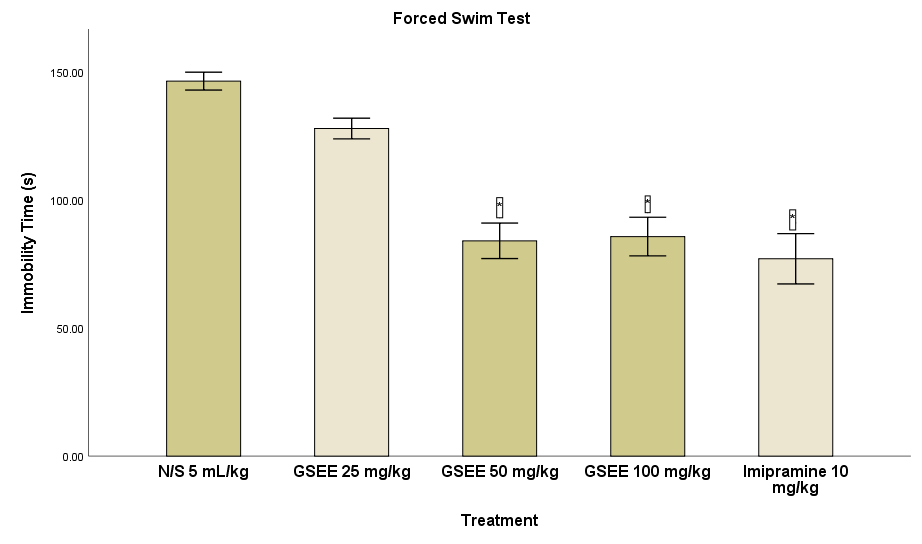
The FST is commonly used to assess antidepressant activity by measuring immobility time, which reflects behavioral despair (18). The ethanol extract significantly reduced immobility time at doses of 50 mg/kg and 100 mg/kg compared to the control group (Figure 1). The reduction in immobility time was comparable to that observed with Imipramine (10 mg/kg). These results suggest that G. senegalensis possesses antidepressant-like effects, potentially through monoaminergic modulation, particularly increasing serotonin and norepinephrine levels. Flavonoids in the extract may contribute to this effect by inhibiting monoamine oxidase (MAO), thereby enhancing neurotransmitter availability (13).
Tail Suspension Test (TST)
The TST is another widely used model for assessing antidepressant activity, particularly in response to acute stress (18). The ethanol extract significantly reduced immobility time at doses of 50 mg/kg and 100 mg/kg compared to the control (Figure 2). However, the reduction was slightly less pronounced than that observed with Imipramine (10 mg/kg). The similar efficacy of the extract and Imipramine suggests that G. senegalensis may modulate stress-coping mechanisms by enhancing serotonergic transmission and reducing HPA axis hyperactivity, both of which are implicated in depression (13, 19). Bioactive compounds such as tannins and saponins have been shown to reduce corticosterone levels, thereby exerting stress-protective effects (19, 20). Furthermore, flavonoids are known to promote hippocampal neurogenesis, a process crucial for mood regulation and antidepressant response (21).
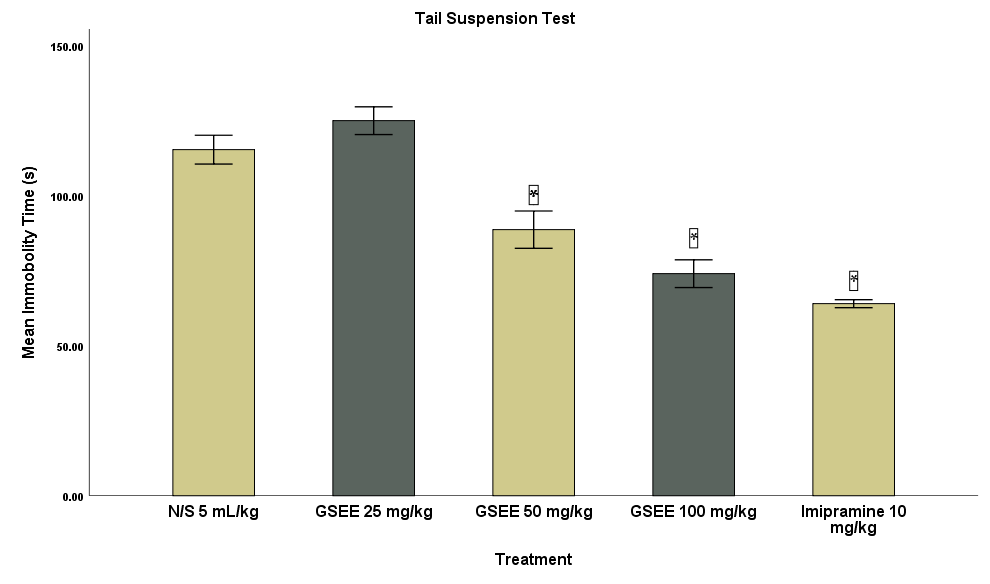
The ethanol extract of G. senegalensis at 100 mg/kg produced an antidepressant effect approaching that of imipramine (10 mg/kg) in both behavioral models. This observation suggests that at higher doses, the extract exhibits a comparable antidepressant-like response, supporting its potential as a natural alternative to conventional antidepressant agents. The present findings are consistent with prior research on G. senegalensis, which has been traditionally used for neurological disorders (22). Similar antidepressant effects have been reported for flavonoid-rich medicinal plants, such as Hypericum perforatum, which exerts its effects via serotonergic modulation (23).
Furthermore, recent in silico findings provide additional molecular support for the antidepressant potential of G. senegalensis. A study by Tahir et al. (2025) demonstrated that key phytochemicals from the plant such as ergostanol, myricetin, quercetin, isorhamnetin, and kaempferol showed good binding affinities toward several depression- and anxiety-related targets, including GABA-A, MAO-A, mGluR5, and the serotonin transporter (SERT). These compounds also exhibited favorable pharmacokinetic and toxicity profiles, suggesting a broad, multi-target modulatory mechanism (24). The convergence between these in silico predictions and the behavioral outcomes of the present study reinforces the hypothesis that G. senegalensis exerts its antidepressant-like effects through integrated modulation of GABAergic and monoaminergic signaling pathways.
Conclusion
The ethanol extract of G. senegalensis demonstrated significant antidepressant-like effects in standard rodent behavioral models. These effects are likely mediated by flavonoids, tannins, and saponins, which may potentially modulate GABAergic and monoaminergic neurotransmission. Given its high safety profile, G. senegalensis may be a potential candidate for developing novel anxiolytic and antidepressant agents. Unlike previous reports based primarily on zebrafish or preliminary screening studies, this work provides dose-dependent behavioral evidence in rats, thereby extending the understanding of G. senegalensis’ neuropharmacological potential. These findings strengthen the experimental basis for future mechanistic and molecular studies aimed at identifying the specific neurotransmitter pathways and bioactive constituents involved in its antidepressant action.
While the present study provides important behavioral evidence supporting the antidepressant potential of G. senegalensis, certain limitations should be acknowledged. The study involved a modest sample size, employed an acute rather than chronic treatment design, and did not include molecular or biochemical analyses to confirm the underlying mechanisms. Future investigations incorporating larger sample populations, extended dosing regimens, and molecular assays are warranted to validate and expand upon these findings.
Declarations
Conflict of Interest
The authors declare no conflicting interest.
Data Availability
All data generated or analyzed during this study are included in this published article.
Ethics Statement
The study's ethical protocol was approved by the Faculty of Basic Medical Sciences Research and Ethics Committee (FBMSREC), Bauchi State University Gadau (approval number: BASUG/FBMS/REC/VOL.07/0103).
Funding Information
The author(s) declare that no financial support was received for the research, authorship, and/or publication of this article.
References
- Wu Y, Wang L, Tao M, Cao H, Yuan H, Ye M, et al. Changing trends in the global burden of mental disorders from 1990 to 2019 and predicted levels in 25 years. Epidemiol Psychiatr Sci. 2023; 32: e63.
- World Health Organization. Depressive disorder (depression). 2023.
- Chu A, Wadhwa R. Selective serotonin reuptake inhibitors. StatPearls. 2024.
- Moraczewski J, Awosika AO, Aedma KK. Tricyclic antidepressants. StatPearls. 2023.
- Gbadamosi IT, Henneh IT, Aluko OM, Yawson EO, Fokoua AR, Koomson A, et al. Depression in Sub-Saharan Africa. IBRO Neurosci Rep. 2022; 12: 309.
- Dirar AI, Devkota HP. Ethnopharmacological uses, phytochemistry and pharmacological activities of Guiera senegalensis J. F. Gmel. (Combretaceae). J Ethnopharmacol. 2021; 267: 113433.
- Hassan UA, Tahir JI, Akanji CF, Adamu A, Tahir A. Analgesic and anti-inflammatory effects of ethanol leaf extract of Guiera senegalensis in murine models. Sci Pharm. 2025; 4 (1): 49– 54.
- Evans WC, Evans D, Trease GE. Trease and Evans Pharmacognosy. 16th ed. Edinburgh: Saunders/Elsevier; 2009. 603 p.
- OECD. Test No. 423: Acute oral toxicity – Acute toxic class method. OECD; 2002. (OECD Guidelines for the Testing of Chemicals, Section 4.)
- Can A, Dao DT, Arad M, Terrillion CE, Piantadosi SC, Gould TD. The mouse forced swim test. J Vis Exp. 2011;(58): 3638.
- Can A, Dao DT, Terrillion CE, Piantadosi SC, Bhat S, Gould TD. The tail suspension test. J Vis Exp. 2012;(59): e3769.
- Elmalik AA, Ahmed FER, Abd ElMooty AE. Phytochemical analysis and antimicrobial activity of Guiera senegalensis leaves extraction. Sch Int J Chem Mater Sci. 2022; 5 (6): 111– 7.
- Alizadeh A, Pourfallah-Taft Y, Khoshnazar M, Safdari A, Komari SV, Zanganeh M, et al. Flavonoids against depression: a comprehensive review of literature. Front Pharmacol. 2024; 15: 1411168.
- Sun A, Xu X, Lin J, Cui X, Xu R. Neuroprotection by saponins. Phytother Res. 2015; 29 (2): 187– 200.
- Hussain G, Rasul A, Anwar H, Aziz N, Razzaq A, Hu W, et al. Role of plant-derived alkaloids and their mechanism in neurodegenerative disorders. Int J Biol Sci. 2018; 14 (3): 341.
- Lawan U, Aliyu A, Mustapha RK, Yunusa A, Danlami H. Biochemical and toxicological activity of Guiera senegalensis leaves extract. Sch Int J Biochem. 2023; 6: 106– 15.
- Yahaya T, Shehu K, Isah H, Oladele E, Shemishere U. Toxicological evaluation of the leaves of Guiera senegalensis (J. F. Gme), Cassia occidentalis (Linn), and Ziziphus mauritiana (Lam). Beni-Suef Univ J Basic Appl Sci. 2019; 8 (1): 14.
- Castagné V, Moser P, Roux S, Porsolt RD. Rodent models of depression: forced swim and tail suspension behavioral despair tests in rats and mice. Curr Protoc Neurosci. 2011; 55: 8.10A.1– 8.10A.14.
- Iob E, Kirschbaum C, Steptoe A. Persistent depressive symptoms, HPA-axis hyperactivity, and inflammation: the role of cognitive-affective and somatic symptoms. Mol Psychiatry. 2019; 25 (5): 1130.
- Wiciń ski M, Fajkiel-Madajczyk A, Kurant Z, Kurant D, Grą cka K, Falkowski M, et al. Can Ashwagandha benefit the endocrine system? A review. Int J Mol Sci. 2023; 24 (22): 16513.
- Jazvinšć ak Jembrek M, Orš olić N, Karlović D, Peitl V. Flavonols in action: targeting oxidative stress and neuroinflammation in major depressive disorder. Int J Mol Sci. 2023; 24 (8): 6888.
- Damo JLK, Boiangiu RS, Brinza I, Kenko Djoumessi LB, Rebe RN, Kamleu BN, et al. Neuroprotective potential of Guiera senegalensis (Combretaceae) leaf hydroethanolic extract against cholinergic system dysfunctions and oxidative stress in scopolamine-induced cognitive impairment in zebrafish (Danio rerio). Plants. 2022; 11 (9): 1149.
- Hritcu L, Ionita R, Postu PA, Gupta GK, Turkez H, Lima TC, et al. Antidepressant flavonoids and their relationship with oxidative stress. Oxid Med Cell Longev. 2017; 2017: 5762178.
- Tahir A, Muazu IK, Ahmad S, Ahmad S. In silico evaluation of Guiera senegalensis phytochemicals as multi-target modulators of anxiety and depression-related proteins. IPS J Mol Docking Simul. 2025; 3 (1): 48– 57.