REVIEW
CRISPR-Integrated Nanogenomic Modulation of β-Cell Epigenome: AI-Assisted Multi-Omics Strategies for Precision Reversal of Diabetes Mellitus
Sciences of Pharmacy|Vol. 5, Issue 3, pp. 351-364 (2026)
CC BY 4.0-2026 Authors
Views
Downloads
Shares

Received
Nov 3, 2025Revised
Feb 10, 2026Accepted
Aug 24, 2026Published
Sep 29, 2026
NOTE
Abstract
Diabetes mellitus remains a global health crisis, with pancreatic β-cell dysfunction as a key pathological feature that current therapies address only palliatively. This narrative review examines an emerging paradigm: the convergence of CRISPR-based epigenome editing, nanotechnology, and artificial intelligence for targeted modulation of the β-cell epigenome. We synthesize evidence on epigenetic dysregulation in diabetic β-cells, critically evaluate preclinical developments in CRISPR epigenome editors and smart nanocarriers for pancreatic delivery, and discuss artificial intelligence applications in guide RNA design and multi-omics integration. Although proof-of-concept studies demonstrate promising synergy, clinical translation remains in its earliest stages. Major challenges including delivery specificity, biosafety, immunogenicity, and regulatory hurdles must be overcome before a precision reversal of diabetes can be realistically contemplated. This review provides a balanced assessment of both the transformative potential and the substantial obstacles facing nanogenomic approaches to diabetes therapy.
Keywords:
Introduction
Diabetes mellitus (DM) represents one of the most significant public health challenges of the 21st century. Global prevalence projections estimate that over 700 million individuals may be affected by 2045, with type 2 diabetes (T2D) accounting for the majority of cases (1). Current therapeutic paradigms have historically focused on glycemic control and complication management. Several drug classes including metformin, sulfonylureas, SGLT2 inhibitors, and GLP-1 receptor agonists have substantially improved patient outcomes (2). However, these interventions remain fundamentally palliative. Critically, these approaches do not address the progressive decline in functional pancreatic β-cell mass a central pathological feature in both T1D (autoimmune destruction) and T2D (dedifferentiation and apoptosis) (3). This limitation has motivated a growing research focus on strategies that directly target the molecular mechanisms underlying β-cell failure, aiming for disease modification rather than symptomatic management. It is important to acknowledge that diabetes pathogenesis extends beyond β-cell dysfunction. In T2D, peripheral insulin resistance in adipose tissue, liver, and skeletal muscle plays a fundamental initiating role, with β-cell failure representing the eventual decompensation of insulin secretory capacity in the face of sustained metabolic demand (4). In T1D, autoimmune-mediated β-cell destruction is the primary insult, requiring different therapeutic considerations such as immune modulation or β-cell replacement. While this review focuses on β-cell epigenetic reprogramming a strategy most directly applicable to rescuing dysfunctional but viable β-cells in early-to-moderate T2D or in the context of islet transplantation we emphasize that comprehensive diabetes management will ultimately require integration with approaches addressing systemic metabolism and immune regulation. The roots of diabetes mellitus are rather convoluted, consisting of a lineup of genetic predisposition and environmental factors that change the epigenetic setup. Genome-wide association studies (GWAS) have identified over 400 loci associated with T2D risk, with many mapping to non-coding regulatory regions and implicating genes involved in β-cell development and function (e.g., TCF7L2, PDX1, NKX6-1) (5). However, genetics cannot explain solely the rate at which the incidence is increasing, which leads to the conclusion that epigenetics was a crucial player in the process. The concept of "metabolic memory" (or "legacy effect") has emerged as a proposed mechanism linking transient metabolic stress to persistent epigenetic alterations that maintain pathological gene expression patterns even after glycemic normalization (6). While supported by substantial observational and preclinical evidence, the precise molecular mechanisms, degree of reversibility, and clinical significance of metabolic memory remain areas of active investigation and debate (7). The said changes in epigenetics, which are characterized by abnormal DNA methylation, histone acetylation, and non-coding RNA expression being out of control, result in the creation of a pathological epigenetic landscape that not only shuts down the key insulinogenic genes but also causes the β-cells to differentiate the other way (8). As a result, the diabetic β-cell does not just undergo apoptosis; its molecular identity is lost. It goes through a process of reverting to a progenitor-like state that is unable to carry out its indispensable endocrine function of hormone production.
Three technological domains are now converging that may enable direct intervention in β-cell epigenetic dysregulation: First, the CRISPR-Cas system has evolved beyond its initial application as a gene-editing nuclease. Catalytically inactive dCas9 fused to epigenetic effector domains (e.g., p300 for activation, DNMT3A for repression) enables targeted modification of the epigenome without altering underlying DNA sequences a feature particularly relevant for correcting disease-associated epigenetic marks (9). Second, nanotechnology offers a suite of delivery platforms being developed to overcome biological barriers to CRISPR-based therapeutics. Lipid nanoparticles (LNPs), polymeric nanoparticles, and bio-inspired exosomes are being engineered to encapsulate and protect CRISPR components, with surface functionalization strategies under investigation to enhance tropism toward pancreatic islets (10). However, achieving efficient and specific in vivo delivery to human β-cells remains a major technical hurdle, with most studies to date limited to murine models or ex vivo human islets. Third, artificial intelligence (AI) and machine learning are increasingly applied to integrate and analyze multi-omics datasets (genomics, epigenomics, transcriptomics) generated from human islet studies. Such approaches have enabled identification of transcriptional programs associated with β-cell dysfunction (11) and are being developed to predict optimal intervention points within gene regulatory networks. We emphasize that most AI applications in this context remain exploratory, with predictions requiring rigorous experimental validation and the inherent limitations of model training data (e.g., sample size, platform biases) representing ongoing concerns.
This review examines the emerging concept of nanogenomic modulation the convergence of AI-assisted multi-omics analysis, CRISPR-based epigenome editing, and precision nanodelivery as a potential approach to targeting β-cell dysfunction at the molecular level. We critically evaluate the evidence supporting each technological pillar, assess their integration into a coherent therapeutic workflow, and analyze the substantial challenges that must be addressed before clinical translation becomes feasible. Rather than claiming imminent disease reversal, we aim to provide a realistic assessment of both the transformative potential and the formidable obstacles facing this research direction.
Methods
This review was prepared as a narrative synthesis of the emerging literature at the intersection of CRISPR-based epigenome editing, nanotechnology, and AI applications in diabetes research. Given the broad and rapidly evolving nature of these fields, a systematic review methodology was not employed. Instead, we aimed to provide a conceptual framework integrating findings from multiple disciplines while critically evaluating the evidence base.
Literature Search: PubMed, Web of Science, and Google Scholar were searched for articles published between January 2010 and December 2024 using combinations of the following keywords: "diabetes mellitus," "β-cell," "pancreatic islet," "epigenetics," "DNA methylation," "histone modification," "CRISPR," "dCas9," "epigenome editing," "nanoparticle," "lipid nanoparticle," "drug delivery," "artificial intelligence," "machine learning," "multi-omics," "single-cell RNA-seq," and "ATAC-seq. " Reference lists of relevant reviews and primary research articles were manually screened for additional citations.
Inclusion Criteria: Peer-reviewed original research articles and reviews written in English that addressed: (1) epigenetic mechanisms in β-cell dysfunction; (2) development or application of CRISPR-based epigenetic editors in mammalian systems; (3) nanocarrier-mediated delivery of nucleic acids or CRISPR components to pancreatic islets or related tissues; or (4) AI/ML analysis of multi-omics data relevant to diabetes. Priority was given to studies using human islets or in vivo models, though in vitro studies were included where they provided mechanistic insight.
Limitations: As a narrative review, this work does not systematically assess study quality or quantitatively synthesize findings. The selection of cited studies reflects the authors' judgment of conceptual relevance rather than an exhaustive catalog of the literature. We acknowledge the potential for selection bias and have attempted to mitigate this by including discussion of challenges, limitations, and areas of ongoing debate.
The Diabetic β-Cell: A Multi-Omics Blueprint of Dysfunction
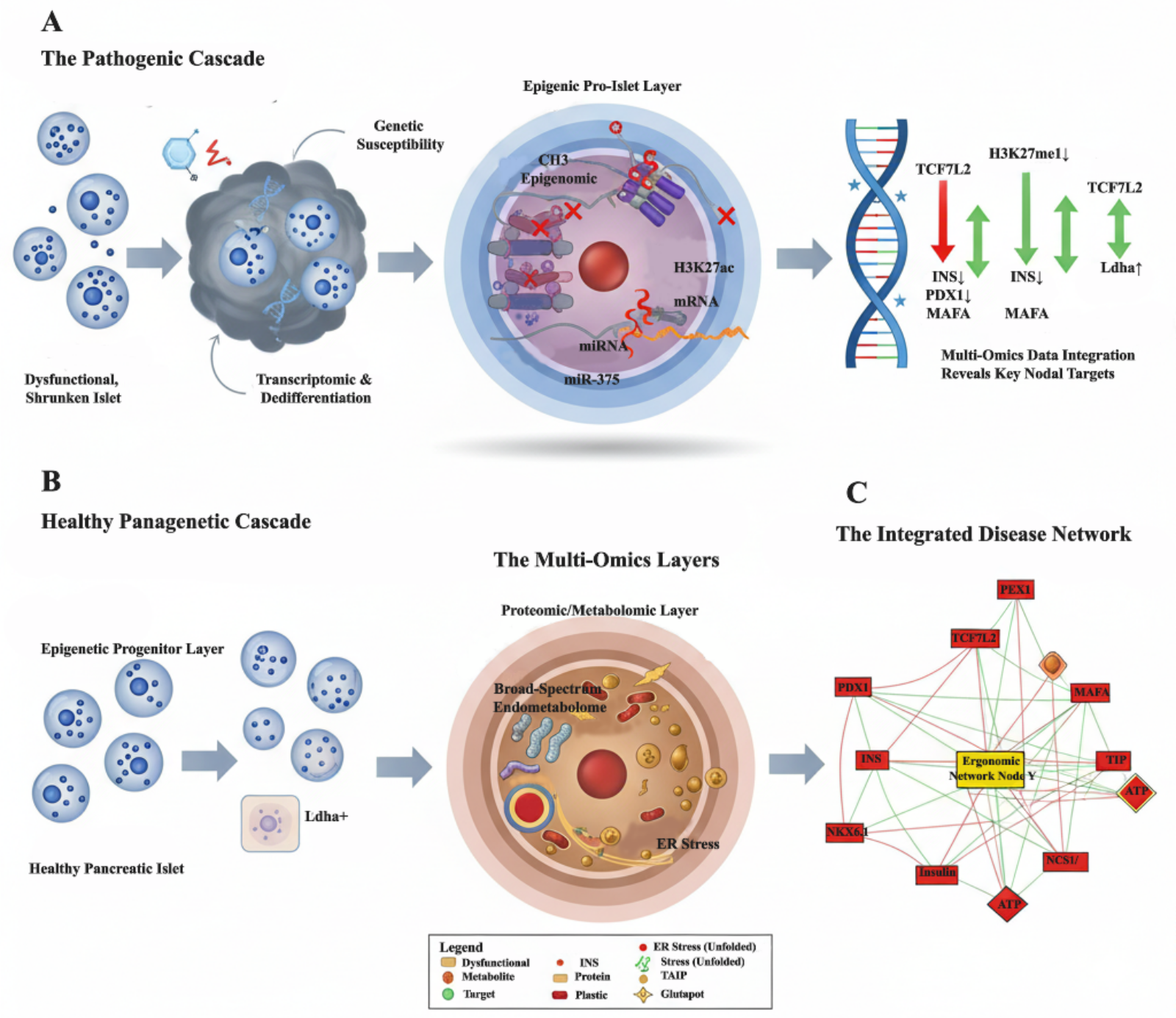
Multi-omics approaches have substantially advanced our understanding of β-cell failure by enabling simultaneous interrogation of genomic, epigenomic, transcriptomic, and proteomic alterations. Integration of these data layers while methodologically challenging has begun to reveal how genetic predisposition, environmental stressors, and epigenetic modifications converge to produce the functional deficits characteristic of diabetic β-cells (Figure 1). We note that much of this work remains descriptive, with causal relationships requiring functional validation.
The Genetic Foundation: A Landscape of Inherited Susceptibility
The genome-wide association studies (GWAS) have revealed more than 400 loci that are linked to the risk of type 2 diabetes (T2D), with most of them located in non-coding regulatory areas, which emphasizes the leading role of changed gene regulation in the cause of the disease (5). The important loci point to the main weaknesses in β-cell physiology. Variants in TCF7L2, being the most potent T2D-related locus, hinder Wnt signaling and proglucagon processing, thus making β-cells more prone to die during metabolic stress. In the latest functional genomics research, it is shown that TCF7L2 controls a large network of genes that are critical for the preservation of β-cell function and vitality (12). Similarly, KCNJ11 and ABCC8 codify for the Kir6.2 and SUR1 subunits that are responsible for the β-cell ATP-sensitive potassium (KATP) channel. Certain gene variants might hinder the channel's proper function, which is to close when ATP increases, thereby reducing the amount of insulin released in response to glucose and raising the risk for T2D considerably (13). PDX1 is a master regulator of β-cell development along with the mature function. The haploinsufficient condition leads to insulin (INS) and glucose transporter gene expression disruption, which results in the occurrence of monogenic diabetes (MODY4) and also adds to the polygenic T2D risk by making the β-cell transcriptional identity weaker (14).
Genetic variants give rise to a susceptible background, which, along with the overall environmental factors, leads to the triggering of dysfunction mostly through dynamic epigenetic mechanisms. It is important to note that GWAS-identified variants typically confer modest increases in disease risk and are predominantly non-coding, implicating regulatory rather than structural alterations. The functional consequences of most risk variants remain uncharacterized, and heritability estimates suggest that much of T2D genetic risk remains unexplained highlighting the need for continued investigation and caution in overinterpreting known loci.
The Epigenetic Layer: The Dynamic Interface of Genes and Environment
The epigenome has been proposed as a molecular substrate for "metabolic memory," whereby prior metabolic stress leaves persistent marks that influence gene expression even after the initial stimulus is removed. Studies of human islets from T2D donors have revealed that diabetic β-cells show, in terms of epigenetics, a very different picture on the whole. Regarding DNA methylation, increased DNA methylation (hypermethylation) at promoters of key β-cell genes, including PDX1 and INS, has been observed in human islets from T2D donors compared with non-diabetic controls (15). These changes correlate with reduced gene expression, and in vitro models suggest that glucotoxic conditions can induce similar methylation patterns. However, establishing causality whether methylation changes drive transcriptional silencing or reflect other regulatory alterations remains challenging in human islet studies. In addition, histone modifications show an alteration in the ratio of activating and repressive histone marks as a typical sign of β-cell death. For example, high glucose lowers the activating mark H3K27ac at the INS promoter while raising the repressive one H3K9me2 at the PDX1 locus, and thus, totally disassembling the β-cell's transcriptional identity program (16). Furthermore, non-coding RNAs such as microRNAs (e.g., miR-375) and long non-coding RNAs (e.g., HI-LNC15) are greatly impacted in diabetes and cause the development of complex regulatory networks that post-transcriptionally control genes linked to insulin secretion, cell growth, and apoptosis (17). This durable, but at the same time adaptable, epigenetic dysregulation is considered a major therapeutic chance for changing the pathological code without actually modifying the DNA sequence.
Transcriptional and Functional Decay: The Phenotypic Manifestation
The effects of genetic and epigenetic factors are leading to the total collapse of the β-cell's transcriptomic program. The use of single-cell RNA sequencing (scRNA-seq) has been very important in uncovering the process of β-cell dedifferentiation in diabetes. Rather than only dying, a considerable number of β-cells go back to a progenitor-like state and in the process lose the expression of important transcription factors (e.g., PDX1, NKX6-1, MAFA) and even insulin, besides expressing abnormally the "disallowed" genes (11). This identity crisis brings about the loss of the special metabolic coupling where glucose metabolism is directly linked to insulin secretion. The findings of proteomic analyses confirm this view by reporting drastic changes in mitochondrial energetics, increased ER stress, and a disrupted secretory granule pool, as evidenced in human islet organoid models of diabetes (18).
Integrating the Omics: A Systems View for Target Identification
A key promise of multi-omics integration is the ability to map GWAS-identified risk variants onto regulatory landscapes defined by epigenomic assays (e.g., ATAC-seq for chromatin accessibility, ChIP-seq for histone modifications) and to assess their correlation with transcriptomic changes in diabetic islets. Such integrative analyses can prioritize candidate functional variants and identify potential target genes for downstream investigation (19). We emphasize that these approaches generate hypotheses requiring experimental validation, as statistical association does not demonstrate causality. Then we can represent the disease as a network model, where the pathways that have gone wrong are not regarded as separate but as a connected web. To illustrate, a genetic variant in a non-coding area could be associated with increased chromatin accessibility, which then affects the expression of a transcription factor that controls a group of genes related to insulin vesicle docking (19). This holistic, multi-omics diagram is important for getting from correlation to causation and hence pinpointing the most powerful and central epigenetic targets for the following CRISPR-based nanogenomic modulation.
The CRISPR Toolkit: Evolving from Gene Editing to Epigenomic Reprogramming
The CRISPR-Cas system has evolved from a programmable nuclease for gene editing into a versatile platform for diverse genomic manipulations, including targeted transcriptional regulation and epigenetic modification. This evolution is particularly relevant for diabetes, where permanent gene knockout is rarely the therapeutic goal. Instead, strategies aimed at modulating gene expression to restore β-cell function without altering underlying DNA sequences may offer a more appropriate intervention. The modern-day CRISPR toolset now provides a complete range of precise instruments that are capable of modifying the epigenetic code and undoing the transcriptional dysregulation that is characteristic of the diabetic β-cell.
From Nucleases to Navigators: The dCas9 Core
The first major step forward was the development of the catalytically "dead" Cas9 (dCas9), which was made by introducing point mutations that completely remove its DNA-cleaving activity but still allow it to bind to DNA in a programmed manner (20). This change in Cas9's nature from a highly active nuclease to a modular one that can be aimed at specific areas of the genome without causing double-strand breaks was a breakthrough. The dCas9 core is now utilized as a programmable scaffold that can be attached to many different effector domains, thus allowing for very accurate intervention at the transcription and epigenetic levels.
Epigenetic Editing: Rewriting the Metabolic Memory
Fusion of dCas9 to epigenetic modifier domains enables targeted manipulation of the chromatin landscape, offering a potential approach to reversing disease-associated epigenetic states. While these tools represent a promising strategy for addressing the epigenetic components of "metabolic memory," their application remains largely confined to preclinical models, and direct comparison with alternative approaches (e.g., small molecule epigenetic modulators, conventional gene therapy) is needed to establish relative efficacy and safety. For targeted activation, the combination of dCas9 with the histone acetyltransferase p300 or the transcriptional activator VP64 can lead to chromatin opening and strong activation of previously silent genes. As an example, dCas9-p300 targeted to PDX1 and INS promoters in human islet cells has been reported to increase expression of these genes and enhance glucose-stimulated insulin secretion under glucotoxic conditions in vitro (21). While encouraging, these findings require replication, and translation to in vivo settings remains to be demonstrated. Conversely, for targeted repression, by connecting dCas9 to repressive domains such as the Krüppel-associated box (KRAB) or DNA methyltransferases (DNMT3A), gene silencing can be implemented at specific loci. This method has potential in β-cells for applications such as DPP-4 gene silencing or repressing dedifferentiation drivers, thereby facilitating the maintenance of a mature, functional state (22).
Transcriptional Modulation: CRISPR Interference and Activation (CRISPRi/a)
At its core, the dCas9 technology paved the way for CRISPRi and CRISPRa systems, which are reversible methods that enable the control of gene expression with high precision, again, without the necessity of altering the DNA or epigenetic sequence. In CRISPRi (Interference), an active dCas9-KRAB complex binds to the promoter or enhancer, thereby creating a repressive chromatin structure that occludes gene transcription totally. This technique is especially advantageous for functional genomics screens aiming at discovering genes whose repression turns out to be favorable for the survival and functionality of β-cells. On the other hand, CRISPRa (Activation) utilizes dCas9-based systems such as SunTag or VPR, which are far more sophisticated than the conventional activator fusions, to assemble an entire array of transcriptional activators around a single dCas9, thus causing the target genes to be activated far beyond the normal physiological level. This potent strategy has the potential to bring about the complete re-expression of the set of transcription factors that are characteristic of β-cell identity, thereby reprogramming the dedifferentiated cells back to a functional state (23).
Advanced Genome Surgery: Base and Prime Editing
In the case of curing specific pathogenic point mutations, which are likely to be hereditary conditions (MODY, for example), the use of the CRISPR technology has advanced to a level where disruption of double-strand breaks is no longer necessary. Base editing involves the application of a Cas9 nickase linking with a deaminase enzyme to change directly one DNA base pair into another (e.g., C•G to T•A) without cutting through the DNA backbone. It provides a highly effective and neater alternative for curing diabetes-related single-nucleotide polymorphisms with a considerable decline in indel rates (24). Prime editing is the most accurate method yet. It utilizes a Cas9 nickase reverse transcriptase fusion and a prime editing guide RNA (pegRNA) to directly write new genetic information into a target DNA site. This "search-and-replace" method can perform all 12 possible base-to-base conversions as well as small insertions and deletions with very little off-target effects, thus providing a potentially universal approach for correcting most of the known diabetic genetic variants (25). The different CRISPR tools have been strategically applied to the β-cell rejuvenation, leading from the resetting of the global epigenetic landscape at one end to the making of surgical corrections of the causal genetic lesions at the other, thus opening a new avenue for a new class of regenerative therapeutics for diabetes. It is important to note that base editing and prime editing, while promising for correcting monogenic forms of diabetes (e.g., MODY), have not yet been extensively evaluated in primary human islets or in vivo. Delivery efficiency, off-target activity, and potential unintended consequences of DNA editing (even without double-strand breaks) remain active areas of investigation.
Nanogenomic Platforms: The Vehicle for Precision Delivery
The therapeutic potential of CRISPR-based approaches cannot be realized without delivery systems that can safely and efficiently transport these macromolecular payloads to target cells. For pancreatic β-cells, nanocarriers must overcome multiple biological barriers: vascular clearance, immune recognition, extravasation into islet tissue, cellular uptake, and endosomal escape—all while minimizing off-target distribution, as illustrated in Figure 2. This section critically examines progress toward such platforms and the substantial challenges that remain.
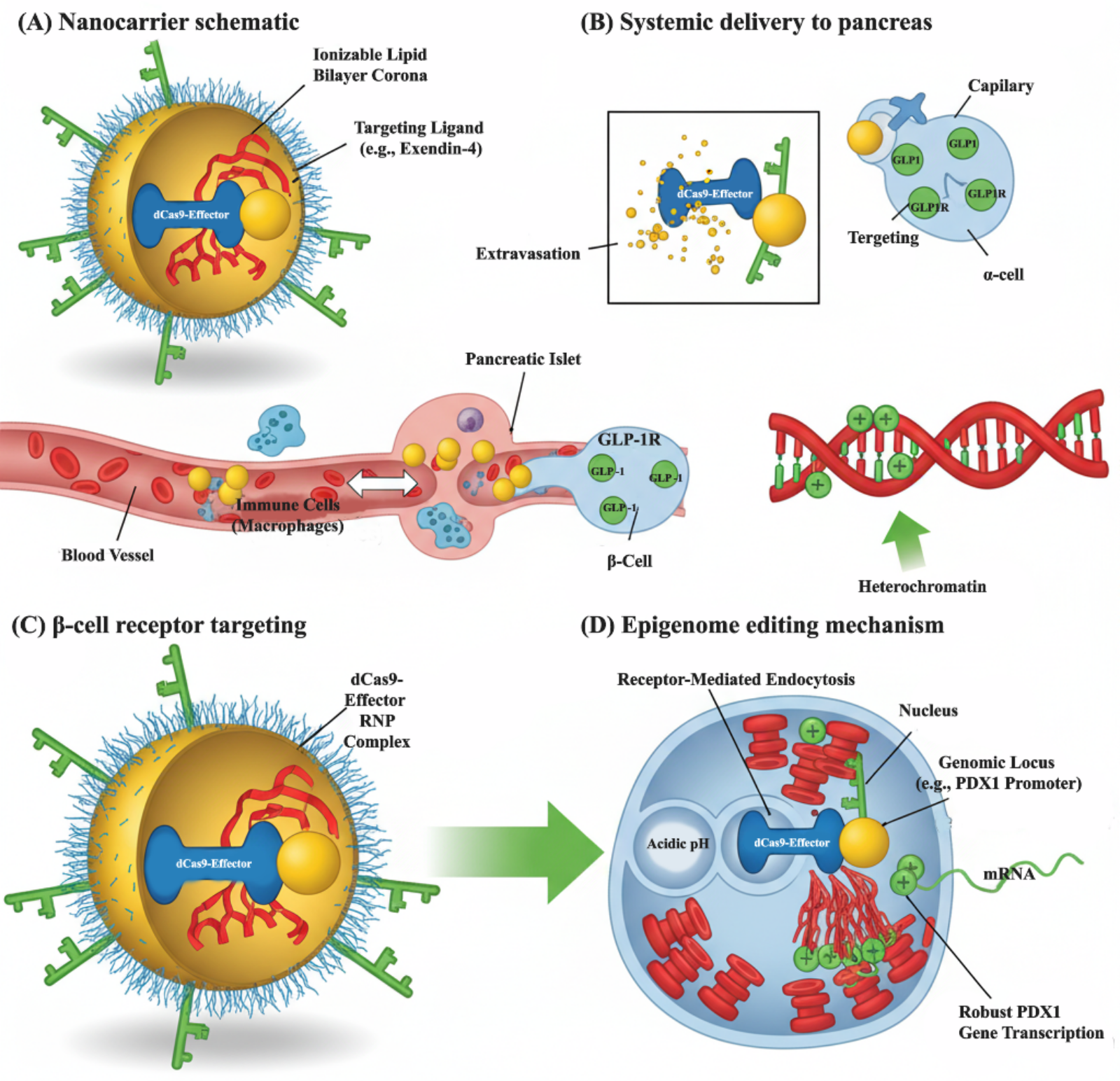
A lipid nanoparticle (LNP) is surface‑functionalized with stealth polymer and β‑cell‑specific ligands (e.g., GLP‑1R agonist). The LNP encapsulates a CRISPR ribonucleoprotein (dCas9‑effector + gRNA). After systemic administration, receptor‑mediated endocytosis delivers the payload into the β‑cell. Endosomal escape releases the complex, which translocates to the nucleus. The dCas9‑effector modifies the target epigenetic locus, restoring gene expression and β‑cell function.
Rational Design of Smart Nanocarriers
The selection and engineering of nanocarriers are critical factors in realizing the potential of CRISPR applications. These platforms are recognized by their design and functionality. Regarding lipid nanoparticles (LNPs), the mRNA vaccine based on LNPs has shown the method's suitability for nucleic acid delivery, and LNPs are the ones used in CRISPR today. Modern LNPs are composed of ionizable lipids that are positively charged in the acidic endosomal environment, thus facilitating endosomal escape the critical bottleneck in functional delivery. There has been a development of ionizable lipids that are structurally selective and optimized for the delivery of ribonucleoproteins (RNPs) to somatic tissues other than the liver (26). Despite the clinical success of LNPs for hepatic delivery (e.g., Onpattro, mRNA vaccines), translation to pancreatic islets presents distinct challenges. The pancreas is not a primary site of LNP accumulation following systemic administration, necessitating active targeting strategies whose efficacy in humans remains unproven. Similarly, polymeric nanoparticles utilize biodegradable polymers like poly (lactic-co-glycolic acid) (PLGA) which allow excellent control of release kinetics through their properties. Moreover, cationic polymers such as polyethylenimine (PEI) can form complexes with CRISPR components via electrostatic attractions, but recent approaches are directed towards reducing toxicity and optimizing molecular weight and branching while keeping high transfection efficiency (27). Furthermore, bio-inspired exosomes and hybrid systems involving the use of native exosomes or their designed synthetic counterparts imply the lack of biocompatibility issues and low immunogenicity. The recent studies have opened up a new avenue for the incorporation of Cas9 ribonucleoprotein into exosomes coming from mesenchymal stem cells, resulting in efficient gene editing in vitro and enhanced tropism to damaged tissues, a property that could be used for stressed β-cells targeting (28).
Achieving β-Cell Specificity: Beyond Passive Targeting
Transitioning from the improved permeability and retention (EPR) effect, active targeting is crucial for pancreatic β-cell selectivity. This is done by attaching the targeting moieties to the nanocarrier that can identify the receptors that are present in large amounts on β-cells. GLP-1R is highly expressed on β-cells, making it an attractive target for ligand-mediated delivery. Studies in murine models have reported increased pancreatic accumulation of nanoparticles functionalized with GLP-1R ligands such as exendin-4 (29). However, several caveats warrant consideration: GLP-1R is also expressed in other tissues (lung, kidney, brain), potentially contributing to off-target distribution; ligand density and orientation on nanoparticles affect targeting efficiency in ways not fully understood; and demonstration of functional CRISPR payload delivery at therapeutically relevant levels in vivo remains limited. Similarly, the use of monoclonal antibodies or single-domain nanobodies directed against certain β-cell surface markers (e.g., anti-DPP6, anti-CD269) provides a very specific approach. On one hand, larger antibodies could alter pharmacokinetics; on the other hand, nanobodies would be the best option for accurate targeting as they are both small and stable.
The Protein Corona: A Critical and Often Overlooked Barrier
Upon introduction into the bloodstream, nanoparticles are rapidly coated with a layer of serum proteins the "protein corona" that fundamentally alters their biological identity. This corona can mask targeting ligands, alter cellular uptake pathways, and influence biodistribution in ways that are difficult to predict from in vitro characterization (30). The composition of the corona is dynamic and depends on nanoparticle physicochemical properties, administration route, and individual patient factors (e.g., disease state, protein levels). Strategies to mitigate corona effects include surface grafting with stealth polymers (e.g., PEG), though anti-PEG antibodies are increasingly recognized as a potential complication. More sophisticated approaches involve engineering nanoparticles to recruit a "customized" corona that promotes target cell recognition, but this remains an experimental concept. Critically, most preclinical studies evaluate nanoparticles in buffer or simple media, potentially overestimating in vivo performance by failing to account for corona effects.
Smart Release Mechanisms: Spatiotemporal Control
To minimize premature payload degradation and nonspecific release, nanocarriers can be engineered with stimuli-responsive features that trigger cargo release upon encountering specific microenvironmental cues. For instance, release responsive to pH takes advantage of the endosome's acidic pH (pH ~5.5–6.5) which causes the degradation of pH-sensitive polymers or lipids, allowing endosomal escape and preventing lysosomal degradation of the CRISPR equipment. Similarly, release responsive to enzyme utilizes the special protease distribution of the pancreatic islet. For example, matrix metalloproteinases (MMPs) that are active in the islet microenvironment can cut specific peptide linkers, making the nanoparticle unstable and thereby leading to localized payload release (31).
Computational Design: AI-Driven Nano-Optimization
The multidimensional parameter space of nanoparticle design including size, charge, hydrophobicity, lipid composition, and ligand density makes empirical optimization resource-intensive. Machine learning models trained on existing formulation data are being developed to predict relationships between nanoparticle properties and in vivo performance, with the goal of accelerating candidate screening (32). However, these models are constrained by the quality and diversity of training data, and their predictions require experimental validation. Prospective prediction of performance for truly novel formulations remains challenging.
The AI Engine: From Multi-Omics Data to Predictive Models
Multi-omics technologies generate high-dimensional datasets whose analysis presents substantial computational challenges. AI and ML approaches are increasingly being developed and applied to integrate these data types, identify patterns associated with disease states, and generate hypotheses about underlying regulatory mechanisms. We emphasize that AI in this context is a tool for hypothesis generation and pattern recognition, not a replacement for experimental validation. The quality of AI-derived insights depends critically on the quality, quantity, and biological relevance of training data.
Multi-Omics Data Integration for Unsupervised Discovery
The first step is to amalgamate different omics datasets (genomic, epigenomic, and transcriptomic) to form a comprehensive model of β-cell state. Unsupervised learning techniques, for instance, variational autoencoders (VAEs) and non-negative matrix factorization (NMF), can perform this operation very well. Dimensionality reduction and pattern discovery methods (e.g., variational autoencoders, non-negative matrix factorization) can identify coordinated variation across data types that may reflect underlying biological states. For example, integrated analysis of chromatin accessibility (ATAC-seq) and gene expression (RNA-seq) from human diabetic islets can nominate specific enhancer-promoter pairs whose coordinated dysregulation correlates with transcriptional changes (33). These predictions generate hypotheses for experimental testing (e.g., via CRISPRi/a perturbation) but do not themselves establish causality.
AI-Guided gRNA Design and Off-Target Prediction
The effectiveness and safety of CRISPR procedures are heavily reliant on the guide RNA (gRNA) design. Guide RNA (gRNA) design has evolved from rule-based approaches to deep learning models trained on large-scale datasets of gRNA activity and off-target effects. Tools such as DeepCRISPR and CRISPR-Net integrate convolutional and recurrent neural networks to predict on-target efficiency and potential off-target sites based on sequence context and chromatin features (34). While these models improve upon earlier methods, their predictions are not perfect, and experimental validation of gRNA specificity (e.g., via GUIDE-seq, CIRCLE-seq) remains essential, particularly for therapeutic applications where off-target effects could have serious consequences. With respect to diabetes, the models can be adjusted using β-cell-specific genomic data (e.g., islet-specific chromatin openness) so that the gRNAs being produced for genes such as PDX1 or INS are highly specific and thus the action of therapeutic editing is made safe (35).
Network Medicine: Identifying Key Nodal Points for Intervention
A systems-level understanding of β-cell gene regulatory networks may enable identification of "master regulator" nodes whose modulation could have broader effects on network state. AI-based network analysis integrates GWAS signals with protein-protein interaction and co-expression data to prioritize genes whose network position suggests potential for greater influence on downstream targets (36). These computational predictions require experimental validation (e.g., via CRISPRa/i perturbation followed by transcriptomic analysis) to confirm that modulating a proposed master regulator indeed produces the predicted network-wide effects.
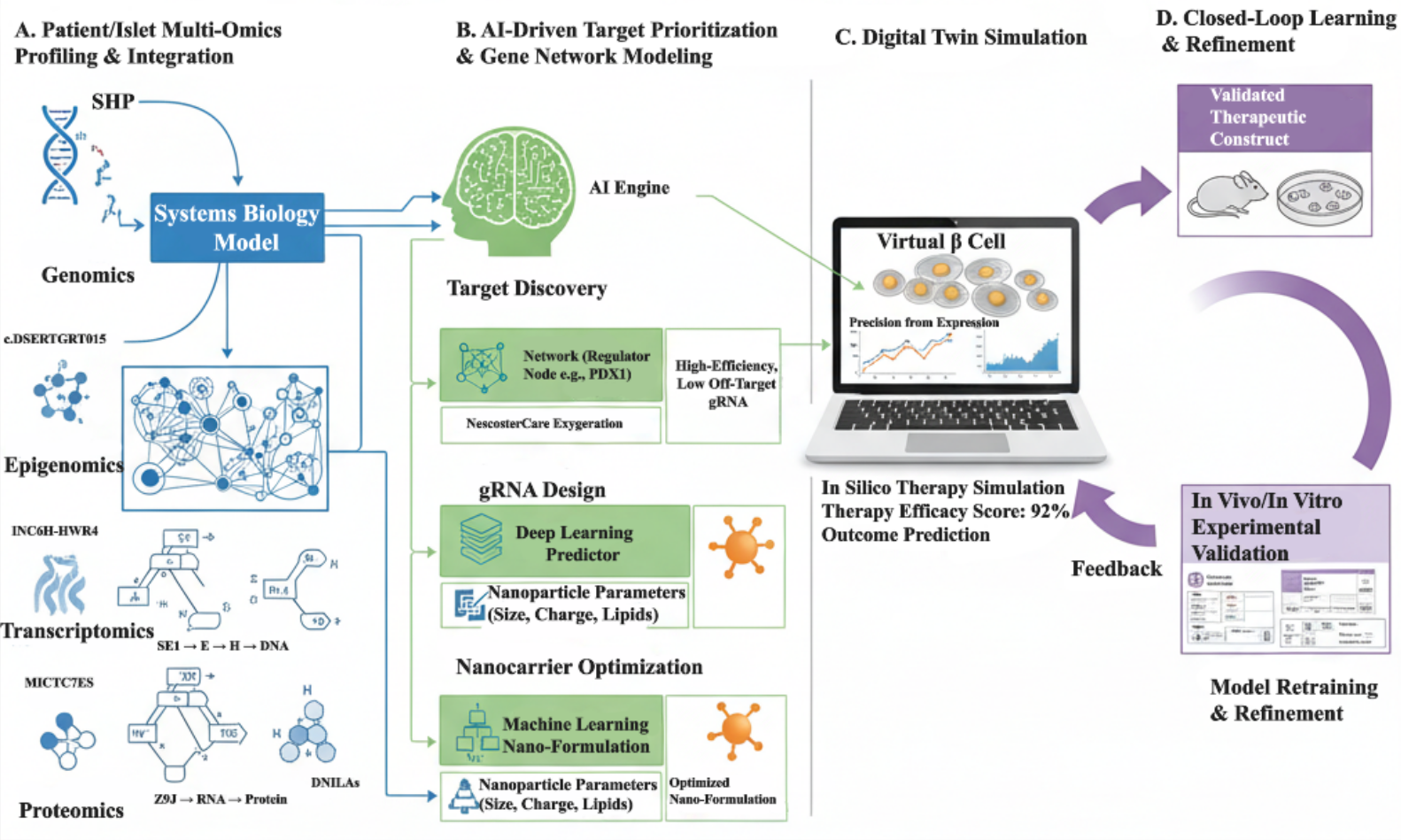
The Digital Twin Concept: In Silico Therapy Simulation
A longer-term vision involves the development of "digital twins" multiscale computational models integrating patient-specific molecular data to simulate therapeutic responses in silico prior to intervention. Such models would, in principle, enable iterative optimization of target selection, gRNA design, and dosing regimens. We emphasize that this remains a highly speculative concept requiring decades of research to realize. Current efforts are limited to proof-of-concept models of isolated pathways (37) and do not approach the complexity of whole-cell or tissue-level simulation needed for therapeutic prediction.
To sum up, AI is not just a supporting tool, but the brain of the nanogenomic ecosystem, managing the progress from unprocessed multi-omics data to a safe, efficient, and tailored curative strategy for diabetes.
Synthesis: The AI-Nano-CRISPR Workflow for Diabetes Reversal
The integration of AI, nanotechnology, and CRISPR-based epigenome editing can be conceptualized as a closed-loop workflow spanning target discovery, therapeutic design, and experimental validation (Figure 3). This framework illustrates a potential pathway from data generation to intervention, though we emphasize that each step remains under active development and the fully integrated pipeline has not yet been demonstrated experimentally.
The Integrated Therapeutic Pipeline
The proposed workflow, while aspirational, illustrates the potential for iterative refinement. The first step involves multi-omics data acquisition and AI-powered target discovery. The workflow begins with multi-omics profiling of pancreatic islets (where accessible) or surrogate tissues. Integration of these datasets using computational approaches can nominate candidate intervention points such as differentially methylated enhancers near key β-cell genes or coordinately dysregulated gene modules. These nominations represent hypotheses requiring experimental testing, as computational predictions do not establish therapeutic relevance. Following this, in silico therapy design involves computational tools that can predict optimal CRISPR modalities (e.g., dCas9-p300 for activation, dCas9-KRAB for repression) and design gRNAs predicted to maximize on-target activity while minimizing off-target potential. Separately, nanoparticle formulation parameters (size, lipid composition, ligand density) can be computationally explored to identify candidates predicted to favor pancreatic delivery. These in silico predictions require experimental validation and iterative refinement, as current models have limited accuracy for novel combinations or human in vivo contexts. The next step involves digital twin simulation, which is a more speculative concept involving patient-specific computational models ("digital twins") that could simulate therapeutic responses prior to intervention. Such models would, in principle, enable virtual screening of therapeutic combinations and prediction of adverse effects. We emphasize that this remains a distant goal requiring major advances in multiscale modeling, data integration, and computational power. Current efforts are limited to pathway-level simulations and do not approach the complexity needed for whole-cell or in vivo prediction. Subsequently, in vivo application and validation involve the production of the lead candidate: the gRNA designed by AI and the mRNA or protein of Cas are housed in a nanocarrier optimized by AI. This nanogenomic construct is given in vivo. The lead candidate is then administered in vivo. The nanoparticle formulation is designed to preferentially accumulate in pancreatic tissue via surface ligands, where it must undergo cellular uptake and endosomal escape to deliver its CRISPR payload for the intended epigenetic modification. Finally, feedback loop and re-optimization involve conducting follow-up multi-omics analysis on the treated islets to evaluate the molecular outcomes after the intervention. The newly generated data is then uploaded to the AI models, thus setting up a closed-loop learning process. The models are constantly improved and renewed according to the results from the real world, thus enhancing the precision of their forecasts for the next therapeutic cycles or for new patients, which in turn can be seen as the realization of a self-optimizing, learning therapeutic system.
Preclinical Validation and Safety
The early preclinical studies are gradually confirming the parts of this integrated workflow. For instance, one of the studies has provided evidence for the in vivo delivery of CRISPR-activators through targeted nanoparticles to mouse islets, which caused the upregulation of important β-cell genes and the improvement of glucose tolerance (21). The next step is combining this delivery with the AI-driven target prioritization. Safety is the topmost concern; the workflow comes with multiple layers of risk mitigation from the first in silico off-target prediction to the use of epigenome editors that prevent double-strand breaks and the targeted delivery that reduces the exposure of non-β-cells to the drug, which are all inherent in the workflow.
To sum up, the AI-Nano-CRISPR flow that is synthesized is the peak of precision medicine. It changes the treatment of diabetes from being static, one-size-fits-all, to being a dynamic, personalized, and curative strategy that directly targets the unique molecular pathophysiology of an individual's disease.
Translational and Ethical Frontiers
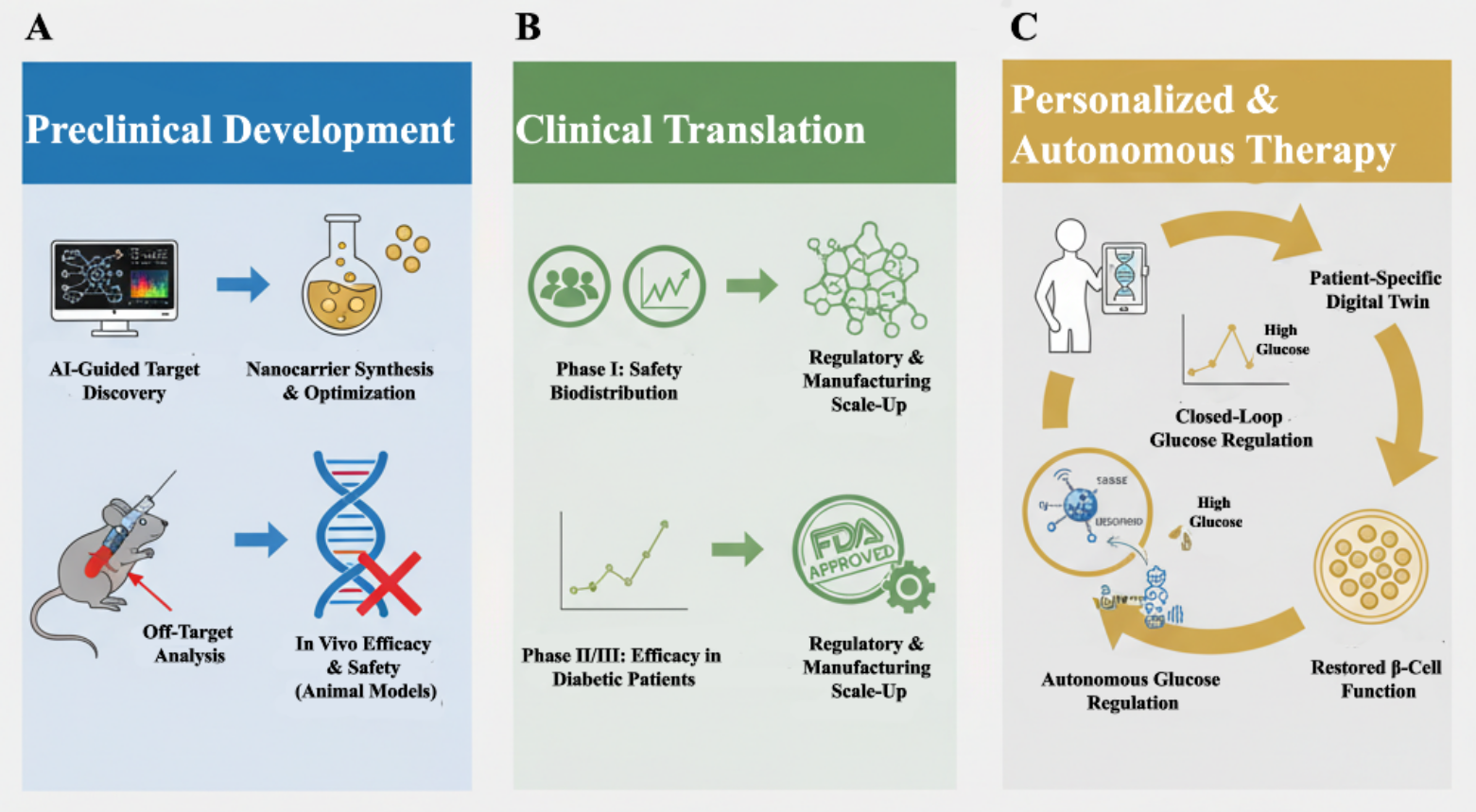
The translation of AI-assisted CRISPR-nanogenomic therapies from preclinical models to clinical application faces substantial hurdles spanning biological safety, manufacturing scalability, regulatory approval, and ethical governance. This section critically examines these challenges. Dealing with these issues of translation and ethics is not a marginal job but rather a primary condition for the responsible development of a cure for diabetes. This end-to-end translational pathway—from preclinical target discovery and nanocarrier engineering to clinical trials and autonomous closed-loop metabolic systems—is mapped out in Figure 4.
From Bench to Bedside: The Preclinical Pathway
In vitro studies and murine models provide essential proof-of-concept and initial safety data. However, the significant differences between murine and human β-cell biology, immune systems, and pancreatic architecture mean that successful translation will require rigorous evaluation in large animal models, particularly non-human primates (NHPs), whose physiology more closely approximates humans. Key objectives include durable efficacy, which involves demonstration that therapeutic effects (e.g., improved glucose homeostasis) persist beyond the initial intervention period, with stability of epigenetic modifications and β-cell function over months to years. Another critical objective is comprehensive biodistribution and off-target analysis, which involves quantification of nanocarrier accumulation in non-target tissues and detection of off-target epigenetic modifications using sensitive sequencing methods (e.g., GUIDE-seq, CIRCLE-seq) in relevant large animal models, complementing rather than replacing in silico predictions (38).
The Safety Triad: Mitigating Multifaceted Risks
This therapy's integrated nature forms a novel fusion of risks that need to be managed together. First, regarding genomic and epigenomic safety, the use of epigenome editors prevents breaks in the DNA strands, yet risky, unintentional chromatin changes at non-target sites remain. The use of AI prediction tools must constantly be improved, and the birth of high-fidelity Cas variants must take place. In addition, the effects of the gene that is made very active by CRISPRa, on the other hand, are still unclear and have to be examined thoroughly over time. Regarding immunogenicity, components of CRISPR-nanogenomic therapies, particularly bacterially derived Cas proteins, can elicit both humoral and cellular immune responses. Such responses may neutralize the therapeutic effect, clear transfected cells, or cause inflammatory injury. Pre-existing immunity to Cas proteins has been documented in human populations, complicating clinical application. Strategies to mitigate immunogenicity include pre-treatment screening, transient immunosuppression, and engineering of humanized or immune-evasive Cas variants (39). The efficacy and safety of these approaches in relevant in vivo models remain to be established. Finally, concerning nanoparticle toxicity, before the synthetic nanocarriers can be declared safe for human use, their fate and potential chronic toxicity must be thoroughly understood, especially in the case of repeated administration. The investigation of biocompatible and degradable new ionizable lipids and polymers has to include an extensive toxicological profile.
Navigating the Regulatory Labyrinth
CRISPR-nanogenomic therapies present complex regulatory challenges as combination products spanning gene therapy, nanomedicine, and drug delivery. Regulatory agencies including the FDA and EMA are developing frameworks for such products, but specific guidance for epigenetic editing and AI-designed components remains limited. Sponsors will need to demonstrate several key aspects. First, they must prove efficacy and consistency through intensive tests to measure the biological activity of the final product in each batch. Second, they must provide characterization of the complex product through accurate description of the nanoparticle's physicochemical properties, the CRISPR payload's integrity and sequence fidelity, and the stability of the final formulated product. Finally, they must present a comprehensive risk-benefit analysis with a very strong argument that the possibility of bringing a one-time, curative intervention to a patient with serious diabetic complications will outweigh the known and theoretical risks.
Bioethical Considerations and Societal Impact
The capacity to intentionally modify a patient's epigenome raises significant ethical considerations that warrant proactive discussion. These considerations include the distinction between somatic and germline modification. While the intended target is somatic cells (pancreatic β-cells), the possibility of inadvertent germline delivery which could produce heritable epigenetic changes cannot be dismissed without rigorous biodistribution studies. The international research community has reached consensus that germline genome editing for reproductive purposes is unacceptable at present, and this principle extends to heritable epigenetic modifications. Clear demonstration of germline exclusion will be a prerequisite for clinical translation. Another critical concern is equity and access, as the complexity and personalized nature of AI-nano-CRISPR therapies will likely result in high development and manufacturing costs, raising concerns about equitable access. Without proactive engagement with payers, policymakers, and health systems, these innovations risk exacerbating existing health disparities a "genomic divide" where advanced therapies are available only to privileged populations. Strategies to address this include development of scalable manufacturing processes, tiered pricing models, and early dialogue with regulatory and health technology assessment bodies. In addition, informed consent presents a significant challenge, as the communication of the new mechanisms of action, the possibility of unknown long-term side effects, and the difference between genetic and epigenetic editing to the patients is quite a big challenge. The consent process will have to be very thorough and clear. Finally, the distinction between therapy and enhancement must be carefully drawn, as the line must be very clear between applying this technology to curing sick β-cells. The interaction between restoration (therapy) and enhancement of that which is already good metabolism (enhancement) can be confusing. Thus, it is very important to set up guidelines for the responsible use of epigenetic tools in medicine (40). Finally, the urge to treat patients with AI-driven nanogenomics, which is the main scientific promise, will be accompanied by the equally powerful demand for safety testing, regulatory clarity, and ethical stewardship of ethical and society's trust-building efforts as the scientific innovation would end up being dubbed.
Future Directions
The quickly changing situation of nanogenomic diabetes treatment points to more and more complex, accurate, and self-governing systems. The combination of new molecular techniques, high-tech materials, and the most advanced computing power is going to change the limits of precision medicine.
The preceding sections have emphasized that while the convergence of AI, nanotechnology, and CRISPR epigenome editing offers transformative potential, substantial challenges remain before clinical translation can be contemplated. Looking further ahead, several research directions ranging from near-term technical improvements to long-term speculative concepts merit consideration. We emphasize that the following represents a vision of possible futures rather than a roadmap of imminent developments.
Next-Generation Molecular Tools
The CRISPR toolkit is a work in progress that is constantly refined and expanded. The CRISPR-CasΦ system, which is an ultracompact one from large bacteriophages, is a recently discovered system that offers a substantial benefit due to its small size and high efficacy, thereby allowing easy packaging into delivery-limited nanocarriers for robust in vivo editing (41). Apart from DNA, RNA-targeting CRISPR systems (for instance, Cas13) are considered to be a temporary and probably safer option for the purpose of gene expression modulation, which can be done by making the genes less active or stronger without changing the DNA permanently (42). What is more, self-amplifying RNA (saRNA) systems, which replicate in the host cell, could lead to a sustained production of therapeutic proteins from just one low-dose administration, thereby dramatically increasing the durability of epigenetic interventions (43). While these advances are promising, each requires extensive validation in relevant preclinical models. The ultracompact size of CRISPR-CasΦ, for example, may facilitate packaging into AAV vectors but does not address delivery to pancreatic islets or immunogenicity concerns.
Autonomous Theranostic Nanosystems (Long-Term Vision)
A more distant concept involves the development of "smart" nanoplatforms capable of sensing physiological signals (e.g., hyperglycemia, β-cell stress markers) and responding with autonomous therapeutic action such as releasing a CRISPR payload when a pathological state is detected. While proof-of-concept studies have demonstrated environmentally responsive materials (44) integration with CRISPR payloads, demonstration of sensing specificity, and validation of closed-loop control in vivo remain substantial challenges. This concept, while scientifically intriguing, should be viewed as a long-term research aspiration rather than a near-term development goal.
Quantum-Enhanced Analysis (Long-Term Vision)
The increasing scale and complexity of multi-omics datasets may eventually exceed the processing capabilities of classical computing architectures. Quantum computing, while still in its early developmental infancy, has been proposed as a promising approach for analyzing high-dimensional biological data, offering theoretical advantages for solving specific classes of optimization and correlation problems (45). However, we emphasize that a practical quantum advantage for biological data analysis has not yet been demonstrated, meaning that significant hardware improvements and novel algorithm developments are strictly required before this technology becomes relevant to diabetes research. Consequently, this remains a highly speculative, long-term scientific prospect.
Conclusion
The convergence of CRISPR-based epigenome editing, precision nanodelivery, and AI-powered multi-omics analysis represents a conceptually powerful approach to addressing β-cell dysfunction in diabetes. As this review has detailed, each technological pillar has advanced substantially over the past decade: CRISPR has evolved from a gene-editing tool to a platform for targeted epigenetic modulation; nanocarriers have demonstrated proof-of-concept for nucleic acid delivery to multiple tissues; and AI methods have enabled integration and pattern discovery across complex multi-omics datasets.
However, the synthesis of these technologies into a clinically viable therapeutic strategy faces formidable obstacles. Efficient and specific delivery to pancreatic β-cells in humans remains unachieved; the safety of epigenome editing particularly with respect to off-target effects and immunogenicity requires rigorous evaluation in large animal models; and the computational frameworks for true predictive therapeutic design are in their earliest stages. The vision of patient-specific digital twins and autonomous theranostic nanosystems, while scientifically compelling, should be recognized as long-term research aspirations requiring decades of development.
The path forward demands sustained interdisciplinary collaboration, rigorous and transparent preclinical validation, and proactive engagement with the ethical and regulatory challenges inherent in first-in-class combination products. Rather than claiming imminent disease reversal, the field must focus on establishing fundamental feasibility, defining clear milestones, and maintaining scientific rigor amid justifiable excitement. If these challenges are addressed systematically, the AI-nano-CRISPR paradigm may ultimately contribute to a future where the molecular drivers of β-cell failure can be directly targeted moving beyond symptomatic management toward disease modification. Realizing this potential will require patience, persistence, and a commitment to evidence over aspiration.
List of Abbreviations
AI: Artificial Intelligence, CRISPR: Clustered Regularly Interspaced Short Palindromic Repeats, CRISPRa: CRISPR Activation, CRISPRi: CRISPR Interference, dCas9: Catalytically "dead" Cas9, DM: Diabetes Mellitus, DNA: Deoxyribonucleic Acid, ER: Endoplasmic Reticulum, gRNA: guide RNA, GWAS: Genome-Wide Association Study/Studies, LNP: Lipid Nanoparticle, ML: Machine Learning, mRNA: messenger RNA, ncRNA: non-coding RNA, NHP: Non-Human Primate, NP: Nanoparticle, PEG: Polyethylene Glycol, PLGA: Poly (lactic-co-glycolic acid), RNP: Ribonucleoprotein, RNA: Ribonucleic Acid, saRNA: self-amplifying RNA, scRNA-seq: Single-Cell RNA sequencing, T1D: Type 1 Diabetes, T2D: Type 2 Diabetes, β-cell: Beta Cell (Pancreatic Islet Cell).
Declarations
Acknowledgment
During the preparation of this manuscript, the author used ChatGPT-4 solely as an assistant for language editing, grammar correction, and improving readability. No data, figures, or original research concepts were generated using artificial intelligence. The author thoroughly reviewed and edited all AI-assisted text, take full responsibility for the contents of the published article, and approved the final manuscript prior to submission.
Conflict of Interest
The author declare no conflicting interest.
Data Availability
All data generated or analyzed during this study are included in this published article.
Ethics Statement
Ethical approval was not required for this study.
Funding Information
The author declare that no financial support was received for the research, authorship, and/or publication of this article.
References
- Saeedi P, Petersohn I, Salpea P, Malanda B, Karuranga S, Unwin N, et al. Global and regional diabetes prevalence estimates for 2019 and projections for 2030 and 2045: Results from the International Diabetes Federation Diabetes Atlas, 9th edition. Diabetes Research and Clinical Practice. 2019;157:107843. doi: https://doi.org/10.1016/j.diabres.2019.107843
- Davies MJ, Aroda VR, Collins BS, Gabbay RA, Green J, Maruthur NM, et al. Management of Hyperglycemia in Type 2 Diabetes, 2022. A Consensus Report by the American Diabetes Association (ADA) and the European Association for the Study of Diabetes (EASD). Diabetes Care. 2022;45(11):2753-2786. doi: https://doi.org/10.2337/dci22-0034
- Zhang Z, Amorosa LF, Coyle SM, Macor MA, Birnbaum MJ, Lee LY, et al. Insulin-Dependent Regulation of mTORC2-Akt-FoxO Suppresses TLR4 Signaling in Human Leukocytes: Relevance to Type 2 Diabetes. Diabetes. 2016;65(8):2224-2234. doi: https://doi.org/10.2337/db16-0027
- Kahn SE, Cooper ME, Del Prato S. Pathophysiology and treatment of type 2 diabetes: perspectives on the past, present, and future. The Lancet. 2014;383(9922):1068-1083. doi: https://doi.org/10.1016/s0140-6736(13)62154-6
- Vujkovic M, Keaton JM, Lynch JA, Miller DR, Zhou J, Tcheandjieu C, et al. Discovery of 318 novel loci for type-2 diabetes and related micro- and macrovascular outcomes among 1.4 million participants in a multi-ethnic meta-analysis. Medrxiv. 2019. doi: https://doi.org/10.1101/19012690
- Keating ST, El-Osta A. Epigenetics and Metabolism. Circulation Research. 2015;116(4):715-736. doi: https://doi.org/10.1161/circresaha.116.303936
- Reddy MA, Zhang E, Natarajan R. Epigenetic mechanisms in diabetic complications and metabolic memory. Diabetologia. 2014;58(3):443-455. doi: https://doi.org/10.1007/s00125-014-3462-y
- Shi H, Huang KC. Pictures of Tongues Sticking Out. Trends in Endocrinology & Metabolism. 2020;31(11):805-807. doi: https://doi.org/10.1016/j.tem.2020.05.003
- Thakore PI, D'Ippolito AM, Song L, Safi A, Shivakumar NK, Kabadi AM, et al. Highly specific epigenome editing by CRISPR-Cas9 repressors for silencing of distal regulatory elements. Nat Methods. 2015;12(12):1143-1149. doi: https://doi.org/10.1038/nmeth.3630
- Bu LL, Wang HQ, Pan Y, Chen L, Wu H, Wu X, et al. Gelatinase-sensitive nanoparticles loaded with photosensitizer and STAT3 inhibitor for cancer photothermal therapy and immunotherapy. J Nanobiotechnol. 2021;19(1). doi: https://doi.org/10.1186/s12951-021-01125-7
- Camunas-Soler J, Dai XQ, Hang Y, Bautista A, Lyon J, Suzuki K, et al. Patch-Seq Links Single-Cell Transcriptomes to Human Islet Dysfunction in Diabetes. Cell Metabolism. 2020;31(5):1017-1031.e4. doi: https://doi.org/10.1016/j.cmet.2020.04.005
- Shan Q, Li X, Chen X, Zeng Z, Zhu S, Gai K, et al. Tcf1 and Lef1 provide constant supervision to mature CD8+ T cell identity and function by organizing genomic architecture. Nat Commun. 2021;12(1). doi: https://doi.org/10.1038/s41467-021-26159-1
- Jesuthasan A, Zhyzhneuskaya S, Peters C, Barnes AC, Hollingsworth KG, Sattar N, et al. Sex differences in intraorgan fat levels and hepatic lipid metabolism: implications for cardiovascular health and remission of type 2 diabetes after dietary weight loss. Diabetologia. 2021;65(1):226-233. doi: https://doi.org/10.1007/s00125-021-05583-4
- Staffers DA, Ferrer J, Clarke WL, Habener JF. Early-onset type-ll diabetes mellitus (MODY4) linked to IPF1. Nat Genet. 1997;17(2):138-139. doi: https://doi.org/10.1038/ng1097-138
- Dayeh T, Volkov P, Salö S, Hall E, Nilsson E, Olsson AH, et al. Genome-Wide DNA Methylation Analysis of Human Pancreatic Islets from Type 2 Diabetic and Non-Diabetic Donors Identifies Candidate Genes That Influence Insulin Secretion. PLoS Genet. 2014;10(3):e1004160. doi: https://doi.org/10.1371/journal.pgen.1004160
- Attema B, Janssen AW, Rijkers D, van Schothorst EM, Hooiveld GJ, Kersten S. Exposure to low-dose perfluorooctanoic acid promotes hepatic steatosis and disrupts the hepatic transcriptome in mice. Molecular Metabolism. 2022;66:101602. doi: https://doi.org/10.1016/j.molmet.2022.101602
- Cani PD, Knauf C. A newly identified protein from Akkermansia muciniphila stimulates GLP-1 secretion. Cell Metabolism. 2021;33(6):1073-1075. doi: https://doi.org/10.1016/j.cmet.2021.05.004
- Yoshihara E, O’Connor C, Gasser E, Wei Z, Oh TG, Tseng TW, et al. Immune-evasive human islet-like organoids ameliorate diabetes. Nature. 2020;586(7830):606-611. doi: https://doi.org/10.1038/s41586-020-2631-z
- Chiou J, Zeng C, Cheng Z, Han JY, Schlichting M, Miller M, et al. Single-cell chromatin accessibility identifies pancreatic islet cell type– and state-specific regulatory programs of diabetes risk. Nat Genet. 2021;53(4):455-466. doi: https://doi.org/10.1038/s41588-021-00823-0
- Qi LS, Larson MH, Gilbert LA, Doudna JA, Weissman JS, Arkin AP, et al. Repurposing CRISPR as an RNA-Guided Platform for Sequence-Specific Control of Gene Expression. Cell. 2013;152(5):1173-1183. doi: https://doi.org/10.1016/j.cell.2013.02.022
- Wang L, Kainulainen MH, Jiang N, Di H, Bonenfant G, Mills L, et al. Differential neutralization and inhibition of SARS-CoV-2 variants by antibodies elicited by COVID-19 mRNA vaccines. BioRxiv. 2021. doi: https://doi.org/10.1101/2021.11.24.469906
- Malcher J, Heidt L, Goyenvalle A, Escobar H, Marg A, Beley C, et al. Exon Skipping in a Dysf-Missense Mutant Mouse Model. Molecular Therapy Nucleic Acids. 2018;13:198-207. doi: https://doi.org/10.1016/j.omtn.2018.08.013
- Beziaud L, Young CM, Alonso AM, Norkin M, Minafra AR, Huelsken J. IFNγ-induced stem-like state of cancer cells as a driver of metastatic progression following immunotherapy. Cell Stem Cell. 2023;30(6):818-831.e6. doi: https://doi.org/10.1016/j.stem.2023.05.007
- Koblan LW, Erdos MR, Wilson C, Cabral WA, Levy JM, Xiong ZM, et al. In vivo base editing rescues Hutchinson–Gilford progeria syndrome in mice. Nature. 2021;589(7843):608-614. doi: https://doi.org/10.1038/s41586-020-03086-7
- Neugebauer ME, Hsu A, Arbab M, Krasnow NA, McElroy AN, Pandey S, et al. Evolution of an adenine base editor into a small, efficient cytosine base editor with low off-target activity. Nat Biotechnol. 2022;41(5):673-685. doi: https://doi.org/10.1038/s41587-022-01533-6
- Cheng Q, Wei T, Farbiak L, Johnson LT, Dilliard SA, Siegwart DJ. Selective organ targeting (SORT) nanoparticles for tissue-specific mRNA delivery and CRISPR–Cas gene editing. Nat. Nanotechnol. 2020;15(4):313-320. doi: https://doi.org/10.1038/s41565-020-0669-6
- Dilliard SA, Cheng Q, Siegwart DJ. On the mechanism of tissue-specific mRNA delivery by selective organ targeting nanoparticles. Proc. Natl. Acad. Sci. U.S.A. 2021;118(52). doi: https://doi.org/10.1073/pnas.2109256118
- Dubey S, Chen Z, Jiang YJ, Talis A, Molotkov A, Ali A, et al. Small extracellular vesicles (sEVs)-based gene delivery platform for cell-specific CRISPR/Cas9 genome editing. Theranostics. 2024;14(7):2777-2793. doi: https://doi.org/10.7150/thno.92133
- Hwang JH, Park YS, Kim HS, Kim DH, Lee SH, Lee CH, et al. Yam-derived exosome-like nanovesicles stimulate osteoblast formation and prevent osteoporosis in mice. Journal of Controlled Release. 2023;355:184-198. doi: https://doi.org/10.1016/j.jconrel.2023.01.071
- Tenzer S, Docter D, Kuharev J, Musyanovych A, Fetz V, Hecht R, et al. Rapid formation of plasma protein corona critically affects nanoparticle pathophysiology. Nature Nanotech. 2013;8(10):772-781. doi: https://doi.org/10.1038/nnano.2013.181
- Wang W, Cui Z, Ning M, Zhou T, Liu Y. In-silico investigation of umami peptides with receptor T1R1/T1R3 for the discovering potential targets: A combined modeling approach. Biomaterials. 2022;281:121338. doi: https://doi.org/10.1016/j.biomaterials.2021.121338
- Lee J, Sands I, Zhang W, Zhou L, Chen Y. DNA-inspired nanomaterials for enhanced endosomal escape. Proc. Natl. Acad. Sci. U.S.A. 2021;118(19). doi: https://doi.org/10.1073/pnas.2104511118
- Fossati A, Mozumdar D, Kokontis C, Mèndez-Moran M, Nieweglowska E, Pelin A, et al. Next-generation proteomics for quantitative Jumbophage-bacteria interaction mapping. Nat Commun. 2023;14(1). doi: https://doi.org/10.1038/s41467-023-40724-w
- Chuai G, Ma H, Yan J, Chen M, Hong N, Xue D, et al. DeepCRISPR: optimized CRISPR guide RNA design by deep learning. Genome Biol. 2018;19(1). doi: https://doi.org/10.1186/s13059-018-1459-4
- Martinez KP, Gasmi N, Jeronimo C, Klimova N, Robert F, Turcotte B. Yeast zinc cluster transcription factors involved in the switch from fermentation to respiration show interdependency for DNA binding revealing a novel type of DNA recognition. Nucleic Acids Research. 2023;52(5):2242-2259. doi: https://doi.org/10.1093/nar/gkad1185
- Tong Y, Zhuang F, Zhang H, Fang C, Zhao Y, Wang D, et al. Improving biomedical named entity recognition by dynamic caching inter-sentence information. Bioinformatics. 2022;38(16):3976-3983. doi: https://doi.org/10.1093/bioinformatics/btac422
- Valenzuela B, Olsson Gisleskog P, Poggesi I, Sidorenko T, Burcklen M, Kracker H, et al. An exposure‐response analysis of ponesimod clinical efficacy in a randomized phase III study in patients with relapsing multiple sclerosis. CPT Pharmacom & Syst Pharma. 2022;11(10):1294-1304. doi: https://doi.org/10.1002/psp4.12778
- Cai R, Kolabas ZI, Pan C, Mai H, Zhao S, Kaltenecker D, et al. Whole-mouse clearing and imaging at the cellular level with vDISCO. Nat Protoc. 2023;18(4):1197-1242. doi: https://doi.org/10.1038/s41596-022-00788-2
- Soteriou D, Kubánková M, Schweitzer C, López-Posadas R, Pradhan R, Thoma OM, et al. Rapid single-cell physical phenotyping of mechanically dissociated tissue biopsies. Nat. Biomed. Eng. 2023;7(11):1392-1403. doi: https://doi.org/10.1038/s41551-023-01015-3
- Savage N. Meet the unsung scientists behind the Nobel for quantum dots. Nature. 2023;622(7984):680-681. doi: https://doi.org/10.1038/d41586-023-03179-z
- Pausch P, Al-Shayeb B, Bisom-Rapp E, Tsuchida CA, Li Z, Cress BF, et al. CRISPR-CasΦ from huge phages is a hypercompact genome editor. Science. 2020;369(6501):333-337. doi: https://doi.org/10.1126/science.abb1400
- Abudayyeh OO, Gootenberg JS, Essletzbichler P, Han S, Joung J, Belanto JJ, et al. RNA targeting with CRISPR–Cas13. Nature. 2017;550(7675):280-284. doi: https://doi.org/10.1038/nature24049
- Bloom K, van den Berg F, Arbuthnot P. Self-amplifying RNA vaccines for infectious diseases. Gene Ther. 2020;28(3-4):117-129. doi: https://doi.org/10.1038/s41434-020-00204-y
- Cho NH, Guerrero-Martínez A, Ma J, Bals S, Kotov NA, Liz-Marzán LM, et al. Bioinspired chiral inorganic nanomaterials. Nat Rev Bioeng. 2023;1(2):88-106. doi: https://doi.org/10.1038/s44222-022-00014-4
- Preskill J. Quantum Computing in the NISQ era and beyond. Quantum. 2018;2:79. doi: https://doi.org/10.22331/q-2018-08-06-79