RESEARCH ARTICLE
Effect of Tween 80 and Span 80 Surfactants Systems on the Malus domestica Emulsions for Anti-Cutibacterium acnes
Academic Editor: Garnadi Jafar
Sciences of Pharmacy|Vol. 5, Issue 1, pp. 60-67 (2026)
CC BY 4.0-2026 Authors
Views
Downloads
Shares

Received
Dec 8, 2025Revised
Jan 6, 2026Accepted
Jan 23, 2026Published
Feb 16, 2026
Abstract
Red apple (Malus domestica) extract, rich in hydrophobic quercetin, was formulated into oil-in-water (O/W) emulsion using a 22 factorial design to evaluate Tween 80 (8-10 g) and Span 80 (2-4 g) concentrations, targeting pH (4.5-6.0), transmittance (90-100%), and viscosity (10-2000 cPs). Design-Expert® 13 analysis identified formulations F1, FA, and FAB within acceptable physical property ranges, with all red apple emulsions exhibiting O/W type, skin-compatible pH (5.20-5.48), high transmittance, and suitable viscosity. Freeze-thaw cycling (3 cycles, -15/25°C) and centrifugation showed physical stability with non-significant changes for F1 (p > 0.05). The agar well diffusion assay was performed on F1 (n = 3), which exhibited optimal physical parameters and met stability criteria, revealing Cutibacterium acnes inhibition zones up to 22.7 ± 0.577 mm. Thus, F1 emerges as a promising nanoemulsion candidate demonstrating antibacterial activity against acne-causing bacteria.
Introduction
Acne vulgaris (AV) is one of the most common dermatological disorders affecting the skin. It affects approximately 75% of adolescents worldwide, typically between the ages of 12 and 15, with peak severity occurring between 17 and 21 years of age. According to the Division of Medical Cosmetics, Department of Dermatology and Venereology, Outpatient Clinic of Dr. Soetomo General Hospital, Surabaya, the highest prevalence of AV cases was found among individuals aged 15-19 years (52.4%) (1). Acne develops due to inflammation of the pilosebaceous follicles, characterized by the appearance of blackheads, pustules, and nodules on the face, shoulders, chest, upper back, and upper arms (2). The occurrence of acne is influenced by various factors, including genetic predisposition, ethnicity, psychological conditions, hormonal imbalance, and more commonly, bacterial infection such as that caused by Cutibacterium acnes (3).
Common topical therapied used for treatment of acne include topical retinoids, benzoyl peroxide (BP), antibiotics, clascoterone, salicylic acid, and azelaic acid (4). Systemic therapies such as oral antibiotics, hormonal treatment, and isotretinoin are also widely prescribed for more severe cases. Although these agents are clinically effective, their use is often limited by adverse effects, particularly skin irritation, which may lead to poor patient adherences (5).
Apples are known to contain various compound such as flavonoids, polyphenols, and tannins (6). Quercetin is a flavonoid compound found in apples. It has been demonstrated to inhibit the growth of acne-causing bacteria such as C. acnes. The growth of these bacteria is suppressed by quercetin through inhibition of protein synthesis and toxin metabolite production (7). Chandra et al. (2022) reported that quercetin gel, yielded a 22.20 mm inhibition zone against C. acnes. This result affirms the capability of red apple extract emulsion in inhibiting acne pathogenesis, consistent with its with its antimicrobial properties observed in vivo (8).
In line with growing interest in safer and more tolerable alternatives, natural products such as apple extract, a source of the flavonoid quercetin are being explored as active ingredients in cosmetic and dermatological formulations. However, the practical application of quercetin is challenged by its poor aqueous solubility, which can restrict its bioavailability, and consequently, its therapeutic performance in topical products (9).
Nanotechology offers several advantages in pharmaceutical product formulation, including enhanced solubility of poorly water-soluble compounds and more controlled drug delivery (10, 11). Nanoemulsions (NEs) consist of two immiscible liquids, typically oil and water, stabilized by surfactans (10). NEs are widely applied in dermal delivery systems owing to their small droplet size, fluid properties, and capacity to adsorb onto the stratum corneum lipid layer. NEs are categorized into two prmary types: oil-in-water (O/W) and water-in-oil (W/O). O/W Nes effectively deliver hydrophobic agents by enhancing the aqueous solubility of lipophilic substances (12). Apple extract contain quercetin is a hydrophobic material (13, 14). Thus, O/W NEs represent a suitable approach for formulating apple extraxt-containing pharmaceutical products to improve active compound solubility in water and optimize formulation absorption.
Tween 80 and Span 80 are widely used in formulations due to their non-ionic properties, which provide superior emulsion stability, high formulation flexibility via HLB matching, and safety for cosmetic products (11). However, emulsions formulated with Tween 80 and Span 80 surfactant systems exhibit inherent limitations that necessitate investigation of their concentration effects on pH, %transmittance, and viscosity for Malus domestica formulations. High concentration of surfactants ratios often shift pH toward alkalinity and reduce %transmittance through flocculation or Oswald ripening, while suboptimal ratios yield excessive viscosity that impairs topical spreadability. Examination of these parameters is thus essential to identify stable configurations that enhance the formulation delivery (15). Therefore, the development of a drug delivery system capable of improving the stability and absorption of quercetin is crucial to maximizing its clinical benefit (9). One emerging approach to adress these limitation is its formulation in the form of a nanoemulsion serum.
This study aims to evaluate the effect of Tween 80 and Span 80 on pH, %transmittance, and viscosity of M. domestica extract emulsions. The analysis identifies variations in physical properties resulting from different surfactant ratios. Accordingly, an emulsion derived from apple extract holds capability as a nanoemulsion candidate for acne prophylaxis, substantiated by antibacterial assays demonstrating inhibitory effects againts acne pathogens.
Methodology or Experimental Section
Materials
The instrument used in this study included a UV-Vis spectrophotometer (Shimadzu UV mini-1240), a laptop (Acer Aspire 3) equipped with Design Expert® 13 software, magnetic stirrer and hotplate (Thermo Scientific), Oven (Memmert), Incubator (Memmert), Laminar Air Flow (Innotech), Rotary Evaporator (Rotavapor R-100 Buchi), and Glassware (Pyrex). The materials used were red apples (M. domestica), Clindamycin gel (Cindala®), Methanol (Smartlab), Tween 80 (Merck), Span 80 (Merck), Virgin Coconut Oil (Smart Organik), Mueller-Hinton Agar (Himedia), Suspension of C. acnes (agaviLab), and aquadest.
Plant Collection and Determination
M. domestica fructus was taken from Kota Batu, East Java, in September 2025. The selected fruits were red mature fruit in good condition, without holes and traces of animal bites. Only fruits meeting visual quality criteria, including uniform ripeness and absence of physical damage, were included to ensure sample consistency Determination was conducted to verify the identity of the plant species used in this study. Determination was performed in UPT Laboratorium Herbal Materia Medica Batu, Kota Batu, East Java, with certificate number 000.9.3/3409/102.20/2025. This taxonomic verification ensured the authenticity of the botanical material prior to further experimental procedures.
Preparation and Extraction of red apple extract
In this study, the extraction of red apple (M. domestica) was conducted from its fruit. This extraction was performed utilising maceration technique was adapted from the procedure previously described by Ranjha et al. (2020), with certain modifications. A total of 1 kg of apple was meticulously washed, then subjected to wet-sorting, after which the fruit was thinly sliced and dried in an oven at 45oC. the apple was then milled using a blender and sieved to obtain a powder of uniform size. Subsequently, 15 g of the powder was placed into an Erlenmeyer flask and macerated with methanol at a solid-to-solvent ratio of 1: 10. Methanol is highly effective, commonly used maceration solvent for extracting flavonoids from apple materials. This involved the addition of 150 mL of methanol, followed by stirring, covering the flask with aluminium foil, and allowing it to stand for 24 h with intermittent agitation. The mixture was then filtered through the filter paper, after which centrifugation was performed for approximately 10 min at 5000 rpm. Subsequently, the filtrate was subjected to concentration using a rotary evaporator, thereby yielding the extract (16,18).
Preparation of Red Apple Extract Emulsion
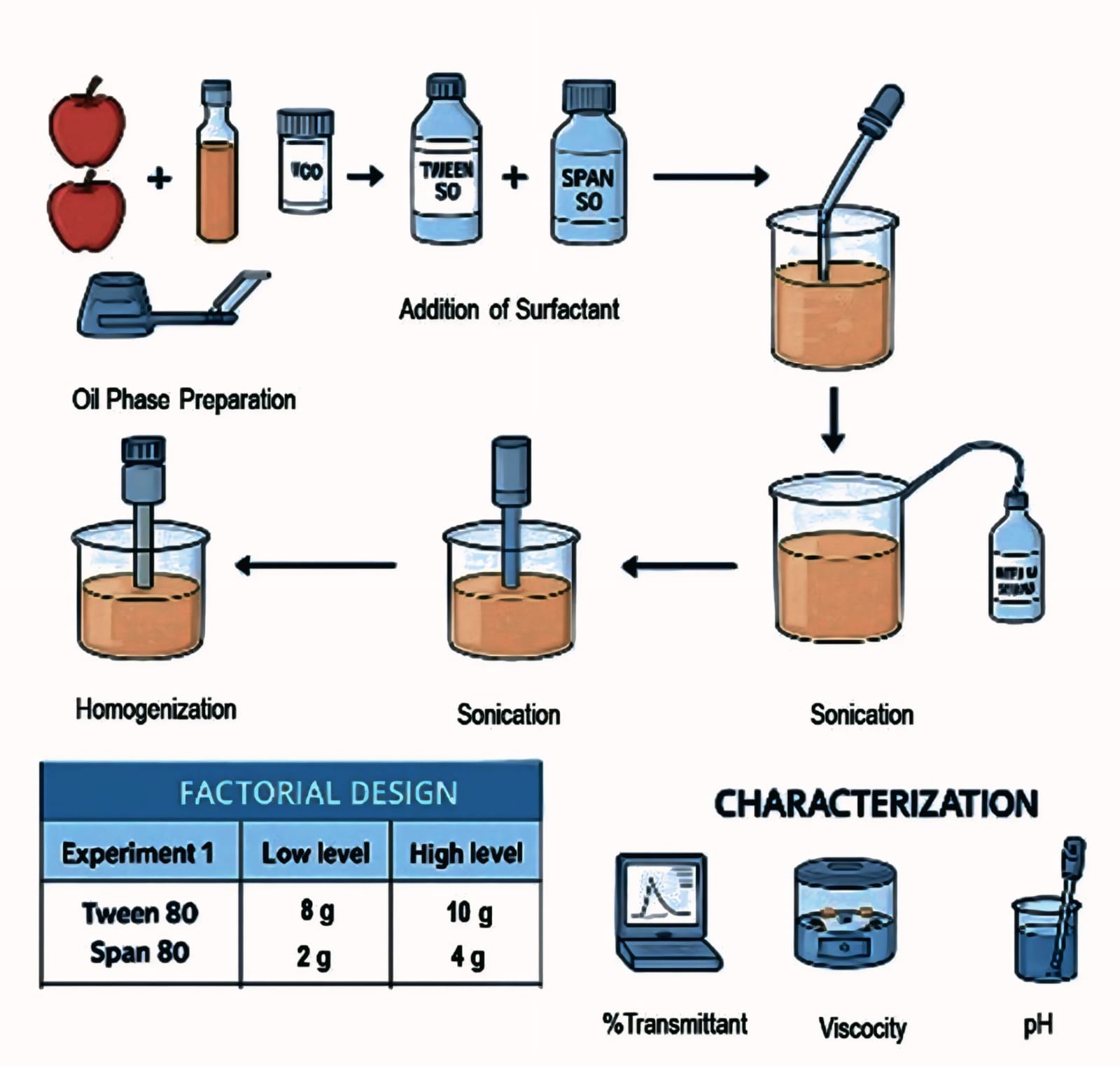
The preparation of red apple (M. domestica) emulsions was carried out by adapting the method described by Guanse et al. (2025) with several modifications. The formulation process involved preparing two separate mixtures. Firstly, the red apple extract was mixed with virgin coconut oil (VCO). Second, mixture consisting of Tween 80 and Span 80 was blended on a separate hot plate. Both mixtures were stirred using a magnetic stirrer at 1000 rpm and maintained at 45°C until complete homogeneity was achieved. Subsequently, mixture 1 was added dropwise into mixture 2 under continuous stirring at 1000 rpm for 10 min at the same temperature. Following the emulsification step, 100 mL of distilled water was gradually introduced into the homogeneous system while increasing the stirring speed to 1250 rpm for an additional 10 min. The resulting pre-emulsion was then homogenized using a high-speed homogenizer for 2 min and subjected to ultrasonic treatment in a sonicator bath for 45 min with amplitude 65% and pulse on-off every 3 min. All formulations, as presented in Table 1, were prepared in triplicate (19). The obtained emulsions were characterized for physicochemical properties (pH, transmittance percentage (%T) by UV-Vis spectrophotometry, and viscosity) and stability test. These evaluations were conducted to assess the physical quality and short-term stability of the prepared emulsion systems.
| Material | Function | Formula | |||
|---|---|---|---|---|---|
| F1 | FA | FB | FAB | ||
| Red apple extract | Active substance | 10 g | 10 g | 10 g | 10 g |
| Tween 80 | Surfactant | 8 g | 10 g | 8 g | 10 g |
| Span 80 | Co-surfactant | 2 g | 2 g | 4 g | 4 g |
| VCO | Oil phase | 3 g | 3 g | 3 g | 3 g |
| Aquadest | Water phase | 100 mL | 100 mL | 100 mL | 100 mL |
Physical Characterization
Organoleptic Test
All emulsion formulations were subjected to macroscopic physical examination. The observed parameters included colour, odor, and the presence of visually detectable phase separation (20). Data interpret descriptively.
Emulsion Type Test
The emulsion type was determined using the dilution method. Samples were diluted 1: 100 (v/v) in both aqueous phase (distilled water) and oil phase (VCO). Formulations exhibiting complete miscibility in the aqueous phase were classified as oil-in-water (O/W) emulsions, whereas those showing complete solubility in the oil phase were identified as water-in-oil (W/O) emulsions (19).
pH Test
The pH value of emulsion was measured using a digital pH meter, with each formulation analyzed in triplicate to determine the mean and standard deviation. The acceptable pH range for the formulation was set between 4.5 and 6.0 (21).
Transmittance Percentage Test
The percent transmittance of the red apple extract emulsions was evaluated using a UV-Vis spectrophotometer at 650 nm wavelength. Each sample was measured in triplicate, with results are expressed as mean transmittance (%) ± standard deviation to assess optical clarity and emulsion homogeneity. The emulsions were considered to have acceptable optical clarity when the percent transmittance values were within the range of 90-100% (22).
Viscosity Test
Viscosity measurements were performed using an LV-type Brookfield viscometer at room temperature (25°C). Each sample (100 mL) was placed in a glass container, with spindle 2 operated at 3 rpm. Viscosity values in centipoises (cPs) were calculated by multiplying the dial readings by the instrument’s correction factor (22).
Data Analysis
All formulas were subjected to a 22-factorial experimental design, utilising Design Expert 13 Software to determine the response of Tween 80 and Span 80 to each physical test parameters, as illustrated in Figure 1. Subsequently, the stability results were analysed using a T-test with SPSS software to analysed the optimal formulation, with a confidence level of 95% (α= 0.05). The best formula was then subjected to antibacterial testing (23,25).
Stability Test
Emulsion stability was assessed using two complementary methods. In the centrifugation test, samples were placed in Eppendorf tubes and subjected to 5, 000 rpm for 5 min. Post centrifugation stability was evaluated by visual inspection for phase separation, precipitation, creaming, or cracking. Additionally, a freeze-thaw cycle test was conducted by storing formulations at -15°C for 48 h, followed by incubation at 25°C for 48 h, with this cycle repeated three times. Stability parameters monitored included pH, %T, and the viscosity (25). These physicochemical measurements were performed before and after the stability tests to determine significant changes in emulsion characteristics, indicating the formulation’s physical robustness under stress.
Antibacterial Activity Test
C. acnes colonies, cultured for 24 h, were inoculated into 10 mL of 0.9% NaCl solution, vortexed for homogenization, and incubated at 30-37°C for 24 h until turbid. Turbidity was adjusted to match a 0.5 McFarland standart (1.5 x 10⁸ CFU/mL), and this suspension served as the test inoculum. Antibacterial activity of the emulsion formulation was assessed using the agar diffusion method: wells in inoculated agar plates received negative control (aquadest), positive control (clindamycin gel 10 mg/g), and optimal emulsion sample, followed by incubation at 30-37 °C for 24 h. Inhibition zones were measured using calipers (26, 27).
Results and Discussion
Physical Properties and Stability Tests of Red Apple Extract Emulsions
Organoleptic
The formed red apple extract emulsions exhibited transparent and yellowish appearance. The surfactant and co-surfactant combination effectively stabilized the oil-water interface by forming a protective film around the dispersed particles. The HLB values for the four formulations ranged from 11.943 to 13.217.
Emulsion Type
Emulsion types were determined by diluting 1% (v/v) samples in the aqueous phase (20). All four formulations demonstrated complete miscibility in water, they show their classification as oil-in-water (O/W) emulsions. This observation aligns with the calculated HLB values (11, 943 to 13, 217), which fall within the typical range for O/W emulsion formation.
The HLB value is a calculated parameter derived from the chemical structure of surfactants, allowing pure compounds to be ranked by their relative hydrophilicity-lipophilicity balance (28). HLB values predict both emulsion formation type and stability. Values greater than 10 show oil-in-water (O/W) emulsion, while values below 10 promote water-in-oil (W/O) systems (29). This theory aligns with the experimental findings of this study, which indicated the emulsions as O/W type.
pH Test
pH measurements were conducted to evaluate the acidity/alkalinity profile of the formulations. Values within the acceptable range for facial skin (4.5-6.0) prevent irritation, dryness, or itching associated pH values ranged from 5.20 to 5.48, meeting skin compatibility criteria.
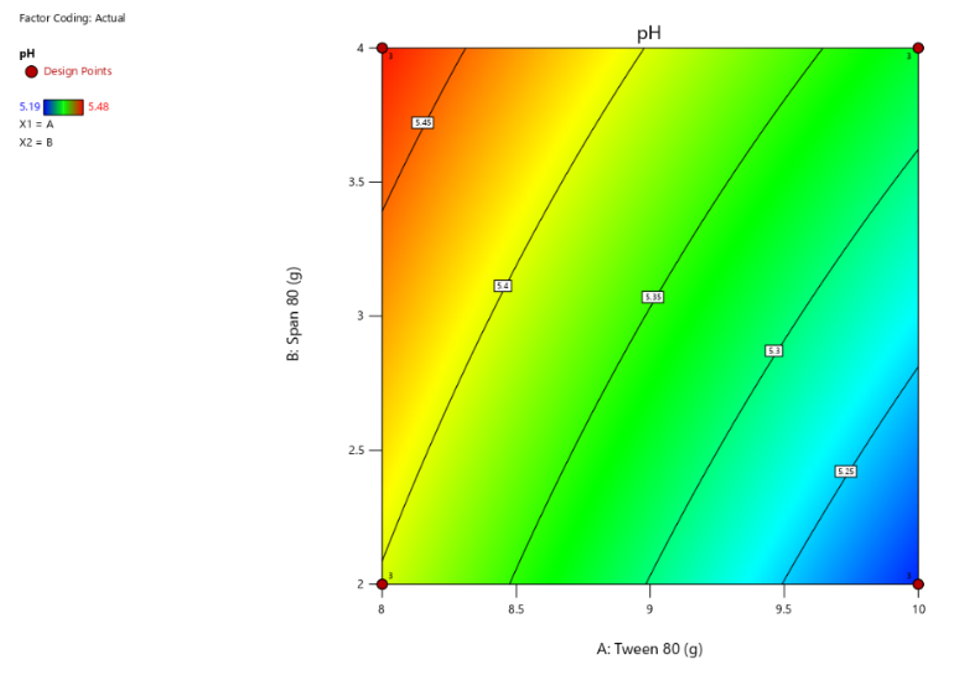
The relationship between factors, levels, and response values can be specifically interpreted through regression equations and contour plots. The pH response as a function of Tween 80 (X1) and Span 80 (X2) levels, derived from factorial design is given by: Y= 5.34833 – 0.0866667X1 + 0.5X2 + 0.0116667X1X2. Where Y represents pH, X1X2 denotes the Tween 80-Span 80 interaction, and the equation reveals linear relationships with each factor and their interaction, enabling response prediction via substitution of desired factor levels.
Two-way ANOVA analysis revealed significant differences in pH responses across formulations (p < 0, 0001). Tween 80 exerted the dominant influence (F-value = 515.05; % contribution= 73.18%), primarily reducing pH values. The interaction effects of Tween 80 and Span 80 on pH responses are illustrated in Figure 2.
Transmittance value
Percent transmittance serves as another key indicator for assessing the particle size of nanoemulsion formulations. Particle size trends are indirectly assessed through %T measurements via clarity evaluation principles, though %T alone cannot confirm nano-scale droplet formation. The higher transmittance values correspond to increased clarity and suggest smaller droplet sizes. Values approaching 100% indicate small droplet sizes and good optical clarity. While elevated %T indicates formulation clarity consistent with nanoemulsions, this metric alone cannot distinguish nano-scale droplets from other clear system (e. g. , micellar solutions or low-oil microemulsions). Complementary techniques such as droplet size distribution and polydispersity index (PDI) measurements are therefore strongly still required to validate nanoemulsion characteristics beyond transmittance assessment (30, 31).
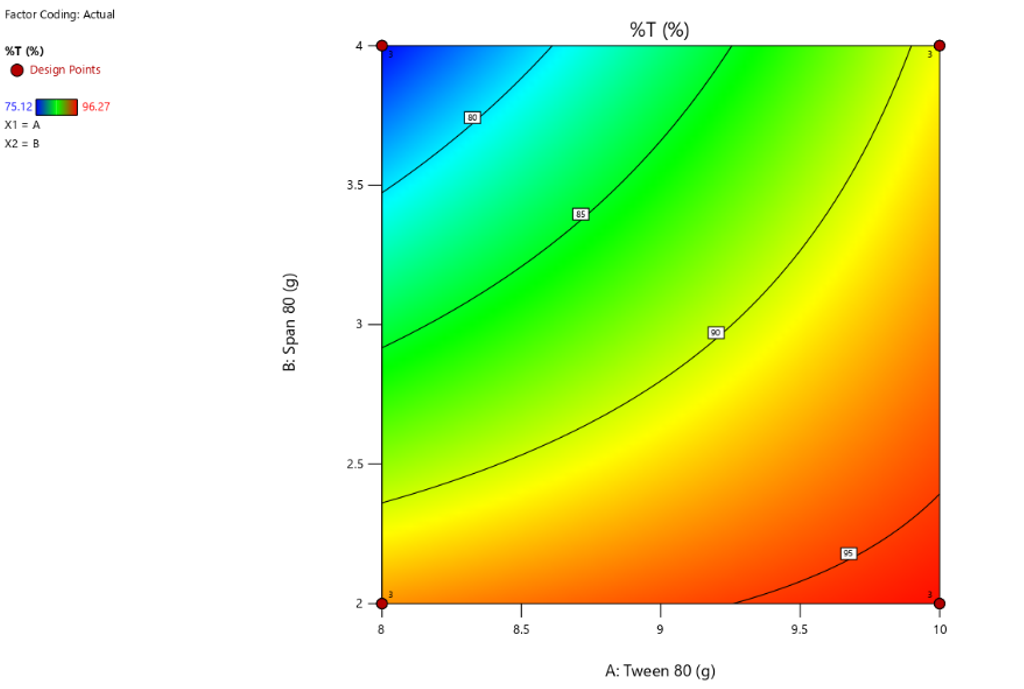
Regression equations and contour plots precisely interpret the relationship between factors, levels, and response values by quantitatively describing trends within the experimental domain. The percent transmittance response from Tween 80 (X1) and Span 80 (X2) levels in factorial design follows: Y = 88.8308 + 4.5775X1 – 5.80917X2 + 3.1875X1X2. Y represents percent transmittance, X1X2 signifies the Tween 80-Span 80 interaction term, and the equation demonstrates linear dependencies on individual factor and their interaction, supporting predictive applications through targeted factor substitution in formulation development.
Measurement results indicated that formula 1, A, and AB fell within the acceptable transmittance range, indicate good optical clarity and homogeneity of the emulsion system. Statistical analysis of formulation effects on transmittance responses revealed significant ANOVA model differences (p < 0.0001). Span 80 was the dominant factor influencing transmittance (F-value = 8581.11; %contribution = 52, 00%), primarily increasing clarity values. The interaction effects of both surfactants on transmittance responses are depicted in Figure 3.
Viscosity
Viscosity measures the internal resistance of a fluid to flow. This resistance arises from frictional forces between the fluid’s constituent molecular volumes, which depend on molecular interactions within the system. In emulsions system, viscosity is primarily influenced by temperature, droplet size, phase concentrations, and the preparation method employed (21, 32). The optimal viscosity range for emulsion formulations is 10-2000 cPs (33).
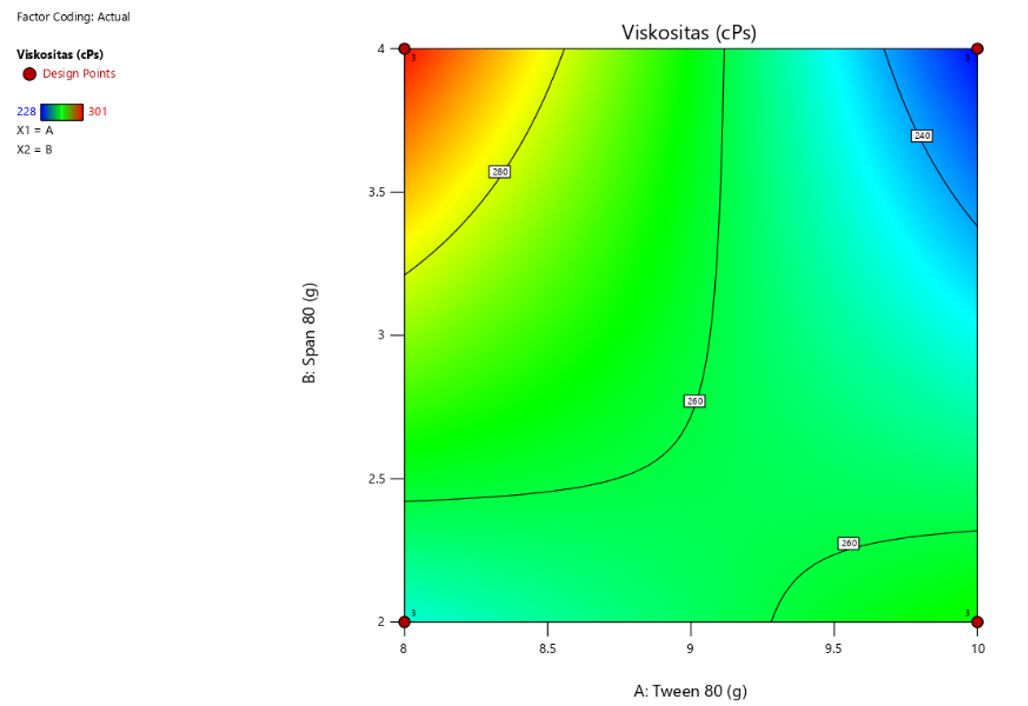
Regression equations and contour plots provide precise interpretation of factor, level, and response relationships. The factorial design model for viscosity (Y) as influenced by Tween 80 (X1) and Span 80 (X2) is Y = 260.917 – 13.75X1 + 3.25X2 + 22.0833X1X2. Whereas, X1X2 signifies the Tween 80-Span 9- interaction term, and the equation demonstrates linear dependencies on individual factors and their interaction, supporting predictive applications through targeted factor substitution.
Statistical analysis of formulation effects on viscosity responses revealed significant ANOVA model differences (p < 0.0001). The interaction between Tween 80 and Span 80 exerted the dominant influence on viscosity (8788.12), contributing 70.91% to the response variation. The combined effects of both surfactants on viscosity responses are illustrated in Figure 4.
Formulation Evaluation
A 22 factorial design evaluated red apple emulsions using Tween 80 (8 g and 10 g) and Span 80 (2 g and 4 g) concentrations. Three key responses were assessed: pH, %T, and viscosity as presented in Table 2. Data analysis were performed using Design Expert® software, to generate regression models and response surface plots.
| Formula | pH | Transmittance (%) | Viscosity (cPs) | |||
|---|---|---|---|---|---|---|
| aF value | bp value | aF value | bp value | aF value | bp value | |
| Model | 231.94 | < 0.0001 | 5497.59 | < 0.0001 | 4123.79 | < 0.0001 |
| Tween 80 | 515.05 | < 0.0001 | 5328.10 | < 0.0001 | 3403.12 | < 0.0001 |
| Span 80 | 171.43 | < 0.0001 | 8581.11 | < 0.0001 | 190.12 | < 0.0001 |
| Tween 80*Span 80 | 9.33 | 0.0157 | 2583.55 | < 0.0001 | 8778.12 | < 0.0001 |
| Description: aF value determined the variation has the significant impact, two-way ANOVA; bp value determined the significant values, two-way ANOVA | ||||||
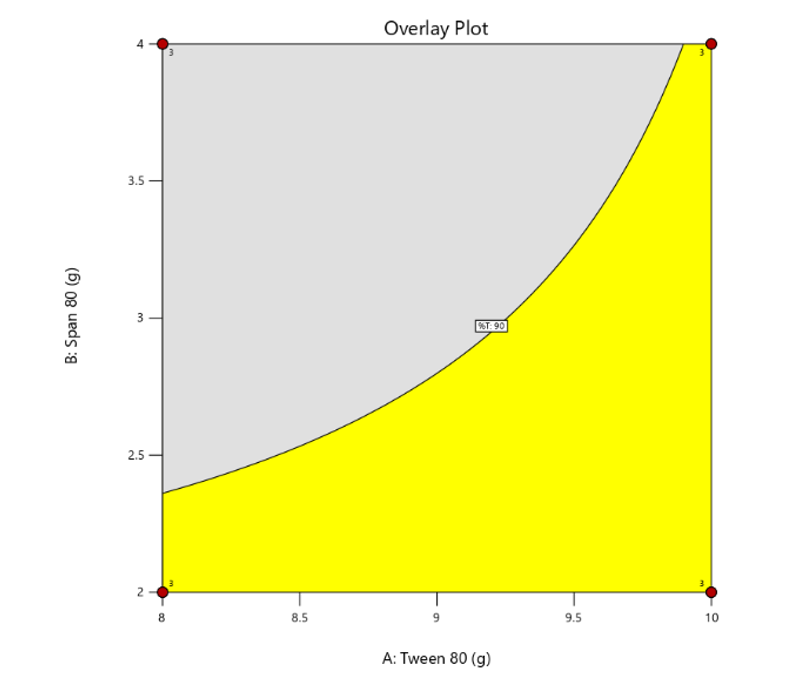
The overlay plot presented in Figure 5 illustrates the acceptable response region by the design model. The plot suggests that only formulations F1, FA, and FAB fall within the acceptable range, whereas formulation FB exhibits a transmittance value outside the acceptable limits. Consequently, selection of the best formulation should based on the lowest surfactant and co-surfactant composition lying within the predicted acceptable region to maximize material efficiency.
Accelerated stability testing
Stability testing was performed using the cycling test method over 3 cycles. Each cycle comprising storage at alternating temperature of -15°C and 25°C for 48 h per condition (25). This procedure was intended to simulate extreme storage conditions that may affect the physical integrity of the emulsion system. Following completion of the 6 cycles, evaluations of organoleptic, pH, %T, and viscosity were conducted on the emulsions formulation. These parameters were selected to monitor potential physical and chemical instability after temperature stress. The results before and after the cycling test stability are presented in Table 3.
| Formula | Before the Cycling Test | After the Cycling Test | ||||
|---|---|---|---|---|---|---|
| *pH | *%T | *Viscosity (cPs) | *pH | *%T | *Viscosity (cPs) | |
| F1 | 5.40 ± 0.006 | 93.25 ± 0.262 | 249.33 ± 0.577 | 5.39 ± 0.015 | 92.85 ± 0.084 | 250.67 ± 0.577 |
| FA | 5.20 ± 0.017 | 96.03 ± 0.216 | 266.00 ± 1.000 | 5.00 ± 0.010 | 90.09 ± 0.085 | 304.67 ± 4.041 |
| FB | 5.47 ± 0.012 | 75.26 ± 0.135 | 300.00 ± 1.000 | 4.88 ± 0.025 | 14.11 ± 0.472 | 396.00 ± 6.083 |
| FAB | 5.32 ± 0.015 | 90.79 ± 0.235 | 228.33 ± 0.577 | 5.11 ± 0.020 | 80.38 ± 0.418 | 285.33 ± 5.686 |
It demonstrates that pH and transmittance values decreased significantly (p < 0.05), whereas viscosity increased significantly (p < 0.05) across all formulations except F1 (p > 0.05). The accumulation of unfrozen solutes with increasing cycles accounts for the observed shifts in pH, and viscosity of the formulations (34). Besides, accelerated stability testing using centrifugation method was conducted, revealing no phase separation of flocculation, thereby indicating its stability. Only formulation F1 successfully passed both the cycling test and centrifugation test, demonstrating physical stability. Consequently, F1 was selected as the best formula for subsequent evaluation on its C. acnes inhibitory activity.
Antibacterial Activity
Antibacterial testing of optimal formula was performed to assess its efficacy against C. acnes and to determine the appropriate dosage for emulsion preparation. This evaluation provided preliminary insight into the biological performance of the selected formulation. The assay employed the agar well diffusion method under aseptic condition, with sterility controls indicating absence of bacterial growth and clarity of the medium. All procedures were carried out in triplicate to ensure the reliability and reproducibility of the obtained results. Anti-C. acnes activity testing outcomes are summarized in Table 4.
| Formula | Inhibition Zone (mm) | Zone of Inhibition (mm) | Antibacterial strength criteria | ||
|---|---|---|---|---|---|
| R1 | R2 | R3 | |||
| Optimal formula (F1) | 18.00 | 16.00 | 17.00 | 17.00 ± 1.000 | Strong |
| Positive control (Clindamycin) | 23.00 | 22.00 | 23.00 | 22.70 ± 0.577 | Strong |
| Negative control (aquadest) | 0 | 0 | 0 | 0 ± 0.000 | No inhibition zone |
Conclusion
The best red apple extract emulsion (F1) exhibited remarkable physicochemical stability and substantial antibacterial activity. The O/W emulsion obtained possess the potential for effective delivery of the hydrophobic apple extract. However, further investigation is necessary to fully ascertain this. This natural formulation demonstrates considerable promise and potential for advancement in the field of nanotechnology.
Declarations
Conflict of Interest
The authors declare no conflicting interest.
Data Availability
All data generated or analyzed during this study are included in this published article.
Ethics Statement
Ethical approval was not required for this study.
Funding Information
The author(s) declare that no financial support was received for the research, authorship, and/or publication of this article.
Supplemental Material
The supplemental material can be found at the following links: (https://view.officeapps.live.com/op/embed.aspx?src=https://etflin.com/file/document/202601220700232042342377.docx), (https://view.officeapps.live.com/op/embed.aspx?src=https://etflin.com/file/document/20260122070023536049166.docx), (https://view.officeapps.live.com/op/embed.aspx?src=https://etflin.com/file/document/20260122070023403924151.docx). These supplementary files correspond to Paired T Test_pH, Paired T Test_Viscosity, and Paired T Test_%T, respectively.
References
- Vasam M, Korutla S, Ashok R. Acne vulgaris: a review of the pathophysiology, treatment, and recent nanotechnology-based advances. Biochem Biophys Rep. 2023;36:101578.
- Wardani HN. Potensi ekstrak daun sirsak dalam mengatasi kulit wajah berjerawat. J Penelit Perawat Prof. 2020;2(4):563–570.
- Hadia R, Tousif IM, Kapadia A, Pillai S, Rajput HS, Joshi D, et al. Assessing the risk factors and determining the epidemiology of acne vulgaris in a tertiary care teaching hospital. J Pharm Res Int. 2021;33(1):261–271.
- Reynolds RV, Yeung H, Cheng CE, Keri JE, Gold FS, Tan JKL, et al. Guidelines of care for the management of acne vulgaris. J Am Acad Dermatol. 2024;90(5):1006.e1–1006.e30.
- Shaheen A. Comprehensive review of keloid formation. Clin Res Dermatol. 2017;4(5):1–18.
- Soetadipura AD. Skrining fitokimia dan karakterisasi simplisia buah apel hijau (Malus sylvestris (L.) Mill). Bandung Conf Ser Pharm. 2022;2(2):1–6.
- Lim HJ, Kang SH, Song YJ, Jeon YD, Jin JS. Inhibitory effect of quercetin on Propionibacterium acnes-induced skin inflammation. Int Immunopharmacol. 2021;96:107557.
- Chandra MA, Kuncahyo I, Indrayati A. Optimization of quercetin gel formulation using factorial design method and antibacterial test against Propionibacterium acnes. Borneo J Pharm. 2022;5(2):126–135.
- Bo Y, Li Y. Multi-target mechanisms and potential applications of quercetin in the treatment of acne vulgaris. Front Pharmacol. 2025;16:1–19.
- Mushtaq A, Mohd S, Malik AR, Gull A, Ramniwas S, Ahmad G, et al. Recent insights into nanoemulsions: their preparation, properties and applications. Food Chem X. 2023;18:1–15.
- Iskandar B, Liu TW, Mei HC, Kuo IC, Dwi M, Surboyo MDC, et al. Herbal nanoemulsions in cosmetic science: a comprehensive review of design and preparation. J Food Drug Anal. 2024;32(4):428–458.
- Rahmani Z, Karimi M, Saffari I. Nanoemulsion and nanoencapsulation of hydroethanolic extracts of Urtica dioica and Artemisia absinthium: comparison of antibacterial and anticancer activity. Front Chem. 2024;12:1–11.
- Qi W, Xiong D, Long M. Quercetin: its antioxidant mechanism and antibacterial properties. Molecules. 2022;27:1–16.
- Suhesti TS, Prasasti E, Aldi NA. Nanoemulsion formulation and antibacterial activity of nagasari (Mesua ferrea L.) leaf extract. J Sains Farm Klin. 2025;12(1):41–49.
- Dinshaw IJ, Ahmad N, Salim N, Leo BF. Nanoemulsions: a review on the conceptualization of treatment for psoriasis using a green surfactant with low-energy emulsification method. Pharmaceutics. 2021;13(7):1–34.
- Andry M, Ramadaini T, Marseli C, Azzahra R, Shiyan S. Antioxidant activity test of durian seed herbal tea (Durio zibethinus Murr.) with addition of stevia leaves (Stevia rebaudiana Bertoni) using DPPH method. J Pharm Sci. 2025;8(4):2462–2471.
- Modassar M, Nawaz A, Amjad S, Ashraf S, Khawar L, Safdar MN, et al. Extraction of polyphenols from apple and pomegranate peels employing different extraction techniques for the development of functional date bars. Int J Fruit Sci. 2020;20(3):1201–1221.
- Sunilson JAJ, Kumari AVAG, Khan A, Anandarajagopal K. Effects of Malus domestica fruit extracts against clinically isolated dental pathogens. J Pharm Sci Res. 2019;11(3):1–6.
- Guanse Y, Dwiastuti R, Tuelvin B, Gandi J, Chabib L. Optimization and physical characterization of nanoemulsion as a whitening agent of kojic acid. J Pharm Sci Community. 2025;22(2):310–318.
- Chrismaurin F, Dwiastuti R, Chabib L, Yuliani H. Effect of olive oil, Tween 60 and Span 20 on physical characteristics of quercetin nanoemulgel. Int J Appl Pharm. 2023;15(1):212–217.
- Khalid A, Arshad MU, Imran A. Development, stabilization, and characterization of nanoemulsion of vitamin D3-enriched canola oil. Front Nutr. 2023;10:1–9.
- Helsawati, Ratnaputri PH, Fitriana M. Formulation and evaluation of nanoemulsion kelakai (Stenochlaena palustris) herbs with smix (Tween 80 and glycerin) and pine oil. Borneo J Pharm. 2023;6(4):406–416.
- Sopyan I, Gozali D, Sriwidodo, Guntina RK. Design-Expert software (DOE): an application tool for optimization in pharmaceutical formulation. Int J Appl Pharm. 2022;14(4):55–63.
- Thango BA. Application of analysis of variance (ANOVA) in the interpretation of power transformer faults. Energies. 2022;15(19):1–15.
- Noralita K, Gumilar B, Yuliani H, Dwiastuti R. Optimization and physical characterization of quercetin nanoemulgel formula as an antibacterial agent. Int J Appl Pharm. 2023;15(1):104–110.
- Christiane S, Madonna V, Toruan L, Paramita S. Antibacterial test of bangle rhizome essential oil (Zingiber purpureum Roscoe) from East Kalimantan against Cutibacterium acnes and Staphylococcus epidermidis in vitro. J Ilmu Kesehat. 2025;13(1):77–86.
- Priani SE, Nurasyfa RF, Darma GCE, Fitraningsih SP, Syafnir L, Prayitno R. Antibacterial activity of rosemary oil against Propionibacterium acnes and formulation into nanoemulsion system. Indones J Pharm Sci Technol. 2023;10(1):1–9.
- Smejkal G, Gross V, Lazarev A. Theoretical and experimental determinations of the hydrophilic–lipophilic balance (HLB) of representative oils and lecithins. Colloids Interfaces. 2024;8(21):1–13.
- Almeida F, Corr M, Melero A, Garrigues T, Isaac V. Influence of different surfactants on development of nanoemulsion containing fixed oil from an Amazon palm species. Colloids Surf A Physicochem Eng Asp. 2022;643:1–10.
- Senapati PC, Sahoo SK, Sahu AN. Mixed surfactant-based self-nanoemulsifying drug delivery system presenting efavirenz for enhancement of oral bioavailability. Biomed Pharmacother. 2016;80:42–51.
- Gurpreet K, Singh SK. Review of nanoemulsion formulation and characterization techniques. Indian J Pharm Sci. 2018;80(5):781–789.
- Iacob-Tudose ET, Mamaliga I, Iosub AV. TES nanoemulsions: a review of thermophysical properties and their impact on system design. Nanomaterials. 2021;11(12):1–40.
- Agustin R, Silsadilla A, Ismed F. Nanoemulsion formulation of cardamom essential oil (Amomum compactum) and its in vitro anti-aging activity. Int J Appl Pharm. 2025;17(1):132–137.
- Mulia K, Ramadhan RMA, Krisanti EA. Formulation and characterization of nanoemulgel mangosteen extract in virgin coconut oil for topical formulation. MATEC Web Conf. 2018;156:1–7.