RESEARCH ARTICLE
Tree Species Composition and Spatial Distribution in a Primary Lowland Forest of Sitio Inadan, San Miguel, Surigao del Sur, Philippines
Academic Editor: Sabaruddin Kadir
Crop Life|Vol. 2, Issue 1, pp. 1-5 (2026)
CC BY 4.0-2026 Authors
Views
Downloads
Shares

Received
Jan 9, 2026Revised
Feb 27, 2026Accepted
Mar 26, 2026Published
Apr 17, 2026
Abstract
This study assessed tree species composition and spatial distribution patterns within a 0.32-ha lowland dipterocarp forest in the Philippines. Eight 20 m × 20 m plots were established to document tree species meeting the minimum diameter criterion. Species richness, relative abundance, and selected structural attributes were calculated, and a chi-square test was applied to assess plot-level distribution patterns. A total of 14 tree species were recorded, including dipterocarps and other canopy-associated taxa, as well as shade-tolerant understory species and several light-demanding pioneer species. The presence of shade-tolerant families such as Fagaceae and Lauraceae indicates ongoing recruitment under closed-canopy conditions, while the occurrence of pioneer species suggests localized canopy openings within the sampled area. Distribution analysis showed that some species exhibited aggregated patterns, whereas others did not significantly deviate from random distribution. This indicates that certain species tend to cluster in areas with favorable environmental conditions or resources, while others are more evenly dispersed across the habitat. Given the limited sampling extent and number of plots, the findings are interpreted only at the scale of the study area and do not imply broader forest-level structural conditions. Although species richness was lower than typically reported for larger lowland dipterocarp forest inventories in the Philippines, the results provide preliminary insights into local stand composition and small-scale spatial structure.
Keywords:
Introduction
Trees in untouched ecosystems are critical for global biodiversity, climate regulation, and ecological resilience. Nature found that primary forests (untouched by human activity) store 30% more carbon than secondary forests, making them vital for mitigating climate change (1). Tree diversity of trees are important for ways of conserving trees and to understand the state and health of the forest (2). It plays a critical role for people and the planet (3).
In the Philippines, not all trees have been documented. The composition and diversity of tree information in the planning and implementation of biodiversity conservation efforts is important (4). There is an estimated 73,000 reported species of trees and still 9,000 trees that are just to be discovered (5). Different species flora lives in various primary forests but decline due to human activities, climate change, and alien species that aided to biodiversity loss (6). Study conducted by Sarmiento et al. , (2) in Carrascal within the nickel mining resulted that there are native, endemic, and endangered varieties of tree species; however, despite these national and regional findings, there is a total absence of documented tree information in San Miguel, Surigao Del Sur specifically in Inadan.
The present study was undertaken in Sitio Inadan, Barangay Magroyong, Municipality of San Miguel, Surigao del Sur. Situated approximately 15 to 20 minute-drive from the municipal center of San Miguel, Surigao del Sur, Sitio Inadan is distinguished by its primary forest characteristics, rich biodiversity, and extensive agricultural land use. The economic and ecological importance of this area is intrinsically linked to its agricultural activities, thereby necessitating a comprehensive analysis of its dynamics and potential to inform sustainable development strategies.
Given the continuous expansion of these agricultural activities and the threat of biodiversity loss, there is an immediate and critical urgency to conduct this baseline study. To enhance the understanding and management of this valuable ecosystem, there is a critical imperative to determine the composition and distribution of tree species within the sitio before irreversible changes occur. This research endeavor will furnish essential data for conservation initiatives, sustainable land-use planning, and the preservation of Inadan's natural heritage.
Specifically, the study aimed to: 1) Determine the tree species composition in the study area; 2) Assess the conservation status of the recorded tree species; and 3) Describe the spatial distribution patterns of trees within the sampled plots.
Material and Methods
Materials
The materials used in this study included a 20-meter rope for establishing sampling plots and measuring distances within the study area. A measuring tape was used to measure the Diameter at Breast Height (DBH) of selected trees. Pruning shears were utilized to collect branch and leaf, flowers, and fruit samples from identified trees.
Collected specimens were placed in plastic bags for temporary storage and transport. Denatured alcohol was used to preserve the plant specimens and prevent decomposition. The preserved samples were wrapped in clean, used newspapers to absorb excess moisture and protect them during drying. Tags were attached to each specimen to indicate the local name of the tree, date of collection, and other necessary information.
Field notes were recorded to document measurements and observations during data collection.
In Vivo Test
Data collection was conducted in vivo, with all trees observed and measured directly in their natural habitat to ensure accurate recording of species identity, Diameter at Breast Height (DBH), health condition, and ecological interactions. Sample administration was carefully organized by establishing 20 m × 20 m fixed-area plots at 20-meter intervals, assigning identification numbers to each plot, and systematically recording all trees with DBH ≥ 10 inches. Field teams collected and labeled voucher specimens for taxonomic verification, pressed and preserved samples in denatured alcohol, and maintained detailed field notes for each plot. GPS coordinates were recorded to map species distribution, and photo documentation captured key morphological features. This approach ensured reliable management of samples and data while minimizing disturbance to the living trees and their environment.
In addition, the conservation status of each identified species was verified using the International Union for Conservation of Nature (IUCN) Red List (7) and the Philippine national assessment under the Department of Environment and Natural Resources–Biodiversity Management Bureau’s list of threatened species (CDF). This ensured that both global and national conservation classifications were considered in evaluating the ecological significance of the recorded tree species.
Sample Administration
Vegetative and reproductive parts of the trees were carefully collected using pruning shears to avoid excessive damage to the plant. The collected samples were pressed between sheets of newspaper and tied with plastic twine to ensure they remained flat and organized during transport. To prevent decay and preserve the specimens for further analysis, they were stored in polyethylene bags containing denatured alcohol. Each specimen was labeled with a unique collection number and the local name of the tree for proper identification. Detailed information about each sample, including its location, physical characteristics, and any notable observations, was recorded systematically in field notes to maintain accurate and organized documentation of the collected data.
Results and Discussion
A total of 16 tree species belonging to 11 families were documented in Inadan, San Miguel. The most represented families were Moraceae (3 species), Lauraceae (2), Burseraceae (2), and Dipterocarpaceae (2), while the remaining families were represented by a single species. The presence of ecologically important genera such as Shorea, Canarium, and Pterocarpus indicates that the area retains the structural characteristics of a lowland dipterocarp forest (Figure 1).
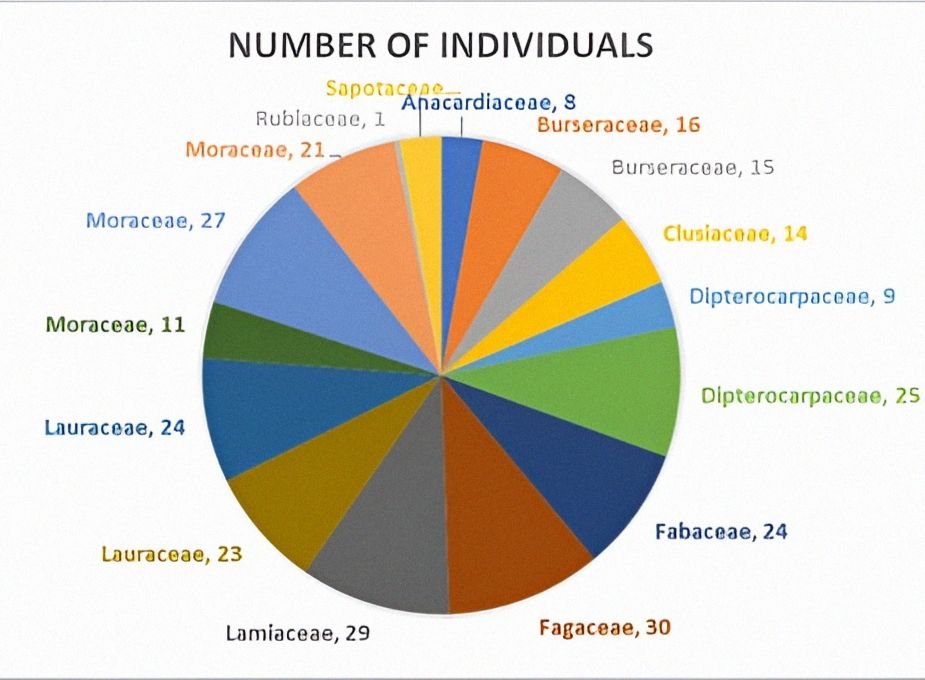
Although the forest remains relatively undisturbed, the observed species richness is moderate. This is primarily due to the ≥ 10 cm DBH inclusion criterion, which excluded saplings and juvenile individuals that contribute to total diversity.
Methodological and ecological factors further influenced the recorded richness. The limited plot size and DBH threshold may have underestimated total species counts, particularly understorey and regenerating taxa. In addition, the relative isolation of the study site from larger forest complexes such as Mount Hamiguitan and Mount Apo may restrict species dispersal and colonization.
Despite these constraints, the coexistence of Dipterocarpaceae and Lauraceae species reflects ecological stability and minimal anthropogenic disturbance within the forest ecosystem.
Conservation assessment based on the International Union for Conservation of Nature (IUCN) Red List and Co’s Digital Flora (CDF) showed that most species are categorized as Least Concern (Table 1). However, Litsea urdanetensis is classified as Vulnerable, and Pterocarpus indicus is listed as Endangered, highlighting the conservation importance of the site. Several taxa remain Not Assessed, indicating the need for further evaluation and monitoring.
| Family | Species Name | IUCN | CDF |
|---|---|---|---|
| Annacardiaceae. | Buchanania sp. | Not assessed | Not assesed |
| Burseraceae | Canarium asperum Benth. | Least Concerned | Least Concerned |
| Burseraceae | Canarium euryphyllum Perkins | Least Concerned | Least Concerned |
| Rubiaceae. | Urophyllum sp. | Not assessed | Not assesed |
| Moraceae | Artocarpus sp. | Not assessed | Not assesed |
| Dipterocarpaceae | Shorea negrosensis Foxw. | Least Concerned | Least Concerned |
| Dipterocarpaceae | Shorea assamica Dyer, | Least Concerned | Least Concerned |
| Fagaceae | Lithocarpus sp. | Not assessed | Not assesed |
| Lauraceae | Litsea urdanetensis Elmer | Vulnerable | Vulnerable |
| Lauraceae. | Litsea sp. | Not assessed | Not assesed |
| Clusiaceae. | Garcinia sp. | Not assessed | Not assesed |
| Lamiaceae | Teijsmanniodendron pteropodum (Miq.) Bakh. | Least Concerned | Least Concerned |
| Moraceae | Ficus altissima Blume. | Least Concerned | Least Concerned |
| Fabaceae. | Pterocarpus indicus Willd. | Endangered | Endangered |
| Sapotaceae | Palaquium sp. | Not assessed | Not assesed |
| Moraceae | Ficus caulocarpa (Miq.) | Least Concerned | Least Concerned |
Spatial analysis across eight 20 m × 20 m plots revealed both random and aggregated distribution patterns (Table 2). Aggregated distributions observed in some species suggest localized clustering influenced by microhabitat conditions, resource availability, and dispersal mechanisms, whereas randomly distributed species indicate relatively uniform environmental conditions. These patterns collectively reflect habitat heterogeneity and contribute to the overall forest structure of the study area.
| Species | Variance | Mean | Chi-sq | d. f | Probability | Aggregation |
|---|---|---|---|---|---|---|
| Artocarpus sp. | 3.9821 | 1.375 | 20.2727 | 7 | 0.0051477 | Aggregated |
| Buchanania sp. | 1.4286 | 1 | 10 | 7 | 0.1876098 | Random |
| Canarium asperum Benth. | 4.2857 | 2 | 15 | 7 | 70.0358132 | Random |
| Canarium euryphyllum Perkins | 3.4286 | 3.4286 | 2 | 7 | 70.09978 | Random |
| Urophyllum sp. | 0.125 | 0.125 | 7 | 7 | 0.4292931 | Random |
| Shorea negrosensis Foxw. | 4.125 | 1.125 | 7 | 7 | 0.0006404 | Aggregated |
| Shorea assamica Dyer | 6.125 | 3.125 | 13.72 | 7 | 0.0559718 | Random |
| Lithocarpus sp. | 8.5 | 3.75 | 15.8667 | 7 | 0.0262969 | Random |
| Litsea urdanetensis Elmer | 2.9821 | 2.875 | 7.26097 | 7 | 0.4024365 | Random |
| Litsea sp. | 7.7143 | 3 | 18 | 7 | 0.0120707 | Aggregated |
| Garcinia sp. | 2.5 | 1.75 | 10 | 7 | 0.1876098 | Random |
| Teijsmanniodendron pteropodum (Miq.) Bakh. | 3.15 | 9.9821 | 19.27 | 7 | 0.0800162 | Aggregated |
| Ficus altissima Blume | 6.7857 | 3.75 | 12.6667 | 7 | 0.1876098 | Random |
| Pterocarpus indicus Willd. | 4.2857 | 3 | 10 | 7 | 0.342247 | Random |
| Palaquium sp. | 1.2679 | 1.125 | 7.8889 | 7 | 5.31E-05 | Random |
| Ficus caulocarpa (Miq.) | 11.9821 | 2.625 | 31.9524 | 7 | 70.0074993 | Aggregated |
Conclusion
This study successfully characterized the tree species composition of the forest in Sitio Inadan, San Miguel, documenting 285 individuals representing 16 species, 11 families, and 12 genera within a 3,200 m² area. The dominance of native families such as Dipterocarpaceae, Lauraceae, Moraceae, and Fagaceae confirms that the site retains the structural attributes of a relatively undisturbed lowland forest and maintains good ecological integrity.
Conservation assessment using the International Union for Conservation of Nature (IUCN) and Co’s Digital Flora (CDF) showed that most species are categorized as Least Concern, while one species is Vulnerable and one is Endangered, highlighting the presence of conservation-significant taxa.
The observed random and aggregated distribution patterns indicate active natural regeneration and ecological stability. Although the forest remains resilient, the presence of threatened and low-abundance species underscores the need for continued monitoring and proactive conservation strategies to safeguard biodiversity amid increasing external pressures.
Abbreviations
IUCN = International Union for Conservation of Nature; CDF = Co’s Digital Flora.
Declarations
Acknowledgment
We would like to express our sincere gratitude to all the people who supported and contributed to the completion of our research study. First and foremost, we would like to thank our Research Adviser for the valuable guidance, patience, and encouragement throughout the entire research process. Their knowledge and support greatly helped us improve and successfully complete this study. We are also deeply grateful to the owner of the land who generously allowed us to conduct our research in the study area. Without their permission and cooperation, this research would not have been possible. Our heartfelt thanks are extended to the Barangay Captain, the Barangay Tanods, and the Municipal Mayor for their support, assistance, and approval that allowed us to conduct our research within the community. We would also like to thank our School Principal for the encouragement and support given to us as students in conducting this research project. Special thanks go to our parents for their endless support, motivation, and understanding throughout the process of completing this study. Lastly, we sincerely appreciate all the individuals who generously donated financial support and to everyone who, in one way or another, contributed to the success of this research. Your kindness, cooperation, and support made this study possible.
Conflict of Interest
The authors declare no conflicting interest.
Data Availability
All data generated or analyzed during this study are included in this published article.
Ethics Statement
Ethical approval was not required for this study.
Funding Information
The authors declare that no financial support was received for the research, authorship, and/or publication of this article. Each of the author contributed finances to make the study successful.
References
- Lewis SL, Wheeler CE, Mitchard ETA, Koch A. Restoring natural forests is the best way to remove atmospheric carbon. Nature. 2019 Apr;568(7750):25–8.
- Lleno J, Ligalig RJ, Sarmiento RT, Along AA. Tree diversity, composition, and stand structure of lowland tropical forest in Prosperidad, Agusan del Sur, Philippines. Open J Fish Res. 2023;10(1S):4810–30.
- Cavender‐Bares J. Diversification, adaptation, and community assembly of the American oaks ( Quercus ), a model clade for integrating ecology and evolution. New Phytol. 2019 Jan 23;221(2):669–92.
- Suratman MN. Tree Species Diversity and Forest Stand Structure of Pahang National Park, Malaysia. Biodivers Enrich a Divers World. 2012 Aug 29;473–92.
- Cazzolla Gatti R, Reich PB, Gamarra JGP, Crowther T, Hui C, Morera A, et al. The number of tree species on Earth. Proc Natl Acad Sci. 2022 Feb 8;119(6):e2115329119.
- Naeem S, Duffy JE, Zavaleta E. The functions of biological diversity in an age of extinction. Science. 2012 Jun 15;336(6087):1401–6.
- IUCN [Internet]. 2025. The IUCN Red List of Threatened Species. Available from: https://www.iucnredlist.org