RESEARCH ARTICLE
Formulation Optimization of a Thermosensitive Curcumin Hydrogel for Localized Drug Delivery Using Response Surface Methodology
Academic Editor: Nurhasni Hasan
Sciences of Pharmacy|Vol. 5, Issue 2, pp. 189-199 (2026)
CC BY 4.0-2026 Authors
Views
Downloads
Shares

Received
Jan 17, 2026Revised
Feb 5, 2026Accepted
Mar 3, 2026Published
May 20, 2026
Abstract
Curcumin has been widely reported to exhibit anticancer potential; however, its clinical application is limited by poor aqueous solubility and low permeability. This study aimed to develop a thermoresponsive hydrogel system based on Poloxamer 407 and hydroxypropyl methylcellulose (HPMC) for localized curcumin delivery through sol–gel transition at physiological temperature. Curcumin nanoparticles were prepared via ionic gelation and incorporated into hydrogel matrices containing varying ratios of Poloxamer 407 and HPMC. Optimization was performed using Response Surface Methodology. pH, gelation time, and viscosity were selected as critical quality attributes reflecting the applicability of in situ hydrogels. The evaluated responses included pH (5–7), gelation time (9–11 min), and viscosity (2000–5000 mPa·s), with model validation based on lack-of-fit > 0.05, high R², a difference between adjusted and predicted R² < 0.2, and adequate precision > 4. Nano-curcumin exhibited a particle size of 423.03 ± 27.80 nm, PDI of 0.59 ± 0.08, and a zeta potential of −12.47 ± 0.74 mV. The optimized formulation (17.067% Poloxamer 407 and 4% HPMC) achieved a desirability value of 0.86, with a pH of 5.85, gelation time of 9 minutes, and viscosity of 4389.76 mPa·s. In vitro release followed the Korsmeyer–Peppas model, indicating diffusion-controlled release and suggesting the suitability of the optimized thermosensitive hydrogel as a localized curcumin delivery platform. These findings provide a basis for further investigation of the system’s stability and performance under extended conditions.
Keywords:
Introduction
Localized delivery Current therapeutic approaches are often associated with systemic side effects, drug resistance, and limited selectivity toward malignant cells (1). Curcumin, the principal bioactive compound of Curcuma longa L., has attracted considerable attention due to its reported antiproliferative and pro-apoptotic activities in localized delivery models (2, 3).
Despite these promising biological properties, the clinical translation of curcumin remains challenging due to its unfavorable physicochemical characteristics. According to the Biopharmaceutical Classification System (BCS), curcumin is categorized as a Class IV compound, exhibiting poor aqueous solubility and low permeability (4). In addition, curcumin exhibits limited stability under physiological conditions, further limiting its potential delivery (5). These characteristics highlight the importance of formulation strategies to improve drug stability and support localized delivery approaches.
Localized drug delivery systems have emerged as a promising strategy to enhance drug concentration at the intended site while minimizing systemic exposure (7). Among these systems, thermosensitive hydrogels represent an attractive platform because they remain in a sol state at room temperature and undergo sol–gel transition at physiological temperature (~37 °C). This in situ gelation behavior enables minimally invasive administration and the formation of a local depot that supports sustained and controlled drug release (8).
In thermosensitive hydrogel formulations, physicochemical parameters such as pH, gelation time, and viscosity play essential roles in determining system performance. The pH influences drug stability and formulation compatibility, gelation time governs the sol–gel transition at physiological temperature, enabling in situ depot formation, and viscosity affects pre-administration handling while contributing to matrix integrity and sustained release (5, 6). Within this context, the present study focuses on the formulation and optimization of a localized thermoresponsive delivery system rather than investigating cancer biology itself, aiming to enhance curcumin stability and site-specific retention. Therefore, controlling these parameters is fundamental to achieving reproducible and functional localized delivery systems.
Poloxamer 407 (Pluronic F127) is a thermosensitive polymer capable of reversible sol–gel transition at physiological temperature; however, its relatively low mechanical strength may limit its performance as a standalone matrix (9, 10). The incorporation of hydroxypropyl methylcellulose (HPMC) can enhance viscosity, modulate gelation behavior, and reinforce the gel network, thereby improving formulation stability (11). The Poloxamer 407–HPMC system has been widely investigated as a thermoresponsive platform for localized drug delivery due to its tunable physicochemical properties (12). However, studies integrating nanoparticle-stabilized curcumin with statistically optimized Poloxamer 407–HPMC thermosensitive hydrogels remain limited, particularly in the context of systematic formulation optimization.
Optimizing the composition of thermosensitive hydrogel formulations is essential to obtain well-defined physicochemical characteristics and predictable gelation behavior. Response Surface Methodology (RSM) provides a systematic statistical approach to evaluate the linear, quadratic, and interaction effects of formulation variables, specifically Poloxamer 407 and HPMC concentrations, on critical responses such as pH, gelation time, and viscosity (13, 14). Compared with conventional trial-and-error approaches, RSM reduces the number of experimental runs while enabling the development of statistically validated predictive models and desirability functions to determine optimal formulation conditions (12, 15). Although RSM relies on localized model assumptions, careful selection of factor ranges and experimental design enhances model reliability and interpretability (16, 17).
Therefore, this study focuses on the statistical optimization of a Poloxamer 407–HPMC thermosensitive hydrogel incorporating curcumin nanoparticles to achieve controlled gelation and viscosity suitable for potential localized administration. The objective is to establish a rational formulation framework that supports physicochemical stability and controlled drug release, providing a basis for future evaluation in localized delivery applications.
Experimental Section
Materials
Curcumin analytical grade (pro analysis) obtained from PT Merck, Indonesia, was used as the active compound in nanoparticle preparation and hydrogel formulation. Curcumin from PT Haldin Pacific Semesta was used as a reference material for comparison. Hydroxypropyl methylcellulose (HPMC) and Poloxamer 407 (Kolliphor® P407, BASF) were obtained from PT Sampharindo Perdana, Indonesia. All excipients were of pharmaceutical grade and used without further purification.
Preparation of Curcumin Nanoparticles
Curcumin nanoparticles were prepared using the ionic gelation method based on electrostatic interaction between chitosan and sodium tripolyphosphate (STPP). The polymer ratio and process parameters were selected based on preliminary screening to obtain a stable nanoparticle dispersion.
Curcumin (80 mg) was dissolved in 70% ethanol and diluted to 100 mL. A 0.1% w/v chitosan solution was prepared in 0.1% acetic acid, while a 0.01% w/v STPP solution was prepared separately.
One mL of curcumin solution was added to 3 mL of chitosan solution under magnetic stirring (1000 rpm) for 60 min to ensure homogeneous interaction. Subsequently, 1 mL of STPP solution was added dropwise to induce ionic crosslinking and nanoparticle formation. The dispersion was stirred until homogeneous and used fresh for hydrogel incorporation without post-processing, as this study focused on preliminary formulation development.
Particle Size and Zeta Potential of the Optimized Formula
Particle size and zeta potential were measured using a particle size analyzer (Malvern Instruments) at 25 °C using water for injection as the dispersing medium. Measurements were performed to suggest nanoparticle formation before hydrogel incorporation (1).
Formulation of Curcumin-Loaded Thermosensitive Hydrogels
Poloxamer 407 was dissolved in distilled water at 8 ± 2 °C under magnetic stirring (800 rpm) and stored at 4–8 °C for 24 h to ensure complete hydration. The HPMC solution was prepared separately under stirring at 600 rpm until a homogeneous viscous solution was obtained.
Nanoparticle dispersion was incorporated into the polymer matrix at a ratio of 1: 4.5: 4.5 (nanoparticle dispersion: Poloxamer solution: HPMC solution) to obtain a final volume of 10 mL. Mixing was conducted at low temperature (8 ± 2 °C) with gradual dropwise addition of nanoparticle dispersion under stirring (800 rpm) to minimize aggregation and maintain nanoparticle stability within the polymer matrix.
The formulation was stored at 4–8 °C for 24 h to allow micellization and stabilization before physicochemical evaluation (21, 22). The research design is presented in Table 1.
| Run | Polymeric Matrix (%b/v) | Active Ingredient (%w/v) | Response 1 | Response 2 | Response 3 | |
|---|---|---|---|---|---|---|
| Poloxamer-407 | HPMC | Curcumin | pH | Tsol-gel (min) | Viscosity (mPa·s) | |
| 1 | 17.5 | 1.58579 | 0.02 | 7.08 | 7.29 | 2802.22 |
| 2 | 13.9645 | 3 | 0.02 | 5.05 | 12.68 | 2802.51 |
| 3 | 20 | 4 | 0.02 | 7.05 | 6.65 | 4205.2 |
| 4 | 17.5 | 3 | 0.02 | 6.07 | 7.98 | 3471.8 |
| 5 | 17.5 | 3 | 0.02 | 6.04 | 8.07 | 3450.6 |
| 6 | 17.5 | 3 | 0.02 | 6.07 | 7.99 | 3930.7 |
| 7 | 15 | 2 | 0.02 | 6.02 | 9.85 | 2801.26 |
| 8 | 17.5 | 3 | 0.02 | 6.07 | 8.05 | 3560.52 |
| 9 | 15 | 4 | 0.02 | 5.25 | 10.25 | 4201.61 |
| 10 | 20 | 2 | 0.02 | 7.56 | 5.57 | 3250.45 |
| 11 | 17.5 | 3 | 0.02 | 6.52 | 6.89 | 3540.21 |
| 12 | 21.0355 | 3 | 0.02 | 7.83 | 5.04 | 3541.79 |
| 13 | 17.5 | 4.41421 | 0.02 | 7.05 | 6.65 | 4205.2 |
Physicochemical Characterization of Nano-Curcumin Thermosensitive Hydrogels
pH Measurement
The pH of the hydrogels was determined using a calibrated pH meter. Calibration was performed using standard buffers at pH 4, 7, and 10 before analysis. The probe was immersed in the sample at ambient temperature, and the pH value was recorded once the reading stabilized (2).
Gelation Time
Gelation time was evaluated by placing the sample in a water bath maintained at 37°C ± 0.5°C. The sol-to-gel transition time was recorded when the formulation fully transformed into a gel, suggested using the vial-inversion method (2).
Viscosity Measurement
Viscosity was assessed using a Rheosys Merlin II viscometer equipped with a cone-and-plate system. The sample was placed on a 30-mm plate, and a 2.0-mm cone spindle was lowered to an approximate 1-mm gap. Instrument parameters included an integration time of 10 s, a delay time of 30 s, a temperature range of 23–40 °C, and spindle rotation speeds of 20–80 rpm. Viscosity values (mPa·s) were calculated using kv and fk constants obtained from standard fluid calibration (2, 3).
Experimental design and statistical optimization (CCD–RSM)
A two-factor Central Composite Design (CCD) was employed to optimize the thermosensitive hydrogel formulation using Poloxamer 407 (X₁) and HPMC (X₂) as independent variables. The experimental design consisted of 13 runs, including factorial points, axial points, and replicated center points, generated using Design-Expert® software version 13.0.
The factor ranges were selected based on preliminary formulation studies to obtain gelation behavior and viscosity appropriate for injectable thermosensitive systems. An axial distance (α) of 1.414 was applied to maintain design rotatability.
The evaluated responses included pH (Y₁), gelation time (Y₂), and viscosity (Y₃), which are critical parameters influencing gel formation behavior and rheological performance in localized delivery systems. The relationship between formulation variables and the corresponding responses was described using a s-order polynomial model, as presented in Equation 1.
where Y represents the predicted response, β₀ is the intercept, β₁ and β₂ are linear coefficients, β₁₂ represents the interaction coefficient, and β₁₁ and β₂₂ are quadratic coefficients. Model adequacy was evaluated using analysis of variance (ANOVA), lack-of-fit test (p > 0.05), coefficient of determination (R²), adjusted R², predicted R², and adequate precision (4, 5).
Results and Discussion
Physicochemical Characterization of Curcumin Nanoparticles
The results of particle size, zeta potential, and polydispersity index measurements are presented in Table 2.
| Size (d. nm) | Polydispersibility | Zeta potential (mV) |
|---|---|---|
| 401.7 | 0.495 | -11.5 |
| 405.1 | 0.59 | -12.6 |
| 462.3 | 0.681 | -13.3 |
| 423.03±27.80 | 0.59±0.08 | -12.47±0.74 |
Based on Table 2, the characteristics of particle size, polydispersity index (PDI), and zeta potential of the curcumin nanosystem in the thermosensitive hydrogel are significantly influenced by the pH conditions of the formulation environment. The zeta potential value in the range of −12.47 ± 0.74 mV indicates limited electrostatic stability. However, this does not necessarily compromise the overall stability of the system, as non-ionic polymer-based systems such as Poloxamer 407–HPMC are primarily stabilized by steric hindrance rather than charge repulsion. At near-neutral pH conditions, the phenolic groups of curcumin undergo partial ionization, which can increase the negative charge on the particle surface, thus contributing to reduced aggregation even though the zeta potential is relatively low (6, 7).
Low zeta potential remains a limitation for the nanoparticle dispersion itself, while embedding within the hydrogel may provide secondary steric stabilization at the formulation level. In such a system, interactions between polymer chains form a more compact gel network when physiological temperatures are reached. This stable gel structure will inhibit curcumin diffusion and promote drug release more controlled by matrix relaxation and erosion. Recent studies have shown that nanosystems with a zeta potential < 20 mV remain stable when protected by non-ionic polymers, and their drug release tends to follow a diffusion–relaxation mechanism (steric-controlled release) (8, 9).
The PDI value of 0.59 ± 0.08 indicates a relatively heterogeneous particle size distribution, which is likely influenced by the interaction between Poloxamer micelles and the HPMC network during gel formation. This variation in size distribution may occur due to changes in micro-pH within the hydrogel matrix that affect the level of curcumin ionization and hydrophobic–hydrophilic interactions within the micelle system, thus impacting the stability of the particle dispersion (8, 10).
Nevertheless, the stability of the system is maintained because the steric stabilization mechanism of the polymer chain is able to prevent particle coalescence despite the relatively high PDI value. In addition, the average particle size of 423.03 ± 27.80 nm indicates that the system is in the nano-micro range, which is still suitable for hydrogel-based local drug delivery. At physiological pH, the combination of negative zeta potential and steric protection of Poloxamer–HPMC helps maintain dispersion stability and control the release behavior of curcumin from the gel matrix. This is in line with recent reports that in thermosensitive hydrogel systems, the stability and characteristics of particles are more influenced by the polymer network structure and steric effects than by surface charge alone (11).
Physicochemical Characterization of Nano-Curcumin Thermosensitive Hydrogels.
The optimization data for the Poloxamer 407–HPMC matrix indicate the pH, sol–gel transition time, and viscosity of the formulations. These three parameters served as the primary responses in identifying the optimal conditions for the curcumin thermosensitive hydrogel, ensuring physiological pH stability, an appropriate gelation time, and a viscosity profile suitable for localized application. Collectively, these responses are critical in determining the overall performance of the system, particularly in terms of injectability, in situ gel formation, and controlled drug release behavior.
pH
The quadratic model generated for the pH response was statistically significant (p = 0.0005), with a coefficient of determination (R²) of 0.9333, indicating that approximately 93.33% of the variability in pH could be explained by the model. This indicates strong agreement between the experimental data and the fitted model. Poloxamer 407 (A) exerted the most significant effect on pH (p< 0.0001), where increasing its concentration consistently elevated the pH of the formulation. In contrast, HPMC (B) showed no significant linear effect (p = 0.1432); however, the quadratic term of HPMC (B²) was significant (p = 0.0090), suggesting a nonlinear influence in which lower concentrations slightly reduced pH, while higher concentrations caused it to rise again.
The lack-of-fit value was not significant (p = 0.1495), suggesting that the model adequately represented the experimental data without substantial systematic error. The Adequate Precision value of 13.53 (> 4) indicated a high signal-to-noise ratio, supporting the predictive reliability of the model. Additionally, the low coefficient of variation (CV = 4.41%) reflected good reproducibility and minimal experimental variation. “The model equation in factor form is presented in Equation 2. The interaction between Poloxamer 407 and HPMC is illustrated in Figure 1.
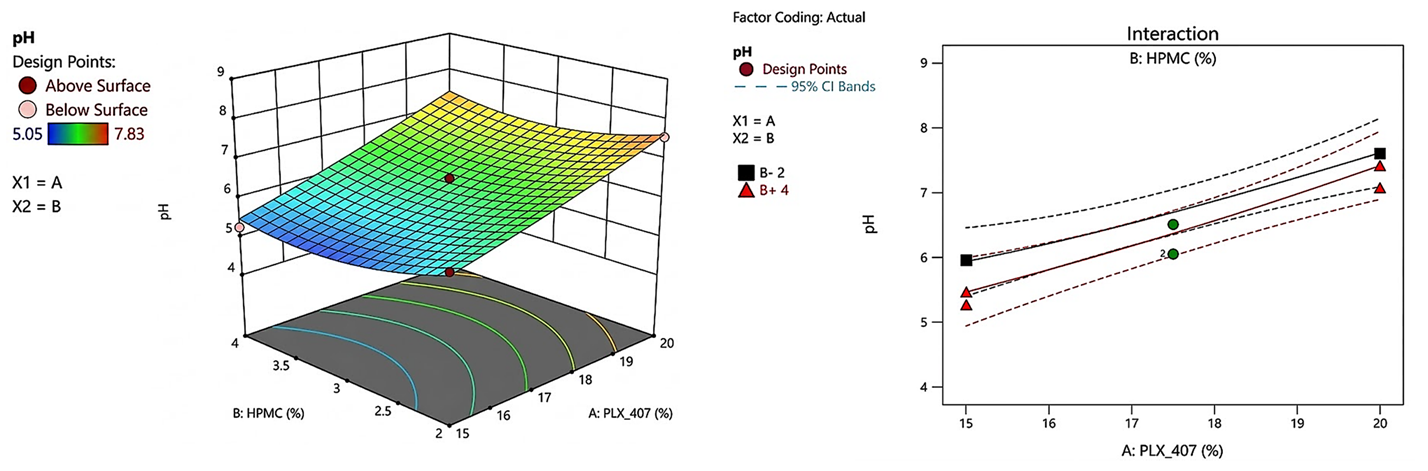
Based on the model equation, the combination of 17.5% Poloxamer 407 and 3.0% HPMC yielded an optimal pH value of 6.15, which is considered suitable for maintaining the physicochemical stability of curcumin within a thermosensitive hydrogel system. Curcumin is known to exhibit enhanced stability in mildly acidic to near-neutral environments, where hydrolytic degradation is minimized, and its therapeutic activity can be preserved (12, 13). Therefore, achieving this pH range is critical to ensure drug integrity during formulation and storage. The three-dimensional surface plot in Figure 1 shows a rising pH trend with increasing Poloxamer 407 concentration, whereas higher concentrations of HPMC result in a plateauing pH curve. This behavior may be attributed to the formation of a denser hydrogel network that modulates ionic mobility and reduces proton diffusion within the matrix, thereby contributing to a more stable microenvironment for curcumin entrapment and sustained release (14–16).
The interaction between Poloxamer 407 and HPMC contributes not only to hydrogel stability but also to its compatibility with mildly acidic physiological conditions. At higher HPMC concentrations, viscoelastic buffering from polymer chain entanglement stabilizes pH, forming a semi-interpenetrating network that supports drug stability and diffusion under localized physiological conditions (14, 17). This hydrated and hydrogen-bonded matrix enhances localized retention and controlled release of hydrophobic drugs such as curcumin, reflecting the formulation’s potential to maintain compatibility within localized delivery environments (11, 16).
Sol–Gel Transition Time
The optimized sol–gel transition time data for the curcumin thermosensitive hydrogel formulations are presented in Figure 2.
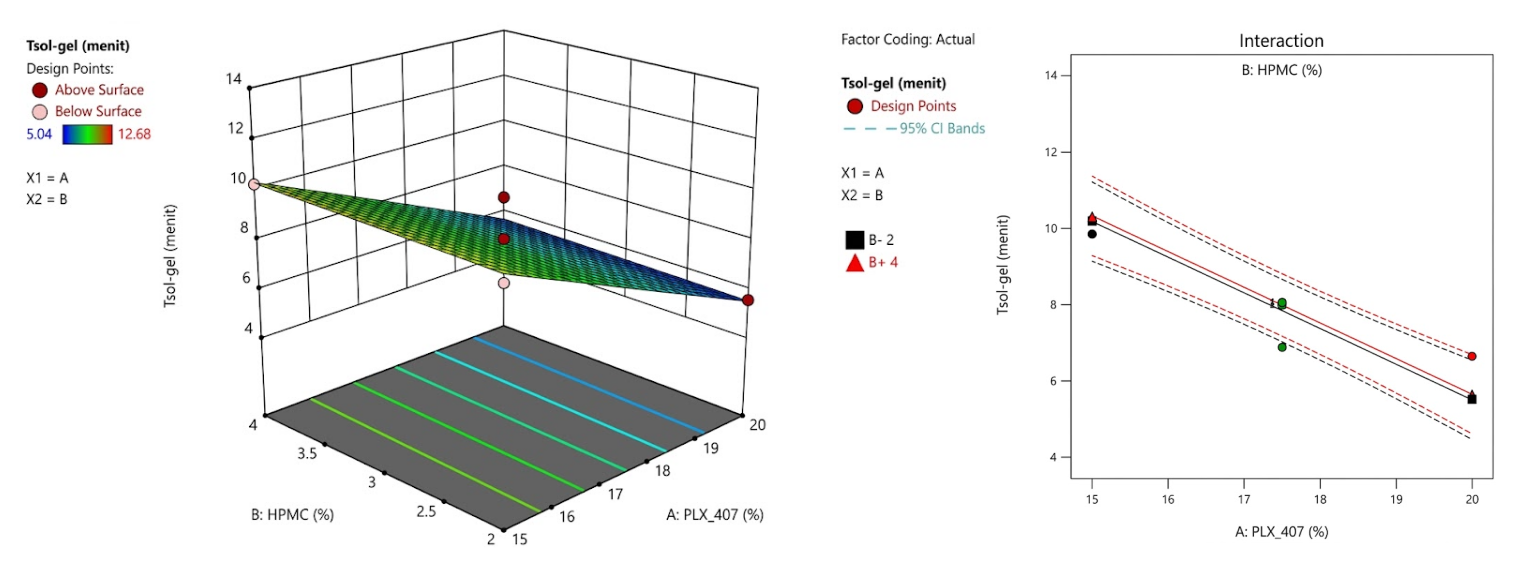
The plot indicates that increasing the concentration of Poloxamer 407 leads to a reduction in gelation time, whereas increasing the concentration of HPMC produces a more complex effect, generally prolonging the sol–gel transition at higher levels. The model equation in factor form is presented in Equation 3.
The reduction in gelation time at higher Poloxamer 407 concentrations (≥18%) can be attributed to the increased formation of micellar aggregates and enhanced hydrophobic interactions among polypropylene oxide (PPO) blocks, which facilitate rapid gel network formation at physiological temperatures (18). In contrast, the incorporation of HPMC increases system viscosity and reinforces the gel network through hydrogen bonding, but concurrently restricts polymer chain mobility, thereby extending the gelation time (19). The synergistic interaction between these polymers allows modulation of thermogelation behavior to meet therapeutic requirements.
Based on Figure 2, the optimal sol–gel transition time ranges between 5–12 min, with the ideal region achieved at approximately 17–19% Poloxamer 407 and 2.5–3% HPMC. These concentrations provide a balanced system that gels rapidly upon application while maintaining stability during storage at lower temperatures (20).
This phenomenon aligns with recent findings that highlight the importance of combining Poloxamer with auxiliary polymers, such as HPMC or chitosan, to fine-tune the gelation and rheological characteristics of thermosensitive curcumin-based delivery systems (21, 22). Such systems offer enhanced control over drug release, mucosal retention, and the bioavailability of curcumin, which is inherently limited under physiological conditions (13).
Gelation time plays a critical role in ensuring in situ retention of thermosensitive hydrogels following localized administration. Rapid gelation at physiological temperature promotes immediate sol–gel transition, reducing burst leakage and preventing formulation migration from the application site (9, 23). This fast network formation may enhance local drug retention and prolong residence time through viscoelastic matrix stabilization and micellar reorganization, ultimately supporting controlled diffusion–relaxation drug release (14, 17).
Viscosity of Curcumin Thermosensitive Hydrogel
The optimization data for the viscosity parameter of the thermosensitive hydrogel formulated with Poloxamer 407 and HPMC are presented in Figure 3.
As shown in the Figure 3, simultaneous increases in both polymers result in a significant rise in viscosity. The red regions of the response surface indicate the highest viscosity values (approximately 4200 mPa·s), while the blue areas show the lowest values (around 2800 mPa·s). Poloxamer 407 contributes to viscosity enhancement by forming progressively denser three-dimensional micellar networks, thereby increasing resistance to deformation and flow (24). Meanwhile, higher concentrations of HPMC further increase viscosity by generating interconnected polymer chain networks through hydrogen bonding, strengthening the gel structure and limiting water mobility (25). Together, these two polymers exhibit a pseudoplastic flow behavior, characterized by a decrease in viscosity with increasing shear rate, which is typical of poloxamer-based thermosensitive hydrogels (26).
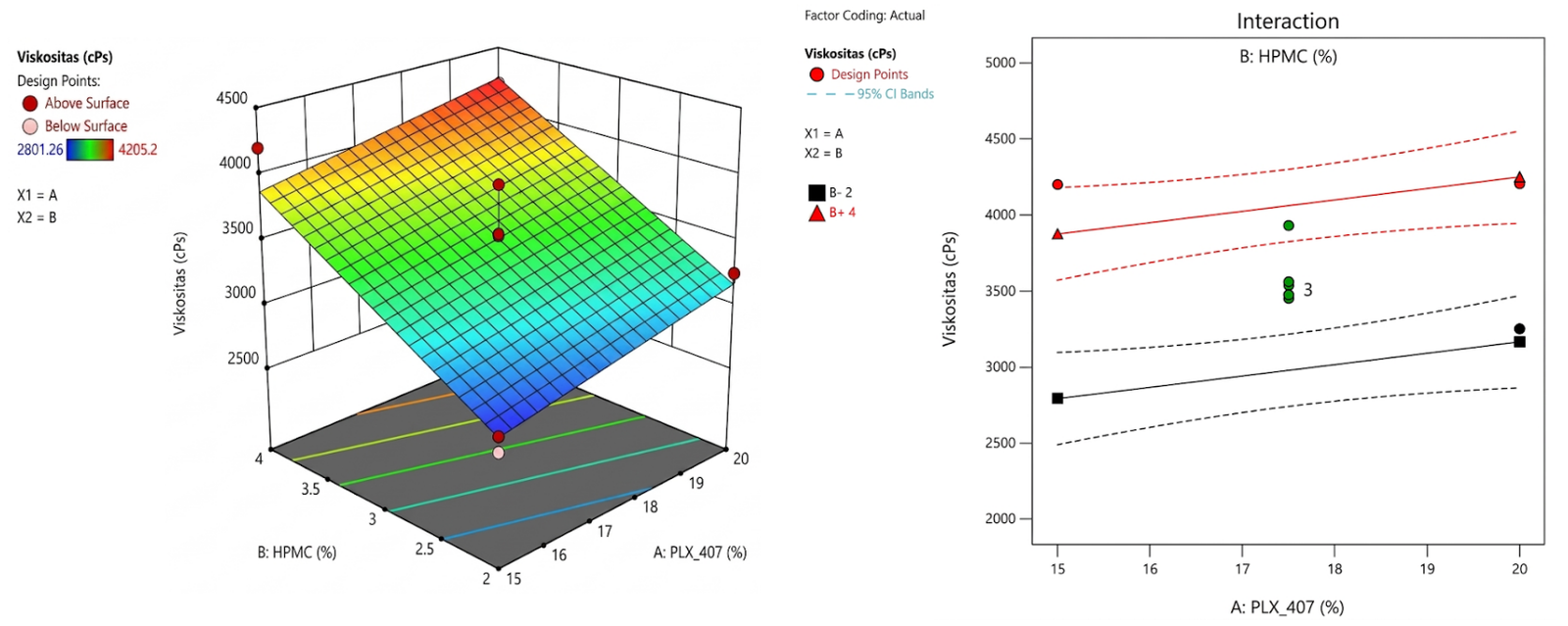
Figure 3 also displays the interaction plots between the two factors. The red line (B = 4%) and black line (B = 2%) represent the effect of HPMC on viscosity across various Poloxamer 407 concentrations. The nearly parallel patterns indicate an additive interaction rather than an antagonistic effect, meaning that increases in both polymers positively contribute to viscosity without diminishing each other's influence (27). The 95% confidence interval bands suggest that the observed variations fall within the model's predictive limits, indicating statistically significant relationships between the independent variables and the response. The resulting model fits the two-factor regression equation as presented in Equation 4.
where A represents Poloxamer 407 (%), and B represents HPMC (%). A well-controlled viscosity profile is essential to maintain physical stability, topical application comfort, and an optimal sol–gel transition at physiological temperature (~37°C), which ultimately influences the efficiency of curcumin delivery through thermosensitive hydrogels (28).
Viscosity determines the ease of injection of curcumin-loaded thermosensitive hydrogels, where low viscosity at room temperature allows easy flow through the needle, while increased viscosity at physiological temperatures supports stable gel formation at the application site (11, 14). An optimal viscosity profile helps prevent leakage before gelation while enhancing local retention and controlled drug release after injection (29, 30).
Validation of the Optimum Formula Between Predicted and Actual Values of the Thermosensitive Curcumin Hydrogel
A confirmation test was performed to validate the accuracy of the predictive model generated through Response Surface Methodology (RSM). The optimum formulation, consisting of 17.067% Poloxamer 407 and 4% HPMC, was predicted to yield desirable responses in terms of the physical stability of the thermosensitive curcumin hydrogel. The ANOVA results indicated that the pH response was best described by a quadratic model, with a lack-of-fit value greater than 0.05 and a high coefficient of determination (R² = 0.9917). Similarly, viscosity was adequately represented by a quadratic model, demonstrating acceptable model adequacy (lack-of-fit > 0.05) and a strong correlation (R² = 0.9427). In contrast, the sol–gel transition time (Tsol–gel) followed a linear model, with a lack-of-fit value exceeding 0.05 and a high R² value of 0.9947. For all responses, the difference between adjusted R² and predicted R² was less than 0.2, indicating good agreement between experimental and predicted values and supporting the reliability of the selected models. The results of the confirmation study, conducted in triplicate (n = 3), are presented for the key response parameters pH, gelation time, and viscosity, as shown in Table 3.
| Analysis | Predicted Mean | Predicted Median | Observed | Std Dev | N | SE Pred | 95% PI low | Data Mean | 95% PI High |
|---|---|---|---|---|---|---|---|---|---|
| pH | 5.8519 | 5.8519 | 0.176238 | 3 | 0.137487 | 5.5268 | 5.85 | 6.17701 | |
| Tso-gel | 9.00019 | 9.00019 | 0.629513 | 3 | 0.46217 | 7.97041 | 9.04667 | 10.03 | |
| Viscosity | 4389.75 | 4389.75 | 194.074 | 3 | 151.401 | 4031.74 | 4372.54 | 4747.74 |
Based on Table 3, the model predicted a pH value of 5.8519, while the experimental mean was 5.85, with a 95% prediction interval ranging from 5.5268 to 6.17701. The actual data fell within this interval, indicating that the model has excellent accuracy in predicting the pH stability of the formulation. A pH range of 5.5–6.0 is ideal for topical preparations, as it aligns with the physiological pH of the skin and minimizes the risk of irritation (31).
For the gelation time, the model prediction and the actual measurements showed comparable average values, with a 95% prediction interval of 7.97–10.03 s. The actual values were within this predicted range, suggest the reliability of the model in predicting thermogelation behavior. A gelation time of approximately 9 s is considered highly responsive for Poloxamer-based thermosensitive hydrogels and is favorable for topical applications due to its rapid sol–gel transition upon contact with skin temperature (32). The presence of HPMC further contributes to structural stability without markedly slowing the gelation process (22).
Moreover, the predicted optimum viscosity was 4389.75 cPs, while the experimental result was 4372.54 cPs, which fell within the 95% prediction interval of 4031.74–4747.76 cPs. The deviation between the predicted and actual values was less than 1%, demonstrating the robustness of the regression model as a formulation design tool. A viscosity range of 4000–4500 cPs supports the formation of a stable hydrogel with appropriate spreadability and enhanced residence time on the skin (16). The synergistic interaction between Poloxamer 407 and HPMC is known to improve resistance to shear forces, resulting in the pseudoplastic flow behavior desirable in topical formulations (23).
Overall, the strong agreement between predicted and actual values across all responses suggests that the RSM model is suitable for optimizing thermosensitive hydrogel formulations. The combination of Poloxamer 407 (17.067%) and HPMC (4%) can be recommended as the optimal ratio to produce a stable curcumin hydrogel with favorable application properties and rapid gelation at physiological temperature. This indicates that the mathematical predictions generated through response surface analysis may be applied for further formulation modifications or process scale-up (27).
The Encapsulation Efficiency (EE%) of Curcumin Nanoparticles
The encapsulation efficiency (EE%) of curcumin nanoparticles was determined by comparing the total drug content in the system with the amount of free drug (unentrapped) detected in the supernatant after centrifugation. The total drug content was 0.2275 ± 0.0038 mg. The encapsulation efficiency (EE%) of curcumin nanoparticles was determined by comparing the total drug content in the system with the amount of free drug (unentrapped) detected in the supernatant after centrifugation. The total drug content was 0.2275 ± 0.0038 mg, and the free drug content was 0.0690 ± 0.0018 mg, resulting in an EE% of 69.7%. This value indicates that most of the curcumin was successfully incorporated into the nanoparticle matrix.
The EE% value can be attributed to the ionic gelation mechanism, where the drug entrapment process is influenced by the electrostatic interaction between chitosan and the cross-linking agent, as well as the hydrophobic nature of curcumin, which has low water solubility (33). In chitosan-based nanoparticle systems, encapsulation efficiency is strongly influenced by polymer concentration, cross-linking density, and the strength of drug-polymer interactions (34).
A relatively high polydispersity index (PDI ≈ 0.59) indicates a heterogeneous particle size distribution, which can affect drug distribution and potentially enhance drug diffusion from smaller particles (35). Furthermore, the zeta potential of −12.47 mV indicates limited electrostatic stability, as colloidal systems are generally considered electrostatically stable at values above ±30 mV (36).
However, after the nanoparticles were incorporated into the Poloxamer 407–HPMC-based thermosensitive hydrogel matrix, steric stabilization by the polymer network improved the system integrity and helped reduce premature drug release (28). Overall, the obtained EE% values were within the reported range for chitosan nanoparticles (60–80%) and were deemed adequate to support further integration into the optimized thermosensitive hydrogel platform.
In Vitro Drug Release Study
The in vitro release profile of curcumin from the thermosensitive Poloxamer 407–HPMC hydrogel matrix at the optimum formulation (Poloxamer 407: HPMC = 17.067%: 4%) was evaluated to understand the underlying release mechanism and its potential for controlled drug delivery. The kinetic model was determined from regression results, as presented in Table 4 and Figure 4.
| Different Kinetic-orders | |||
|---|---|---|---|
| Zero-order | First-Order | Higuchi Diffusion | Kosmeyer-Peppas |
| 0.8245 | 0.5631 | 0.9186 | 0.9376 |
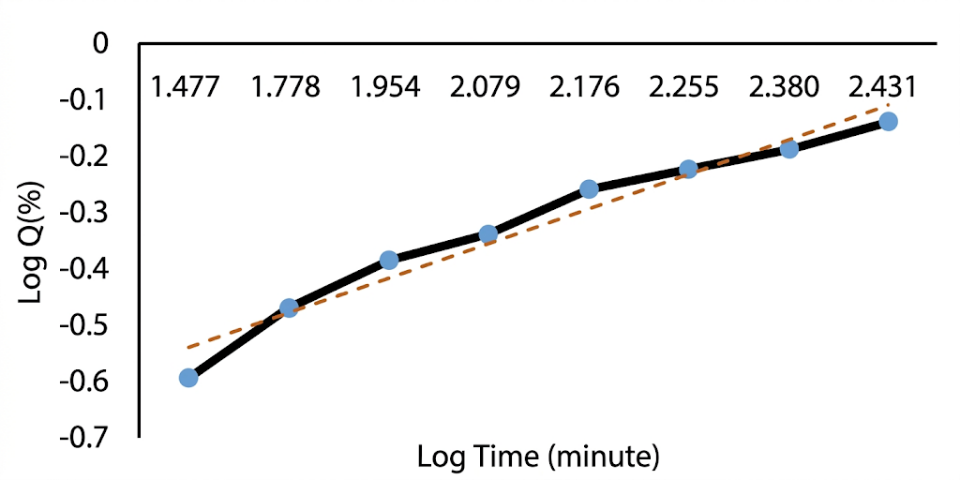
Based on Table 4 and Figure 4, the Korsmeyer–Peppas model exhibited the highest coefficient of determination (R² = 0.9376) compared to the Higuchi model (0.9186), zero-order (0.8245), and first-order (0.5631), indicating that curcumin release from the thermosensitive Poloxamer 407–HPMC hydrogel matrix is governed by a combination of diffusion and matrix relaxation mechanisms. This is supported by the Log Q versus Log time plot, which Indicates a non-ideal linear pattern characteristic of a non-Fickian (anomalous transport) release mechanism in thermosensitive hydrogel systems (37, 38).
Following gel formation at physiological temperature, fluid from the surrounding medium penetrates into the hydrogel network, resulting in swelling and loosening of the HPMC polymer chains, while the Poloxamer 407 micelle structure undergoes reorganization in the aqueous environment. These viscoelastic changes lead to matrix relaxation, creating additional diffusion pathways for curcumin and suggesting that drug release is regulated not only by the concentration gradient but also by the dynamic structural behavior of the gel. In general, drug release from thermosensitive hydrogel matrices is controlled by two main mechanisms: diffusion through the gel layer and erosion of the polymer matrix. For poorly water-soluble compounds such as curcumin, diffusion is limited; therefore, drug release is more influenced by matrix relaxation and erosion resulting from HPMC swelling and Poloxamer 407 micelle reorganization. As the temperature rises above a critical temperature, the hydrogel network collapses following a coil-to-globule transition. Consequently, curcumin release from the Poloxamer 407–HPMC hydrogel occurs through a coupled diffusion–matrix dynamics process, reflecting a non-Fickian mechanism that allows for more controlled drug release (29, 39, 40).
Limitations
Overall, this study focuses on the optimization of a thermosensitive Poloxamer 407–HPMC hydrogel formulation for curcumin delivery using a rational, statistically driven approach. The findings are limited to formulation optimization and physicochemical characterization and do not yet establish therapeutic performance. Therefore, further evaluations, including drug content analysis, formulation stability, and in vitro biological studies, are required to validate the functional applicability of this sytem for localized delivery. This study has several limitations. The use of triplicate measurements (n = 3) may affect the statistical robustness of the results. Moreover, as this work focuses on physicochemical characterization, further investigations, including stability and biological evaluations, are necessary to confirm the functional applicability of the system.
Conclusion
The optimization of the thermosensitive curcumin hydrogel formulation using Response Surface Methodology (RSM), based on a combination of 17.067% Poloxamer 407 and 4% HPMC, resulted in a formulation with desirable physicochemical characteristics in terms of pH, gelation time, and viscosity. The agreement between predicted and experimental values within the 95% prediction interval suggests the adequacy of the statistical model in describing formulation behavior. These findings indicate successful optimization of formulation parameters; however, the present study is limited to physicochemical evaluation. Further investigations, including extended drug release studies, rheological performance, stability assessment, and biological evaluation, are required to support the functional applicability of this system as a localized delivery platform.
Abbreviations
HPMC = Hydroxypropyl Methylcellulose; RSM = Response Surface Methodology.
Declarations
Acknowledgment
The authors are thankful to PT Sampharindo Perdana, Semarang, Jawa Tengah, for providing us with Poloxamer 407 as a gift material, and the study was conducted utilizing personal funding resources
Conflict of Interest
The authors declare no conflicting interest.
Data Availability
All data generated or analyzed during this study are included in this published article.
Ethics Statement
Ethical approval was not required for this study.
Funding Information
The authors declare that no financial support was received for the research, authorship, and/or publication of this article.
References
- Moacă EA, Watz CG, Socoliuc V, Racoviceanu R, Păcurariu C, Ianoş R, et al. Biocompatible Magnetic Colloidal Suspension Used as a Tool for Localized Hyperthermia in Human Breast Adenocarcinoma Cells: Physicochemical Analysis and Complex In Vitro Biological Profile. Nanomaterials. 2021;11(5):1189. doi: https://doi.org/10.3390/nano11051189
- Kurniawan MF, Prakoso A, Irawan MI. The Anti-inflammatory Effect of Ethanol Extract Gel of Fig Leaves (Ficus carica Linn.) and Sidr Leaves (Ziziphus mauritiana Linn.). Ijper. 2021;55(2s):s518-s527. doi: https://doi.org/10.5530/ijper.55.2s.123
- Garrett B, Matharu AS, Hurst GA. Using Greener Gels To Explore Rheology. J. Chem. Educ. 2017;94(4):500-504. doi: https://doi.org/10.1021/acs.jchemed.6b00584
- Vasam M, Sambamoorthy U. Integrating quality by design principles for. Asian J Pharm. 2024;18:880–93.
- Thalluri C, vasam M, Jampala R, Alagarsamy S, Dubey A, Lather A, et al. Formulation, Development, and Optimization of Fast Dissolving Tablets Containing Tapentadol Hydrochloride. Pnt. 2024;13. doi: https://doi.org/10.2174/0122117385350217241122151638
- Yakubu J, Pandey AV. Innovative Delivery Systems for Curcumin: Exploring Nanosized and Conventional Formulations. Pharmaceutics. 2024;16(5):637. doi: https://doi.org/10.3390/pharmaceutics16050637
- Kanwal Q, Ahmed M, Hamza M, Ahmad M, Atiq-ur-Rehman, Yousaf N, et al. Curcumin nanoparticles: physicochemical fabrication, characterization, antioxidant, enzyme inhibition, molecular docking and simulation studies. RSC Adv. 2023;13(32):22268-22280. doi: https://doi.org/10.1039/d3ra01432k
- Owen SC, Chan DP, Shoichet MS. Polymeric micelle stability. Nano Today. 2012;7(1):53-65. doi: https://doi.org/10.1016/j.nantod.2012.01.002
- Zhang Y, Yu J, Ren K, Zuo J, Ding J, Chen X. Thermosensitive Hydrogels as Scaffolds for Cartilage Tissue Engineering. Biomacromolecules. 2019;20(4):1478-1492. doi: https://doi.org/10.1021/acs.biomac.9b00043
- Liu Z, Fu R, Yuying Y. Preparation and evaluation of stable nanofluids for heat transfer application. Elsevier; 2022. doi: https://doi.org/10.1016/b978-0-323-88656-7.00013-1
- Zhang L, Zhang CY, Xiong D, Sun Y, Zhao B, Lin WJ. Self-assembled micelles based on pH-sensitive PAE-g-MPEG-cholesterol block copolymer for anticancer drug delivery. Ijn. 2014;4923. doi: https://doi.org/10.2147/ijn.s69493
- Pula W, Pepe A, Ferrara F, Bondi A, Mariani P, Ortore MG, et al. In situ forming gels as subcutaneous delivery systems of curcumin and piperine. Sci Rep. 2025;15(1). doi: https://doi.org/10.1038/s41598-025-87750-w
- Maryiam A, Batool S, Ali Z, Zahid F, Alamri AH, Alqahtani T, et al. Thermoresponsive biomaterial system of irinotecan and curcumin for the treatment of colorectal cancer: in-vitro and in-vivo investigations. Pharmaceutical Development and Technology. 2024;30(1):37-56. doi: https://doi.org/10.1080/10837450.2024.2448334
- Mei E, Chen C, Li C, Ding X, Chen J, Xi Q, et al. Injectable and Biodegradable Chitosan Hydrogel-Based Drug Depot Contributes to Synergistic Treatment of Tumors. Biomacromolecules. 2021;22(12):5339-5348. doi: https://doi.org/10.1021/acs.biomac.1c01279
- Brambilla E, Locarno S, Gallo S, Orsini F, Pini C, Farronato M, et al. Poloxamer-Based Hydrogel as Drug Delivery System: How Polymeric Excipients Influence the Chemical-Physical Properties. Polymers. 2022;14(17):3624. doi: https://doi.org/10.3390/polym14173624
- Song X, Zhang Z, Zhu J, Wen Y, Zhao F, Lei L, et al. Thermoresponsive Hydrogel Induced by Dual Supramolecular Assemblies and Its Controlled Release Property for Enhanced Anticancer Drug Delivery. Biomacromolecules. 2020;21(4):1516-1527. doi: https://doi.org/10.1021/acs.biomac.0c00077
- Jin Z, Al Amili M, Guo S. Tumor Microenvironment-Responsive Drug Delivery Based on Polymeric Micelles for Precision Cancer Therapy: Strategies and Prospects. Biomedicines. 2024;12(2):417. doi: https://doi.org/10.3390/biomedicines12020417
- Khan S, Akhtar N, Minhas MU, Shah H, Khan KU, Thakur RRS. A difunctional Pluronic®127-basedin situformed injectable thermogels as prolonged and controlled curcumin depot, fabrication,in vitrocharacterization andin vivosafety evaluation. Journal of Biomaterials Science, Polymer Edition. 2020;32(3):281-319. doi: https://doi.org/10.1080/09205063.2020.1829324
- Choudhary AJ, Mahajan SS, Majumdar AS. Nose to brain delivery of flurbiprofen from a solid lipid nanoparticles-based thermosensitive in-situ gel. Neuroscience Applied. 2024;3:104062. doi: https://doi.org/10.1016/j.nsa.2024.104062
- Wang K, Chen G, Weng S, Hou L, Ye D, Jiang X. Thermo-Responsive Poly(N-isopropylacrylamide)/Hydroxypropylmethyl Cellulose Hydrogel with High Luminous Transmittance and Solar Modulation for Smart Windows. ACS Appl. Mater. Interfaces. 2023;15(3):4385-4397. doi: https://doi.org/10.1021/acsami.2c15367
- Patel D, Vaswani P, Sengupta S, Ray D, Bhatia D, Choudhury SD, et al. Thermoresponsive phase behavior and nanoscale self-assembly generation in normal and reverse Pluronics®. Colloid Polym Sci. 2022;301(2):75-92. doi: https://doi.org/10.1007/s00396-022-05039-0
- Zhang Y, Wen S, Zheng K, Zhou X, Huang C, Xu Y, et al. Fabricating a Curcumin-Loaded Chitin/Lignin Micelle Thermoresponsive Hydrogel with Dynamic Contractility and Tissue-Adhesive Properties for Enhanced Wound Regeneration. Biomacromolecules. 2025;26(9):5778-5790. doi: https://doi.org/10.1021/acs.biomac.5c00603
- Li X, Xu X, Xu M, Geng Z, Ji P, Liu Y. Hydrogel systems for targeted cancer therapy. Front. Bioeng. Biotechnol. 2023;11. doi: https://doi.org/10.3389/fbioe.2023.1140436
- Ding T, Ren C, Meng L, Han G, Xue Y, Song W, et al. Nonswelling Lubricative Nanocolloidal Hydrogel Resistant to Biodegradation. Nano-Micro Lett. 2025;17(1). doi: https://doi.org/10.1007/s40820-025-01830-0
- Ma L, Shi T, Liu X, Wang X, Zhang X. Structural properties of HPMC/PEG/CS thermosensitive porous hydrogels. Polym Bull. 2023;80(10):10863–80.
- Nijhawan HP, Vyas J, Verma P, Yadav KS. Hyaluronic acid-coated cubosomal in situ gel for Brimonidine Tartrate: a sustained delivery system with enhanced ocular bioavailability and intraocular pressure reduction. Journal of Biomaterials Science, Polymer Edition. 2025;37(6):1119-1152. doi: https://doi.org/10.1080/09205063.2025.2543071
- Kumar P, Choonara YE. Thermogelling behaviour of PEG-enclatherated Methylcellulose/Alginate sols. Mater. Res. Express. 2021;8(10):105303. doi: https://doi.org/10.1088/2053-1591/ac2b59
- Liu H, Cao X, Liu BZ, He L. Thermoresponsive in situ forming self-healing hydrogel dressings with pH/glucose dual responsive curcumin release for diabetic wound healing. J Mater Sci. 2024;59(37):17573-17592. doi: https://doi.org/10.1007/s10853-024-10240-3
- Carrelo H, Escoval AR, Vieira T, Jiménez-Rosado M, Silva JC, Romero A, et al. Injectable Thermoresponsive Microparticle/Hydrogel System with Superparamagnetic Nanoparticles for Drug Release and Magnetic Hyperthermia Applications. Gels. 2023;9(12):982. doi: https://doi.org/10.3390/gels9120982
- Patel P, Mandal A, Gote V, Pal D, Mitra AK. Thermosensitive hydrogel-based drug delivery system for sustained drug release. J Polym Res. 2019;26(6). doi: https://doi.org/10.1007/s10965-019-1771-z
- Kim MH, Nguyen DT, Kim DD. Recent studies on modulating hyaluronic acid-based hydrogels for controlled drug delivery. J. Pharm. Investig. 2022;52(4):397-413. doi: https://doi.org/10.1007/s40005-022-00568-w
- Ding C, Liu Z, Zhao T, Sun S, Liu X, Zhang J, et al. A temperature-sensitive hydrogel loaded with taxifolin promotes skin repair by modulating MAPK-mediated autophagic pathway. J Mater Sci. 2023;58(37):14831-14845. doi: https://doi.org/10.1007/s10853-023-08951-0
- Sahariah P, Másson M. Antimicrobial Chitosan and Chitosan Derivatives: A Review of the Structure–Activity Relationship. Biomacromolecules. 2017;18(11):3846-3868. doi: https://doi.org/10.1021/acs.biomac.7b01058
- Stefanache A, Lungu II, Anton N, Damir D, Gutu C, Olaru I, et al. Chitosan Nanoparticle-Based Drug Delivery Systems: Advances, Challenges, and Future Perspectives. Polymers. 2025;17(11):1453. doi: https://doi.org/10.3390/polym17111453
- Danaei M, Dehghankhold M, Ataei S, Hasanzadeh Davarani F, Javanmard R, Dokhani A, et al. Impact of Particle Size and Polydispersity Index on the Clinical Applications of Lipidic Nanocarrier Systems. Pharmaceutics. 2018;10(2):57. doi: https://doi.org/10.3390/pharmaceutics10020057
- Bhattacharjee S. DLS and zeta potential – What they are and what they are not?. Journal of Controlled Release. 2016;235:337-351. doi: https://doi.org/10.1016/j.jconrel.2016.06.017
- Pardeshi S, Damiri F, Zehravi M, Joshi R, Kapare H, Prajapati MK, et al. Functional Thermoresponsive Hydrogel Molecule to Material Design for Biomedical Applications. Polymers. 2022;14(15):3126. doi: https://doi.org/10.3390/polym14153126
- Abdellatif AAH, Mohammed AM. Thermosensitive polymers-based injectable hydrogels: a quantitative validations design utilized for controlled delivery of gefitinib anticancer drug. Eur Rev Med Pharmacol Sci. 2023;27:2646–58.
- Wang Y, Li Z, Ouyang J, Karniadakis GE. Controlled release of entrapped nanoparticles from thermoresponsive hydrogels with tunable network characteristics. Soft Matter. 2020;16(20):4756-4766. doi: https://doi.org/10.1039/d0sm00207k
- Prasittisart P. Correlating drug release with microstructure of hydrogel-based delivery systems. Nottingham: University of Nottingham; 2019.