RESEARCH ARTICLE
Representation of Journalistic Investigation into Sexual Exploitation on Social Media
Artistic Studies|Vol. 2, Issue 1, pp. 14-20 (2026)
CC BY 4.0-2026 Authors
Views
Downloads
Shares

Received
Feb 20, 2026Revised
May 5, 2026Accepted
Jun 25, 2026Published
Jun 28, 2026
Abstract
Cyber sexual exploitation has emerged as a critical digital crime facilitated by anonymous platforms, yet structural media representations remain insufficiently examined. This study analyzes how the documentary Cyber Hell represents the mechanisms, actors, and cycle of cyber sexual exploitation, along with its broader social implications. Utilizing a qualitative visual and narrative analysis, this research examines 18 key scenes, two primary visual figures, and one exploitation cycle diagram. The analysis identifies six sequential stages of exploitation: social media contact, victim access, data theft, threats and extortion, sexual exploitation, and content distribution. Two major themes emerged: systematic digital control and investigative exposure. The findings portray exploitation as an organized, technology-facilitated, and coercive process, while highlighting investigative media as a critical tool for revealing hidden crimes. The documentary effectively visualizes complex digital violence, underscoring the urgent need for robust legal enforcement and media literacy. This study contributes empirical insights to communication scholarship and offers practical implications for policymakers, educators, and digital platforms to strengthen victim protection and enhance global awareness of technology-facilitated sexual violence.
Introduction
The rapid expansion of digital media and social networking platforms has fundamentally transformed how information is produced, distributed, and consumed. While simultaneously creating new vulnerabilities, including sexual exploitation in online environments. Film, as a powerful medium of mass communication, plays a critical role in reflecting and shaping social realities by presenting narratives that combine visual and emotional elements to convey complex issues to broad audiences (1, 2). In the digital era, documentary films have become particularly influential in exposing hidden social problems, including cybercrime and sexual exploitation, by presenting factual accounts and investigative narratives (3). At the same time, the proliferation of social media has dramatically increased global connectivity. According to (4, 5), social media enables interactive communication, user-generated content, and rapid information exchange across vast networks. However, these same affordances have facilitated new forms of online sexual exploitation, particularly among vulnerable populations such as minors and young women, highlighting an urgent global concern that intersects technology, media, and social harm.
The urgency of addressing online sexual exploitation is underscored by the increasing prevalence and severity of such cases worldwide. Social media platforms, designed to foster communication and community, are frequently misused for grooming, sexual coercion, and exploitation, often under conditions of anonymity and weak regulatory oversight (6). High-profile cases, such as the Nth Room case in South Korea, revealed how perpetrators used encrypted platforms to manipulate and exploit dozens of victims, many of whom were minors, while distributing exploitative content to thousands of users. These cases demonstrate how technological features intended to protect privacy can paradoxically enable criminal activity. Despite efforts by platform providers and authorities, significant challenges remain, including limited detection mechanisms, inadequate moderation systems, and insufficient public awareness. Documentary films distributed via streaming platforms such as Netflix have emerged as influential tools to expose such crimes and raise awareness among global audiences (7). Investigative documentary storytelling provides not only factual evidence but also emotional and narrative framing that shapes public understanding of cyber exploitation and the systemic failures surrounding it (8).
Although previous studies have examined social media exploitation from legal, technological, and psychological perspectives, limited research has focused on how investigative journalism is represented within documentary films and how such representations construct public meaning about sexual exploitation in digital environments. This gap is significant because media representations influence public perception, policy discourse, and collective responses to social problems. The documentary Cyber Hell offers a state-of-the-art example of investigative journalism revealing the mechanisms, actors, and consequences of online sexual exploitation. However, scholarly analysis of its representational strategies remains scarce. Therefore, this study aims to analyze the representation of journalists’ investigations into sexual exploitation in the documentary Cyber Hell on social media. Using a qualitative content analysis approach, this research examines narrative structures, visual elements, and investigative portrayals to understand how the documentary constructs meaning about cyber exploitation. This study contributes to communication and media scholarship by providing new insights into the role of investigative documentary media in exposing digital sexual exploitation, shaping public awareness, and supporting broader efforts toward prevention and social accountability. Academically, this research is highly relevant to artistic studies, particularly in documentary film analysis, which combines journalism, communication, artistic studies, and digital security. This research focuses specifically on presenting the audio and visual elements in the documentary, ensuring a deeper, interpretable meaning.
The novelty of this research lies in its study of the documentary film Cyber Hell, a topic previously unstudied by other researchers. Furthermore, its theoretical novelty combines six theories in data analysis: Media Representation Theory, Investigative Journalism Theory, Social Construction of Reality Theory, Social Media Theory and Its Impact, Journalistic Ethics Theory, and Media Impact Theory.
Methodology
Study Design and Rationale
This study employed a qualitative content analysis design to examine the representation of journalists’ investigations into sexual exploitation on social media in the documentary Cyber Hell. Qualitative content analysis is widely used to systematically interpret textual, visual, and narrative data by identifying patterns, meanings, and thematic structures within media content (9, 10). This approach is particularly appropriate for documentary analysis because documentaries construct social reality through narrative, visual representation, and investigative framing. Furthermore, qualitative content analysis enables researchers to explore latent meanings and media representations beyond surface-level content, allowing a deeper understanding of how social issues such as sexual exploitation are constructed and communicated (11). This methodological approach aligns with the interpretive paradigm, which seeks to understand how media texts shape social meaning and public perception.
Apart from understanding the text, the qualitative approach also aims to interpret the contextual meaning of the research object which is the center of the study. By combining textual and contextual meaning, research results become more comprehensive.
Data Source and Sampling
The primary data source consisted of the documentary Cyber Hell (2022), with a total duration of 105 minutes. The unit of analysis was defined as meaningful narrative segments, including dialogues, narration, visual scenes, and investigative sequences related to sexual exploitation, journalistic investigation, victim experiences, and the use of digital platforms. A purposive sampling strategy was applied to select segments that were directly relevant to the research objectives. Purposive sampling is appropriate in qualitative media research because it allows the selection of information-rich cases that provide meaningful insights into the phenomenon under investigation (10). Segments were included if they contained explicit representations of exploitation mechanisms, investigative journalism activities, or technological facilitation through social media platforms. Irrelevant segments, such as purely aesthetic scenes or unrelated narrative transitions, were excluded to maintain analytical focus.
Apart from the data source for this research being the documentary film Cyber Hell, it is also used as a literature review as a supporting secondary data source. In the realm of qualitative research, the researcher's position is also as a research instrument.
Data Collection Procedures
Data collection was conducted through systematic and iterative procedures to ensure analytical rigor and credibility. The documentary was viewed repeatedly at least three times to achieve familiarization with its narrative structure, themes, and investigative processes. Repeated viewing is essential in qualitative media analysis to enhance immersion and improve analytical depth (12). Following familiarization, relevant scenes were transcribed verbatim, including spoken dialogue, narration, and visual context necessary for interpretation. Each segment was then organized chronologically and prepared for coding. A structured coding framework was developed based on theoretical constructs related to media representation, sexual exploitation, and investigative journalism. Coding involved identifying, labeling, and categorizing segments according to thematic relevance. This systematic coding process enables researchers to organize qualitative data into meaningful analytical categories and enhances the transparency and reliability of interpretation (9).
Data Analysis
To examine how Cyber Hell constructs meaning around cyber sexual exploitation, this study integrated thematic content analysis with Stuart Hall’s constructionist theory of representation, operationalized through the qualitative flow model by Miles and Huberman (12) and supported by Ghony and Almanshur (13). Thematic analysis is a rigorous qualitative method used to systematically identify, analyze, and interpret patterns of meaning within qualitative data (13), making it particularly suitable for media research because it enables systematic interpretation of complex narrative and visual data while maintaining contextual meaning (11). This integration directly addresses the process of representation across three continuous phases—data reduction, data presentation, and conclusion drawing/verification—which followed a rigorous pipeline explicitly mapped against our representation framework as seen in Figure 1.
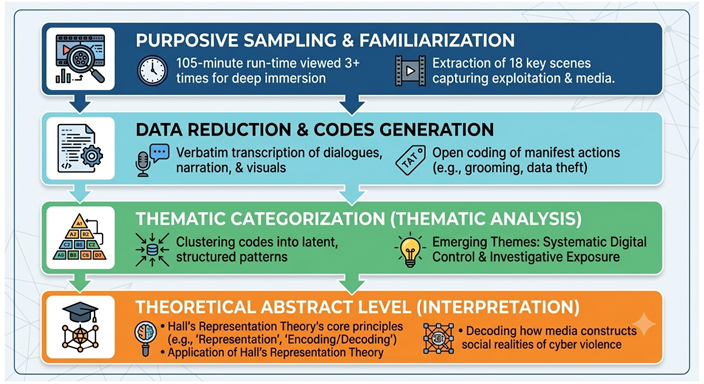
During the initial data reduction phase, spoken dialogues, narration, and visual contexts from the 18 selected key scenes were transcribed verbatim, and the text was subjected to inductive open coding to capture explicit indicators of digital control, grooming mechanisms, and journalistic investigation. In the subsequent data presentation or display phase, these generated codes were systematically grouped and categorized to condense the empirical evidence into two primary, higher-order thematic dimensions: systematic digital control and investigative exposure by journalists. Finally, in the conclusion drawing and verification phase, Stuart Hall’s representation framework served as the interpretive lens to decode the latent meanings within these themes, evaluating how specific creative choices—such as the dark visual tones and symbolic anonymity on the film poster—actively construct a shared social reality regarding digital vulnerabilities, legal loopholes, and institutional gaps to ensure analytical consistency and validity.
Results and Discussion
Representation of Systematic Cyber Sexual Exploitation
The analysis reveals that Cyber Hellrepresents cyber sexual exploitation as a structured and systematic digital crime facilitated by anonymous online platforms. The documentary illustrates how perpetrators used encrypted messaging services to manipulate victims, collect personal data, and coerce them into producing sexually exploitative content under threats of exposure. Victims were subjected to continuous intimidation, surveillance, and psychological coercion, which created prolonged victimization and dependency. These findings indicate that cyber sexual exploitation is not an isolated incident but rather a coordinated process enabled by digital infrastructures. This representation aligns with Indonesian research emphasizing that digital technologies and social media platforms have increased the risk and prevalence of sexual violence, as perpetrators exploit technological anonymity and weak cybersecurity protections to target victims (14). Furthermore, the legal dimension of online exploitation demonstrates that perpetrators often operate within complex networks that are difficult to detect and prosecute, highlighting systemic vulnerabilities in digital environments (15).
The visual representation of the documentary also reinforces the hidden and organized nature of cyber exploitation. The official film poster uses dark visual tones, digital imagery, and symbolic anonymity to convey secrecy, fear, and invisibility associated with online sexual crimes (see Figure 2).

This visual framing supports the narrative that cyber sexual exploitation operates within concealed digital systems, reinforcing its systemic and organized nature.
Role of Media and Investigative Exposure
The findings further demonstrate that investigative journalism plays a crucial role in uncovering cyber sexual exploitation networks. The documentary presents journalists as central actors who collected digital evidence, traced perpetrators, and collaborated with authorities to expose hidden criminal activities. Through the lens of Stuart Hall’s representation framework, this narrative choice does not merely document historical events; rather, it actively constructs the investigative journalist as a vital mechanism of public accountability and social counter-surveillance. By highlighting how these media actors navigate complex digital spaces to dismantle criminal networks, the text exposes a significant regulatory void where traditional law enforcement initially faltered. This representation underscores the media's power to shift localized, private tragedies into the collective public consciousness, thereby transforming isolated digital crimes into an urgent matter of societal debate. In Indonesia, legal and social research has similarly emphasized that media exposure contributes significantly to revealing hidden cyber sexual crimes and increasing public awareness of exploitation and abuse occurring in digital spaces (16). By validating these findings within the Indonesian context, it becomes clear that media representation serves as a critical catalyst for legal mobilization, prompting state apparatuses to acknowledge and respond to emergent typologies of digital violence that are often obscured by systemic legal gaps and institutional delays.
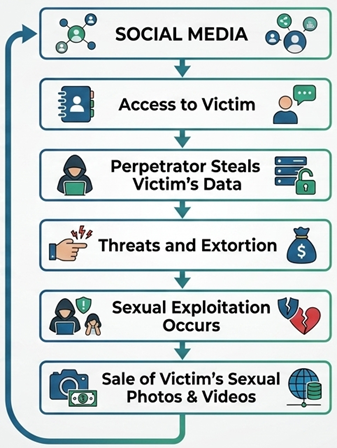
Furthermore, the documentary illustrates that exploitation does not manifest as a series of random, isolated incidents, but rather follows a systematic, self-sustaining cycle involving victim targeting, grooming, coercion, exploitation, and continued control, as visually conceptualized in Figure 3. Victims were systematically manipulated emotionally and psychologically before being forced into exploitative situations, demonstrating how perpetrators strategically weaponize digital architecture to maintain long-term, inescapable dominion over their targets. From an interpretive standpoint, representing this exploitation as a rigid, cyclical pipeline is a deliberate pedagogical strategy that deconstructs pervasive societal myths surrounding victim blame and digital complicity. By illustrating the highly structured, inescapable nature of the grooming and extortion phases, Cyber Hell shifts the focus from individual vulnerability to systemic predatory design. This representation firmly establishes that cyber sexual violence is a continuous and systematic process rather than a single event, a finding that is highly consistent with Indonesian research showing that sexual violence in digital environments often involves structured patterns of coercion and repeated victimization facilitated by technological systems (17). Consequently, this cyclical portrayal serves to demystify the mechanics of digital entrapment, illustrating how anonymous digital platforms can be transformed into complicit environments for human suffering, which ultimately demands a fundamental restructuring of both legal boundaries and corporate digital safety paradigms.
Legal and Social Implications of Cyber Sexual Exploitation
Beyond the immediate mechanics of abuse, the documentary highlights significant legal and social challenges in addressing cyber sexual exploitation. Victims often face immense difficulties reporting abuse due to pervasive fear, internalized shame, and relentless threats from perpetrators. When examined through Hall’s constructionist lens, this cinematic depiction of victim hesitation does not merely report a psychological state; rather, it actively constructs a powerful critique of societal discourses that historically marginalize and stigmatize survivors of sexual violence. By representing the digital space as an omnipresent panopticon where perpetrators can weaponize a victim's private data at any moment, the narrative exposes how psychological entrapment extends far beyond physical boundaries. Furthermore, the documentary illustrates how digital anonymity complicates law enforcement efforts to identify and prosecute offenders, representing internet platforms not as neutral communicative tools, but as structural shields for criminal impunity. This mediated portrayal of institutional paralysis aligns closely with Indonesian legal research, which confirms that cyber sexual exploitation presents major challenges to existing legal frameworks, particularly regarding evidence collection, victim protection, and enforcement mechanisms (16). The film's representation of these deficits underscores a shared transnational reality where the fluid, borderless nature of digital networks clashes fundamentally with the rigid, territorial jurisdictions of traditional state apparatuses, thereby leaving victims in a prolonged state of legal vulnerability.
Furthermore, the findings demonstrate that exploitation frequently targets vulnerable individuals, including minors, who lack critical awareness of digital risks. In Cyber Hell, the representation of youth vulnerability is not treated as a depiction of individual naivety, but rather as a symbolic indictment of broader structural gaps in digital protection systems. By framing minors as primary targets, the documentary constructs a discourse around the urgent need for systemic digital literacy and protective governance, highlighting how the unregulated spaces of anonymous applications inherently commodify and exploit the innocence of young users. This representation successfully shifts the onus of security from the individual child to the institutional bodies responsible for societal oversight. This perspective directly reflects the empirical socio-legal reality documented in Indonesian studies, which emphasize that weaknesses in legal frameworks and institutional responses continue to create opportunities for perpetrators to exploit victims online (17). By projecting these institutional failures onto a global media canvas, the text constructs a profound social argument: without a fundamental overhaul of digital legislation, strict platform accountability, and specialized victim-centered support systems, current institutional structures inadvertently permit the perpetuation of cyber violence. Ultimately, the documentary's representational strategy serves as an urgent call to close these institutional chasms, transforming the passive viewing experience into an active realization of the desperate need for legal modernization both globally and within the Indonesian context.
Media Representation and Social Awareness
Finally, the documentary functions as a powerful form of media representation that raises public awareness about cyber sexual exploitation. Through victim testimonies, investigative narratives, and visual storytelling, the documentary transforms hidden crimes into visible social realities. This representation plays a crucial role in shaping public understanding and highlighting the seriousness of digital sexual violence. Indonesian research confirms that media and digital communication play a central role in influencing public perception, legal awareness, and prevention efforts related to cyber sexual violence (20).
By moving past a descriptive log of scenes, the dialogue between our data and Stuart Hall’s representation framework reveals that Cyber Hell does not merely record a historical case; it actively constructs a pedagogical warning system. The theme of systematic digital control is represented visually through claustrophobic UI framing and dark poster tones to signify the psychological incarceration of victims. Conversely, the theme of investigative exposure uses journalists as active structural counters to digital anonymity. Thus, the text creates an interpretive loop for the viewer: shifting cyber exploitation from an individualized, hidden misfortune into an urgent, structurally organized societal threat demanding institutional intervention.
Overall, the findings demonstrate that Cyber Hellrepresents cyber sexual exploitation as a systematic digital crime enabled by technological systems, reinforced by anonymity, and sustained through psychological coercion and structural vulnerabilities. The documentary also highlights the important role of media in exposing hidden crimes and emphasizes the urgent need for stronger legal protections and digital safety measures.
Conclusion
The documentary Cyber Hell represents cyber sexual exploitation as a systematic and cyclical digital crime facilitated by technological anonymity, coercion, and structured control. It also highlights the critical role of investigative media in exposing hidden exploitation networks and increasing public awareness. These findings emphasize the urgent need for stronger digital protection, legal enforcement, and media literacy to prevent technology-facilitated sexual exploitation.
Critical awareness among young people (especially teenagers and women) regarding various applications in the world of social media and online media is needed to prevent sexual exploitation. Journalists must have social empathy in exposing this type of crime. Law enforcement officials must also be more sensitive and agile in uncovering these cases through precise digital forensics. Research opportunities that need to be developed in the future include exploring the impact of sexual exploitation via cyber and social media on psychological/psychological aspects and people's behavior.
Declarations
Conflict of Interest
The authors declare no conflicting interest.
Data Availability
Data supporting the findings of this study are available from the corresponding author upon reasonable request.
Ethics Statement
Ethical approval was not required for this study.
Funding Information
The author(s) declare that no financial support was received for the research, authorship, and/or publication of this article.
References
- Alfathoni MAM, Manesah D. Pengantar Teori Film. Deepublish; 2020.
- Giannetti LD. Understanding movies. Pearson Education; 2008. 611 p.
- Cahyani MG. Sejarah perkembangan pers dan pemanfaatan museum pers nasional sebagai media pembelajaran sejarah masa pergerakan nasional. Jambi University. 2023;3(1):27-39. doi: https://doi.org/10.22437/jejak.v3i1.24651
- Nasrullah, M.Si. DR. Riset khalayak digital: perspektif khalayak media dan realitas virtual di media sosial. Sostek. 2018;17(2):271. doi: https://doi.org/10.5614/sostek.itbj.2018.17.2.9
- Kaplan AM, Haenlein M. Users of the world, unite! The challenges and opportunities of Social Media. Business Horizons. 2010;53(1):59-68. doi: https://doi.org/10.1016/j.bushor.2009.09.003
- Harahab Y. Community Empowerment Through the Utilization of Zakat for Productive Ventures in Sleman Regency. J Bina Mulia Hukum. 2024;8(2):241-257. doi: https://doi.org/10.23920/jbmh.v8i2.1096
- Sudarsono BG, Leo MI, Santoso A, Hendrawan F. Analisis data mining data netflix menggunakan aplikasi rapid miner. Jbase. 2021;4(1). doi: https://doi.org/10.30813/jbase.v4i1.2729
- Citra Dewi N, Sutabri T, Putrawansyah F. Analisis penyadapan pada telegram dengan network forensic. J. Inf. dan Komp. 2023;7(2):183. doi: https://doi.org/10.26798/jiko.v7i2.789
- Hsieh HF, Shannon SE. Three Approaches to Qualitative Content Analysis. Qual Health Res. 2005;15(9):1277-1288. doi: https://doi.org/10.1177/1049732305276687
- Elo S, Kyngäs H. The qualitative content analysis process. J Adv Nurs. 2008 Apr 18;62(1):107–15. doi:10.1111/j.1365-2648.2007.04569.x.
- Stewart M. Qualitative inquiry: perceptions of sexuality by African Americans experiencing haemodialysis. Journal of Advanced Nursing. 2012;69(8):1704-1713. doi: https://doi.org/10.1111/jan.12028
- Miles, Matthew B and A. Michael Huberman. Qualitative Data Analysis. 1994. Thousand Oaks: Sage.
- M. Djunaidi Ghony dan Fauzan Al-Mansyur. Metode Penelitian Kualitatif. 2012. Ar-Ruzz Media: Yogyakarta.
- Nowell LS, Norris JM, White DE, Moules NJ. Thematic Analysis. Int J Qual Methods. 2017 Dec 1;16(1). doi:10.1177/1609406917733847.
- Braun V, Clarke V. Using thematic analysis in psychology. Qual Res Psychol. 2006 Jan 21;3(2):77–101. doi:10.1191/1478088706qp063oa.
- Fikriya M, Novia NS,, Muslim MG. Upaya Preventif Pelecehan Seksual di Media Sosial melalui Peran Cybersecurity sebagai Upaya Penjaminan HAM di Era Digital. themis. 2023;1(1):32-37. doi: https://doi.org/10.70437/themis.v1i1.333
- Charenitha A, Firmansyah H. A Juridical Analysis of the Criminal Liability of Perpetrators of Online Child Sexual Exploitation. ALLRev. 2025;8(1). doi: https://doi.org/10.56301/awl.v8i1.1910
- Lisanawati G. Cyber Child Sexual Exploitation dalam Perspektif Perlindungan atas Kejahatan Siber [Internet]. Vol. 8. 2013;8. Available from: http://journal.unnes.ac.id/nju/index.php/pandecta17.2+Aspek+Hukum+Penanganan+Kekerasan+Berbasis+Gender+-+edit+template.
- Okprianti R, Emilson NH, Nurhaliza, Nova TE, Rahmawati PY, Ananda ID. Analisis perlindungan hukum bagi korban kekerasan seksual berbasis internet ditinjau dari hukum pidana dan kebijakan keamanan digital indonesia. tjuris. 2025;9(2):580-584. doi: https://doi.org/10.56301/juris.v9i2.1982
- Nelson FM, Santoso T. Financial Service Provider and Online Sexual Exploitation of Children: A Lacunae in Indonesia Legal Framework?. jllr. 2025;6(1):391-420. doi: https://doi.org/10.15294/jllr.v6i1.14264
- Sulastri R, Walidah MQ. Utilizing Social Media to Combat Sexual Violence: A Study of the Speak Up Movement on Instagram. Temali. 2024;7(2):208-219. doi: https://doi.org/10.15575/jt.v7i2.38334