RESEARCH ARTICLE
Racial Discrimination, School Violence, and Intergenerational Trauma in Indonesian Cinema: A Critical Discourse Analysis of Pengepungan di Bukit Duri
Artistic Studies|Vol. 2, Issue 1, pp. 21-28 (2026)
CC BY 4.0-2026 Authors
Views
Downloads
Shares

Received
Feb 23, 2026Revised
May 21, 2026Accepted
Jun 21, 2026Published
Jun 28, 2026
Abstract
Persistent racial discrimination, school violence, and historical trauma remain important social issues in Indonesia and are often reinforced through everyday discourse and institutional silence. This study examines how these issues are represented in Pengepungan di Bukit Duri using Norman Fairclough’s Critical Discourse Analysis (CDA). Employing a qualitative multimodal approach, the study analyzes 14 purposively selected scenes and 40 audience comments across Fairclough’s three dimensions: textual analysis, discursive practice, and social practice. The findings reveal four dominant discourses: racialized othering, normalized school violence, institutional failure, and intergenerational trauma. These discourses are constructed through the interaction of dialogue, visual representation, narrative structure, and cinematic techniques such as framing, camera positioning, spatial composition, and low-key lighting. The analysis further shows that educational institutions are portrayed as sites where violence and exclusion are reproduced through silence and inaction, while audience responses extend the film’s discourse into broader public discussions. The study contributes theoretically by demonstrating the applicability of Fairclough’s CDA to multimodal film analysis and by highlighting how cinematic discourse participates in the construction and contestation of social ideologies. More broadly, the findings underscore the value of cinema as a medium for examining issues of race, power, and social justice, contributing to wider debates in film studies, discourse analysis, and critical social research.
Keywords:
Introduction
Cinema has increasingly been recognized as a powerful cultural medium through which social realities, ideological struggles, and historical traumas are articulated, negotiated, and contested (1). Beyond functioning as entertainment, films operate as social texts that shape public perception, collective memory, and ideological discourse through the interaction of narrative, visual symbolism, and cultural representation (2). In critical film and media studies, cinema is therefore understood not merely as a reflective medium, but as an active site where social power relations are reproduced, normalized, or challenged across political and cultural contexts (3). In Indonesia, film has historically played an important role in addressing sensitive social issues, including authoritarian violence, ethnic tension, religious conflict, gender inequality, and institutional injustice, particularly in contexts where formal public criticism remains constrained (4). Scholars of Indonesian cinema have further argued that post-Reformasi films increasingly function as platforms for negotiating national identity, historical trauma, and minority representation within contemporary society (5).
The issue of racial discrimination toward ethnic Chinese Indonesians remains particularly significant within Indonesian sociohistorical discourse. Although legal reforms after the Reformasi era formally promoted equality and multicultural inclusion, empirical studies and public reports continue to document the persistence of hate speech, stereotyping, exclusion, and symbolic violence directed toward Chinese Indonesian communities in both offline and digital spaces (6). The legacy of the 1998 anti-Chinese riots and earlier assimilation policies continues to shape intergenerational trauma and public attitudes toward ethnic identity, including within educational and social institutions (7). Schools, which ideally function as safe spaces for social development, have also been identified as sites where bullying, ethnic discrimination, and institutional silence may be reproduced through everyday interactions and disciplinary structures (8). Recent public discussions surrounding youth violence, school bullying, and intolerance in Indonesian educational settings further demonstrate the continuing relevance of these concerns within contemporary society (9).
Within Indonesian film history, several films have explored themes of identity, marginalization, and social violence, including works that address ethnic Chinese experiences, collective trauma, and institutional injustice. Previous studies have examined how Indonesian cinema represents minority identities and national anxieties through narrative symbolism and sociopolitical allegory (10). However, much of the existing scholarship remains concentrated on thematic representation, character analysis, or ideological interpretation, while relatively limited attention has been given to the multimodal mechanisms through which cinematic discourse is constructed and communicated. In particular, there is still limited research examining how visual composition, spatial arrangement, sound, dialogue, and narrative sequencing interact discursively to produce meanings related to racism, violence, and trauma within Indonesian films. Moreover, studies applying Norman Fairclough’s Critical Discourse Analysis (CDA) to Indonesian cinema remain relatively scarce, especially those integrating textual, discursive, and sociocultural dimensions simultaneously within multimodal film analysis (11).
Against this sociohistorical and scholarly background, Pengepungan di Bukit Duri becomes a significant object of study because the film explicitly engages with racial tension, school violence, institutional failure, and intergenerational trauma within contemporary Indonesian society. The film presents educational institutions not merely as neutral spaces, but as contested arenas where discrimination, silence, and power relations are reproduced through both verbal and visual practices (12). Its cinematic construction therefore offers an important opportunity to examine how Indonesian cinema critically negotiates issues of ethnicity, authority, and social fragmentation in the post-Reformasi era.
Addressing these gaps, the present study examines Pengepungan di Bukit Duri as a cinematic text that articulates racial discrimination, school violence, institutional silence, and intergenerational trauma through interconnected discursive and aesthetic processes. Drawing on Norman Fairclough’s Critical Discourse Analysis (CDA), this research conceptualizes film not merely as a reflective medium but as a multimodal artistic practice that constructs meaning through the interaction of language, visual form, and narrative structure (13). Rather than focusing solely on narrative themes or representational dimensions as emphasized in many previous studies, the present study examines how cinematic elements such as framing, lighting, spatial composition, dialogue, and narrative organization operate discursively across textual, discursive, and social practice dimensions. By integrating multimodal film analysis with Fairclough’s Critical Discourse Analysis (CDA) framework, this research contributes to Indonesian film scholarship by providing a more comprehensive explanation of how cinema participates in the construction, legitimization, and contestation of social ideologies related to race, violence, and institutional power (14). Methodologically, the study employs a qualitative multimodal CDA of selected scenes, dialogues, visual compositions, and contextual production reception data to reveal the ideological and aesthetic implications embedded in the film.
Methodology
Study Design and Rationale
This study adopts a qualitative single-case multimodal Critical Discourse Analysis (CDA) grounded in the three-dimensional framework proposed by Norman Fairclough (15). The study specifically positions Pengepungan di Bukit Duri as a single critical case because the film explicitly addresses racial discrimination, school violence, institutional silence, and intergenerational trauma within the Indonesian sociohistorical context. This approach was selected to enable a systematic examination of how language, cinematic representation, and narrative structures interact with institutional and societal contexts to produce and contest meaning. CDA is particularly appropriate for analyzing film texts that engage with issues of power, ideology, and social inequality, especially when combined with attention to visual and aesthetic strategies, as it allows discourse to be examined as both a representational and constitutive social practice (15, 16). The multimodal orientation of this study further draws on visual grammar and multimodal discourse frameworks, which emphasize the interaction between verbal and visual semiotic resources in constructing ideological meaning.
Data Source and Sampling Strategy
The primary data source is the Indonesian feature film Pengepungan di Bukit Duri, directed by Joko Anwar. The unit of analysis includes verbal dialogue, visual imagery, narrative sequences, and cinematic techniques such as camera angles, lighting, framing, sound design and spatial composition. This study employed purposive sampling to select analytically relevant scenes. A total of 14 scenes were selected from the full film duration because they explicitly or implicitly represented themes of racialized interaction, school violence, institutional response, exclusion, trauma, resistance, and power relations. Scene selection followed three criteria: (1) scenes containing verbal or visual indications of discrimination, violence, or institutional control; (2) scenes demonstrating significant multimodal interaction between dialogue, cinematography, and narrative structure; and (3) scenes receiving substantial narrative emphasis or audience attention within the film’s progression.
The selected scenes ranged from approximately 1 to 5 minutes in duration and were identified through repeated film viewing conducted over three analytical rounds. The first viewing focused on identifying potentially relevant scenes, the second viewing involved preliminary thematic coding, and the third viewing refined scene selection based on discursive intensity and multimodal complexity. Supplementary data were drawn from publicly available interviews with the director, official promotional materials, and audience responses collected from YouTube trailers, Instagram promotional posts, and online film discussion forums published between April and August 2025. Approximately 120 audience comments were initially reviewed, from which 40 comments were purposively selected based on relevance to themes of race, violence, trauma, and institutional critique.
Materials and Analytical Instruments
The study utilized a high-definition digital version of the film as the primary material. To support contextual interpretation, supplementary materials such as the official film synopsis, media interviews with the director, promotional content, and audience responses were also consulted (17). The analytical instruments consisted of four interconnected components. First, dialogue transcription sheets were manually prepared to document spoken language, pauses, emotionally emphasized expressions, and relevant contextual actions. All selected scenes were transcribed verbatim and accompanied by time stamps to facilitate systematic cross-referencing during analysis.
Second, visual observation sheets were developed to operationalize cinematic features into observable analytical categories. Camera angles were coded into high-angle, eye-level, and low-angle positions; lighting was categorized as high-key, low-key, or contrast lighting; framing was identified through close-up, medium shot, and long shot composition; while spatial arrangement focused on character positioning, distance, and visual dominance within scenes. Sound elements such as silence, ambient noise, background music, and vocal intensity were also documented to identify emotional and ideological emphasis.
Third, discourse coding tables based on Fairclough’s three-dimensional CDA model were employed to classify findings into textual practice, discursive practice, and social practice dimensions. Textual analysis focused on lexical choices, metaphors, labeling, visual symbolism, and narrative sequencing. Discursive practice analysis examined production context, circulation, audience interpretation, and intertextual references. Social practice analysis contextualized the film within broader Indonesian sociopolitical issues such as racism, educational violence, historical trauma, and institutional power relations.
Fourth, thematic mapping matrices were used to connect multimodal patterns with broader ideological themes including institutional oppression, ethnic othering, resistance, silence, and collective trauma. All analytical procedures were conducted manually to preserve interpretative sensitivity and contextual accuracy.
Analytical Procedures
The analytical procedure followed three interrelated stages based on Fairclough’s CDA framework. In the first stage, textual analysis was conducted by examining dialogue transcripts, visual composition, camera movement, lighting, sound design, and narrative structure within each selected scene. Particular attention was given to recurring lexical patterns, speech acts, metaphors, visual hierarchies, and symbolic representations associated with discrimination, fear, authority, exclusion, and resistance.
In the second stage, discursive practice analysis examined how meanings were produced, circulated, and interpreted. This stage integrated contextual data from director interviews, promotional discourse, and selected audience responses to identify how the film was framed publicly and interpreted by viewers. Audience comments were categorized into supportive, critical, and interpretative responses to assess patterns of ideological reception related to race, violence, and institutional critique.
In the third stage, social practice analysis situated the identified discourses within broader Indonesian sociohistorical conditions, including ethnic Chinese marginalization, school violence, post-Reformasi social tensions, and intergenerational trauma. Findings from textual and discursive analysis were triangulated with relevant sociocultural literature to strengthen interpretative validity. The analysis was conducted iteratively through repeated comparison across textual, discursive, and social dimensions to ensure analytical coherence and minimize over-interpretation.
Data Analysis and Analytical Rigor
The analytical findings were organized using thematic discourse mapping, through which recurring multimodal patterns were grouped into analytically relevant themes such as institutional oppression, identity construction, ethnic othering, resistance, silence, and social trauma. The coding process was conducted manually in three stages: open coding, axial coding, and thematic integration. During open coding, verbal and visual indicators related to discrimination, violence, power, and trauma were identified. Axial coding then connected these indicators into broader discursive relationships across scenes. Finally, thematic integration synthesized the findings into overarching ideological themes aligned with Fairclough’s CDA dimensions.
Methodological rigor was maintained through repeated engagement with the film data, transparent analytical documentation, triangulation across verbal, visual, and contextual sources, and theoretical grounding in established CDA and multimodal discourse literature (18, 19). To strengthen reliability, coded scenes were re-evaluated multiple times to ensure consistency between visual evidence, dialogue interpretation, and thematic categorization. Reflexivity was continuously applied throughout the study to acknowledge the researcher’s interpretative position and potential bias during the analytical process.
Ethical Consideration
All audience comments analyzed in this study were obtained from publicly accessible online platforms. No personal or identifiable information was collected, recorded, or reported. The comments were used solely for academic purposes and analyzed in accordance with ethical guidelines for the use of publicly available online data.
Results
Textual Dimension
The textual analysis of the 14 purposively selected scenes reveals that Pengepungan di Bukit Duri consistently constructs meanings related to racial discrimination, institutional violence, social exclusion, and intergenerational trauma through interconnected verbal and visual strategies. Across the coded scenes, recurring linguistic patterns included derogatory ethnic labeling, coercive speech acts, verbal intimidation, and collective insults directed toward marginalized characters. The most dominant lexical indicators identified during open coding were racial slurs, animalistic metaphors, threats, and commands associated with domination and humiliation.
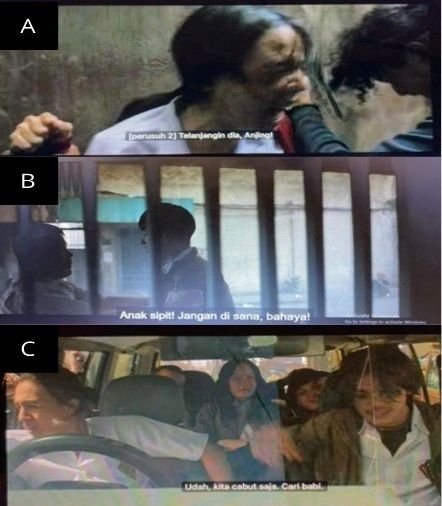
Dialogues directed at ethnic Chinese characters frequently employ derogatory labels such as “cina,” “babi,” and other animalistic metaphors, functioning as mechanisms of othering and dehumanization (20) These expressions are often articulated in collective settings, transforming individual prejudice into group-based aggression (see Figure 1). For example, in Scene 3 (06: 35–07: 36), repeated verbal insults are delivered collectively by groups of students while the victim remains visually isolated through restricted framing and minimal verbal response. This multimodal combination strengthens the representation of intimidation as both linguistic and spatial domination. Verbal threats, coercive commands, and humiliating imperatives normalize violence as an everyday communicative practice within the school environment.
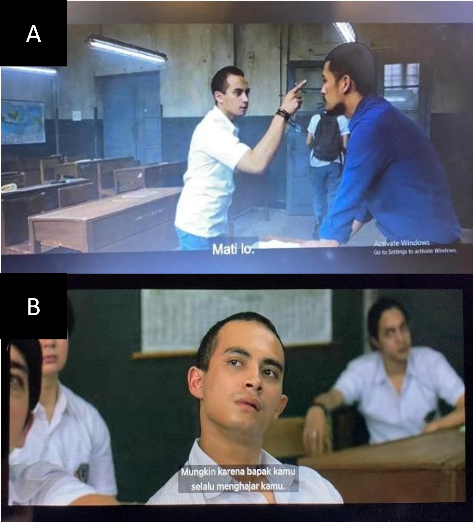
Visually, discrimination and violence are reinforced through close-up shots that emphasize fear and vulnerability, low-key lighting that creates an atmosphere of confinement, and spatial compositions that restrict movement. During axial coding, visual elements were repeatedly associated with discursive themes of surveillance, exclusion, and institutional control. High-angle shots were primarily coded as indicators of victim vulnerability, while low-angle shots frequently signified aggression, authority, or dominance. Similarly, low-key lighting and narrow spatial framing were interpreted as visual markers of psychological pressure and social entrapment. High-angle shots often position victims as powerless, while low-angle and over-the-shoulder perspectives align viewers with perpetrators or dominant groups. The school setting is repeatedly framed as a site of surveillance and domination rather than protection, underscoring the normalization of structural violence (see Figure 2).
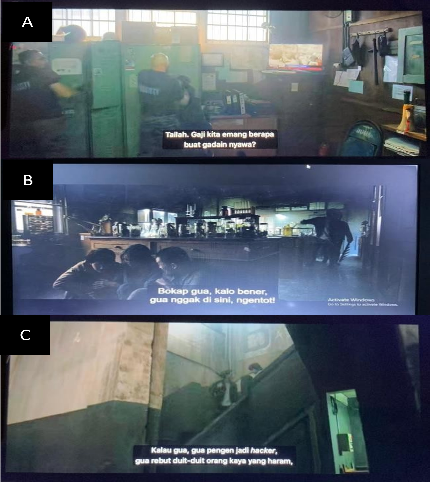
Narratively, the film organizes its conflict around intersecting axes of ethnicity, authority, and institutional breakdown. Violence escalates from verbal harassment to physical persecution, while silence and inaction by authority figures are recurrent motifs. Several scenes coded under the category of “institutional silence” depict teachers, administrators, or adult figures remaining passive during episodes of intimidation and violence. This pattern was identified in 8 out of the 14 analyzed scenes, suggesting that institutional inaction functions as a recurring narrative structure rather than an isolated occurrence. The absence of narrative resolution reinforces the persistence of these conditions, presenting violence and injustice as systemic rather than exceptional (see Figure 3).
Discursive Practice Dimension
At the level of discursive
practice, the production of Pengepungan di Bukit Duri reflects a
deliberate engagement with contemporary Indonesian socio-political issues.
Artistic decisions concerning dialogue, character construction, and spatial
setting function as strategies to foreground discrimination, institutional
neglect, and historical memory. The choice of Bukit Duri as a setting
symbolizes spatial inequality and contested urban development, situating
personal experiences within broader structural conditions (see Figure 4).
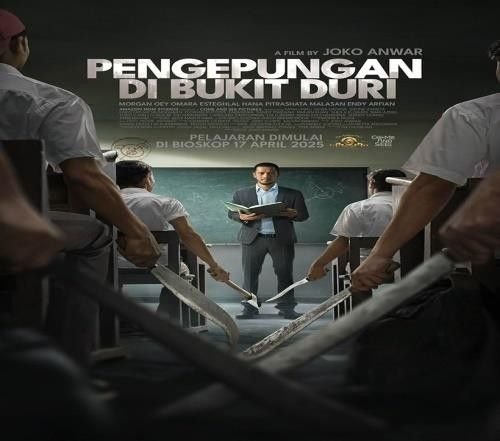
Distribution through national cinemas and digital streaming platforms expanded the film’s reach and facilitated public engagement. Analysis of 40 purposively selected audience comments from YouTube, Instagram, and online discussion forums indicates that viewers actively interpreted the film through personal, historical, and political perspectives. Audience responses were categorized into three dominant interpretative patterns: (1) personal identification with bullying or discrimination experiences, (2) criticism of institutional failure and social intolerance, and (3) reflections on historical trauma and ethnic tension in Indonesia. Viewer comments frequently connect cinematic scenes with personal memories and social critique, indicating active processes of interpretation and identification rather than passive consumption. For instance, several comments explicitly associated the film with experiences of racial bullying during school years, while others interpreted the film as a critique of unresolved post-Reformasi social tensions. The institutional framework of the film’s production and distribution further situates its discursive positioning within broader industrial networks (see Figure 5).

Social Practice Dimension
Within broader social practice, the film reflects and reproduces dominant discourses surrounding intolerance, educational failure, and unresolved historical violence in Indonesia. Representations of racial harassment and school violence parallel widely reported social problems (21), while references to inherited trauma highlight the enduring impact of past injustices. Institutional silence, particularly within education and state governance, emerges as a recurring pattern, framing discrimination and violence as normalized social conditions rather than aberrations (22).
The triangulation between textual evidence, audience interpretation, and sociocultural context demonstrates that the film’s discourse extends beyond fictional representation into broader ideological critique. Themes identified through coding processes including ethnic othering, institutional passivity, and collective trauma correspond closely with contemporary public debates concerning intolerance, school violence, and the continuing social legacy of anti-Chinese discrimination in Indonesia.
Discussion
The findings demonstrate that Pengepungan di Bukit Duri operates as a complex multimodal discourse through which racial discrimination, institutional failure, and intergenerational trauma are both reproduced and contested. Consistent with Fairclough’s CDA framework, the film does not merely represent social reality but actively participates in the construction of ideological meanings that shape public understandings of race and social justice. The repeated use of racial slurs and derogatory labeling reflects what critical race scholars describe as the discursive production of racialized identities, whereby language functions as a mechanism for normalizing social hierarchy and exclusion (23). In this sense, the film exposes how everyday discriminatory expressions operate not as isolated acts of prejudice but as manifestations of broader structures of power embedded within social institutions.
The integration of verbal and visual coding further reveals that discriminatory discourse is not communicated solely through dialogue, but also through cinematic organization. This finding aligns with multimodal discourse scholarship, which argues that meaning is produced through the interaction of multiple semiotic resources rather than through language alone (24). The recurring use of restrictive framing, low-key lighting, and asymmetrical camera positioning not only depicts vulnerability but also constructs visual hierarchies that naturalize unequal power relations. Consequently, discrimination is communicated through both what characters say and how cinematic form positions viewers to perceive particular social realities.
From a critical discourse perspective, institutional silence should not be interpreted as mere absence of action. Rather, silence itself constitutes a form of discourse that contributes to the maintenance of existing power structures. Similar observations have been reported in international studies of educational institutions, where organizational neutrality often functions to preserve dominant interests while marginalizing vulnerable groups. The film therefore expands the concept of institutional violence by illustrating how non-intervention may operate as an ideological practice that indirectly legitimizes discrimination and social exclusion.
Intergenerational trauma emerges as a central explanatory framework linking personal suffering with historical injustice. The findings resonate with international trauma studies, which conceptualize trauma as a social and cultural phenomenon transmitted across generations through memory, silence, narrative inheritance, and collective experience (25). Rather than portraying trauma as an individual psychological condition, the film situates suffering within broader historical processes, particularly the continuing social consequences of anti-Chinese discrimination. This representation challenges depoliticized understandings of trauma by emphasizing its structural and historical dimensions.
The multimodal nature of the film strengthens its critical force. Visual grammar, through lighting, framing, and spatial restriction, works in tandem with language to position marginalized subjects as surveilled and vulnerable. This confirms that power circulates across semiotic modes, reinforcing the necessity of multimodal CDA in film analysis (26). The audience reception findings further demonstrate that viewers do not passively consume the film’s messages, but actively reinterpret them within personal and sociopolitical contexts. The circulation of audience interpretations on digital platforms extends the film’s discourse into participatory public spaces, transforming cinematic representation into broader social dialogue.
More broadly, the findings contribute to ongoing international debates within critical discourse studies, film studies, and critical race scholarship regarding the role of cultural texts in reproducing and contesting social inequality. While previous studies have frequently examined racism through policy discourse, news media, or political communication, the present study demonstrates that cinema constitutes an equally significant arena of ideological struggle. By integrating Fairclough’s CDA with multimodal film analysis, this research highlights how racialization, institutional authority, and collective memory are negotiated through interconnected linguistic and visual practices. The findings therefore extend existing scholarship by illustrating how film can function simultaneously as a site of representation, ideological reproduction, and social critique.
Pengepungan di Bukit Duri functions as a transformative cultural text that exposes normalized injustice while opening space for ethical reflection and resistance. By situating individual experiences within structural and historical contexts, the film transcends its narrative boundaries and contributes to critical debates on race, education, and social justice in Indonesia. This study advances CDA scholarship by demonstrating the analytical value of film as a site of ideological negotiation and by highlighting the importance of discourse in challenging inherited silence.
Conclusion
This study demonstrates that Pengepungan di Bukit Duri functions as a critical social text that constructs racial discrimination, school violence, institutional silence, and intergenerational trauma through interconnected textual, discursive, and social practices. Using Fairclough’s Critical Discourse Analysis, the findings reveal that language, visual representation, and narrative structures not only reflect but also reproduce and contest power relations within Indonesian society. The film therefore transcends its role as entertainment by serving as a medium of social critique that challenges normalized injustice and historical silence.
The study contributes theoretically by extending Fairclough’s CDA to multimodal film analysis, demonstrating how ideological meanings are produced through the interaction of language, visual elements, and narrative structure. Beyond the Indonesian context, the findings also contribute to broader discussions in international film and discourse studies by highlighting cinema’s role in negotiating issues of race, institutional power, and collective memory.
This study is limited by its single-case design and purposive scene selection. Future research is recommended to conduct comparative analyses across multiple films and incorporate audience-centered or mixed-method approaches to provide deeper insights into cinematic discourse and audience reception.
Declarations
Conflict of Interest
The authors declare no conflicting interest.
Data Availability
Data supporting the findings of this study are available from the corresponding author upon reasonable request.
Ethics Statement
Ethical approval was not required for this study.
Funding Information
The author(s) declare that no financial support was received for the research, authorship, and/or publication of this article.
References
- Basaran A. Filmic Therapeutic Encounters and Resistance: Silence, Forgetting, and Guilt in the Face of Historical Violence. Journal of Humanistic Psychology. 2021;62(6):838-852. doi: https://doi.org/10.1177/00221678211010013
- Eren İ, Aktan EÖA. Beyond the Silver Screen: Exploring Future Public Life Through Sociological Film Analysis. Sage Open. 2024;14(4). doi: https://doi.org/10.1177/21582440241296074
- Indana Zulfia, Badriyah Wulandari, Mardiningsih Mardiningsih. Relasi Kekuasaan dan Representasi Perempuan dalam Film Ipar adalah Maut Menggunakan Kajian Semiotika Roland Barthes. jpb. 2025;15(3):361-367. doi: https://doi.org/10.37630/jpb.v15i3.3343
- Wijaya FR, Puspita V, Kenny K, Sedharta BO. Haunting narratives: female entities and gender inequality in Indonesian horror films. Humanit Soc Sci Commun. 2025;12(1). doi: https://doi.org/10.1057/s41599-025-04815-x
- Sudirman FA. Teknologi informasi dan komunikasi (tik) dan sdgs : review literatur sistematis. Jikuho. 2023;8(2):273-288. doi: https://doi.org/10.52423/jikuho.v8i2.56
- Bhaskara ILA. A Road to “Unity in Diversity”: The Case of Indonesia’s Chinese Minority Group. Jassr. 2024;5(2):123-136. doi: https://doi.org/10.15575/jassr.v5i2.80
- Mulianggi NC, Najwa RM. From Silence to Voice: Collective Memory and Representation of Victims of the May 1998 Tragedy in Surakarta. Aimmah: Social Sciences Journal. 2025;2(1):10–9.
- Dwi S, Arissandi Z, Shofiyuddin H, Islam U, Sunan N, Surabaya A. Representasi Diskriminasi Etnis dalam Film Pengepungan Di Bukit Duri: Kajian Semiotika John Fiske. In: Proccedings Uinsa. Konasindo; 2025.
- Nurhijriah N, Israfil I, Imaniar M. Sosialisasi Sekolah Anti Perundungan, Kekerasan Seksual dan Intoleransi Di SMKN 2 Kota Bima. Jompa Abdi. 2024;3(4):146-154. doi: https://doi.org/10.57218/jompaabdi.v3i4.1266
- Sibawati I. Eksistensi Etnis Cina di Bawah Pemerintahan Orde Baru, 1966-1998. tamaddun. 2024;2(2):81-94. doi: https://doi.org/10.70115/tamaddun.v2i2.242
- Azizah IN. Gender, Ideologi dan Kekuasaan dalam Video VICE Indonesia yang berjudul Polemik Poligami di Indonesia: Analisis Wacana Kritis Norman Fairclough. Nusa. 2020;15(3):409-418. doi: https://doi.org/10.14710/nusa.15.3.409-418
- Intan Ayu Rahmawati, Fifi Nofiaturrahmah. Representasi Sistem Pendidikan dan Kondisi Sosial dalam Film Pengepungan di Bukit Duri (Studi Analisis Semiotika Charles Sanders Pierce). Juragan. 2026;3(Spesial Issue):1565-1574. doi: https://doi.org/10.62710/pansv847
- Asmara N, Pamungkas P, Sokowati ME. Production of Femininity Discourse in Documentary Films (Critical Discourse Analysis of Our Mothers’ Land Films). Proceedings of Universitas Muhammadiyah Yogyakarta Graduate Conference. 2022 Jun 30;2(1). doi:10.18196/UMYGRACE.V2I1.466
- Suriadi S, Baharman B. Nilai Eksperensial dalam Kosakata Ujaran Kebencian di Twitter: Analisis Wacana Kritis Norman Fairclough. Onoma. 2024;10(4):4541-4558. doi: https://doi.org/10.30605/onoma.v10i4.4756
- Fairclough N. Critical Discourse Analysis: The Critical Study of Language. 2nd ed. London: Routledge; 2010.
- Hakim NH. Analisis Wacana Kritis Norman Fairclough pada Video YouTube Zulfan Lindan "Unpacking Indonesia". Prasasti. 2025;10(1):104. doi: https://doi.org/10.20961/prasasti.v10i1.97189
- Listiyapinto RZ, Mulyana. Analisis Wacana Kritis dalam Film Budi Pekerti. Jubasan. 2024;8(1):11-17. doi: https://doi.org/10.29407/jbsp.v8i1.21749
- Morchid DM. A methodological framework for applying critical discourse analysis to textual data. Ijrehc. 2025;06(06):77-82. doi: https://doi.org/10.37602/ijrehc.2025.6606
- Nurohmah H, Sundasewu RU. Research Trends In Multimodal Critical Discourse Analysis: A Bibliometric Analysis. Td. 2024;23(1):149-163. doi: https://doi.org/10.33096/tamaddun.v23i1.700
- Haslam N. Dehumanization: An integrative review. Personality and Social Psychology Review. 2006;10(3):252–64. doi:10.1207/s15327957pspr1003_4 PubMed PMID: 16859440.
- Arntson C. Designed to Fail: Media Representations of Racialized Classrooms and Schools. Cjfy. 2020;12(2):1-14. doi: https://doi.org/10.29173/cjfy29503
- Bruneau EG, Saxe R. The power of being heard: The benefits of ‘perspective-giving’ in the context of intergroup conflict. Journal of Experimental Social Psychology. 2012;48(4):855-866. doi: https://doi.org/10.1016/j.jesp.2012.02.017
- Suriadi S, Baharman B. Nilai Eksperensial dalam Kosakata Ujaran Kebencian di Twitter: Analisis Wacana Kritis Norman Fairclough. Onoma. 2024;10(4):4541-4558. doi: https://doi.org/10.30605/onoma.v10i4.4756
- Dani Fitrah Kurniawan, Nursapia Harahap. The Representation of Racism in the Film Pengepungan di Bukit Duri (A Semiotic Analysis Based on Roland Barthes’ Model). Ijhess. 2026;5(5). doi: https://doi.org/10.55227/ijhess.v5i5.2321
- Hirschberger G. Collective trauma and the social construction of meaning. Front Psychol. 2018 Aug 10;9(AUG):351992. doi:10.3389/fpsyg.2018.01441
- Shirazi R. Discourse Studies, Corpus, and Multimodality in Urban Research. articulo. 2024;24. doi: https://doi.org/10.4000/12gaq