RESEARCH ARTICLE
Gut Content Analysis and Feeding Relationships Reveal Low Competition for Food Resources in Non-Annual African Rainforest Nothobranchiid Assemblages
Academic Editor: Putri Anugerah
Aquatic Life Sciences|Vol. 3, Issue 2, pp. 62-77 (2026)
CC BY 4.0-2026 Authors

Received
Mar 27, 2026Revised
Jun 9, 2026Accepted
Sep 12, 2026Published
Oct 27, 2026
Abstract
Understanding the trophic ecology of fish species is essential for developing effective management and conservation strategies. This study examined the role of diet in the assemblage structure of non-annual nothobranchiid fish species inhabiting permanent rainforest streams in southern Cameroon. In total, 1010 nothobranchiid individuals, assigned to 12 species belonging to two subgenera (mainly Aphyosemion), were harvested. The non-empty guts of 488 individuals were analysed, both qualitatively and quantitatively. All species examined were generalists. Their diet primarily consisted of terrestrial insects falling from the tree canopy, representing the bulk of their foraged food (%N = 76.8%), with an index of relative importance (IRI) of 94.3%. Hymenopterans were predominant in the environment (62%) and constituted the preferred prey type (IRI = 96.7%); the other items were accidental. Aquatic dipterans (Chironomidae) and Ephemeroptera followed. The diet of these fish species did not vary with parameters like site altitude, season, sex/ontogenetic groups, or fish size. They all fed on the same prey categories in equal proportions. The dietary overlap between the nothobranchiid fish species at sympatric occurrence sites was generally high, with a high reduction in their prey type uptake compared to a greater variety of prey intake in allopatric situations. Results suggest that there is low competition for food resources among these phylogenetically related species; they coexist by making immediate adjustments. In Cameroon rainforest streams, diet is not a factor structuring Nothobranchiid fish assemblages, providing valuable information for the ecological preservation of their biotope characteristics, which they rely on the most for survival.
Introduction
Central African rainforests, the second-largest block of humid dense forests following Amazonia, represent exceptional carbon and biodiversity reservoirs for countries concerned and the planet (1). They are crossed by several low-order streams and backwaters that are discrete ecosystems with restricted environmental factors such as site size, depth, and population density, thus constituting good models for ecological research on species’ community organization and adaptation of aquatic vertebrates in such systems. Under their heavy canopy closure, they shelter fish organisms such as the Cyprinodontiformes that require very specific ecological conditions unique to stable and relatively non-disrupted large forests (2). They can demonstrate interesting biological features and significant evolution within a manageable time frame in a context where ecological consequences can be measured, therefore justifying the choice of this group in understanding forest ecosystems (3). West African nothobranchiid fish species of the genera Aphyosemion Myers, 1924, and Epiplatys Gill, 1862, are well-known among aquarists and often studied by ethologists for agonistic behavior (4, 5) or their potential use as biological controls of larval mosquito populations in nature (6, 7). They are non-annual organisms whose assemblages and distribution are highly structured by the forest ecosystem, especially the site elevation in correlation with water temperature and specific local habitat characteristics (8-12). They are ecologically isolated from other groups of fish specific to forest backwaters, both at the trophic, temporal, and spatial levels, and are the only fish that catch prey on the surface in the very shallow areas they inhabit, where they are present in large numbers, all species combined, in backwaters that could be no more than 2–3 cm deep. Above 25 cm, only lentic water species, such as species of Epiplatys, are likely to be found, which themselves seem to disappear beyond 50 cm (8). Despite these preliminary results, we are still far from understanding how they coexist in high numbers in the same space, given that they have similar ecological needs, to approach a precise vision or model that accounts for the functioning of their communities.
Identifying the elements that influence the coexistence of diverse species and communities in an ecosystem is necessary for understanding biodiversity (13, 14). Phylogenetically related organisms often co-occur in sympatry, raising the concern about the mechanisms ruling their coexistence (15, 16), given that they are more likely to satisfy their needs similarly due to their systematic relatedness (17). Resource partitioning, typically resulting from past or ongoing interspecific competition for limited resources in multiple dimensions, such as space, time, or food (18-20), is one of the mechanisms that help understand how species assemblages are organised in their habitats (21). Classical theses may have given competition, the driving force of niche distribution, an excessively exclusive role in structuring populations (22), based on the assumption that different species in an assemblage must display different use for the limited resources for a certain equilibrium and coexistence to be achieved among several specialized species; otherwise, long-term interactions may result in some species being excluded or extinct, according to the Competitive Exclusion Principle (23), thereby predicting species assemblage organization as a function of resource use. Other theories, on the other hand, assume there are no interspecific relationships as far as resource use and associated habitat variables in species assemblages are concerned, arguing that species’ responses to ecological constraints are equivalent (24), thereby not predicting species coexistence as a result of niche differentiation, but rather associated with stochastic forces (25). It is therefore delicate to extrapolate habitat-wide for community organization since the deterministic processes structuring communities affect taxa differently (26).
Studies of species coexistence have largely focused on annual taxa in ephemeral pools, where seasonal disturbance, habitat drying, and rapid population turnover promote coexistence through mechanisms such as the storage effect and dispersal dynamics (27). In contrast, non-annual species in permanent streams experience prolonged interactions under relatively stable conditions, where coexistence may depend more strongly on behavioral responses and fine-scale habitat use. Investigating these systems is therefore crucial for testing the generality of coexistence theory beyond disturbance-driven environments and for understanding biodiversity maintenance in freshwater ecosystems (27, 28). Various combinations of the highly phylogenetically related nothobranchiid species with minimal evolutionary constraints often occur in syntopy in the rainforest streams of Cameroon. These species generally do not display any noticeable habitat niche separation when in sympatry (8, 29), and, unlike stated by Brosset (8) in the Ivindo basin, biotic factors like parasitism seemed not to regulate their communities in the wild, the prevalence of infections by parasite taxa being low, and life in community for these fish species being likely to represent a strategy of spreading of risks (30). Compared to their representatives in other parts of the world, only a few studies on food and feeding interactions playing a part in fish assemblage organization are undertaken in Africa, especially for non-annual nothobranchiids in the wild, probably due to their small size, catching difficulty, and non-eating value that deters research interest. Meanwhile, the role of diet in structuring fish communities in nature is of considerable interest, as diet influences an organism's biology along with several other ecological features, including the community structure (31-38).
The present study, a part of a larger research project, therefore aimed to investigate the impact of diet on the functioning of non-annual nothobranchiid fish assemblages in their natural habitat, the southern Cameroon rainforest streams. It specifically focused on examining their diet patterns through gut content analysis, assessing both the qualitative and quantitative aspects of their food intake using ecological indices as well as their trophic relationships, and investigating the influence of site location (elevation), seasons, sex/ontogenetic variations, and fish size on their diet, to determine whether these closely species related with morphological similarities coexist through food niche partitioning or simple interactive segregation when in sympatry.
Methodology
Study Area
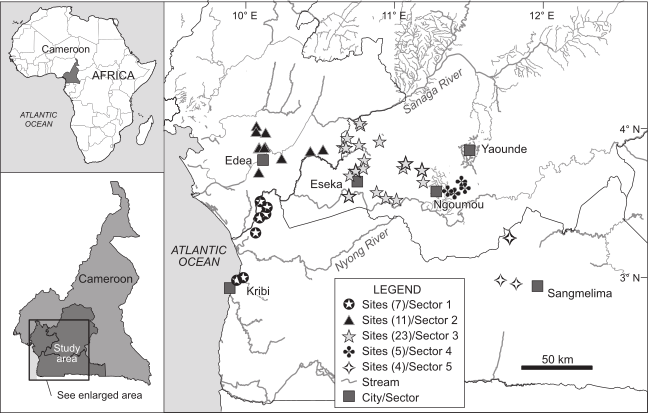
The study took place in deep rainforest first-order and exceptionally second-order forest springs, brooklets, and streams of the south-central plateau and the northern and southern parts of the coastal plain of Cameroon, tributaries of the Nyong and Sanaga Rivers of the Atlantic basin. With an elevation of less than 300 metres and generally much lower, the coastal plain stretches 150 kilometres deep inland and presents favourable conditions for the growth of a lush shade forest. It borders the Gulf of Guinea. The Southern Cameroon plateau rises above the low plains in its western region through steep escarpments. The climate in this region is moderate and characterised by four seasons: two rainy and two dry. The natural vegetation in the area is mixed, comprising the mesophilic forest and the evergreen forest (the Congolese forest) (39). The Sanaga River (920 km in length; 140, 000 km² of watershed) descends from the Adamaoua region, while the Nyong River (750 km in length; 30, 000 km² of watershed) comes from the southern Cameroonian plateau (40). The study covered the sectors of Edea (in the coastal plain), Eseka, Ngoumou, Kribi, and Sangmelima (in the centre-south plateau), where a varying number of fishing stations were randomly surveyed (Figure 1 and Table 1). The mean elevations of the varying study sectors were as follows: Kribi (62.80 ± 18.86 m), Edea (79.09 ± 18.76 m), Eseka (316.82 ± 188.68 m), Ngoumou (709.38 ± 11.47 m), and Sangmelima (690 ± 26.1 m). Nothobranchiids occurred in waters that were poorly mineralized (conductivity = 24.79 ± 9.31 μS cm-1), acidic (pH = 5.8 ± 1.37), highly oxygenated (dissolved O2 = 17.68 ± 15.73 mg l-1), and with an average temperature of 23.61 ± 3.64°C. The marginal vegetation was frequently dense, with a high canopy closure above the watercourse. Stream bottoms were composed of litter, sand, mud, and pebbles. These streams had an average course width of just over a metre, an average depth of about 14 cm, and a low water flow rate (0.11 m s-1). Species spatial distribution across the entire study area is primarily dependent on the station’s elevation, water temperature, and certain local habitat physicochemical characteristics (12). No species-specific habitat use was observed among these fish when they occurred in sympatry.
| Sectors | Localities | Streams | N | E | Altitude (m) |
|---|---|---|---|---|---|
| 1. Kribi | Bikondo | Namassambi | 02°58090′ | 009°57129′ | 46 |
| Pama | Pama | 03°17193′ | 010°04764′ | 48 | |
| Bissiang | Bognoungou | 02°59196′ | 009°59747′ | 55 | |
| Bonguen | Ndoung lo'o | 03°29821′ | 010°06669′ | 66 | |
| Mbongo'o | Man ndon | 03°24859′ | 010°08849′ | 89 | |
| Ebondé | Mboke | 03°27443′ | 010°09475′ | 104 | |
| Bivouba | Ndong medzip | 03°232669′ | 10°064424′ | 45 | |
| 2. Edéa | Pouma | Lép Sô | 03°512050′ | 10°322349′ | 198 |
| Koukoue | Ndong sone | 03°42021′ | 010°06314′ | 54 | |
| Malimba II | Hiléba Si Makai | 03°51845′ | 010°06384′ | 64 | |
| Malimba II | Hiléba Malimba | 03°51845′ | 010°06384′ | 64 | |
| Malimba II | Titimba Malimba | 03°51993′ | 010°08556′ | 73 | |
| Besombe | Lép si Yap | 04°00711′ | 010°05324′ | 76 | |
| Log Badjeck | Awomakolo | 03°58407′ | 01°05176′ | 82 | |
| Somakek | Nkom | 03°58004′ | 010°09056′ | 85 | |
| Telèp bana | Man ngombe | 02°52244′ | 010°08849′ | 99 | |
| Seppè | Si hikoa | 03°47662′ | 010°15477′ | 107 | |
| Ngwei I | Hiléléba ko'o | 03°50493′ | 010°27138′ | 117 | |
| 3. Eséka | Makak | Hiléléba Yébél | 03°320043′ | 010°575996′ | 618 |
| Makak | Makoubé | 03°310566′ | 011°023979′ | 621 | |
| Ilanga | Ilanga | 03°440055′ | 010°485995 | 227 | |
| Song Mandeng | Hiléléba njek | 03°42912′ | 010°45468′ | 185 | |
| Manguengues | Dileleba diba | 03°32757′ | 010°42823′ | 207 | |
| Manguengues | Madjandjan | 03°32773′ | 010°42823′ | 210 | |
| Song Mandeng | Dileleba diaa | 03°42912′ | 010°45468′ | 230 | |
| Ndoupè | Hileleba pem | 03°52493′ | 010°40448′ | 210 | |
| Boga | Saanda | 03°53482′ | 010°46876′ | 215 | |
| Bilagal II | Lép Ndjab | 03°41014′ | 010°43184′ | 219 | |
| Sombo | Séa | 03°52207′ | 010°41548′ | 222 | |
| So mapan | Lép So mapan | 03°47251′ | 010°48992′ | 232 | |
| Mom Dibang | Tibda | 03°56158′ | 010°42091′ | 334 | |
| Matôl II | Jolibam | 04°01331′ | 010°47551′ | 373 | |
| Matôl I | Bobog | 04°02275′ | 010°47069′ | 384 | |
| Meloh-Maloume | Bikout | 03°34361′ | 010°53962′ | 501 | |
| Mandoumba | Lép Ndombol | 03°45913′ | 011°057007′ | 623 | |
| Mandoumba | Man mpan | 03°45913′ | 011°05707′ | 623 | |
| Kombing | Hiléba Kombéng | 03°44132′ | 011°04611′ | 637 | |
| Mom II | Ligen li sogôl | 03°38471′ | 011°12850′ | 703 | |
| Mawel | Lép Ngo Bikun 1 | 03°43350′ | 011°12330′ | 728 | |
| Mawel | Lép Ngo Bikun 2 | 03°43350′ | 011°12330′ | 729 | |
| Libel lingoï | Lép manguene | 03°54476′ | 010°55123′ | 390 | |
| 4. Ngoumou | Ambatou | Bikok | 03°351385′ | 11°290975′ | 708 |
| Mbalelon | Ebem Ngama | 03°33907′ | 011°22120′ | 695 | |
| Nkong | Ndikoa | 03°32966′ | 011°24995′ | 700 | |
| Angon II | Bikomna | 03°32966′ | 011°24995′ | 700 | |
| Koulboa | Osoe Nyada | 03°37749′ | 011°27670′ | 720 | |
| 5. Sangmelima | Mvoutessi II | Bives | 03°15358′ | 011°47492′ | 658 |
| Mvoutessi II | Ototong | 03°15358′ | 011°47492′ | 658 | |
| Nkol ngbwa | Man otong | 02°56876′ | 011°50118′ | 693 | |
| Avebe Esse | Avo'o | 02°58403′ | 011°43828′ | 719 |
Fish Sampling
Nothobranchiids were sampled in their natural habitat in forest streams during daylight. They were successfully harvested in 50 stations along an altitudinal gradient, with low and high elevations separated at 350 m. The samplings were conducted bimonthly from January 2012 to February 2014 during 11 sampling campaigns of three to six days each. At each sampling station, the water depth, current velocity, temperature, pH, conductivity, and dissolved oxygen were measured in situ using portable multimeters. A GPS unit permitted the recording of the coordinates of the sampling stations. A 90 cm by 60 cm hand dip-net of 3 mm mesh size attached to a rigid rectangular iron frame helped to catch fish; they were immediately euthanized with an overdose of clove oil and fixed in 10% formalin for the taxonomic and quantitative determination of gut content. Fish species were identified using appropriate keys (3, 41-44).
By the time of fish collection, representatives of environmental prey types available were also sampled at each site using the same device and fixed in 10% formalin. Once in the laboratory, invertebrates were removed from debris and substratum, sorted into taxonomic categories, counted, and their relative environmental proportion determined for prey selectivity analyses.
Gut Content Examination
In the laboratory, each preserved fish specimen was gently mopped with tissue paper, weighed (total mass in grams), and measured (standard length in mm). Individuals were sexed based on visible sexual features (coloration) and grouped into demographic categories as males (brightly coloured), females (pale), and immatures (small individuals with unclear features preventing sex determination). Fish dissection was performed under a dissecting stereomicroscope using fine scissors. Because Cyprinodontiformes lack a distinct stomach (45), the digestive tract was sectioned at the anterior and posterior ends and then opened longitudinally with two entomology needles on mandrels with caution. Dietary analysis was limited to species represented by at least three individuals with full guts; empty and highly digested guts were excluded from the analyses (46, 47). The prey items were identified to the lowest taxonomic level possible using different keys (48, 49) and grouped based on their taxonomic category (order or family level). Individuals of every prey type were numbered and recorded. Unidentifiable materials were termed as such and removed from the analyses.
Food Analyses
Both qualitative and quantitative descriptions of the prey items helped characterise the diet of the nothobranchiid fish species. Dietary analyses focused on the overall diet composition of the fish species caught throughout the study area. These included interspecific comparisons of nothobranchiid species found at both low and high elevations, comparisons between subgeneric species, and an examination of dietary overlap between sympatric species in contrast to their allopatric occurrences. The relative importance of each prey category was assessed, and probable effects of factors such as season, fish size, and sex/ontogenetic variations on diet were also examined. The mean values of the various scores in diet composition were tested for any statistical significance using the non-parametric Kruskal-Wallis test at a 95% confidence limit.
The mean percentage of all prey categories was calculated for every fish species. The quantitative dietary measures used to assess the feeding of these fish species assemblages were the most commonly used ones (50): the frequency of occurrence (%O) (the ratio between the number of digestive tracts containing a prey type and the total number of "not empty" tracts examined) and the per cent abundance (%N) (the ratio between the number of each prey type encountered and the total number of prey pooled in for all tracts). The contribution percentage (%V) of all prey categories found in the gut to the total gut content was visually estimated to improve numerical methods and assess the relative importance of each food item (51, 52). Although this method of analysis is subjective, its defects were minimised to a great extent by a large sample examined over two years. The index of relative importance (IRI) of each prey type was calculated following Pinkas et al. (53) as seen in Equation 1, where %N = numerical percentage, %V = volumetric percentage, and %O = frequency of occurrence percentage). Following the IRI value, the prey type was classified as preferred (IRI > 50%), secondary (10% < IRI < 50%), complementary (1% < IRI < 10%), or accidental (IRI < 1%).
Prey selectivity (proportion of a prey type in the fish diet compared to its proportion in the environment) was evaluated for all nothobranchiid species together and using the relativized index E* (54) following the Equation 2, where n = number of prey types and Wi calculated using Equation 3. ri and pi = respective percentages of prey item i in the fish diet and in the environment. Environmental prey item abundance was taken as the composition of all sampling sites. E* ranges between -1 (prey avoidance) and +1 (prey selection), with 0 expressing no selection.
The determination of the Schoener similarity index (C) (55) helped assess the overlapping spectra of use of the same type of food resource by two or more nothobranchiid species as seen in Equation 4. pij and pik = relative abundances of the category i resource used by nothobranchiid species j and k, respectively. Cjk varies from 0 (when the species present do not consume the same prey, i. e. , no overlap) to 1 (when all categories of prey are present in equal proportions in the diet of the different species, i. e. , complete overlap). This index is ecologically significant when greater than 0.6 or less than 0.4 (56-58).
Species of the subgenera Scheelsemion and Chromaphyosemion usually occurred in syntopy, while those of the subgenera Chromaphyosemion and Mesoaphyosemion scarcely occurred together. To assess whether food usage accounted for these species' tolerance or exclusion, a comparison of their diets in both allopatric and sympatric occurrences was conducted.
Non-metric multidimensional scaling (nMDS) of a Bray-Curtis dissimilarity matrix, created from the faunal diet composition of each species, was used to visualise interspecific differences in diet composition and overlap among fish species and plotted in two dimensions using the Paleontological Statistics software PAST 3.16.
Results
Species Richness
In total, 1010 specimens, representing 12 nothobranchiid fishspecies from two genera and six subgenera, were harvested in variable proportions in the study area (Table 2). Species occurring at lower elevations (< 350 m) comprised A. loennbergii, A. omega, A. riggenbachi, A. ahli, A. amoenum, andEpiplatys infrafasciatus, and those in higher altitudes (> 350 m) included A. exiguum, A. obscurum, A. cameronense, A. batesii, A. raddai, and Aphyosemion sp.
| Genus | Sub-genus | Species | Altitude range (m) |
|---|---|---|---|
| Aphyosemion | Aphyosemion Myers, 1924 | Aphyosemion sp. | > 650 |
| Chromaphyosemion Radda, 1971 | A. (Chrom.) loennbergii (Boulenger, 1903) | 0 – 300 | |
| A. (Chrom.) omega (Sonnenberg, 2007) | < 100 | ||
| A. (Chrom.) riggenbachi (Ahl, 1924) | < 100 | ||
| Kathetys Huber, 1977 | A. (Kath.) exiguum (Boulenger, 1911) | > 650 | |
| Mesoaphyosemion Radda, 1977 | A. (Mes.) amoenum Radda et Pürzl, 1976 | 100 – 300 | |
| A. (Mes.) obscurum (Ahl, 1924) | > 650 | ||
| A. (Mes.) cameronense (Boulenger, 1903) | > 650 | ||
| A. (Mes.) raddai Scheel, 1975 | 300 – 650 | ||
| Raddaella Huber, 1978 | A. (Rad.) batesii (Boulenger, 1911) | > 650 | |
| Scheelsemion Huber, 2013 | A. (Sch.) ahli Myers, 1933 | < 100 | |
| Epiplatys | E. infrafasciatus | 0 – 300 |
A few stations at low elevations had co-occurrence (syntopy) cases of A. ahli-E. infrafasciatus-A. loennbergii, A. omega-A. riggenbachi-E. infrafasciatus, A. ahli-A. omega, and A. amoenum-A. loennbergii. Syntopic cases that occurred at higher altitudeswere A. cameronense-A. exiguum-A. batesii, A. cameronense-A. batesii, A. exiguum-A. batesii, A. cameronense-A. exiguum, A. exiguum-Aphyosemion sp. , and A. exiguum-A. obscurum. However, some species occurred as single populations at some other stations. Aphyosemion raddai did not co-occur with any of its congeneric species within its distribution range, i. e. 300 to 650 m elevation). Aphyosemion batesii had the largest body overall, followed by E. infrafasciatus, A. riggenbachi, and A. obscurum (Table 3).
| Species | n | LS (mm) | MT (g) |
|---|---|---|---|
| Aphyosemion ahli | 40 | 24.6 ± 5.2 | 0.3 ± 0.2 |
| Aphyosemion loennbergii | 145 | 25 ± 4.3 | 0.3 ± 0.1 |
| Epiplatys infrafasciatus | 36 | 36.7 ± 10.4 | 0.9 ± 0.8 |
| Aphyosemion amoenum | 53 | 27.24 ± 5.5 | 0.3 ± 0.2 |
| Aphyosemion omega | 31 | 22.3 ± 2.9 | 0.2 ± 0.1 |
| Aphyosemion riggenbachi | 3 | 30.7 ± 1.5 | 0.4 ± 0.1 |
| Aphyosemion raddai | 34 | 25.4 ± 4.8 | 0.3 ± 0.1 |
| Aphyosemion exiguum | 33 | 21.2 ± 3.6 | 0.2 ± 0.1 |
| Aphyosemion cameronense | 52 | 28.3 ± 5.9 | 0.3 ± 0.2 |
| Aphyosemion obscurum | 14 | 30.4 ± 10.7 | 0.3 ± 0.2 |
| Aphyosemion sp. | 7 | 25.6 ± 5.9 | 0.2 ± 0.1 |
| Aphyosemion batesii | 40 | 38.8 ± 8.8 | 0.7 ± 0.4 |
| Description: LS: standard length; MT: total mass; n: number of fish analysed. | |||
Gut Content Analysis
Overall, 488 guts from all species contained food (vacuity rate = 51.7%); empty guts were not part of the gut content analyses. In total, 14 prey categories were identified from the environment and recovered in fish guts (Table 4); they were grouped into taxonomic categories according to their ecological similarity. These categories were terrestrial insects (including Hymenoptera-Formicidae, Hymenoptera-Apidae, Arachnida, Coleoptera, and Diptera-Muscidae), aquatic insects (Diptera-Chironomidae and Ephemeroptera), crustaceans (Branchiopoda-Cladocera, Decapoda, Copepoda, and Ostracoda), and others (Mollusca-Gasteropoda, Protozoa, and Annelida-Oligochaeta). The environmental proportion of the Hymenoptera (Formicidae) was the highest (62%), followed by the Chironomidae (12%) and Cladocera (4.3%). In the fish guts, Formicidae represented the most preyed item (72.5%) by all species of this fish family, followed by aquatic dipterans (Chironomidae) (9.1%) and Ephemeroptera (5.3%). The 14 prey categories occurred in varying proportions in the guts of the various nothobranchiid predators (Figure 2).
| Food items | Pi (%) | Fish species | Total (%) | |||||||||||
|---|---|---|---|---|---|---|---|---|---|---|---|---|---|---|
| Aahl | Epip | Aloe | Aome | Arig | Aamo | Arad | Aexi | Asp | Abat | Aobs | Acam | |||
| Terrestrial insects | 76.8 | |||||||||||||
| Hymenoptera-Formicidae | 62 | 54.5 | 82 | 60.5 | 25.6 | 100 | 74.6 | 76.7 | 62.5 | 81.8 | 89.9 | 100 | 86.7 | 72.5 |
| Hymenoptera-Apidae | 2 | - | 1 | - | - | - | - | - | - | - | - | - | - | 0.1 |
| Arachnida | 4 | 34.1 | 3 | - | - | - | 3.4 | - | 2.5 | - | - | - | 1.2 | 2.9 |
| Coleoptera | 1 | - | - | 1.0 | - | - | - | - | - | - | - | - | - | 0.3 |
| Diptera-Muscidae | 3 | - | 7 | 0.5 | - | - | - | - | - | - | - | - | - | 1.0 |
| Aquatic insects | 14.4 | |||||||||||||
| Diptera-Chironomidae | 12 | - | 1 | 17.6 | 15.4 | - | 5.1 | 11.6 | 30.0 | - | 5.5 | - | 1.2 | 9.1 |
| Ephemeroptera | 3 | 9.1 | 2 | 10.2 | - | - | 5.1 | 2.3 | 5.0 | 18.2 | 0.9 | - | 6.0 | 5.3 |
| Crustaceans | 6.4 | |||||||||||||
| Branchiopoda-Cladocera | 4.3 | - | 3 | - | 53.8 | - | 8.5 | - | - | - | - | - | - | 3.8 |
| Decapoda | 2 | 2.3 | 1 | 1.0 | - | - | 1.7 | - | - | - | - | - | 1.2 | 0.8 |
| Copepoda | 2.5 | - | - | 2.4 | - | - | 1.7 | 9.3 | - | - | 1.8 | - | 1.2 | 1.7 |
| Ostracoda | 0.1 | - | - | 0.5 | - | - | - | - | - | - | - | - | - | 0.1 |
| Others | 2.5 | |||||||||||||
| Mollusca-Gasteropoda | 2 | - | - | 1.0 | - | - | - | - | - | - | 0.9 | - | 2.4 | 0.6 |
| Protozoa | 0.1 | - | - | - | - | - | - | - | - | - | 0.9 | - | - | 0.1 |
| Annelida-Oligochaeta | 2 | - | - | 5.4 | 5.1 | - | - | - | - | - | - | - | - | 1.7 |
| Description: A. ahli (Aahl), A. omega (Aome), A. riggenbachi (Arig), A. raddai (Arad), A. exiguum (Aexi), A. obscurum (Aobs), A. cameronense (Acam), A. amoenum (Aamo), A. loennbergii (Aloe), A. batesii (Abat), Aphyosemion sp. (Asp), Epiplatys infrafasciatus (Epip). | ||||||||||||||
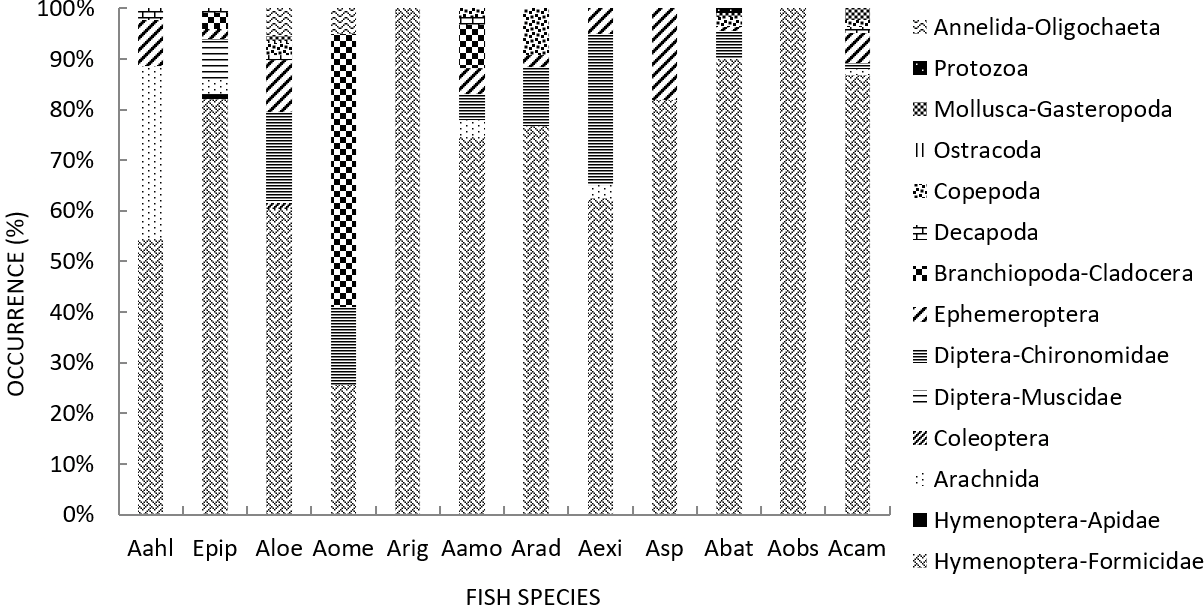
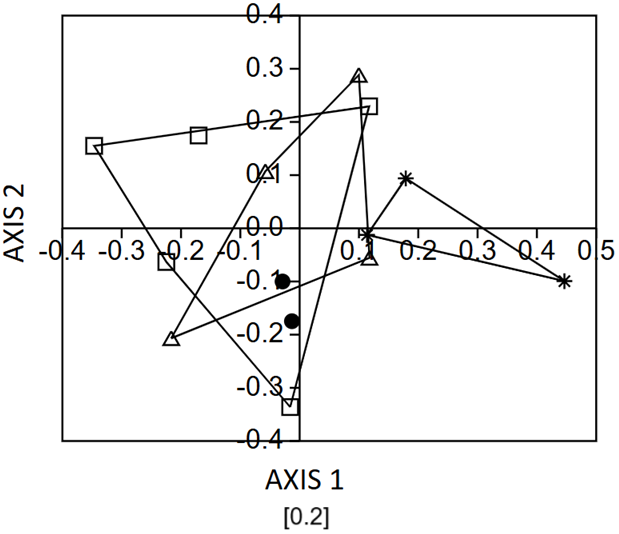
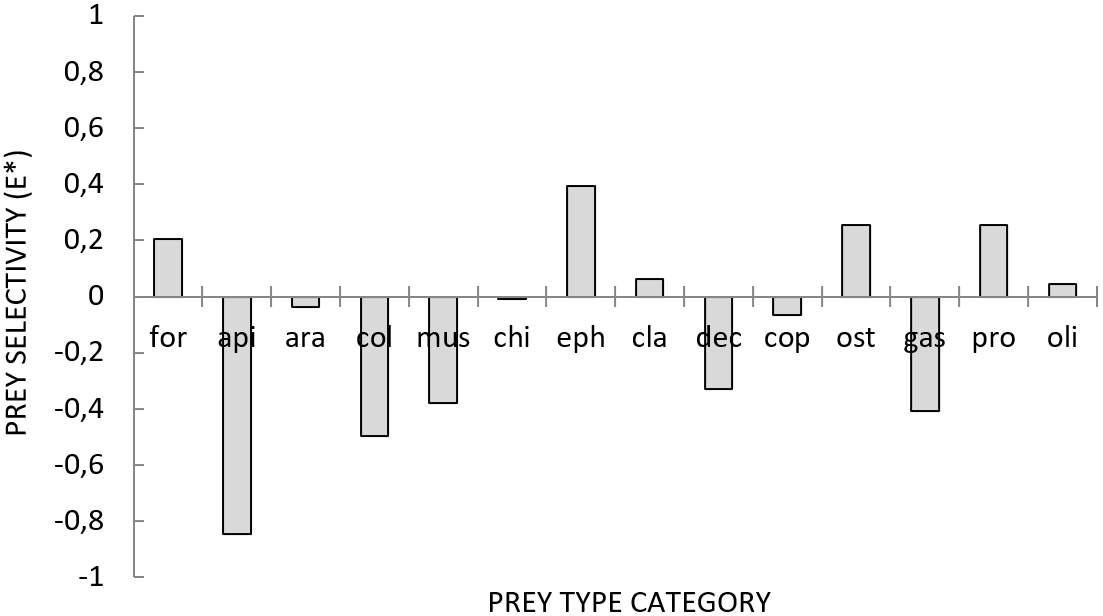
In general, various food combinations occurred in the different fish species. They foraged between one item (case of A. obscurum and A. riggenbachi) and ten items (case of A. loennbergii). However, there was no difference in the prey item intake between the various fish species caught (H = 13.38; p = 0.07). The diet composition was similar among species at low (H = 5.75; p = 0.13) and high (H = 3.91; p = 0.29) elevations, on the one hand, and between species at low elevations compared to those at high elevations, on the other hand (H = 2.74; p = 0.095). Diet composition between species of the same subgenus did not differ: Chromaphyosemion spp. (H = 3.92; p = 0.054) and Mesoaphyosemion spp. (H = 4.05; p = 0.13). Diet differences between the various nothobranchiid species were not obvious, as shown by the multidimensional scaling (Figure 3). For this reason, the prey selectivity index determination considered all the nothobranchiid species combined. The result showed that, in general, positively selected prey items by these fish species were pronounced for the Ephemeroptera, Formicidae, Ostracoda, and Protozoa categories; the Apidae, Coleoptera, Muscidae, Decapoda, and Gasteropoda were generally avoided (Figure 4).
Globally, food niche overlap between the nothobranchiid species at sympatric occurrence sites was high, as shown by Schoener C values that were generally above 0.6, except between A. omega and the species A. ahli, E. infrafasciatus, and A. riggenbachi, and between A. ahli and A. loennbergii (Table 5). The sole case of syntopy of species belonging to the same subgenus was that of A. omega and A. riggenbachi at a single site, with a C value of 0.2. Syntopic species at higher elevations showed moderate to high overlapping trophic interactions (C values between 0.6 and 0.9). Food usage of species of the subgenera Scheelsemion and Chromaphyosemion, often encountered together, as is the case for A. ahli with the species A. loennbergii or A. omega, were compared and showed that in allopatric situations, A. loennbergii can take up to 10 items against only four for A. ahli, while in sympatry, these two species shared only the Hymenoptera (the most common food of all the nothobranchiids examined) and segregated their diet in that they abandoned the decapods. Moreover, the C index between A. ahli in sympatry with each of the Chromaphyosemion species indicated low overlap.
| Species | Epip | Aloe | Aome | Arig | Aamo | Aobs | Acam | Asp | Abat |
|---|---|---|---|---|---|---|---|---|---|
| Aahl | 0.61 | 0.26 | 0.26 | - | - | - | - | - | - |
| Epip | - | 0.66 | 0.3 | 0.82 | 0.85 | - | - | - | - |
| Aloe | - | - | - | - | 0.78 | - | - | - | - |
| Aome | - | - | - | 0.26 | - | - | - | - | - |
| Aexi | - | - | - | - | - | 0.63 | 0.79 | 0.68 | 0.69 |
| Acam | - | - | - | - | - | - | - | - | 0.9 |
| Description: A. ahli (Aahl), A. omega (Aome), A. riggenbachi (Arig), A. exiguum (Aexi), A. obscurum (Aobs), A. cameronense (Acam), A. amoenum (Aamo), A. loennbergii (Aloe), A. batesii (Abat), Aphyosemion sp. (Asp), E. infrafasciatus (Epip). | |||||||||
During the samplings, A. loennbergii and A. amoenum of the same subgenus together occurred at two sites. Their diet composition did not differ (H = 0.008; p = 0.92) and largely overlapped (C = 0.78), indicating that these species were generalists, feeding on the same items in similar proportions. Qualitative comparison of their gut contents in allopatric and sympatric situations showed that in allopatry, they preyed on a large variety of food items; however, in sympatry, there was a high reduction in their prey type uptake, though the number of individuals of both species in this case was unequally distributed (Table 6).
| Food items | Allopatry | Sympatry | ||
|---|---|---|---|---|
| A. loennbergii | A. amoenum | A. loennbergii (n = 54) | A. amoenum (n = 19) | |
| Hymenoptera-Formicidae | + | + | + | + |
| Hymenoptera-Apidae | - | - | - | - |
| Arachnida | - | + | - | - |
| Coleoptera | + | - | - | - |
| Diptera-Muscidae | + | - | - | - |
| Diptera-Chironomidae | + | + | + | + |
| Ephemeroptera | + | + | - | - |
| Branchiopoda-Cladocera | - | + | - | - |
| Decapoda | + | + | - | - |
| Copepoda | + | + | - | - |
| Ostracoda | + | - | + | - |
| Mollusca-Gasteropoda | + | - | - | - |
| Protozoa | - | - | - | - |
| Annelida-Oligochaeta | + | - | - | - |
| Description: (+) = presence; (-) = absence; n = number of individuals. (Broken lines separate ecologically different food category). | ||||
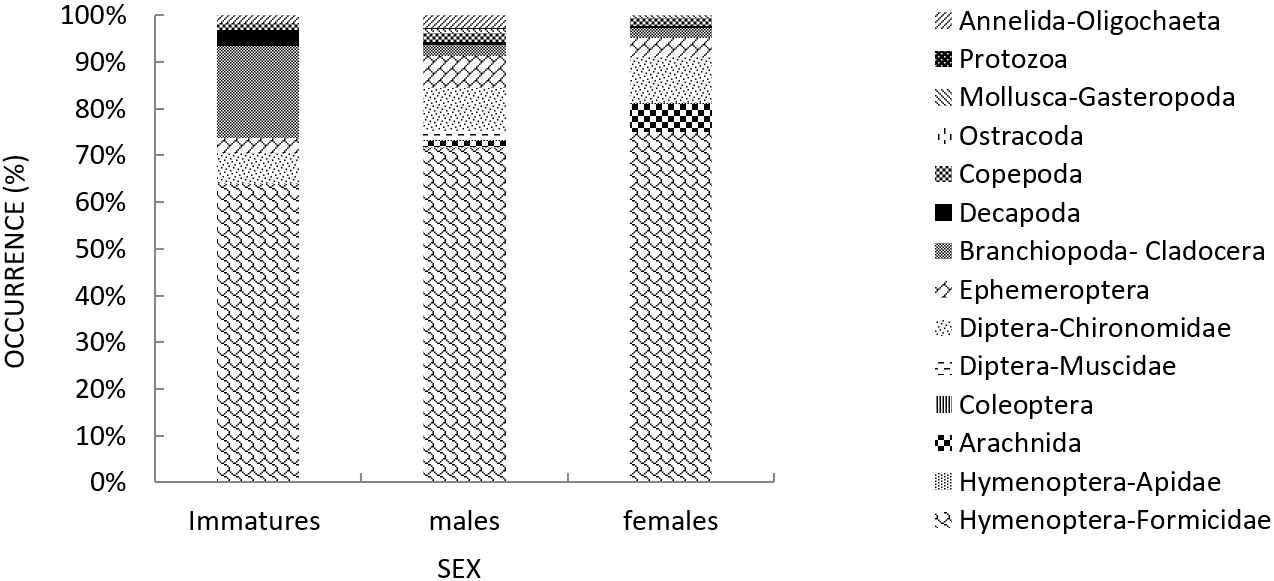
The gut content of each species collected in the various seasons was similar. As previous findings suggest that the species studied appear to prey on the same objects equally, they were all pooled to assess if they could be considered a cohesive whole, following the suggestion of Brosset (8). In this regard, to evaluate the influence of seasons (two dry and two rainy seasons, each with a short and a long season) on prey intake and to determine the index of relative importance of each prey item, the food item categories of all fish species were pooled together. Results showed no seasonal variation in prey item intake (H = 6.31; p = 0.08) (Table 7). Among the trophic spectrum of these fish species, terrestrial insects represented the primary food category (%N = 76.8%) and were the almost exclusive food they foraged on (IRI = 94.3%). In this category, hymenopterans were the dominant group and constituted the preferred prey type (IRI = 96.7%); the other prey items were accidental. Aquatic insects and crustaceans constituted complementary food categories for the nothobranchiids, with respective IRI values of 4.5% and 1.2%. Molluscs, protozoans, and annelids were less frequent and constituted accidental prey (Table 8). The combination of all fish species together and their distribution into the various demographic groups helped check the effect of fish sex/ontogenetic groups (Table 9 and Figure 5) and fish size (Table 10) on prey consumption. Results showed that the diet did not vary either with sex (H = 1.52; p = 0.46), ontogenetic groups (p = 1), or fish size (H = 1.22; p = 0.27).
| Prey type | LDS (n = 120) | SRS (n = 72) | SDS (n = 88) | LRS (n = 208) |
|---|---|---|---|---|
| Hymenoptera-Formicidae | 56.5 | 69.1 | 84.7 | 76.4 |
| Hymenoptera-Apidae | 0.5 | - | - | - |
| Arachnida | 1.0 | - | 10.9 | 1.4 |
| Coleoptera | 0.5 | 1.5 | - | 0.6 |
| Diptera-Muscidae | 4.1 | - | - | - |
| Diptera-Chironomidae | 15.0 | 11.8 | 3.6 | 8.3 |
| Ephemeroptera | 6.7 | 11.8 | - | 5.3 |
| Branchiopoda- Cladocera | 1.6 | - | 0.7 | 5.8 |
| Decapoda | 2.6 | - | - | 0.3 |
| Copepoda | 4.1 | 2.9 | - | 1.1 |
| Ostracoda | 0.5 | - | - | - |
| Mollusca-Gasteropoda | - | 2.9 | - | 0.8 |
| Protozoa | 0.5 | - | - | - |
| Annelida-Oligochaeta | 6.2 | - | - | - |
| Description: LDS = long dry season; SRS = short rainy season; SDS = short dry season; LRS = long rainy season; n = number of fish individuals. | ||||
| Food item | %O | %N | %V | IRI (%) | Prey importance | Rank |
|---|---|---|---|---|---|---|
| Terrestrial insects | 63.9 | 76.8 | 72.6 | 94.3 | preferred | 1 |
| Hymenoptera-Formicidae | 60.9 | 72.5 | 69.1 | 96.7 | preferred | 1 |
| Hymenoptera-Apidae | 0.2 | 0.1 | 0.2 | 0.0 | accidental | 3 |
| Arachnida | 1.8 | 2.9 | 2.1 | 0.1 | accidental | 3 |
| Coleoptera | 0.4 | 0.3 | 0.5 | 0.0 | accidental | 3 |
| Diptera-Muscidae | 0.6 | 1.0 | 0.7 | 0.0 | accidental | 3 |
| Aquatic insects | 14.5 | 14.4 | 16.5 | 4.5 | complementary | 2 |
| Diptera-Chironomidae | 8.2 | 9.1 | 9.3 | 1.7 | complementary | 2 |
| Ephemeroptera | 6.4 | 5.3 | 7.2 | 0.9 | accidental | 3 |
| Crustaceans | 7.8 | 6.4 | 8.8 | 1.2 | complementary | 2 |
| Branchiopoda- Cladocera | 3.9 | 3.8 | 4.4 | 0.4 | accidental | 3 |
| Decapoda | 1.2 | 0.8 | 1.4 | 0.0 | accidental | 3 |
| Copepoda | 2.5 | 1.7 | 2.8 | 0.1 | accidental | 3 |
| Ostracoda | 0.2 | 0.1 | 0.2 | 0.0 | accidental | 3 |
| Others | 1.8 | 2.5 | 2.1 | 0.1 | accidental | 3 |
| Mollusca-Gasteropoda | 1.0 | 0.6 | 1.2 | 0.0 | accidental | 3 |
| Protozoa | 0.2 | 0.1 | 0.2 | 0.0 | accidental | 3 |
| Annelida-Oligochaeta | 0.6 | 1.7 | 0.7 | 0.0 | accidental | 3 |
| Description: Percent occurrence (%O); percent in number (%N); percent volume (%V); index of relative importance (%IRI). | ||||||
| Food item | Immatures (n = 40) | Males (n = 270) | Females (n = 178) |
|---|---|---|---|
| Hymenoptera-Formicidae | 63.9 | 71.6 | 75.0 |
| Hymenoptera-Apidae | - | 0.2 | - |
| Arachnida | - | 1.2 | 5.9 |
| Coleoptera | - | 0.2 | 0.3 |
| Diptera-Muscidae | - | 1.9 | - |
| Diptera-Chironomidae | 6.6 | 9.2 | 10.1 |
| Ephemeroptera | 3.3 | 6.9 | 3.8 |
| Branchiopoda- Cladocera | 19.7 | 2.4 | 2.1 |
| Decapoda | 3.3 | 0.7 | 0.3 |
| Copepoda | 1.6 | 1.9 | 1.7 |
| Ostracoda | - | 0.2 | - |
| Mollusca-Gasteropoda | - | 0.5 | 0.7 |
| Protozoa | - | 0.2 | - |
| Annelida-Oligochaeta | 1.6 | 2.8 | - |
| Food item | Size class (mm LS) | |||||||||
|---|---|---|---|---|---|---|---|---|---|---|
| [15.0-20.4] (n = 82) | [20.5-25.9] (n = 56) | [26.0-31.4] (n = 135) | [31.5-36.9] (n = 62) | [37.0-42.4] (n = 29) | [42.5-47.9] (n = 9) | [48.0-53.4] (n = 11) | [53.5-58.9] (n =2) | [59.0-64.4] (n = 1) | [64.5-69.9] (n = 1) | |
| Hymenoptera-Formicidae | 56.0 | 65.4 | 75.9 | 73.6 | 86.2 | 84.6 | 92.3 | 100.0 | 100.0 | 100.0 |
| Hymenoptera-Apidae | - | 0.5 | - | 0.9 | - | - | - | - | - | - |
| Arachnida | - | 7.1 | 0.5 | 2.7 | 1.7 | 3.8 | - | - | - | - |
| Coleoptera | 1.0 | - | - | - | - | - | - | - | - | - |
| Diptera-Muscidae | - | 0.5 | - | 5.5 | - | 3.8 | - | - | - | - |
| Diptera-Chironomidae | 13.0 | 11.4 | 9.7 | 8.2 | 3.4 | - | 3.8 | - | - | - |
| Ephemeroptera | 3.0 | 4.3 | 10.6 | 2.7 | 5.2 | - | 3.8 | - | - | - |
| Branchiopoda- Cladocera | 13.0 | 4.7 | 1.4 | 0.9 | 1.7 | - | - | - | - | - |
| Decapoda | 2.0 | 0.5 | 0.5 | 1.8 | - | - | - | - | - | - |
| Copepoda | 1.0 | 3.8 | - | 1.8 | - | 7.7 | - | - | - | - |
| Ostracoda | - | - | - | 0.9 | - | - | - | - | - | - |
| Mollusca-Gasteropoda | 1.0 | 0.5 | 0.5 | 0.9 | 1.7 | - | - | - | - | - |
| Protozoa | - | - | 0.5 | - | - | - | - | - | - | - |
| Annelida-Oligochaeta | 10.0 | 1.4 | 0.5 | - | - | - | - | - | - | - |
| Description: n = number of individuals; LS = standard length. | ||||||||||
Discussion
The gut content analysis of 12 non-annual nothobranchiid species investigated revealed that they were all generalists, feeding various prey items, mostly terrestrial arthropods. Previous studies, such as (15) in southeastern Uruguay, (59) in Mozambique, and (60) in southern Brazil, also reported a generalist feeding strategy for annual cyprinodontiform fishes living in ephemeral habitats, but whose diet was instead largely based on aquatic invertebrates. In fact, closely related species living in comparable settings are likely to have similar diet patterns, whether they are annual or not (60). The habitat characteristics of these fish species, which may face some degree of spatial and temporal variability in prey availability, likely account for their choice of the generalist feeding strategy to avoid the costs associated with dietary specialization (15, 59).
The hymenopterans were the most consumed prey item by all the nothobranchiid species, followed by aquatic dipterans (Chironomidae) and Ephemeroptera. These results corroborate those of (61) in Amazonian forest streams and (8) in the Ivindo Basin (Gabon). Results from (62) for Aphyosemion gardneri in Nigeria and most of the fish species in Amazonian waters (63) also showed that terrestrial insects accounted for 76.8% of the total prey consumed. Moreover, results from our ecological investigation are congruent with those of (64), who reported on the diet of Epiplatys infrafasciatus based on a more sophisticated method, the genetic metabarcoding datasets, to estimate biodiversity. By using haplotypic diversity information for finer analyses of prey–predator interactions, the latter authors demonstrated that 60% of the prey items ingested by this species were of terrestrial origin, primarily of the Formicidae, with aquatic organisms just representing 15%. The prominent lower jaw and upward mouth opening are the features allowing these organisms to capture prey at the water surface, especially allochthonous ones, an organism’s trophic ecology being largely determined by the morphology of its feeding structures (65). Our finding, therefore, supports reports stating that permanent rainforest stream fish species depend on allochthonous materials such as terrestrial insects. Indeed, the tropical forest canopy is home to many animals; the diversified and plentiful space and food resources at this level attract and best suit smaller animals, especially arthropods and insects (66). They constitute one of the abundant food resources for small fish inhabiting forest water bodies (67). The food chain in the headwater basin primarily relies on allochthonous resources, as the riparian vegetation inhibits primary production, suggesting that invertivorous fish species dominate upstream (68). According to McKey (69), Hymenoptera (along with the Homoptera with which they are associated) form the dominant animal group in the canopy and account for most of the biomass in tropical rainforests. Their presence in the diet of A. gardneri was observed throughout the year by (62). Together with their almost constant presence and effects on other species, they provide information on the considerable importance of tree ants (70). Hymenoptera and Arachnida constituted the staple food of the genera Aphyosemion and Epiplatys of the Ivindo basin, with hymenopterans coming first with 49 different species belonging mainly to arboreal species of the genera Pheidole, Atopogyrus, and Macromischoides, living on the vegetation itself, and, in a small proportion, the species of the genus Anomma, which are rather terricolous (8).
According to optimal foraging theory (71), prey selectivity depends in part on food resources’ abundance. Formicidae represented the most abundant prey in the environment and formed the primary component of the fish diet. Among aquatic invertebrates, the avoidance of coleopterans and the positive selection of Ephemeroptera insects, Cladocera, and Ostracoda crustaceans are consistent with the findings of (59) for the annual nothobranchiid species N. furzeri and N. rachovii in temporary pools in Mozambique. These small prey types are abundant in African streams, as reported by (72), and their consumption likely reduces foraging expenses. This pattern demonstrates once again ecological consistency among closely related species.
Prey item intake did not differ between the various fish species, neither between species within and between the different elevations, nor from the same subgenus. In addition, food intake did not vary between seasons, sex/ontogenetic groups, or fish size. These results align with (8), suggesting that these taxa have similar diets and would be of the same trophic level, exploiting the same food resources equally. The cyprinodontiformes assemblages and distribution appeared to be highly dependent on environmental gradients, mainly stream altitude (and therefore intra-habitat thermal regimes) (11) and habitat physicochemical characteristics (12, 73-75). Furthermore, even a slight temperature change can highly impact the distribution of Aphyosemion spp. and their freshwater habitats, creating significant barriers to their dispersal (76). The diet of the non-annual fish species was also noticed to be remarkably spatially and temporally stable, even in the long dry season when insect fauna was supposed to have decreased, but with no reduction of prey for cyprinodontiformes (8).
Dietary overlap analyses between sympatric nothobranchiid species showed that resource partitioning among them is not conspicuous. Their food niches generally overlapped. The moderate-to-high food niche overlap between sympatric species suggests that they are ecologically similar organisms with equal responses to environmental demands and no interspecific competition for resource exploitation. According to the neutral theory of Connell’s Intermediate Disturbance Hypothesis (24), their assemblages are maintained at intermediate levels of disturbance, thereby preventing species with high competitive abilities from dominating. The non-pronounced niche differentiation in these circumstances is more likely to predict species coexistence (25). Austrolebias minuano and Cynopoecilus fulgens, two sympatric annual fishes in the temporary pools in Brazil, were found to coexist due to regional-specific characteristics or hazardous events rather than food partitioning, and their high diet overlap was somewhat due to high overall food availability in the area of study and population regulation factors (77). Their findings contradict previous studies on resource partitioning in annual fish communities, which detected dietary diversification driven by ecological and evolutionary constraints (15, 78).
Studies reported that stream fish communities in the tropics experienced very little niche discrimination (61, 63, 79). Aphyosemion amoenum and A. loennbergii are similar in size, morphology, and diet. In syntopy, A. loennbergii was always more abundant; therefore, in a situation of high population density of A. amoenum, there could be a negative interaction between them if food resources decreased. As a group of species that use the same kinds of resources locally, a guild organization largely depends on interspecific competition for these resources (22). However, to coexist in the same milieu, these species must achieve a fine sharing of similar resources that could be direct (when the partial or total ecological segregation of species is the consequence of specific food choices) or indirect (when it results from a spatial or temporal separation), according to two mechanisms attributable to past or present interspecific competition. While the mechanism of immediate adjustments, imposed by the current competition, consists of a reduction in the spectrum of resources usable by the species and is likely to disappear as soon as the pressure of competition ceases, the mechanism of definitive adaptations appears to be imposed by a long co-evolution of competing species (22). In this study, the coexistence of A. amoenum and A. loennbergii can be explained by immediate adjustments, as, despite a few differences observed in their gut contents in both allopatric and sympatric situations, their diets are similar. Moreover, non-annual nothobranchiid fish species tend generally not to have affinities with one another (12). Among the immediate adjustment mechanisms that could be evoked, temporal shifting of their activity period (e. g. from diurnal to nocturnal activity) or movement adjustments can be implemented by the species to avoid physical interactions and reduce overlap while moving through the shared space, a process that could be tied to either individual or species-specific responses to environmental changes (80).
The species of the subgenera Chromaphyosemion and Scheelsemion found in sympatry exhibited a decreased prey type uptake with low overlap. This outcome could suggest probable segregation in food choices to allow coexistence, indicating potential competition between the two species. In this case, such a competition would be more evident in a situation of high population density and limited resources. However, here, the reduced food item categories they preyed upon in sympatry were independent on their abundances, humid tropical forests sheltering the highest levels of biodiversity (81). The competitive exclusion principle (17) would predict a niche separation between sympatric species of Aphyosemion. It appears that this is not the case. According to Brosset (8), the coexistence of multiple nothobranchiid species could not be attributed to different use of food resources, as these fish have nearly identical diets. For this author, the trophic niche of nothobranchiids is realized and understood at the global community level, rather than at the level of individual species, which are ecologically interchangeable. While food competition is the driving force behind exclusion in some tropical stream fish and some South American annual killifish species (15, 56, 78), it seems not to play a role for African rainforest nothobranchiids, probably due to the food supplies remaining more or less stable whatever the season, as reported in the Ivindo basin (8) that extends far beyond the south Cameroonian plateau into Gabon (82) and some Amazonian streams (61, 77). Therefore, in the small streams of the rainforest region of Cameroon, competition for food resources is not likely to be a factor structuring the assemblages and distribution of the non-annual nothobranchiid fish species.
Conclusion
The trophic interactions between non-annual nothobranchiid fish species that coexist in southern Cameroon's forest streams were analysed based on gut content analyses and using ecological indices to determine the role of diet on the structure and organisation of this fish community. The results indicate that their trophic niches in the study area overlap significantly, which at first glance suggests the existence of interspecific competition for food resources, particularly in syntopic situations. However, the low stocking densities of these fish and the abundance of food in their biotope suggest that diet is not a main structuring factor of the spatial distribution of these teleosts. Nothobranchiid species coexist in these circumstances by making immediate adaptations; their social structure is therefore driven by stochastic events and local environmental conditions rather than by any natural particular mechanisms. Nevertheless, using gut content alone to address food resource use is insufficient, and to complete this study, it would be necessary to determine these teleosts’ actual niche in the trophic networks of their biotopes through stable isotope analysis. This study highlights the importance of considering species’ resources and habitats in the face of rapid degradation of particular ecosystems in response to global changes. Therefore, since the Nothobranchiids’ assemblages rely so heavily on allochthonous canopy insects for survival, protecting the terrestrial tree canopy and riparian vegetation is vital for their ecological preservation.
Declarations
Acknowledgment
The authors express their gratitude to the community residents who volunteered their time and helped as guides during sample collection in their localities. The authors declare that no artificial intelligence (AI) or AI-assisted technologies were used in the research, analysis, or preparation of this manuscript.
Conflict of Interest
The authors declare no conflict of interest.
Data Availability
The datasets generated and/or analyzed during the current study are available from the corresponding author on reasonable request.
Ethics Statement
All animal procedures were conducted in accordance with the guidelines of the Institutional Animal Care and Use Committee (IACUC) of Cameroon National Ethical Committee (Approval No. FWAIRD 0001954). The fish collection was under permit 0020/ASE/MINEPIA/DIRPEC/SDARA.
Funding Information
This work received no external funding.
References
- Eba’a Atyi R, Hiol Hiol F, Lescuyer G, Mayaux P, Defourny P, Bayol N, Saracco F, Pokem D, Sufo Kanko R, Nasi R. Les forêts du bassin du Congo: état des forêts 2021. Bogor: CIFOR; 2022.
- Roberts TR. Geographical distribution of African freshwater fishes. Zool J Linn Soc. 1975;57(4):249-319.
- Amiet JL. Fauna of Cameroon - The genus Aphyosemion Myers (Pisces, Teleostei, Cyprinodontiformes), vol 2. Compiègne: Sciences Nat.; 1987.
- Ewing AW, Evans V. Studies on the behaviour of Cyprinodont fish I. The agonistic and sexual behaviour of Aphyosemion bivittatum (Lönnberg 1895). Behaviour. 1973;46(3-4):264-278.
- Dow M, Ewing AW, Sutherland I. Studies on the behaviour of Cyprinodont fishes III. The temporal patterning of aggression in Aphyosemion striatum (Boulenger). Behaviour. 1976;59(3-4):252-268.
- Pandare D, Romand R. Capacité prédatrice d’Epiplatys spilargyreius (Pisces, Cyprinodontidae) de l’Afrique de l’Ouest envers les larves de Culicidae (Diptera). Acta Oecol Oecol Applic. 1986;7(2):201-212.
- Pandare D, Romand R. Feeding rates of Aphyosemion geryi (Cyprinodontidae) on mosquito larvae in the laboratory and in the field. Rev Hydrobiol Trop. 1989;22(3):251-258.
- Brosset A. Le peuplement des Cyprinodontes du bassin de l'Ivindo, Gabon. Rev Ecol (Terre Vie). 1982;36(2):233-292.
- Kamdem Toham A, Teugels GG. Patterns of microhabitat use among fourteen abundant fishes of the lower Ntem River Basin (Cameroon). Aquat Living Resour. 1997;10(5):289-298.
- Kamdem Toham A, Teugels GG. First data on an Index of Biotic Integrity (IBI) based on fish assemblages for the assessment of the impact of deforestation in a tropical West African river system. Hydrobiologia. 1999;397(0):29-38.
- McKenzie DJ, Estivales G, Svendsen JC, Steffensen JF, Agnèse JF. Local adaptation to altitude underlies divergent thermal physiology in tropical killifishes of the genus Aphyosemion. PLoS ONE. 2013;8(1):e54345-5.
- Messu Mandeng FD, Bilong Bilong CF, Agnèse JF. Species diversity and distribution pattern determinants of African rivulines (Cyprinodontiformes: Nothobranchiidae) in rainforest streams of southern Cameroon. Afr Zool. 2024;59(1):10-25.
- Anderson MJ, Millar RB. Spatial variation and effects of habitat on temperate reef fish assemblages in north-eastern New Zealand. J Exp Mar Biol Ecol. 2004;305(2):191-221.
- Peres-Neto PR, Legendre P. Estimating and controlling for spatial structure in the study of ecological communities. Glob Ecol Biogeogr. 2009;19(2):174-184.
- Laufer G, Arim M, Loureiro M, Piñero-Guerra JM, Clavijo-Baquet S, Fagúndez C. Diet of four annual killifishes: an intra and interspecific comparison. Neotrop Ichthyol. 2009;7(1):77-86.
- Polačik M, Reichard M (2009). Indirect fitness benefits are not related to male dominance in a killifish. Behav Ecol Sociobiol. 2009;63(10):1427-1435.
- Gause GF. The struggle for existence. Baltimore: Williams and Wilkins Company; 1934.
- Hutchinson GE. The Ecological theatre and the evolutionary play. New Haven: Yale University Press; 1965.
- Schoener TW. Resource partitioning in ecological communities. Science. 1974;185(4145):27-39.
- Noon BR. The distribution of an avian guild along a temperate elevational gradient: the importance and expression of competition. Ecol Monogr. 1981;51(1):105-124.
- Pianka ER (1974). "Niche overlap and diffuse competition." Proc Natl Acad Sci. 1974;71(5):2141-5.
- Barbault R. Ecologie des populations et des peuplements. Des théories aux faits. Paris: Masson; 1981.
- Hutchinson GE. Concluding remarks. Cold Spring Harbor Symposia on Quantitative Biology. 1957;22(0):415-427.
- Connell JH. Diversity in tropical rain forests and coral reefs. Science. 1978;199(4335):1302-10.
- Tilman D. Niche tradeoffs, neutrality, and community structure: a stochastic theory of resource competition, invasion, and community assembly. Proc Natl Acad Sci. 2004;101(30):10854-61.
- Grossman DG. Food resource partitioning in a rocky intertidal fish assemblage. J Zool. 1986;1(2):317-355.
- Chesson P. Mechanisms of maintenance of species diversity. Annu Rev Ecol Evol Syst. 2000;31:343–366.
- Chase JM, Leibold MA. Ecological Niches: Linking Classical and Contemporary Approaches. Chicago: University of Chicago Press; 2003.
- Reichard M, Polačik M, Sedláček O. Distribution, color polymorphism and habitat use of the African killifish Nothobranchius furzeri, the vertebrate with the shortest life span. J Fish Biol. 2009;74(1):198-212.
- Messu Mandeng FD, Agnèse JF, Morand S, Bilong Bilong CF. Insight into the diversity of parasites of Cyprinodontiformes (Pisces, Teleostei) from forest streams of South Cameroon, Central Africa, and their potential impact. Int J Res Stud Biosci. 2015;3(10):98-106.
- Winemiller KO. Ecomorphological diversification of freshwater fish assemblages from five biotic regions. Ecol Monogr. 1991;61(4):343-65.
- Hughes RN. Introduction. In: Hughes RN, editor. Diet selection, an interdisciplinary approach to foraging behaviour. Oxford: Blackwell Scientific Publications; 1993. p. 1-9.
- Berryman AA. Principles of population dynamics and their application. Cheltenham (UK): Stanley Thornes; 1999.
- McNab BK. The physiological ecology of vertebrates. Ithaca (NY): Cornell University Press; 2002.
- Brown JH, Gillooly JF, Allen AP, Savage VM, West GB. Toward a metabolic theory of ecology. Ecology. 2004;85(7):1771-89.
- Ward AJW, Hart PJB, Krause J. The effects of habitat- and diet-based cues on association preferences in three-spined sticklebacks. Behav Ecol. 2004;15(6):925-929.
- Thébault E, Loreau M. The relationship between biodiversity and ecosystem functioning in food webs. Ecol Res. 2005;21(1):17-25.
- Arim M, Marquet PA, Jaksic FM. On the relationship between productivity and food chain length at different ecological levels. Am Nat. 2006;169(1):62-72.
- Letouzey R. Notice de la carte phytogéographique du Cameroun au 1/500000. Toulouse: Institut de la Carte Internationale de la Végétation; 1985.
- Amou’ou Jam JP, Melingui A, Mounkam J, Tchepannou A. Géographie, le Cameroun. Yaoundé: Editions Clé (Armand Colin); 1985.
- Parenti LR. A phylogenetic and biogeographic analysis of cyprinodontiform fishes (Teleostei, Atherinomorpha). Bull Am Mus Nat Hist. 1981;168(4):335-537.
- Sonnenberg R (2007). Description of three new species of the genus Chromaphysemion Radda, 1971 (Cyprinodontiformes: Nothobranchiidae) from the coastal plains of Cameroon with a preliminary review of the Chromaphyosemion splendopleure complex. Zootaxa. 2007;1591:1-38.
- Van der Zee JR, Woeltjes T, Wildekamp RH. Aplocheilidae Bleeker, 1860. In: Stiassny MLJ, Teugels GG, Hopkins CD, editors. The Fresh and Brackish Water fishes of Lower Guinea, West Central Africa. Vol 2. Paris: IRD; 2007. p. 80-240.
- Huber JH. Reappraisal of the Phylogeny of the African genus Aphyosemion (Cyprinodontiformes) focused on External Characters, in line with Molecular Data, with new and redefined Subgenera. Killi-Data Series 2013. 2013:4-20.
- Labhart P, Ziswiler V. Vergleichende-morphologische Untersuchungen am Verdauungstrakt verschiedener Zahnkärpflinge (U.O. Cyprinodontoidei). Rev Suisse Zool. 1979;86(4):843-854.
- Pouilly M, Barrera S, Rosales C. Changes of taxonomic and trophic structure of fish assemblages along an environmental gradient in the Upper Beni watershed (Bolivia). J Fish Biol. 2006;68(1):137-156.
- Ibanez C, Oberdorff T, Teugels G, Mamononekene V, Lavoué S, Fermon Y, Paugy D, Toham AK. Fish assemblage structure and function along environmental gradients in rivers of Gabon (Africa). Ecol Freshw Fish. 2007;16(3):315-334.
- Needham JG, Needham PR. A guide to the study of Freshwater biology. 5th ed. San-Francisco: Holden-Day; 1962.
- Dierl W, Ring W. Guide des insectes: Description, Habitat et moeurs. Paris: Delachaux et Niestlé; 1992.
- Berg J. Discussion of methods of investigating the food of fishes, with reference to a preliminary study of the prey of Gobiusculus flavescens (Gobiidae). Mar Biol. 1979;50(3):263-273.
- Marrero C, Lopez-Rojas H. Quantitative evaluation of the point method for fish stomach analysis. J Fish Biol. 1995;47(5):914-916.
- McMahon KW, Johnson BJ, Ambrose WG. Diet and movement of the killifish, Fundulus heteroclitus, in a Maine salt marsh assessed using gut contents and stable isotope analyses. Estuaries. 2005;28(6):966-973.
- Pinkas L, Solipant M, Iverson lLK. Food habits of albacore, blue fin tuna and bonito in Californian waters. California, Department of Fish and Game. Fish Bull. 1970;152:1-105.
- Vanderploeg HA, Scavia D. Calculation and use of selectivity coefficients of feeding: zooplankton grazing. Ecol Model. 1979;7(2):135-149.
- Schoener TW. Non-synchronous spatial overlap of lizards in patchy habitats. Ecology. 1970;51(3):408-418.
- Zaret TM, Rand AS. Competition in tropical stream fishes: support for the competitive exclusion principle. Ecology. 1971;52(2):336-342.
- Wallace RK. An assessment of diet-overlap indexes. Trans Am Fish Soc. 1981;110(1):72-76.
- Childs MR, Clarkson RW, Robinson AT. Resource use by larval and early juvenile native fishes in the Little Colorado River, Grand Canyon, Arizona. Trans Am Fish Soc. 1998;127(4):620-629.
- Polačik M, Reichard M. Diet overlap among three sympatric African annual killifish species Nothobranchius spp. from Mozambique. J Fish Biol. 2010;77(3):754-768.
- Gonçalves C da S, Souza UP, Volcan MV. The opportunistic feeding and reproduction strategies of the annual fish Cynopoecilus melanotaenia (Cyprinodontiformes: Rivulidae) inhabiting ephemeral habitats on southern Brazil. Neotrop Ichthyol. 2011;9(1):191-200.
- Knöppel HA. Food of Central Amazonian fishes. Contribution to the nutrient ecology of Amazonian rainforest-streams. Amazoniana. 1970;2(3): 257-352.
- Akpan BE, King RP, Goodluck EJ. Diet of an African killifish Aphyosemion gardneri (Aplocheilidae) in a Nigerian rainforest pond. Acta Zool Sin. 2006;52(4):669-675.
- Saul W. An ecological study of fishes in a site in upper amazonian Ecuador. Proc Acad Nat Sci Phila. 1975;127(12):93-134.
- Corse E, Tougard C, Archambaud-Suard G, Agnèse JF, Messu Mandeng FD, Bilong Bilong CF, Duneau D, Zinger L, Chappaz R, Xu CY, Meglécz E, Dubut V. One-locus-several-primers: A strategy to improve the taxonomic and haplotypic coverage in diet metabarcoding studies. Ecol Evol. 2019;9(8):4603-4620.
- Herder F, Freyhof J. Resource partitioning in a tropical stream fish assemblage. J Fish Biol. 2006;69(2):571-589.
- Puig H. La forêt tropicale humide. Paris: Belin; 2001.
- Motta RL, Uieda VS. Food web structure in a tropical stream ecosystem. Austral Ecol. 2008;30(1):58-73.
- Lowe-McConnell RH. Fish communities in tropical freshwaters: their distribution, ecology and evolution. London: Longman; 1975.
- McKey D. Interactions between ants and plants: comparison of canopy, understory and clearing environments. In: Halle F, Pascal O, editors. Biologie d’une canopée d’une forêt équatoriale. Paris: Longman; 1991. p. 66-73.
- Tobin JE. Ecology and diversity of tropical forest canopy ants. In: Lowman MD, Nadkarni N, editors. Forest canopies. San Diego: Academic Press; 1995. p. 129-147.
- Pyke GH, Pulliam HR, Charno EL. Optimal foraging: a selective review of theory and tests. Q Rev Biol. 1977;52(2):137-154.
- Meintjes S. Seasonal changes in the invertebrate community of small shallow ephemeral pans at Bain’s Vlei, South Africa. Hydrobiologia. 1996;317(1):51-64.
- Zamani Faradonbe M, Eagderi S. Fish assemblages as influenced by environmental factors in Taleghan River (the Caspian Sea basin, Alborz Province, Iran). Casp J Environ Sci. 2015;13(4):363-371.
- Lanés LEK, Reichard M, de Moura RG, Godoy RS, Leonardo Maltchik L. Environmental predictors for annual fish assemblages in subtropical grasslands of South America: the role of landscape and habitat characteristics. Environ Biol Fishes. 2018;101(6):963-977.
- Vieira TB, Tejerina-Garro FL. Relationships between environmental conditions and fish assemblages in tropical savanna headwater streams. Sci Rep. 2020;10(1):2174.
- Olden JD, Kennard MJ, Leprieur F, Tedesco PA, Winemiller KO, García-Berthou E. Conservation biogeography of freshwater fishes: recent progress and future challenges. Divers Distrib. 2010;16(3):496-513.
- Keppeler FW, Lanés LEK, Rolon AS, Stenert C, Reichard M, Maltchik L. The morphology-diet relationship and its role in the coexistence of two species of annual fishes. Ecol Freshw Fish. 2015;24(1):77-90.
- Costa WJEM. Trophic radiation in the South American annual killifish genus Austrolebias (Cyprinodontiformes: Rivulidae). Ichthyol Explor Freshw. 2009;20(2):179-191.
- Goulding M, Carvalho ML, Ferreira EG. Rio Negro, rich life in poor water. Amazonian diversity and food chain ecology as seen through fish communities. The Hague: SPB Academic Publishing; 1988.
- Valladares F, Bastias CC, Godoy O, Granda E, Escudero A. Species coexistence in a changing world. Front Plant Sci. 2015;6(866):1-16.
- Dajoz R. Mésoclimats et microclimats. Leur influence sur les êtres vivants. In: Précis d’écologie. 7th ed. Paris: Dunod; 2000. p. 59-86.
- Fodouop K, Atangana P. Une diversité du milieu biophysique exceptionnelle. In: Le Cameroun: autopsie d’une exception plurielle en Afrique. Paris: L’Harmattan; 2010. p. 25-44.