RESEARCH ARTICLE
Effects of Xanthan, CMC-Na, and Avicel RC-591 on Sucralfate Suspension Characteristics and Physical Stability
Academic Editor: Garnadi Jafar
Sciences of Pharmacy|Vol. 5, Issue 3, pp. 343-350 (2026)
CC BY 4.0-2026 Authors
Views
Downloads
Shares

Received
Apr 9, 2026Revised
Jun 21, 2026Accepted
Jul 17, 2026Published
Aug 23, 2026
Abstract
Sucralfate is a medicine for peptic ulcers that is practically insoluble in water and might to be developed into a suspension. The choice of suspending agents is essential for formula development. This study aimed to determine the physical characteristics and physical stability of xanthan gum, CMC-Na, and Avicel RC-591 in a sucralfate suspension by conducting a characterization and stability study and analyzing the formulations. Suspensions were prepared with 0.3% w/v xanthan gum (XG), 1% w/v CMC-Na (SCMC), and 1% w/v Avicel RC-591 (ARC) and then evaluated for physical appearance, pH, density, viscosity, sedimentation, and redispersibility in a six-month stability study conducted under various storage conditions. The pH results ranged between 5.113 ± 0.001 and 4.622 ± 0.033 (p > 0.05). The density of the SCMC formula (1.1459 ± 0.0003) is greater than the density of the ARC formula (1.1396 ± 0.0002) and XG (1.1162 ± 0.0002), but statistically, the three formulas are not significantly different (p > 0.05). The viscosity of XG is greater than SCMC and ARC. The formulas indicated that XG had greater sedimentation than SCMC and ARC (p > 0.05). The redispersibility of all formulations is ARC > SCMC > XG. In conclusion, ARC and SCMC exhibit acceptable suspension characteristics and robust physical stability. Conversely, formulations utilizing XG fail to meet the required quality standards for sucralfate suspensions regarding redispersibility.
Introduction
Peptic ulcer disease indicates a severe medical problem. People who were born in the middle of the 20th century are more likely to suffer from peptic ulcer disease. Every year, approximately 500, 000 new cases are reported, affecting 5 million individuals in the United States alone. Ulcer disease is an illness that predominantly affects the elderly today, with an average incidence between ages 55 and 65. Three-fifths of gastric ulcer patients develop severe complications (1). During the ages of 30 to 50, the prevalence of peptic ulcers ranges between 11 and 14% for men and 8 and 11% for women. Over the age of 60, peptic ulcers occur infrequently, but they are critical in 80% of those cases (2).
The infection caused by Helicobacter pylori and acid-pepsin secretion are the primary causes of peptic ulcer disease. Other important etiological factors include long-term use of non-steroidal anti-inflammatory drugs (NSAIDs), shock, severa trauma, septicaemia, intracranial lesions, local irritants such as alcohol, smoking, spicy food, and Zollinger-Ellison syndrome, which induces excessive gastric acid secretion due to gastrinoma-associated hypergastrinemia (1, 2).
The pharmacological management of peptic ulcer disease includes gastric acid-suppressing agents (H2-receptor antagonists, proton pump inhibitors, anticholinergics, and prostaglandin analogues), antacids, mucosal protective agents (e. g., sucralfate and colloidal bismuth subcitrate), and antimicrobial agents for Helicobacter pylori eradication. Sucralfate acts locally by forming a protective barrier over gastric mucosal lesions, shielding them from gastric acid, pepsin, and bile salts, thereby promoting mucosal healing (3, 4). Based on its physicochemical properties, particularly its poor water solubility and local mode of action, sucralfate is more appropriately formulated as an oral suspension (5, 6, 7).
The selection of the right suspending agents is an important step in developing appropriate suspension formulations. The function of the suspension agent is to help in the dispersion of dense, undissolved particles in a liquid medium while helping to increase viscosity and prevent sedimentation. For instance, xanthan gum, methylcellulose (MC), carboxymethylcellulose (CMC), hydroxypropyl methylcellulose (HPMC), and tragacanth are all examples of suspension agents (8).
According to investigations of suspension forms of antacids and herbal antiulcer therapies, xanthan gum 0.3% and 0.25% (9); 0.5% and 1% (10), with good redispersion and high viscosity, can decrease particle reactions and slow sedimentation. Another study indicated that a seven-day suspension of 0.1% xanthan gum is easily dispersed, does not form into a cake, and sediments at 0.98 (11). The research suggested that the increase in CMC-Na was due to the added benefit of aiding in the treatment of chronic occupational conditions brought on by antacid therapy. Additionally, the treatment of gastritis with CMC-Na (extract from the leaves of Corchorus olitorius) was utilized as a treatment for ulcers and as a means of preventing ulcers from forming (12). The inversion of the CMC-Na stabilization test resulted in lower viscosity and reduced circulation at higher concentrations of CMC-Na (0.5, 1, 1.5, and 2%) (10). While the formula contains xanthan gum, its redispersibility value decreases as viscosity increases continuously with equal stability (10). Suspension with 1% Avicel RC-591 shows a stable pseudoplastic thixotropy system throughout stability and the potential for low sedimentation, as indicated by a maximum redispersion test with one inversion (4). Syrup study employing delayed-release added Avicel RC-591 to improve viscosity to minimize sedimentation (13).
Based on this background, the purpose of this study was to evaluate the physical characteristic and physical stability of xanthan gum, CMC-Na, and Avicel RC-591 in a sucralfate suspension by conducting a stability study.
Methodology or Experimental Section
Materials
Sucralfate (Zhejiang Haisen) was used as a model drug; Xanthan Gum (Danisco, France), Sodium Carboxymethylcellulose (Ashland, Alizat, France), and Avicel-RC 591 (ASAHI Kasei) were selected as suspending agents; Sucralose (Unisweet, Shandong) was used as sweetening-agent; Sodium Benzoate (Wuhan Youji) was used as preservative; Sorbitol Liquid 70% (Sorini Towa Berlian Corporindo) was used as sweetening-agent and cosolvent; Glycerine (SUMIASIH) was used as wetting-agent and cosolvent; peppermint was used as flavouring agent, and distilled water was used as solvent.
Preparation of Sucralfate Suspension
XG 0.3 g was dispersed in distilled water to form a mucilage. Sucralfate (10 g) was mixed with 6 mL of glycerine and then gradually incorporated into the XG mucilage. Sucralose Dissolve (0.02 g) and sodium benzoate (0.1 g) were dissolved in distilled water and the resulting solution was added to the previous mixture, followed by the addition of 70% sorbitol solution and peppermint flavor. The final volume was adjusted to 100 mL with distilled water, and the suspension was transferred to an amber bottle. The same procedure was repeated with 1 g of SCMC and 1 g of ARC to prepare the respective suspension. The compositions of all the formulations are presented in Table 1.
| Ingredients | Quantity in g/100 mL | ||
|---|---|---|---|
| F1 | F2 | F3 | |
| Sucralfate | 10 | 10 | 10 |
| Xanthan Gum (XG) | 0.3 | - | - |
| Sodium Carboxymethylcellulose (SCMC) | - | 1 | - |
| Avicel RC-591 (ARC) | - | - | 1 |
| Sodium Benzoate | 0.1 | 0.1 | 0.1 |
| Sucralose | 0.02 | 0.02 | 0.02 |
| Glycerine (mL) | 6 | 6 | 6 |
| Sorbitol Liquid 70% (mL) | 20 | 20 | 20 |
| Peppermint flavour | qs | qs | qs |
| Distilled water (mL) ad | 100 | 100 | 100 |
Physical Characterization
Determination of Physical Appearance
Determination of formulation color, odor, clarity, and homogenity compared with chiller stability to ensure the sample showed a proportional form with a white-sweet odor.
Determination of pH
The pH values for formulations were determined at 25 ºC by a Mettler Toledo pH Meter. All measurements were carried out in triplicate (14).
Determination of Density
The density values for formulations were determined at 25 ºC by density meter Anton Paar. All measurements were carried out in triplicate.
Determination of Viscosity
The viscosity was determined at 25 ºC by Viscometer Brookfield with 10 rpm (14).
Determination of Sedimentation
Each suspension was measured in a 50 mL was kept in measuring cylinder. By turning it upside down three times, the suspension was completely dispersed. After three minutes of settling, the volume of sediment was measured. This is the initial sediment volume (H0). The cylinder remained undisturbed for four days. The final volume of sediment (Hu) was determined by measuring the volume of sediment every 24 hours for four days. Sedimentation Volume (F)=Hu/H0 (15, 16).
Determination of Redispersibility
A fixed volume of each suspension (50 mL) was kept at room temperature in a measuring cylinder for four days. The measuring cylinders were manually turned upside down until the sediment was thoroughly dispersed, and the total number of times the cylinders were turned upside down was recorded (15, 16).
Stability of Sucralfate Suspension
Stability studies were carried out on all suspension formulations for 6 months at three temperatures i. e. , 30 °C/70% RH, 40 °C/75% RH and 5 °C ± 3°C. The samples were taken at intervals for 0, 1, 3, 6 months storage to evaluate pH, density, viscosity, sedimentation and redispersibility (17).
Statistical Analysis
The physicochemical characteristics of the sucralfate suspension formulations were statistically analyzed using SPSS software. One-way analysis of variance (ANOVA) was employed as parametric test for data that fulfilled the assumptions of normality and homogeneity of variance. Data that did not meet these assumptions were analyzed using the Kruskal-Wallis test as a nonparametric alternative. Differences among groups were considered statistically significant at p < 0.05.
Results and Discussion
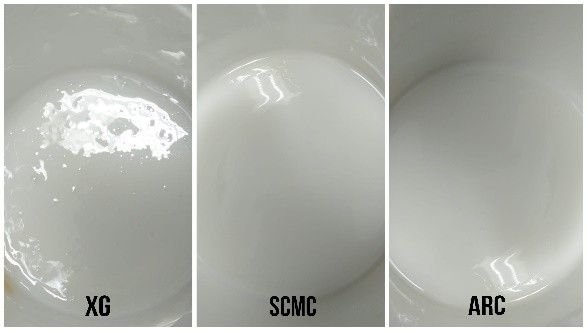
All three sucralfate suspension formulations exhibited a white appearance and a pleasant odor (Figure 1). Initially, all formulations were homogeneous, with no visible particle separation. However, during the stability study, the XG formulation (F1) began to form a hard cake within the first month of storage. In contrast, the SCMC (F2) and ARC (F3) formulations exhibited sedimentation while maintaining good redispersibility.
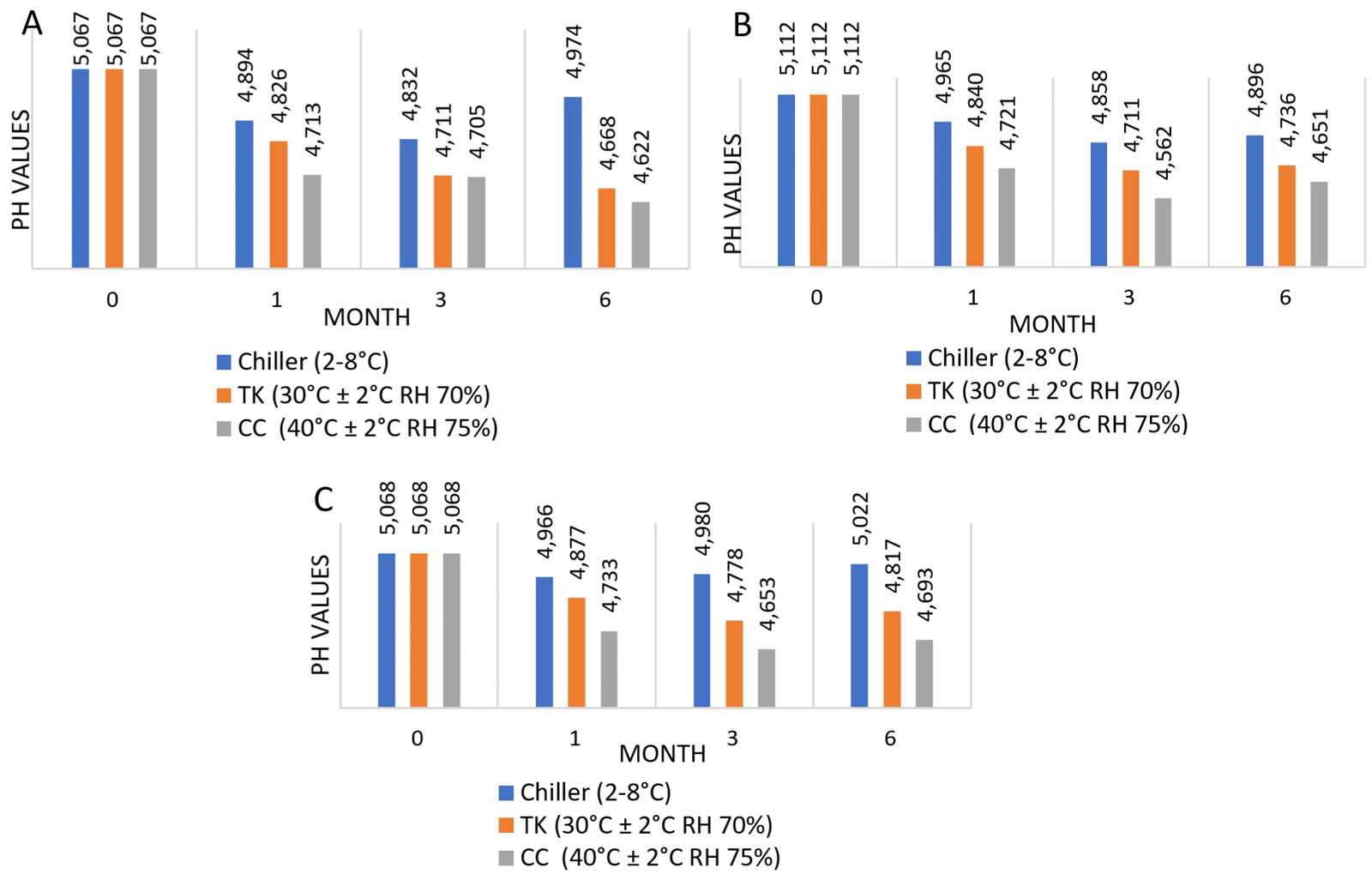
The pH test was performed to evaluate changes in the pH of all formulations throughout the stability study. As shown in Figures 2 and Table 2, the pH values of all formulations ranged from 5.113 ± 0.001 to 4.622 ± 0.033 during storage. These values fall within the weakly acidic range (pH > 4.5) (16), indicating their suitability for use in antiulcer suspension formulations. Although the pH of all formulations gradually decreased during storage as the temperature increased, the changes were not statistically significant (p > 0.05) and remained close to the initial pH values. The stability of the formulations may be attributed to the pH stability of XG, SCMC, and ARC, which are reported to be stable over a pH range of 4–10 according to the Handbook of Pharmaceutical Exipients (18).
| Formula | Organoleptic | Physicochemical Characteristic | ||||
|---|---|---|---|---|---|---|
| pH | Density (g/cm3) | Viscosity (cP) | Sedimentation | Redispersibility (%) | ||
| F1 (XG) | white-sweet odor | 5.067 ± 0.013 | 1.1162 ± 0.0002 | 5428 | caking | caking |
| F2 (SCMC) | white-sweet odor | 5.113 ± 0.001 | 1.1459 ± 0.0003 | 110.4 | 0.52 | 70 |
| F3 (ARC) | white-sweet odor | 5.067 ± 0.002 | 1.1396 ± 0.0002 | 43.8 | 0.54 | 85 |
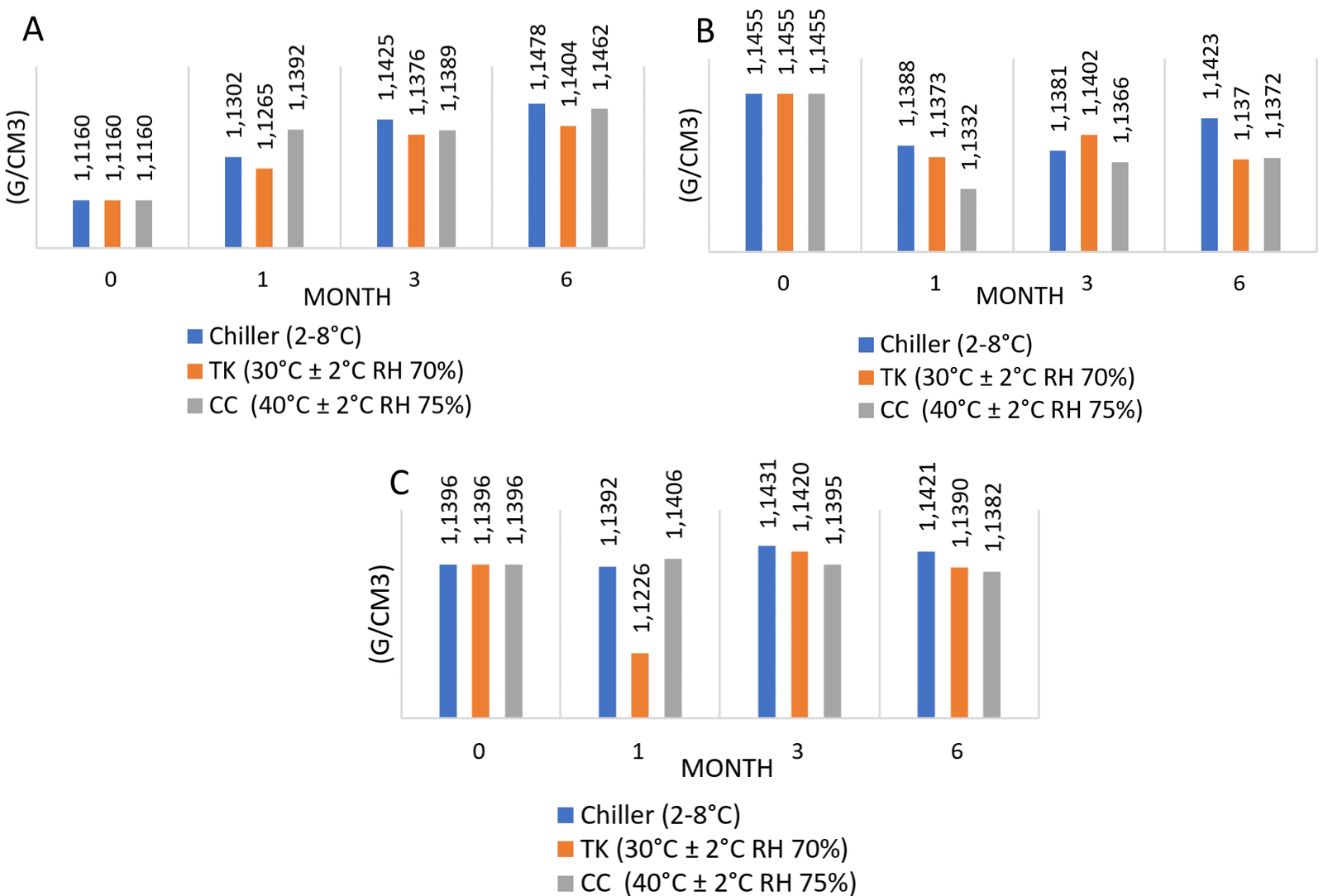
As shown in Figures 3, the density of all formulations remained relatively stable throughout the stability study. Among the formulations, the SCMC suspension exhibited the highest density, ranging from 1.1459 ± 0.0003 to 1.1331 ± 0.0005 (Figure 3B), compared with the XG and ARC formulation (Figure 3A) showed a slight increase as the pH decreased (Figure 2A); however, this change was not statistically significant during storage (p > 0.05). The increase in density may be attributed to particle aggregation under conditions where the pH is below the pKa, resulting in stonger interparticle interaction (19). In contrast, the density of the SCMC formulation (Figure 3B) gradually decreased with the reduction in pH (Figure 2D). Similarly, the ARC formulation exhibited a slight decrease in density during storage. However, the density changes observed in both the SCMC and ARC formulations were not statistically significant (p > 0.05).
As shown in Figure 4 and Table 2, the initial viscosity of the XG formulation was higher than that of the SCMC and ARC formulations. Previous studies by G. Roopa et al. (2010) and Haile et al. (2020), reported that XG at a concentration 0.3% w/v exhibits high viscosity, which reduces particle mobility and delay sedimentation. However, in the present study, the same concentration of XG in the sucralfate suspension resulted in the formation of hard cake despite its high viscosity. As shown in Figure 4B, the viscosity of the XG formulation increased during storage but decreased at elevated temperatures. Nevertheless, these changes were not statistically significant throughout the stability study (p > 0.05).
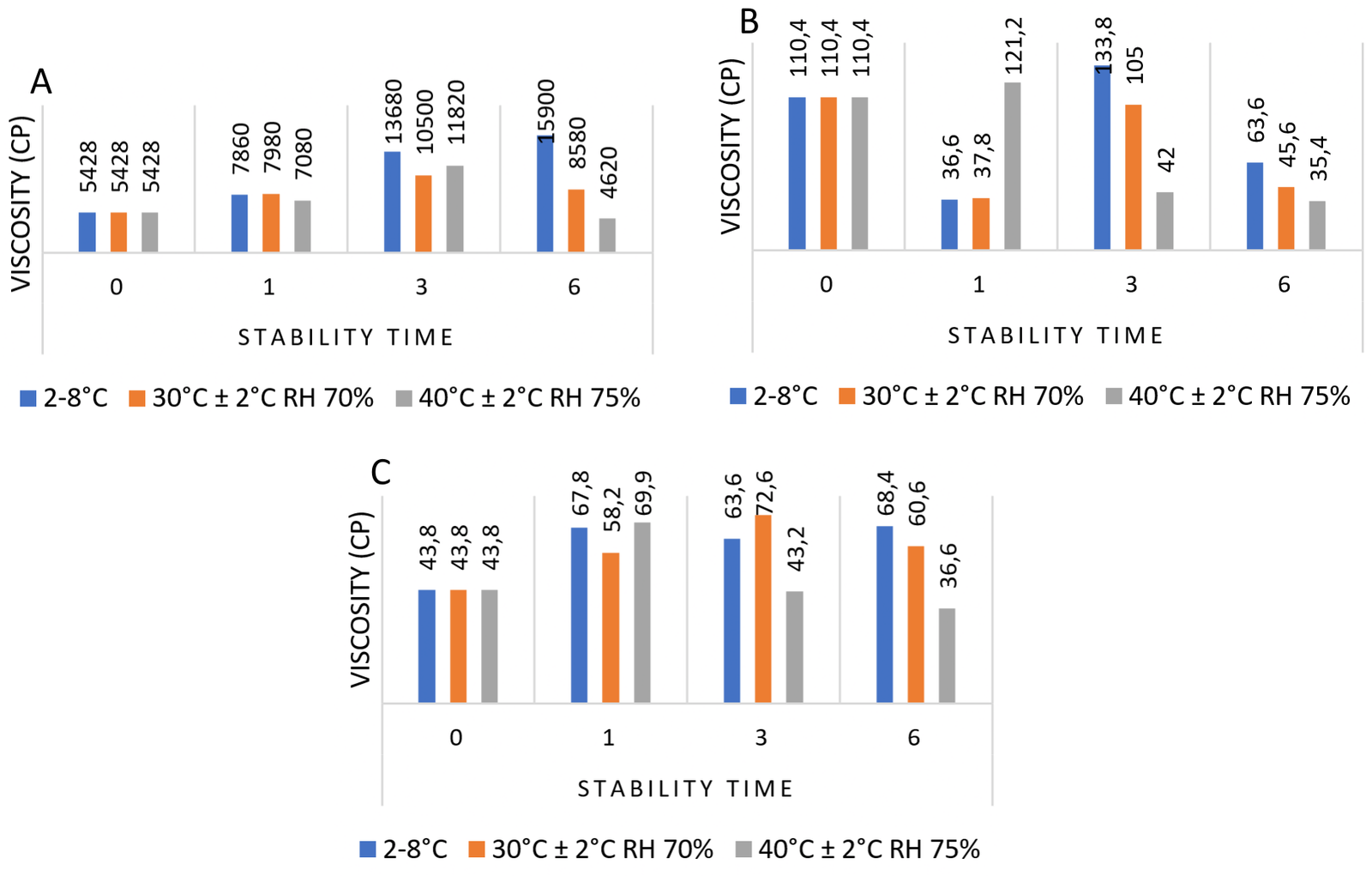
Meanwhile, the viscosities of the SCMC (Figure 4B) and ARC (Figure 4C) formulations decreased over the storage period and with increasing temperature. The viscosity of SCMC gradually decreased under applied shear stress while exhibiting an increased flow activation index. These viscosity properties are influenced by several factors, including the degree of substitution, molecular weight, and temperature (12). The reduction in the viscosity of both SCMC and ARC during the stability study may be attributed to a decline in pH, which can promote the degradation of the acid-labile polymer chains (10). However, the changes in viscosity observed for both SCMC and ARC throughout the stability period were no statistically significant (p > 0.05). The viscosity of the formulations followed a descending order of XG > SCMC > ARC.
The sedimentation results shown in Table 3 all sucralfate suspension formulations formed sediment during stability study. The XG formulation showed no visible sediment particles but formed a hard cake. The formation of caking was attributed to changes in density and viscosity, which promoted stronger interactions among particles within the internal phase, resulting in the development of a compact sediment. Similar findings have been reported in previous studies, in which formulations containing XG as the suspending agent exhibited a significant reduction in sedimentation volume after three weeks of storage. As shown in Figures 3A and 4A, the increase in viscosity and density of the XG formulation during storage was most likely associated with its greater sedimentation tendency. The increase in density may be attributed to the setting of dispersed phase, which promoted interparticle interactions and resulted in the formation of a hard cake, with no statistically significant change during storage (p > 0.05) (10). In contrast, the sedimentation values of the SCMC and ARC formulations were comparable, ranging from 0.48 to 0.58, and did not change significantly during the stability study (p > 0.05). Sediment formation in this formulations was likely associated with the gradual decrease in viscosity during storage, which facilitated floc bridging and subsequent sediment formation (10). Overall, the XG formula formed a cake, while the ARC and SCMC formulas formed sediment, with values of 0.54 and 0.52, respectively, but neither was significantly different.
| Formulas | Condition | Stability Time (Month) | |||
|---|---|---|---|---|---|
| 0 | 1 | 3 | 6 | ||
| XG | 2-8 °C | caking | caking | caking | caking |
| 30 °C ± 2 °C RH 70% | caking | caking | caking | caking | |
| 40 °C ± 2 °C RH 75% | caking | caking | caking | caking | |
| SCMC | 2-8 °C | 0.52 | 0.56 | 0.58 | 0.58 |
| 30 °C ± 2 °C RH 70% | 0.52 | 0.54 | 0.52 | 0.54 | |
| 40 °C ± 2 °C RH 75% | 0.52 | 0.54 | 0.54 | 0.48 | |
| ARC | 2-8 °C | 0.54 | 0.52 | 0.52 | 0.56 |
| 30 °C ± 2 °C RH 70% | 0.54 | 0.50 | 0.50 | 0.50 | |
| 40 °C ± 2 °C RH 75% | 0.54 | 0.54 | 0.50 | 0.50 | |
| Formulas | Condition | Stability Time (Month) | |||
|---|---|---|---|---|---|
| 0 | 1 | 3 | 6 | ||
| XG | 2-8 °C | caking | caking | caking | caking |
| 30 °C ± 2 °C RH 70% | caking | caking | caking | caking | |
| 40 °C ± 2 °C RH 75% | caking | caking | caking | caking | |
| SCMC | 2-8 °C | 7 | 11 | 8 | 6 |
| 30 °C ± 2 °C RH 70% | 7 | 7 | 5 | 5 | |
| 40 °C ± 2 °C RH 75% | 7 | 4 | 6 | 6 | |
| ARC | 2-8 °C | 4 | 5 | 5 | 8 |
| 30 °C ± 2 °C RH 70% | 4 | 5 | 4 | 4 | |
| 40 °C ± 2 °C RH 75% | 4 | 7 | 5 | 4 | |
As shown in Table 4, the number of inversions required to redisperse the sucralfate suspensions was evaluated throughout the stability study. The XG formulation could not be readily redispersed during the storage period because it formed a hard cake after being stored at room temperature in a measuring cylinder for four days. This finding contrasts with the study by G. Roopa et al. , which reported that a suspension containing 0.3% w/v XG exhibited optimal consistency and redispersibility (9). Caking may result from floc consolidation caused by changes in zeta potential of the dispersed particles in the presence of low electrolyte concentration, leading to an increase in the number of interparticle bonds (16, 22). In contrast, the SCMC formulation required 4–11 inversions for complete redispersion and showed no statistically significant change during the stability study (p > 0.05). This finding differs from a previous study, which reported that the redispersibility of SCMC-containing suspensions increased after storage (10). The ARC formulation required the fewest inversions (4–8) among all formulations and likewise exhibited no stastically significant change throughout the stability study (p > 0.05). Overall, the redispersibility of the formulations followed the order: ARC > SCMC > XG.
Conclusion
This study concluded that ARC and SCMC exhibited physical characteristics and suspension stability that met the quality standards for pH, density, viscosity, sedimentation, and redispersibility. In contrast, the suspension formulation using XG failed to meet the quality standards for redispersibility.
Abbreviations
XG = Xanthan Gum; SCMC = Sodium Carboxymethylcellulose; ARC = Avicel RC-591.
Declarations
Conflict of Interest
The authors declare no conflict of interest.
Data Availability
All data generated or analyzed during this study are included in this published article and its supplementary information files.
Ethics Statement
Not applicable.
Funding Information
This work received no external funding.
References
- Srivastav Y, Kumar V, Srivastava Y, Kumar M. Peptic Ulcer Disease (PUD), Diagnosis, and Current Medication-Based Management Options: Schematic Overview. Journal of Advances in Medical and Pharmaceutical Sciences. 2023; 25(11):14-27. doi: https://doi.org/10.9734/JAMS/2023/v25i11651
- Badapanda SS, Kaur A, Jain D, Bhatia D. Epidemiology, Pathogenesis, and Introduction of Peptic Ulcer: A Comprehensive Review. New Emirates Medical Journal. 2024; 5.doi: https://doi.org/10.2174/0102506882348139241210080210
- Bayer G. Martindale: The Complete Drug Reference. 38th ed. Aust Prescr. 2015;38(2):59-59. doi: https://doi.org/10.18773/austprescr.2015.023
- Farhana PS, Surega M, Fathima KSN, Arun V, Kumar AM, Venkatesh. Formulation and Evaluation of Rapid Release Oral Film of Sucralfate. International Journal of Pharmacy and Industrial Research. 2025; 15(1):77-86. doi: https://doi.org/10.61096/ijpir.v15.iss1.2025.77-86
- The Ministry of Health, Labour and Welfare. The Japanese Pharmacopoeia Eighteenth Edition. 2021. url: https://www.mhlw.go.jp/content/11120000/000945683.pdf
- Doye P, Mena T, Das N. Formulation and bio-availability parameters of pharmaceutical suspension. Int J Curr Pharm Sci. 2017;9(3):8. doi: https://doi.org/10.22159/ijcpr.2017.v9i3.18892
- Kumar RS, Yagnesh TNS. Pharmaceutical Suspensions: Patient Compliance Oral Dosage Forms. World J Pharm Pharm Sci 2016;5(12):1471–1537. doi: https://doi.org/10.20959/wjpps201612-8159
- Gupta A, Badola A. Pharmaceutical Suspension: A Review. World J Pharm Res 2022;11(3):1011–1025. doi: https://doi.org/10.20959/wjpr20223-23318
- Roopa G, Bhat RS, Dakshina MS. Formulation and evaluation of an antacid and anti-ulcer suspension containing herbal drugs. Biomedical and Pharmacology Journal 2010;3(1):01–06. http://biomedpharmajournal.org/?p=1103
- Haile TG, Sibhat GG, Tadese E, Tesfay D, Molla F. Evaluation of Grewia ferruginea Hochst ex A. Rich Mucilage as Suspending Agent in Metronidazole Benzoate Suspension. BioMed Research International. 2020;2020(1):1-12. doi: https://doi.org/10.1155/2020/7612126
- Nacera C, Aya A, Abdelghani D, Mohamed D. Formulation and stability study of an Ibuprofen oral suspension with a particular granulometry combining sodium CMC and xanthan gum as suspending agents. GCS Biological and Pharmaceutical Sciences. 2025;32(01):321-333. doi: https://doi.org/10.30574/gscbps.2025.32.1.0298
- Rahman MS, Hasan MS, Nitai AS, Nam S, Karmakar AK, Ahsan MS, et al. Recent Developments of Carboxymethyl Cellulose. Polymers. 2021;13(8):1345. doi: https://doi.org/10.3390/polym13081345
- Ronchi F, Sereno A, Paide M, Sacré P, Guillaume G, Stéphenne V, et al. Development and evaluation of an omeprazole-based delayed-release liquid oral dosage form. International Journal of Pharmaceutics. 2019;567:118416. doi: https://doi.org/10.1016/j.ijpharm.2019.06.007
- United States Pharmacopeia. United States Pharmacopeia and National Formulary (USP-NF). 2455 Teller Road, Thousand Oaks California 91320 United States : SAGE Publications, Inc.; 2008. doi: https://doi.org/10.4135/9781412963855.n1200
- Brhane Y. Evaluation of carboxymethylated plectranthus edulis starch as a suspending agent in metronidazole benzoate suspension formulations. PLoS ONE. 2020;15(3):e0228547. doi: https://doi.org/10.1371/journal.pone.0228547
- Woldu G, Baymot B, Tesfay D, Demoz GT. Evaluation of Aloe elegans Mucilage as a Suspending Agent in Paracetamol Suspension. BioMed Research International. 2021;2021(1):1-12. doi: https://doi.org/10.1155/2021/5058372
- Rignall A. ICHQ1A(R2) Stability Testing of New Drug Substance and Product and ICHQ1C Stability Testing of New Dosage Forms. Genewa: Wiley; 2017. doi: https://doi.org/10.1002/9781118971147.ch1
- Rowe RC, Sheskey PJ, and Owen SC. Handbook of Pharmaceutical Excipients. 8th ed. London and Chicago; Pharmaceutical Press and American Pharmacists Association; 2017. url: https://repo.upertis.ac.id/1827/1/Handbook%20of%20Pharmaceutical%20Excipients.pdf
- Barbosa JA, Abdelsadig MS, Conway BR, Merchant HA. Using zeta potential to study the ionisation behaviour of polymers employed in modified-release dosage forms and estimating their pKa. International Journal of Pharmaceutics: X. 2019;1:100024. doi: https://doi.org/10.1016/j.ijpx.2019.100024
- Kriegseis S, Vogl AY, Aretz L, Tonnesen T, Telle R. Zeta potential and long-term stability correlation of carbon-based suspensions for material jetting. Open Ceramics. 2020; 4:1-4. doi: https://doi.org/10.1016/j.oceram.2020.100037
- Lee CH, Moturi V, Lee Y. Thixotropic property in pharmaceutical formulations. Journal of Controlled Release. 2009;136(2):88-98. doi: https://doi.org/10.1016/j.jconrel.2009.02.013
- Upma, Jalwal P, Singh B, Lata S, Mehndiratta P. Formulation and Stabilization of Antacid Formulation. International Journal of Pharma Professional’s Research (IJPPR) [homepage on the Internet] 2015;6(2):1226–1229. doi: https://doi.org/10.69580/5pahgj02