RESEARCH ARTICLE
Physico-Chemical Parameters of Zobe Lake, Katsina State, Nigeria
Academic Editor: Attabik Mukhammad Amrillah
Aquatic Life Sciences|Vol. 3, Issue 2, pp. 88-93 (2026)
CC BY 4.0-2026 Authors

Received
Apr 26, 2026Revised
Jun 23, 2026Accepted
Sep 12, 2026Published
Nov 1, 2026
Abstract
Water quality parameters play a critical role in determining the health and resilience of aquatic ecosystems, influencing the distribution, behavior and survival of aquatic organisms. The Physico-chemical water quality parameters of Zobe Lake, Katsina State, Nigeria were studied from March 2024 to February, 2025. The study area was divided into four strata (Sites 1, 2, 3 and 4) along the lake for easy assessment. Purposive sampling was used to select one landing site from each stratum based on the level of fishing activities. Air and water temperature, transparency, electrical conductivity and total dissolved solids were determined in-situ. pH, Dissolved oxygen, alkalinity, phosphate and nitrate were determined with standard analytical methods. The mean monthly values of physico-chemical parameters of Zobe Lake obtained are as follows: Dissolved oxygen, (7.59 ± 0.08 mg/l), air temperature; (36.62 ± 0.48˚C), water temperature (27.08 ± 0.24˚C), transparency (1.04 ± 0.03 m), nitrate (0.34 ± 0.03 mg/l), pH (7.36 ± 0.09), phosphate (2.18 ± 0.02mg/l), electrical conductivity (106.28 µS/m) and alkalinity (6.82 mg/l). There are significant differences (p < 0.05) in all the parameters tested across the month except alkalinity. The result of this study revealed relatively minimal differences among the four sampling sites, indicating that the lake is fairly homogeneous in water quality characteristics. However, continuous monitoring of nutrient parameters, particularly phosphate, is recommended to prevent future eutrophication and maintain the ecological health of the lake.
Introduction
Freshwater ecosystems such as rivers, lakes, wetlands, streams, and groundwater systems represent some of the most ecologically and economically significant environments on Earth. Although they cover only about 2.3% of the planet's surface, they support approximately 9.5% of all known species, including one-third of all vertebrates (1). These ecosystems provide a wide range of ecosystem services that are essential for both human and ecological well-being, including water supply, food production, biodiversity support, flood regulation, and climate moderation (2). Despite their importance, freshwater ecosystems are under severe threat globally. Increasing anthropogenic pressures such as population growth, land use change, industrial pollution, agricultural runoff, dam construction, and climate change have resulted in the widespread degradation of freshwater habitats (3). These pressures have led to habitat fragmentation, water quality deterioration, alteration of natural hydrological regimes, and a sharp decline in aquatic biodiversity.
According to the Living Planet Report (4), freshwater species populations have declined by an average of 84% since 1970, more than any other ecosystem type. The situation is particularly critical in developing regions like sub-Saharan Africa, where rapid urbanization and poor environmental management exacerbate the vulnerability of freshwater systems. In Nigeria, for example, freshwater bodies are increasingly impacted by pollution, overfishing, invasive species, and sedimentation, threatening both ecosystem health and the livelihoods of millions who depend on them (5). Sustainable management of freshwater ecosystems requires a multi-disciplinary and integrated approach that incorporates ecological understanding, policy development, and community engagement. However, a major barrier to effective management is the lack of data and awareness, particularly in rural areas where freshwater ecosystems are often undervalued and poorly monitored. Monitoring physico-chemical parameters provides critical information about the health and ecological status of freshwater systems (6). This study aims to evaluate the physico-chemical parameters of Zobe Lake, with the goal of determining its status and productivity.
Methodology
Study Area
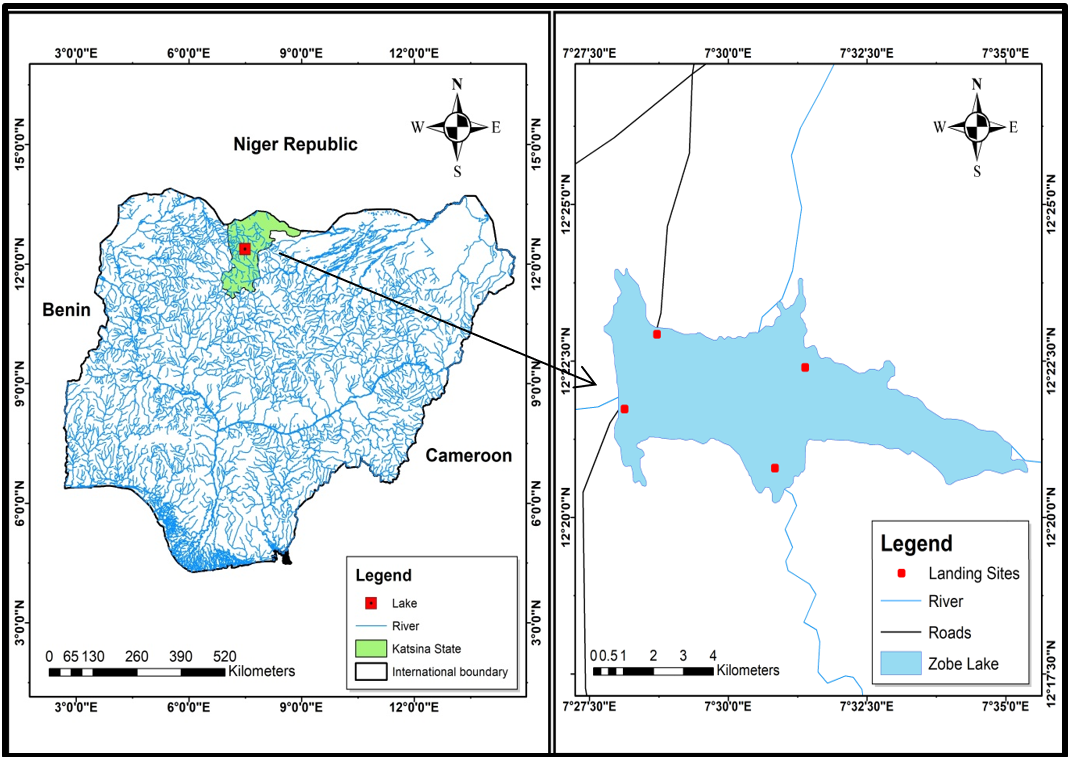
The study was conducted in Zobe Lake, which is situated in Katsina State, Nigeria's Dutsin-Ma Local Government Area Figure 1. It lies on latitude between 12°20′00″ N to 12°25′00″ N, 7°27′23″ E to 7°35′00″ E. It is an earth-fill structure with a height of 19 m and a total length of 2,750 m. The dam has a storage capacity of 179 Mca and irrigation potential of 8,000 hectares (7). The Karaduwa and Gada rivers are the two main tributaries of Zobe Lake (8). The lake was built on the Karaduwa River and has a surface area of around 4,500 hectares and a length of roughly 7 kilometers. The average annual precipitation falls between 590 and 700 mm, while the temperature is between 26.5 and 35˚C (9). The rainy season often lasts four months, from late May to late September, but the dry season typically lasts longer, from November to April. The lake is surrounded by approximately thirty-two communities. The dam Sokoto Rima River Basin Development Authority Dutsin-Ma Area Office (2008) entirely submerged the majority of the settlements.
Water Quality Parameters
Water samples were collected at a depth of 20-30 cm monthly from March 2024 to February 2025 with sampling bottles. Parameters such as air temperature were measured in degree Celsius (°C) in-situ with mercury-in-glass thermometer. Water temperature (°C), pH, electrical conductivity (μS/cm) and total dissolved solids (mg/L) were also measured in-situ with a combined probe (Hanna, Model HI 98129). Dissolved oxygen samples were fixed in-situ with 2 mL each of manganese sulfate, alkali-iodide azide and concentrated sulfuric acid. In the laboratory, Azide-Winkler titration method was used to analyze dissolved oxygen. Water transparency was determined by the use of a Secchi disc, with a method described by (10) and (11). Titrimetric method was used to analyze total alkalinity (12). Vanadomolybido-phosphoric acid colorimetric method was used to measure the concentration of phosphate (mg/L) while solution salicylate (colorimetric) method was used to measure the concentration of nitrates (mg/L) in the water samples (13).
Data Analysis
Descriptive statistics (mean ± SD) were computed for all measured parameters. Spatial variations between landing sites were evaluated and compared, ANOVA was used to test for significance across means.
Results
Water Quality Parameters
The spatial monthly mean values of water quality parameters of Zobe Lake for a period of 12 months (March 2024 to February, 2025) are presented in Table 1. All the water quality parameters evaluated showed no significant difference (p> 0.05) across the locations, with the exception of phosphate, which showed a significant difference (p < 0.05). The pooled mean value of dissolved oxygen was 7.59 ± 0.08 mg/L. The highest value of dissolved oxygen (7.70 mg/L) was recorded at Site 4, while the lowest value (7.35 ± 0.15 mg/L) was found at Site 1. The pooled mean value of air temperature during the period of study was 36.62 ± 0.48 °C. Site 4 had the highest water temperature value of 27.07 ± 0.54 °C, whereas Site 2 recorded the lowest value of 26.88 ± 0.48. The highest mean value (36.75 °C) was recorded in Site 3 while the least value (36.50 °C) was recorded in Site 1. The pooled mean water transparency was 1.04 ± 0.03 m. highest transparency level (1.06 ± 0.07 m) was recorded in Site 1 while the least value (1.03 ± 0.007 m) was recorded in Site 3. The mean of nitrate was 0.34 ± 0.03 mg/L. Site 1 and 3 recorded the least nitrate value (0.33 ± 0.07 mg/L) each, while Site 2 has the highest nitrate value (0.35 ± 0.06 mg/L). Site 1 recorded the highest total dissolved solid value (45.18 ± 1.26 mg/L) while Site 2 recorded the lowest value (43.04 ± 1.26 mg/L). The pooled mean of phosphate was 2.18 ± 0.02 mg/L. Site 1 recorded the lowest value of (2.09 ± 0.02 mg/L) while Site 2 had the highest value (2.24 ± 0.05 mg/L). The pooled mean of pH was 7.36 ± 0.09. Site 2 recorded the highest pH value 7.43 ± 0.22 while Site 4 had the lowest value 7.30 ± 0.15. The pooled mean of Electrical conductivity was 106.28 ± 5.33µS/m. Site 2 had the highest value (116.17 ± 13.83 µS/m) while Site 4 had the lowest (96.35 ± 3.97 µS/m). The pooled mean value of alkalinity was 6.82 ± 0.12 mg/L.
| Parameters | Site 1 | Site 2 | Site 3 | Site 4 | Pooled mean |
|---|---|---|---|---|---|
| DO (mgL-1) | 7.35 ± 0.15 | 7.64 ± 0.14 | 7.66 ± 0.21 | 7.70 ± 0.17 | 7.59 ± 0.08 |
| Water_temp (°C) | 27.06 ± 0.51 | 26.88 ± 0.48 | 27.3 ± 0.49 | 27.07 ± 0.54 | 27.08 ± 0.24 |
| Air_temp (°C) | 36.50 ± 1.12 | 36.62 ± 0.84 | 36.75 ± 0.99 | 36.62 ± 1.10 | 36.62 ± 0.48 |
| Transparency (m) | 1.06 ± 0.07 | 1.05 ± 0.06 | 1.03 ± 0.07 | 1.04 ± 0.06 | 1.04 ± 0.03 |
| Nitrate (mgL-1) | 0.33 ± 0.07 | 0.35 ± 0.06 | 0.33 ± 0.07 | 0.34 ± 0.06 | 0.34 ± 0.03 |
| TDS (mgL-1) | 45.18 ± 1.26 | 43.04 ± 1.27 | 43.72 ± 1.04 | 43.33 ± 0.86 | 43.82 ± 0.55 |
| Phosphate (mgL-1) | 2.09 ± 0.02a | 2.24 ± 0.05b | 2.17 ± 0.04ab | 2.23 ± 0.03b | 2.18 ± 0.02 |
| pH | 7.37 ± 0.20 | 7.43 ± 0.22 | 7.34 ± 0.16 | 7.30 ± 0.15 | 7.36 ± 0.09 |
| EC (µS/m) | 107.48 ± 8.20 | 116.17 ± 13.83 | 105.10 ± 13.50 | 96.35 ± 3.97 | 106.28 ± 5.33 |
| Alkalinity (mgL-1) | 7.19 ± 0.21 | 6.68 ± 0.26 | 6.76 ± 0.15 | 6.63 ± 0.28 | 6.82 ± 0.12 |
| Note: Different superscript letters behind the numbers indicate a significant difference. | |||||
Discussion
The lake generally exhibits good water quality, as indicated by the measured physicochemical parameters. Dissolved oxygen values (7.35 - 7.70 mg/L) exceeded the minimum requirement of 5 mg/L necessary to support aquatic life, indicating a well oxygenated system suitable for fish survival and productivity (14). The pH values (7.30 - 7.43) fall within the recommended range of 6.5-8 for freshwater systems, suggesting a stable and favorable environment for aquatic organisms (15). Furthermore, total dissolved solid (TDS) recorded in the study (43.04 - 45.18 mg/L) are far below the maximum permissible limit of 500 mg/L, indicating low mineral content and good water quality (15). Similarly, nitrate concentrations (0.33 - 0.35 mg/L) are significantly lower than the recommended limit of 50 mg/L, suggesting minimal nutrient pollution and low risk of eutrophication (15).
One of the most significant physical elements affecting the aquatic ecology is temperature. Fundamental environmental factors influence the chemical and biological processes in water (16). It has been observed that there is a significant correlation between changes in air temperature and water temperature, which is a regular factor for a variety of physical, chemical, and biological activities in ecosystems (17). The mean surface water temperature was lower than the mean air temperature corresponds with the findings of (18) in river Hadejia of Jigawa Nigeria. Dissolved oxygen is one of the most important environmental variables affecting the biology of fish (19). The higher level of dissolved oxygen recorded in this study was an indicator of less pollution and productivity of the lake. Lights ability to pass through water is referred to as transparency. Put differently, primary productivity is limited when there is high particle content and haziness in the water, causing light to penetrate the water column less deeply (20). The mean transparency value of 1.04 ± 0.03 m recorded in the lake varies with the findings of (21). The variation might be attributed to change in season, time and investigated sites. Photosynthesis activities increased with increase in transparency (22).
Nitrates are a kind of nitrogen that plants may absorb and are present in both terrestrial and aquatic ecosystems in a variety of forms. According to (23), these types of nitrogen include ammonia (NH3), nitrates (NO3) and nitrite (NO2). Nitrate is less toxic than the other forms of nitrogen in aquatic environment, such as nitrite and ammonia. The nitrate concentration in freshwater is normally low, but can reach high levels in Agricultural runoff, or from contamination by human or animal wastes (24). In aquatic systems nitrate is one of the essential nutrients of life that most commonly control the growth of aquatic plants, algae and bacteria hence increasing the productivity of aquatic system, where an increased nitrate concentration leads to an obvious increase in primary productivity. Nitrate value in aquatic systems may possibly be high due to increase in the degradation of organic matter by microbial activities (25). Meanwhile, aquatic ecosystems have constantly been altered by man and natural activities which are quite evident in the study area due to the agricultural activities. The low amount of nitrate recorded in the lake might be attributed to high utilization by plankton and aquatic plants.
Compared to other studies, the recorded total dissolved solids from the investigation ranged between 43.04 and 45.18 mg/L which is greater than the recommended value of 0.13 mg/L recommended by (26). Total dissolved solid levels can be used to evaluate the purity of water. Higher values of the total dissolved solids recorded in August might be attributed to runoff from sediments and catchment washed into the reservoir. Phosphates are chemical elements made from the elements phosphorus oxygen usually present in water in the form of phosphate (PO43-). Phosphate is one of the important nutrients and limiting factor in the maintenance of water fertility. It is recognized as the principal factor produced by the fish farm that has an effect in the lake environment. Boyd, C. E. (1998) reported that desired concentration of phosphate in water is in the range of 0.005 to 0.02 mg/L (27). Davis J. (1993) reported the mean value of Ahmadu Bello University and Zaria dams in Zaria, Nigeria to be 2.47 mg/L and 1.59 mg/L respectively (26). Olanrewaju, A. N. et al (2013) reported phosphate range 0.53 mg/L to 3.63 mg/L in Eleyele reservoir which was similar to the range of phosphate in this study (29). The pH range (7.30–7.43) was within the limit defined by standard guidelines of 6.5 – 8.5 (30). These results compared well with other similar man-made reservoirs as reported by (29) in Ado-Ekiti reservoir, Ado-Ekiti, and (32) in Awba reservoir Ibadan.
The observed high conductivity in this study (96-107 µS/cm) was within the electrical conductivity range recommended for fresh water fish by 100 -300 µS/ cm by (33). Chapman, D., and Kimstach, V. (2006) also reported electrical conductivity range 10 – 1000 µS/ cm as a typical for a tropical aquatic ecosystem and it further provide information on the level of mineralization of the aquatic ecosystems can serve as an indicator of primary pproductivity (i. e. chemical richness) and this fish production (34). The fluctuation in the value of conductivity could be due to variations in the rate of decomposition of organic matter, low level of water caused by evaporation, influx of seepage and nutrients from the drainage basin and also the presence of higher concentration of inorganic salts.
The mean alkalinity of 6.82 ± 0.12 mg/L recorded in this study was lower than the recommended level of alkalinity for freshwater systems 20 – 300 mg CaCO3 / L reported by (27). Total alkalinity might be used as a tool for the measurement of productivity and conditions of water bodies (35). Olanrewaju, A. N. et al (2013) reported an alkalinity range of 59.90 mg CaCO3 / L to 160 mg CaCO3 / L (29) while 36. Tamot, P. et al reported alkalinity range of 59.90 mg/ CaCO3 / L – 152.60 mg / CaCO3 / L in Halali reservoir (36). 37. Sugunan, V. V. reported that alkalinity value of Indian reservoir water ranged from 40 to 240 mg/ L (37).
Conclusion
The study of the spatial variation of physicochemical parameters in Zobe Lake, Katsina State, revealed relatively minimal differences among the four sampling sites, indicating that the lake is fairly homogeneous in water quality characteristics. Most parameters, including dissolved oxygen, water temperature, pH, transparency, nitrate, total dissolved solids, electrical conductivity, and alkalinity, were within acceptable ranges for freshwater ecosystems and aquatic life. The dissolved oxygen concentrations indicated a well-oxygenated environment capable of supporting fish and other aquatic organisms, while the neutral to slightly alkaline pH values reflected a chemically stable aquatic system. Low nitrate and TDS concentrations further suggest minimal pollution and low nutrient enrichment within the lake. Although phosphate levels showed slight significant spatial variation, the differences were not substantial enough to indicate severe nutrient pollution.
Overall, the findings demonstrate that Zobe Lake possesses relatively good water quality conditions suitable for fisheries production and other aquatic uses. However, continuous monitoring of nutrient parameters, particularly phosphate, is recommended to prevent future eutrophication and maintain the ecological health of the lake.
Declarations
Acknowledgment
The authors used Meta AI for language editing and proofreading only. No AI tool was used to generate, analyse or interpret research findings
Conflict of Interest
The authors declare no conflict of interest.
Data Availability
The datasets generated and/or analyzed during the current study are available from the corresponding author on reasonable request.
Ethics Statement
Not applicable.
Funding Information
This work received no external funding.
References
- Reid AJ, Carlson AK, Creed IF, Eliason EJ, Gell PA, Johnson PTJ, et al. Emerging threats and persistent conservation challenges for freshwater biodiversity. Biol Rev. 2019;94(3):849–73.
- Dudgeon D, Arthington AH, Gessner MO, Kawabata ZI, Knowler DJ, Lévêque C, et al. Freshwater biodiversity: importance, threats, status and conservation challenges. Biol Rev. 2006;81(2):163–82.
- Tickner D, Opperman JJ, Abell R, Acreman M, Arthington AH, Bunn SE, et al. Bending the curve of global freshwater biodiversity loss: an emergency recovery plan. BioScience. 2020;70(4):330–42.
- Almond RE, Grooten M, Peterson T. Living Planet Report 2020 - Bending the curve of biodiversity loss. Gland, Switzerland: World Wildlife Fund; 2020. Available from: https://pure.iiasa.ac.at/id/eprint/16870/1/ENGLISH-FULL.pdf
- Ugwu NF, Ayeni OI, Anibueze AU, Oyegbami GA. Analysis of physical, chemical and microbial properties of commonly used water sources in Ado-Ekiti: public health implications. Unizik J Educ Res Sci Vocat Stud. 2025;2(1).
- Kannel PR, Lee S, Lee YS, Kanel SR, Khan SP. Application of water quality indices and dissolved oxygen as indicators for river water classification and urban impact assessment. Environ Monit Assess. 2007;132(1–3):93–110.
- United Nations Environment Programme, Division of Technology, Industry and Economics. Integrated assessment of the impact of trade liberalization: a country study on the Nigerian rice sector. Geneva: UNEP/Earthprint; 2005.
- Tg A, AR, UM. Seasonal variation of water quality parameters of Zobe Reservoir Dutsinma Katsina State, Nigeria. Hydrol Current Res. 2016;7(4):1000261.
- Sadauki MA, Auta T, Ibrahim J. A survey of ecto-parasites in Oreochromis niloticus (Linnaeus, 1758) (Nile tilapia) in Zobe Reservoir, Katsina State. Sahel J Life Sci FUDMA. 2023;1(1):1–7.
- Michaud JP. A citizen’s guide. Citeseer; 1991.
- Ayotunde EO, Ochang SN, Ada GI. Influence of seasons on water quality, abundance of fish and plankton species of Ikwori Lake, South-Eastern Nigeria. Fish Aquac J. 2013;2(13):1–18.
- American Public Health Association. Standard methods for the examination of water and wastewater. 20th ed. Washington, DC: American Public Health Association; 1998.
- Odulate DO. Diversity and growth parameters of fish population in a part of Gulf of Guinea in Ogun State, Nigeria [dissertation]. Abeokuta: Federal University of Agriculture; 2010.
- Bartley DM. World Aquaculture 2020–A brief overview. 2022. Available from: https://books.google.co.id/books?id=UsNfEAAAQBAJ
- World Health Organization. Guidelines for drinking-water quality. Vol. 1. 3rd ed. Geneva: World Health Organization; 2006. Available from: https://www.who.int/publications/i/item/9789241547611
- Boyd CE. Water quality management for pond fish culture. Amsterdam: Elsevier Science; 1982.
- Sharma RK, Agrawal M. Biological effects of heavy metals: an overview. J Environ Biol. 2005;26(2):301–13.
- Maryam AB, Edegbene AO, Gambo J. Monitoring and exploring the spatio-temporal variation of physico-chemical variables of River Hadejia, Nigeria using statistical approach. Asian J Geogr Res. 2020;3(1):49–61.
- Franklin PA. Dissolved oxygen criteria for freshwater fish in New Zealand: a revised approach. N Z J Mar Freshwater Res. 2014;48(1):112–26.
- Häder DP, Villafañe VE, Helbling EW. Productivity of aquatic primary producers under global climate change. Photochem Photobiol Sci. 2014;13(10):1370–92.
- Sadauki MA, Bichi AH, Dauda AB, Geidam MB. Assessment of water quality parameters of Zobe and Ajiwa Reservoirs, Katsina State, Nigeria. African Sci. 2022;23(1):9–18.
- Omondi R, Kembenya E, Nyamweya C, Ouma H, Machua SK, Ogari Z. Recent limnological changes and their implication on fisheries in Lake Baringo, Kenya. J Ecol Nat Environ. 2014;6(5):154–63.
- Griffiths C, Klemick H, Massey M, Moore C, Newbold S, Simpson D, et al. U.S. Environmental Protection Agency valuation of surface water quality improvements. Rev Environ Econ Policy. 2012;6(1):130–46.
- Environment Canada. Canadian water quality guidelines for the protection of aquatic life: User’s manual. Ottawa: Environment Canada; 2001.
- Deekae SN, Abowei JFN, Chindah AC. Some physical and chemical parameters of Luubara creek, Ogoni land, Niger Delta, Nigeria. Res J Environ Earth Sci. 2010;2(4):199–207.
- Davis JT. Survey of aquaculture effluent permitting and 1993 standards in the south. Stoneville: Southern Regional Aquaculture Center; 1993.
- Boyd CE, Tucker CS. Ecology of aquaculture ponds. In: Boyd CE, Tucker CS, editors. Pond aquaculture water quality management. Boston: Springer US; 1998. p. 8–86.
- Yunusa A, Bolorunduro PI, Onimisi HU, Misau AB, Ahmed A. Comparative analysis of physicochemical characteristics of ABU and Zaria Dam. 2010. Available from: https://www.sidalc.net/search/Record/dig-aquadocs-1834-38163/Description
- Olanrewaju AN, Ajani EK, Kareem OK. Physico-chemical status of Eleyele Reservoir, Ibadan, Nigeria. J Aquac Res Dev. 2017;8(9):503.
- World Health Organization. Guidelines for drinking-water quality. Vol. 1. 3rd ed. Geneva: World Health Organization; 2006.
- Idowu EO, Ugwumba AAA, Edward JB, Oso JA. Study of the seasonal variation in the physico-chemical parameters of a tropical reservoir. Greener J Phys Sci. 2013;3(4):142–8.
- Anago IJ, Esenowo IK, Ugwumba AAA. The physico-chemistry and plankton diversity of Awba Reservoir, University of Ibadan, Nigeria. Res J Environ Earth Sci. 2013;5(11):638–44.
- Ismail SH, Hassan MA, Eissa AE, Hassan AM. Effect of single strength magnetic field on some physicochemical water parameters and performance of O. niloticus. Suez Canal Vet Med J. 2023;28(2):417–33.
- Chapman D, Kimstach V. Selection of water quality variables. In: Chapman D, editor. Water quality assessments: a guide to the use of biota, sediments and water in environmental monitoring. 2nd ed. London: Chapman & Hall; 2006. p. 65–122.
- Jiwyam W, Chareontesprasit N. Cage culture of Nile tilapia and its loading in a freshwater reservoir in Northeast Thailand. Pak J Biol Sci. 2001;4(5):614–7.
- Tamot P, Mishra R. Water quality monitoring of Halali reservoir with reference to cage aquaculture as a modern tool for obtaining enhanced fish production. In: Proceedings of Taal: The 12th World Lake Conference; 2007. p. 318–24.
- Sugunan VV. Reservoir fisheries. In: Handbook of fisheries and aquaculture. New Delhi: Indian Council of Agricultural Research; 2011. p. 239–74.