RESEARCH ARTICLE
Identification and Characterization of Volatile Compounds in Antidesma bunius (Buni) Fruit Kombucha During Fermentation
Academic Editor: Khafit Wiradimafan
Sciences of Phytochemistry|Vol. 5, Issue 2, pp. 214-220 (2026)
CC BY 4.0-2026 Authors
Views
Downloads
Shares

Received
May 4, 2026Revised
May 22, 2026Accepted
Jun 10, 2026Published
Jul 4, 2026
Abstract
Buni fruit (Antidesma bunius) is a fruit commonly found in tropical countries such as Indonesia. This fruit has the potential to be developed into kombucha tea because it contains beneficial bioactive compounds. However, the use of buni fruit as kombucha tea remains very limited and has not been studied in depth. The objective of this study was to identify and characterize the volatile compounds in buni fruit kombucha using GC-MS. This study employed a descriptive experimental design to analyze the volatile compounds in buni fruit kombucha after 8 days of fermentation using GC-MS. Buni fruit kombucha fermented for 8 days produced a dark purple color. Based on the analysis of volatile compounds, buni fruit kombucha was identified as containing 30 volatile compounds. The dominant compounds were hexadecanoic acid methyl ester, hexadecanoic acid ethyl ester, 9-octadecenoic acid methyl ester, (E)-9-octadecenoic acid ethyl ester, octadecanoic acid ethyl ester, eicosanoic acid ester, and docosahexaenoic acid methyl ester, which are classified as fatty acid esters and lipids. Additionally, the identified alcohol compounds are patchouli alcohol and 13-tetradecen-11-yn-1-ol. Buni fruit kombucha tea undergoes chemical transformations characterized by the formation of volatile compounds such as esters, alcohols, and fatty acid derivatives as a result of microbial metabolic activity. The profile of the resulting compounds highlights the important role of biotransformation during fermentation in shaping the sensory characteristics and bioactive potential of kombucha tea.
Introduction
Kombucha is a traditional fermented beverage produced by the fermentation of sweetened tea by a symbiotic consortium of microorganisms known as the Symbiotic Culture of Bacteria and Yeast (SCOBY). Fermentation is one of the oldest methods used in food production and preservation and plays an important role in the development of functional quality and beneficial properties in kombucha tea (1, 2). Innovations based on local ingredients, such as the addition of fruits, are key strategies for enhancing the functional and sensory value of kombucha products. The kombucha fermentation process involves complex interactions between microorganisms and the substrate, producing various metabolites, including organic acids, alcohols, and volatile compounds. Volatile compounds play a role in determining the aroma and flavor characteristics of kombucha, making them key parameters in product quality. Recent research shows that kombucha fermentation can produce various groups of volatile compounds, such as esters, alcohols, carboxylic acids, phenols, and aldehydes, which contribute to the beverage’s sensory profile (3). In addition, the dynamics of volatile compound formation are strongly influenced by microbial activity and fermentation conditions, including fermentation time and the type of raw materials used (4).
Current research is still dominated by studies on conventional tea based kombucha, while exploration of the use of local fruits as fermentation substrates remains limited. One promising fruit is buni (Antidesma bunius). A. bunius is a tropical fruit commonly found in Southeast Asia and is known to be rich in bioactive compounds, particularly phenolic compounds, flavonoids, and anthocyanins. These compounds act as natural antioxidants that may offer health benefits, such as anti-inflammatory and antimicrobial activity. In addition, buni fruit possesses a naturally balanced sweet sour taste, attractive dark purple red pigmentation, and high phenolic content, making it highly suitable as a kombucha substrate compared to many other tropical fruits. Its rich anthocyanin composition not only enhances the functional properties of kombucha but also contributes to the development of distinctive color, aroma, and flavor characteristics during fermentation. Furthermore, the availability of natural sugars and organic acids in buni fruit can support microbial metabolism during SCOBY fermentation, potentially promoting the formation of diverse volatile compounds and improving sensory acceptance of the final product. Previous studies have reported that buni fruit contains bioactive compounds with significant anti-AGEs activity, which are associated with potential health benefits, including the prevention of oxidative stress and metabolic disorders (5). Furthermore, the fruit extract has been reported to inhibit carbohydrate digesting enzymes and protein glycation, indicating its potential in managing hyperglycemia and preventing metabolic disorders (6).
In addition, the buni fruit has a distinctive profile of volatile compounds that contribute to its aroma and flavor. Fruits that are rich in anthocyanins, one of which is buni, contain various volatile compounds such as esters, alcohols, and aldehydes that contribute to their sensory characteristics (7). Moreover, compared to commonly used kombucha substrates such as apple, grape, or berry fruits, buni fruit remains underutilized despite its comparable phytochemical richness and unique indigenous character. This underexplored potential highlight the significance of utilizing buni fruit as an innovative fermentation substrate that support local biodiversity censrvation, diversification of functional beverage, and the development of value added product from indigenous tropical resources. This provides an opportunity to develop novel kombucha products derived from local biodiversity while simultaneously increasing the economic value and utilization of native tropical fruits
However, the use of buni fruit in fermented products, particularly kombucha, remains very limited and has not been extensively studied, especially regarding the characterization of its volatile compounds using analytical techniques such as Gas Chromatography-Mass Spectrometry (GC-MS). GC-MS is widely used in kombucha studies to identify volatile metabolites and understand the metabolic pathways that occur during fermentation (8). In addition, a number of volatile compounds can be detected in kombucha, indicating that biochemical processes occur during fermentation (8). GC-MS analysis also plays a role in linking the composition of the microbiota to the formation of aroma compounds in kombucha (1). Therefore, exploring buni fruit as a substrate in kombucha fermentation not only has the potential to enhance the product’s functional value but can also serve as a foundation for the development of functional foods based on local resources.
Methodology
Experiment Design
This study used a descriptive experimental design to analyze volatile compounds in buni fruit kombucha after 8 days of fermentation using GC-MS. The fermentation period was selected for that day because previous research has shown that the intermediate stages of fermentation significantly influence the biochemical characteristics of kombucha, including total acidity, phenolic compounds, alcohol formation, antioxidant activity, and sensory quality (9). In addition, kombucha fermented during that period was reported to have good physicochemical and sensory characteristics without excessive acidification (10). This study was replicated during the kombucha fermentation stage, while GC–MS analysis was performed only once on samples collected on the eighth day of fermentation, as the analysis was intended to identify volatile compounds. The results of the GC-MS analysis were used for the qualitative identification of the compound profiles. Compound identification was performed using WILEY and NIST spectral libraries.
The Process of Making Kombucha Tea
Water (1 L) was heated in a water bath for 15 minutes after reaching 90 °C. Subsequently, 10% (w/v) granulated sugar was added and dissolved, followed by the addition of 2.5% (w/v) buni fruit The mixture was stirred and allowed to stand for 5 minutes, then filtered into a sterile jar and adjusted to a final volume of 1 L with boiled water. After cooling to 30 °C, a 10% (w/v) SCOBY sheet was introduced. The jar was covered with a sterile cloth and secured (11). Fermentation proceeded throughout the treatment period, and the kombucha was harvested by separating the cellulose layer formed from the fermentation medium for subsequent analysis.
GC-MS Analysis
Analysis of volatile compounds in buni fruit kombucha samples was performed using a Shimadzu GCMS-QP2010 instrument. A total of 50 mL of kombucha sample was pipetted into a container, then 10 mL of n-hexane was added to extract the volatile compounds and separate the aqueous phase from the non-polar components. The mixture was then homogenized until thoroughly mixed and allowed to stand until two completely separate phases formed. The upper layer was collected and transferred into a sample vial. Subsequently, 1 µL of the sample was injected into the GC-MS system for further analysis. Compound identification was performed by comparing the obtained mass spectra with the WILEY7. LIB and NIST08S. LIB spectral libraries. The detected compounds were then analyzed based on retention time and percentage of peak area to determine the relative composition of volatile compounds in the sample (12).
Results and Discussion
GC-MS analysis of buni fruit kombucha after 8 days of fermentation identified 30 volatile compounds in the fermented product. The detected compounds belong to several major groups, namely fatty acid esters, fatty acids and their derivatives, alcohols, aromatic compounds, amides, and siloxanes. The volatile compounds identified in the buni fruit after 8 days of fermentation are shown in Table 1 below.
| No. | Retention Time (RT) in minutes | Compounds | Molecular Formula* | Relative abundance (%) |
|---|---|---|---|---|
| 1 | 14.051 | Azulene 1,2,3,5,6,7,8,8a-octahydro-1,4-dimethyl-7-(1-methylethenyl)- | C15H24 | 0.129 |
| 2 | 16.401 | Patchouli alcohol | C15H26O | 0.288 |
| 3 | 19.088 | Hexadecanoic acid, methyl ester | C17H34O2 | 1.384 |
| 4 | 19.797 | Hexadecanoic acid, ethyl ester | C18H36O2 | 7.303 |
| 5 | 20.889 | 9-Octadecenoic acid, methyl ester | C19H26O2 | 2.780 |
| 6 | 21.475 | 9,12-Octadecadienoic acid | C18H32O2 | 0.950 |
| 7 | 21.535 | (E)-9-Octadecenoic acid, ethyl ester | C20H38O2 | 5.046 |
| 8 | 21.960 | Octadecanamide | C18H37NO | 0.009 |
| 9 | 21.778 | Octadecanoic acid, ethyl ester | C20H40O2 | 0.973 |
| 10 | 22.332 | 1,1,1-Trifluoroheptadecan-2-one | C17H31F30 | 0.747 |
| 11 | 22.814 | Hexadecanoic acid, 2-hydroxy-1,3-propanediyl ester | C35H68O5 | 11.321 |
| 12 | 22.967 | Eicosanoic acid ester | C24H48O2 | 1.020 |
| 13 | 23.023 | 3-isopropoxy-1,1,1,7,7,7-hexamethyl-3,5,5-tris | C18H52O7Si7 | 0.941 |
| 14 | 23.572 | 9-Octadecenamide | C18H35NO | 3.620 |
| 15 | 24.975 | 1,2-Octadecadienoyl chloride | C18H31ClO | 6.081 |
| 16 | 25.055 | Di-(9-octadecenoyl)-glycerol | C39H72O5 | 5.591 |
| 17 | 25.189 | 13-Tetradecen-11-yn-1-ol | C14H24O | 0.408 |
| 18 | 25.283 | Naphthalene derivative | C20H32 | 0.720 |
| 19 | 25.454 | Benzene, (3-methyl-2-butenyl) | C11H14 | 17.832 |
| 20 | 25.668 | Bicyclic compound | C14H20 | 3.380 |
| 21 | 25.940 | Benzene (3-methyl-2-butenyl) | C11H14 | 2.618 |
| 22 | 26.044 | Dispiro compound | C12H18 | 0.467 |
| 23 | 26.172 | Docosahexaenoic acid, methyl ester | C23H34O2 | 15.461 |
| 24 | 26.329 | Docosahexaenoic acid, methyl ester | C23H34O2 | 3.189 |
| 25 | 26.652 | Docosahexaenoic acid, methyl ester | C23H34O2 | 2.477 |
| 26 | 29.032 | Heptasiloxane, hexadecamethyl | C16H48O6Si7 | 1.422 |
| 27 | 29.376 | Terephthalic acid ester | C27H44O4 | 0.617 |
| 28 | 30.068 | Heptasiloxane, hexadecamethyl | C16H48O6Si7 | 1.266 |
| 29 | 32.032 | Cyclodecasiloxane | C20H60O10Si10 | 0.987 |
| 30 | 33.349 | Heptasiloxane | C16H48O6Si7 | 0.882 |
| Note: *Based on comparison of MS spectrum with database of WILEY7.LIB | ||||
Kombucha made from buni fruit, fermented for 8 days, produces a dark purple color. Based on the analysis of volatile compounds in buni fruit kombucha, approximately 30 volatile compounds were identified (Table 1). Hexadecanoic acid methyl ester, hexadecanoic acid ethyl ester, 9-octadecenoic acid methyl ester, (e)-9-octadecenoic acid ethyl ester, octadecanoic acid ethyl ester, eicosanoic acid ester, and docosahexaenoic acid methyl ester are classified as esters and lipids. Meanwhile, the alcohol group included patchouli alcohol and 13-tetradecen-11-yn-1-ol. Some compounds, such as siloxanes and certain hydrocarbon derivatives detected in the analysis, are likely instrumental artifacts or contamination during the analytical process, therefore, they were not included in the interpretation of the sample’s chemical composition. The structure of several main volatile compounds found in buni fruit kombucha can be seen in Figure 1.
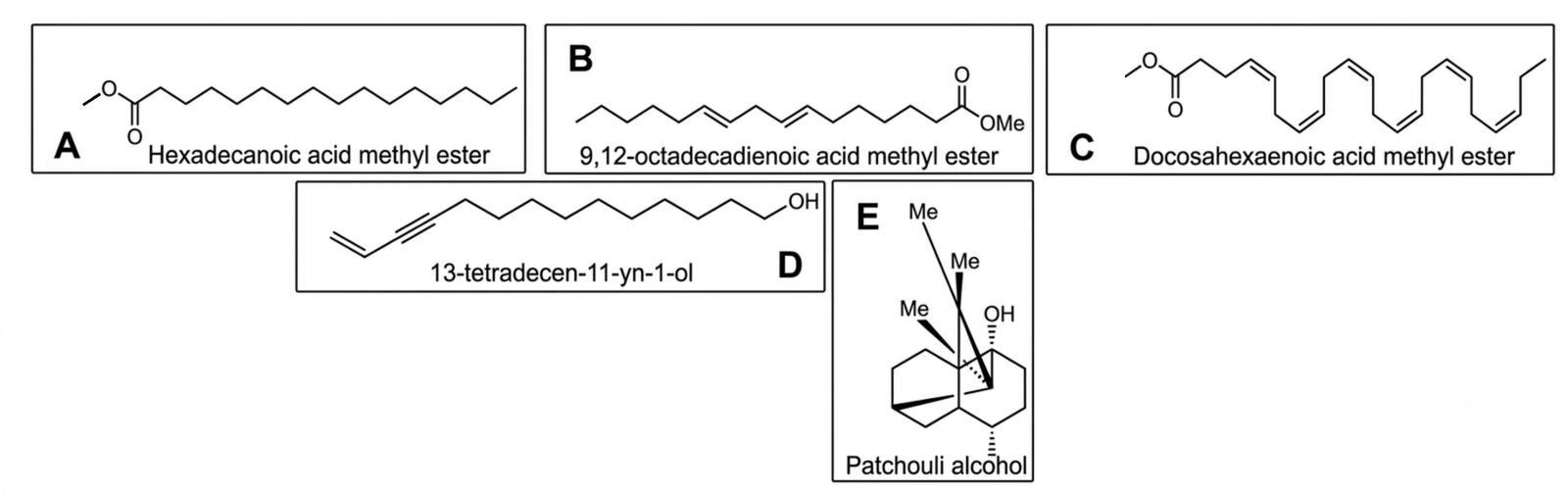
Hexadecanoic acid methyl ester, 9, 12-octadecadienoic acid methyl ester, and docosahexaenoic acid methyl ester are compounds classified as fatty acid esters in fermented kombucha. Hexadecanoic acid methyl ester is found in Hordeum vulgare seeds as a product of lipid metabolism and has potential antimicrobial and anti-inflammatory properties (13). In addition, this compound is derived from palmitic acid in soybeans through the fermentation of food products (douchi) by microorganisms during the fermentation process (14). 9-Octadecenoic acid methyl ester is a form of oleic acid derived from the lipid metabolism of plant seeds, and is used to describe the profile and quality of oils from Satureja species (15). This compound also shows potential as a bioactive anticancer candidate (16). Docosahexaenoic acid methyl ester is a fatty acid methyl ester with antifungal potential (17). The predominance of fatty acid esters is likely due to the metabolic activity of microorganisms, which plays a key role in shaping the volatile profile. The results of this study are consistent that the major volatile compounds in kombucha are dominated by esters, acids, alcohols, and terpenes formed during fermentation (1). In that study, the formation of volatile compounds was reported to be closely correlated with the composition of the microbiota. In fresh buni fruit, fatty acids and their derivatives namely hexadecanoic acid, 9, 12-octadecadienoic acid, and ester derivatives were identified (18). This indicates the presence of lipid pathways in the fruit. Esters play a key role in influencing the final characteristics of kombucha after fermentation, imparting fruity, sweet, and floral aroma profiles. These GC-MS results provide further evidence of the biochemical transformations occurring during fermentation, which are facilitated by microorganisms within the Symbiotic Culture of Bacteria and Yeast (SCOBY). Kombucha based fermentation significantly increases the number and complexity of volatile compounds in grape pulp, particularly esters that contribute to the formation of fruity and sweet aromas (19). Furthermore, the formation of new compounds not present in the starting material indicates active biotransformation by microorganisms. Patchouli alcohol is a type of alcohol identified in this study. Previous studies have reported that this compound possesses anti-inflammatory, antioxidant, antimicrobial, and immunomodulatory activities (20). Restoring the integrity of the intestinal barrier and reducing inflammation in cases of digestive disorders are also benefits of this compound (21). The presence of alcohol in this study particularly ethanol, is the primary fermentation product generated by yeast activity during the early stages of kombucha fermentation Sales, Cunha (22). This compound acts as an intermediate metabolite that not only contributes to the aroma profile but also serves as an important precursor in the formation of esters through reactions with organic acids.
The compound 13-tetradecen-11-yn-1-ol identified in this study is a long chain alcohol derived from lipids. The presence of this compound indicates lipid metabolism activity by microorganisms in the kombucha fermentation system. Previous studies have reported the antibacterial potential of this compound, which has also been identified as a major component in several plant essential oils (23). The compounds detected may be associated with the bioactivity previously reported in the literature, thereby supporting the role of fermentation in producing functional metabolites in kombucha made from buni fruit. Volatile compounds such as esters and alcohols were also identified with black tea based kombucha (24). Kombucha fermentation results in dynamic changes in volatile compounds. During the kombucha fermentation process, volatile compounds consisting of carboxylic acids, alcohols, ketones, esters, aldehydes, phenols, and terpenes were detected (25). In addition, volatile compounds such as alcohols, esters, acids, aldehydes, ketones, and terpenoids were also detected in kombucha made from raw Pu-erh tea (26).
This indicates that volatile compounds are indeed produced during fermentation. During fermentation, the microorganisms in the SCOBY actively convert the initial substrate into various new metabolites through metabolic pathways, including the conversion of sugars into alcohols, oxidation into organic acids, and the formation of volatile compounds such as esters. These biotransformation processes not only increase the complexity of the chemical composition but also contribute to the sensory characteristics and potential bioactivity of the final product.
In previous studies, alcohols, esters, and aldehydes were identified as the main contributors to the characteristic flavor profile of blackberry juice beverage fermented with a kombucha consortium (27). Kombucha fermentation produces various new metabolites with biological activity and is significantly influenced by the type of substrate and the dynamics of the microbiota (28). The occurrence of biotransformation during fermentation can serve as a basis for improving the characteristics of kombucha, both in terms of sensory and functional aspects. Nevertheless, further studies involving quantitative analysis and direct bioactivity assays are required to confirm the functional effects of these compounds in buni kombucha. Several compounds identified in this study have previously been reported to possess antimicrobial, antioxidant, anti-inflammatory, anticancer, and immunomodulatory activities in other studies. However, the present study was limited to the identification of volatile compounds using GC-MS analysis and did not directly evaluate the biological activities of the kombucha product.
Conclusion
Kombucha made from buni fruit was found to contain approximately 30 volatile compounds. The dominant compounds include hexadecanoic acid methyl ester, hexadecanoic acid ethyl ester, 9-octadecenoic acid methyl ester, (E)-9-octadecenoic acid ethyl ester, octadecanoic acid ethyl ester, eicosanoic acid ester, and docosahexaenoic acid methyl ester, which are classified as fatty acid esters and lipids. Additionally, the identified alcohol compounds are patchouli alcohol and 13-tetradecen-11-yn-1-ol. The resulting compound profile indicates the important role of biotransformation during fermentation in shaping the sensory characteristics and bioactivity potential of kombucha tea.
Abbreviations
GC-MS = Gas Chromatography-Mass Spectrometry; SCOBY = Symbiotic Culture of Bacteria and Yeast.
Declarations
Conflict of Interest
The authors declare no conflict of interest.
Data Availability
All data generated or analyzed during this study are included in this published article.
Ethics Statement
Not applicable.
Funding Information
This work received no external funding.
References
- Yao L, Zhang J, Lu J, Chen D, Song S, Wang H, et al. Revealing the influence of microbiota on the flavor of kombucha during natural fermentation process by metagenomic and GC-MS analysis. Food Research International. 2023;169:112909. doi: https://doi.org/10.1016/j.foodres.2023.112909
- Yu-cheng Sui ZJZ, Wu HW, Zhou CB, Jian Zhang XCH,. Flavour chemical dynamics during fermentation of kombucha tea. Emir J Food Agric. 2018;30(9):732-741. doi: https://doi.org/10.9755/ejfa.2018.v30.i9.1794
- Phung LT, Kitwetcharoen H, Chamnipa N, Boonchot N, Thanonkeo S, Tippayawat P, et al. Changes in the chemical compositions and biological properties of kombucha beverages made from black teas and pineapple peels and cores. Sci Rep. 2023;13(1):7859. doi: https://doi.org/10.1038/s41598-023-34954-7
- Wang S, Li C, Wang Y, Wang S, Zou Y, Sun Z, et al. Changes on physiochemical properties and volatile compounds of Chinese kombucha during fermentation. Food Bioscience. 2023;55:103029. doi: https://doi.org/10.1016/j.fbio.2023.103029
- Nguyen-Ngoc H, Alilou M, Derbré S, Blanchard P, Pham GN, Nghiem DT, et al. Chemical constituents of Antidesma bunius aerial parts and the anti-AGEs activity of selected compounds. Phytochemistry. 2022;202:113300. doi: https://doi.org/10.1016/j.phytochem.2022.113300
- Aksornchu P, Chamnansilpa N, Adisakwattana S, Thilavech T, Choosak C, Marnpae M, et al. Inhibitory Effect of Antidesma bunius Fruit Extract on Carbohydrate Digestive Enzymes Activity and Protein Glycation In Vitro. Antioxidants. 2020;10(1):32. doi: https://doi.org/10.3390/antiox10010032
- Khoo HE, Azlan A, Tang ST, Lim SM. Anthocyanidins and anthocyanins: colored pigments as food, pharmaceutical ingredients, and the potential health benefits. Food & Nutrition Research. 2017;61(1):1361779. doi: https://doi.org/10.1080/16546628.2017.1361779
- Wang Z, Ahmad W, Zhu A, Geng W, Kang W, Ouyang Q, et al. Identification of volatile compounds and metabolic pathway during ultrasound-assisted kombucha fermentation by HS-SPME-GC/MS combined with metabolomic analysis. Ultrasonics Sonochemistry. 2023;94:106339. doi: https://doi.org/10.1016/j.ultsonch.2023.106339
- Puspaningrum DHD, Sumadewi NLU, Sari NKY. Karakteristik Kimia dan Aktivitas Antioksidan Selama Fermentasi Kombucha Cascara Kopi Arabika (Coffea arabika L.) Desa Catur Kabupaten Bangli. juses. 2022;5(2):44-51. doi: https://doi.org/10.24246/juses.v5i2p44-51
- Nurhayati N, Yuwanti S, Urbahillah A. Karakteristik fisikokimia dan sensori kombucha cascara (kulit kopi ranum). jtip. 2020;31(1):38-49. doi: https://doi.org/10.6066/jtip.2020.31.1.38
- Kallel L, Desseaux V, Hamdi M, Stocker P, Ajandouz EH. Insights into the fermentation biochemistry of Kombucha teas and potential impacts of Kombucha drinking on starch digestion. Food Research International. 2012;49(1):226-232. doi: https://doi.org/10.1016/j.foodres.2012.08.018
- Foster SC, Tipton L, Perrault Uptmor KA. Evaluating chromatographic techniques for the aroma profiling of kombucha. Anal Bioanal Chem. 2025;418(10):3059-3073. doi: https://doi.org/10.1007/s00216-025-06257-5
- Farooqi SS, Naveed S, Qamar F, Sana A, Farooqi SH, Sabir N, et al. Phytochemical analysis, GC-MS characterization and antioxidant activity of Hordeum vulgare seed extracts. Heliyon. 2024;10(6):e27297. doi: https://doi.org/10.1016/j.heliyon.2024.e27297
- Sui L, Wang S, Wang X, Su L, Xu H, Xu W, et al. Analysis of Different Strains Fermented Douchi by GC×GC-TOFMS and UPLC–Q-TOFMS Omics Analysis. Foods. 2024;13(21):3521. doi: https://doi.org/10.3390/foods13213521
- Gören AC, Bilsel G, Altun M, Satıl F. Fatty Acid Composition of Seeds of Satureja thymbra and S. cuneifolia. Zeitschrift für Naturforschung C. 2003;58(7-8):502-504. doi: https://doi.org/10.1515/znc-2003-7-810
- Rani V, Amudha P, Vidya R, Jayalakshmi M, Kalpana C. Molecular Docking Analysis of 9-Octadecene, 9,12,15-Octadecatrienoic acid, Methyl Ester, Phytol, 9,12-Octadecadienoic Acid and 9-Octadecenoic Acid with Anticancer Target Enzyme Caspase 3 (PDB: 1CP3). Tijph. 2024;12(04). doi: https://doi.org/10.21522/tijph.2013.12.04.art097
- Mustapha T, Kwarau NL, Patil RB, Tang H, Abdullahi MAI, Wu SY, et al. Molecular Dynamics Insights into Cassia tora-Derived Phytochemicals as Dual Insecticidal and Antifungal Agents Against Tomato Tuta absoluta and Alternaria solani. Ijms. 2026;27(3):1410. doi: https://doi.org/10.3390/ijms27031410
- Yelliantty Y, Kartasasmita RE, Surantaatmadja SI, Rukayadi Y. Identification of chemical constituents from fruit of Antidesma bunius by GC-MS and HPLC-DAD-ESI-MS. Food Sci. Technol. 2022;42:e61320. doi: https://doi.org/10.1590/fst.61320
- Qiao C, Wang Y, Xia S, Ji Q, Huo L, Zhang H, et al. Effects of kombucha‐derived microbial fermentation on the flavor profile of grape fruit pulp based on electronic nose analysis, HPLC , GC‐MS and GC ‐ IMS. J Sci Food Agric. 2025;106(3):1871-1889. doi: https://doi.org/10.1002/jsfa.70315
- Lee HS, Lee J, Smolensky D, Lee SH. Potential benefits of patchouli alcohol in prevention of human diseases: A mechanistic review. International Immunopharmacology. 2020;89:107056. doi: https://doi.org/10.1016/j.intimp.2020.107056
- Lu YL, Huang C, Huang SY, Li T, Chen WY, Yi SL, et al. The mechanism of patchouli alcohol in treating IBS-D based on BMP-Smad pathway. Biomedicine & Pharmacotherapy. 2025;187:118050. doi: https://doi.org/10.1016/j.biopha.2025.118050
- Sales AL, Cunha SC, Morgado J, Cruz A, Santos TF, Ferreira IM, et al. Volatile, Microbial, and Sensory Profiles and Consumer Acceptance of Coffee Cascara Kombuchas. Foods. 2023;12(14):2710. doi: https://doi.org/10.3390/foods12142710
- Ousman BM, Belmehdi O, Boussaoudi I, Otchom BB, Younes S. Chemical composition and antibacterial activity of Azadirachta indica seed oil from Chad. International Journal of Secondary Metabolite. 2025;12(2):429-447. doi: https://doi.org/10.21448/ijsm.1460828
- Al-Mohammadi AR, Ismaiel AA, Ibrahim RA, Moustafa AH, Abou Zeid A, Enan G. Chemical Constitution and Antimicrobial Activity of Kombucha Fermented Beverage. Molecules. 2021;26(16):5026. doi: https://doi.org/10.3390/molecules26165026
- Suffys S, Richard G, Burgeon C, Werrie PY, Haubruge E, Fauconnier ML, et al. Characterization of Aroma Active Compound Production during Kombucha Fermentation: Towards the Control of Sensory Profiles. Foods. 2023;12(8):1657. doi: https://doi.org/10.3390/foods12081657
- Zhang J, Ma H, Wang H, Sun M, Yu C, Liu Q, et al. Flavor and sensory profile of kombucha fermented with raw Pu-erh tea and evaluation of the antioxidant properties. Lwt. 2024;200:116220. doi: https://doi.org/10.1016/j.lwt.2024.116220
- Cao Y, Wang Z, Li X, Li N, Dai Y, Xu L, et al. Kombucha Fermentation Enhanced the Flavor and Functional Properties of Blackberry Juice Beverage. Journal of Food Science. 2025;90(11):e70656. doi: https://doi.org/10.1111/1750-3841.70656
- Abaci N, Senol Deniz FS, Orhan IE. Kombucha – An ancient fermented beverage with desired bioactivities: A narrowed review. Food Chemistry: X. 2022;14:100302. doi: https://doi.org/10.1016/j.fochx.2022.100302