RESEARCH ARTICLE
Integrated LC-HRMS Metabolite Profiling and Multitarget Molecular Docking of Ginggiang (Leea aequata L.) Constituents Against Antidiabetic Targets
Sciences of Pharmacy|Vol. 5, Issue 3, pp. 323-331 (2026)
CC BY 4.0-2026 Authors
Views
Downloads
Shares

Received
May 16, 2026Revised
Jun 9, 2026Accepted
Jul 6, 2026Published
Jul 20, 2026
Abstract
Type 2 diabetes mellitus (T2DM) is a metabolic disorder with complex pathophysiological pathways involving multiple physiological factors. Therefore, multitarget therapy has become one of the most rational therapeutic approaches for the management of T2DM. Ginggiang (Leea aequata L.) is a medicinal plant reported to contain various bioactive compounds with potential antidiabetic activity. This study aimed to explore the multitarget antidiabetic potential of the ethanolic extract of Ginggiang leaves through liquid chromatography–high-resolution mass spectrometry (LC-HRMS) analysis followed by molecular docking studies. LC-HRMS analysis was performed to identify compounds in the extract, while molecular docking studies were conducted to evaluate potential interactions between the identified compounds and multiple antidiabetic targets. The concentrated extract obtained by maceration using 96% ethanol was analyzed using LC-HRMS. The annotated compounds were subsequently used as test ligands in molecular docking studies. Molecular docking was performed using AutoDock 4.2.3 against α-glucosidase (PDB ID: 5NN8), SGLT2 transporter protein (PDB ID: 8HEZ), and DPP-4 enzyme (PDB ID: 5T4B). LC-HRMS analysis successfully annotated 31 compounds in the ethanolic extract of Ginggiang leaves. Molecular docking results suggested that catechin gallate and 2-amino-1, 3, 4-octadecanetriol exhibited favorable docking scores against all three target proteins and may be considered potential multitarget antidiabetic compounds. Several other compounds also showed favorable interactions with one or more targets. The results indicate that Ginggiang leaf ethanol extract may serve as a potential source of bioactive compounds for antidiabetic drug discovery. Nevertheless, further studies, including molecular dynamics simulations and experimental validation, are required to confirm these findings.
Introduction
Type 2 diabetes mellitus (T2DM) is a metabolic disorder with a continuously increasing prevalence worldwide (1). The disease is no longer predominantly associated with older adults, but has also increasingly affected younger age groups (2). Patients with T2DM generally experience difficulties in maintaining blood glucose levels without pharmacological therapy. On the other hand, pharmacological treatment may also lead to various problems, particularly those related to the risk of adverse effects. These adverse effects include hypoglycemia, gastrointestinal disturbances, weight gain, cardiovascular complications, lactic acidosis, and renal impairment (3). Therefore, the discovery of safer, more effective, and more convenient antidiabetic agents remains an important challenge in diabetes management (4, 5).
T2DM is a metabolic syndrome with a complex pathophysiology, requiring therapeutic approaches that address multiple aspects involved in glucose metabolism regulation (6). These aspects include glycemic control, prevention of hypoglycemia and obesity, management of insulin resistance, prevention of cardiovascular and renal complications, as well as minimization of treatment-related adverse effects (6, 7). Therefore, multitarget therapy has become one of the most rational approaches for the management of T2DM (8).
Multitarget therapy is performed using antidiabetic agents capable of acting on multiple targets simultaneously (8). Potential targets for multitarget therapy in T2DM include the α-glucosidase enzyme, sodium-glucose cotransporter 2 (SGLT2) transporter protein, and dipeptidyl peptidase-4 (DPP-4) enzyme. Inhibition of α-glucosidase delays carbohydrate breakdown, thereby reducing intestinal glucose absorption. This inhibition may help prevent postprandial hyperglycemia (9). Inhibition of the SGLT2 transporter protein suppresses glucose reabsorption in the kidneys, resulting in increased urinary glucose excretion (10). Meanwhile, inhibition of the DPP-4 enzyme enhances incretin hormone activity. This inhibition leads to increased insulin secretion and decreased glucagon secretion, thereby contributing to the control of postprandial blood glucose levels (11, 12).
Natural products present in the ethanolic extract of Ginggiang (Leea aequata L.) leaves contain various compounds with potential as druggable molecules. Previous phytochemical studies have reported the presence of flavonoids, tannins, steroids, and coumarins in the leaf extract (13). Several of these compounds, such as flavonoids, have also been associated with antidiabetic activity (14).
Ginggiang is one of the species belonging to the genus Leea, which is widely recognized as a medicinal plant genus (15). To date, this plant has been more commonly associated with antimicrobial activity (13, 16); however, its potential antidiabetic activity remains largely unexplored. A study conducted by Tun et al. (2019) further supports the need to investigate the antidiabetic potential of Ginggiang. The study successfully isolated 23 compounds from the ethanolic extract of the aerial parts of L. aequata collected in Myanmar (16). Several isolated compounds, including kaempferol (17), scopoletin (18), and other phenolic compounds (14), have been reported to exhibit potential antidiabetic activity.
This study was conducted to explore the multitarget antidiabetic potential of Ginggiang. Liquid chromatography–high-resolution mass spectrometry (LC-HRMS) analysis was initially performed to identify the compounds present in the leaf ethanolic extract. The identified compounds were subsequently evaluated for their potential antidiabetic activity through molecular docking studies.
Chemotaxonomic considerations within the genus Leea supported the present study. Previous phytochemical investigations have demonstrated that species belonging to this genus contain a wide range of secondary metabolites that are associated with various biological activities, including antioxidant and antidiabetic effects (15). Furthermore, several Leea species, particularly Leea indica (19) and Leea asiatica (20), have been traditionally used in the management of diabetes and hyperglycemia in various Asian communities. These chemotaxonomic and ethnopharmacological findings provide a scientific basis for exploring Ginggiang as a potential source of bioactive metabolites with antidiabetic potential.
Methodology
Equipments
The instruments used in this research include an analytical balance (Mettler Toledo ME204E, Switzerland), rotary evaporator (IKA RV 10 Digital, Germany), LC (Thermo Scientific™ Vanquish™ UHPLC Binary Pump), Orbitrap high-resolution mass spectrometry (Thermo Scientific™ Q Exactive™ Hybrid Quadrupole-Orbitrap™ High Resolution Mass Spectrometer) (Thermo Fisher Scientific, Germany). Molecular docking studies were carried out using AutoDock version 4.2.3.
Materials
The materials used in the study included Ginggiang leaf simplicia, 96% ethanol (Brataco, Indonesia), MS-grade methanol (Merck, Darmstadt, Germany), MS-grade water (Merck, Darmstadt, Germany), and formic acid for LC-MS (Sigma-Aldrich, St. Louis, USA). The materials used in the molecular docking study consisted of the target protein structures of α-glucosidase (PDB ID: 5NN8), the SGLT2 transporter protein (PDB ID: 8HEZ), and the DPP-4 enzyme (PDB ID: 5T4B), along with compounds identified by LC-HRMS as test ligands.
Preparation of Ginggiang Leaf Extract
The extraction was carried out by macerating 1 kg of dried powdered simplicia in 3 x 5 L of 96% ethanol. The solvent was replaced every 24 h. The obtained extracts were combined, filtered, and concentrated using a rotary evaporator to obtain a viscous extract.
Preparation of Test Solution
The test solution was prepared by dissolving the extract in 75% MS-grade methanol to a concentration of 1 mg/mL. The solution was then filtered through a 0.22 μm membrane filter.
Analysis of Test Solutions on LC-HRMS
LC-HRMS analysis was carried out under the conditions in Table 1. Metabolite annotation was performed using a mass error threshold of ≤5 ppm combined with isotopic pattern matching and database cross-verification against PubChem and ChemSpider.
| Parameter | Specification |
|---|---|
| Instrument | LC (Thermo Scientific™ Vanquish™ UHPLC Binary Pump) and Orbitrap high-resolution mass spectrometry (Thermo Scientific™ Q Exactive™ Hybrid Quadrupole-Orbitrap™ High Resolution Mass Spectrometer). |
| Column | Thermo Scientific™ Accucore™ Phenyl-Hexyl 100 mm × 2.1 mm ID × 2.6 µm |
| Column Temperature | 40 °C |
| Mobile phase | The mobile phases used were MS-grade water containing 0.1% formic acid (A) and MS-grade methanol containing 0.1% formic acid (B) employing a gradient technique with the flow rate of 0.3 mL/min. First, the mobile phase B was set at 5% and increased gradually to 90% in 16 min. Then, it was held at 90% for 4 min and continued to the initial condition (5% B) until 25 min |
| Flow rate | 0.3 mL/min |
| Volume Injection | 3 µL |
| Ionization mode | Electrospray ionization (ESI), positive mode |
| Capillary voltage | 3.30 kV |
| Mass scan range | m/z 66.7–1000 |
| Compound identification | Spectral matching using MzCloud Mass (https://www. mzcloud. org/), ChemSpider (https://www. chemspider. com/), and PubChem (https://pubchem. ncbi. nlm. nih. gov/) |
Molecular Docking
Determination of Test Molecules and Their Preparation
The annotated molecules from the LC-HRMS analysis were then selected for molecular docking studies based on the following criteria: 1) mzCloud best match score ≥ 80%; 2) the compounds were not identified as contaminants, analytical artifacts, or background contaminants; and 3) relative abundance ≥ 0.01%.
Preparation of Test Ligands
The preparation of the test ligands was carried out using RDKit software (.xyz file format). Geometry optimization was performed using XTB (eXtended Tight-Binding) software with the GFN-xTB (Generalized Born–Fock Non-Dynamic Tight-Binding) method.
Target Protein Preparation
The target proteins used in this study were α-glucosidase (PDB ID: 5NN8), SGLT2 transporter protein (PDB ID: 8HEZ), and DPP-4 enzyme (PDB ID: 5T4B), obtained from the Protein Data Bank in *.pdb format. Protein preparation was performed by removing water molecules and separating the protein structure from non-protein components, such as native ligands and other co-crystallized molecules, using Discovery Studio software. The preparation process generated two *.pdb files, namely the purified protein structure file and the native ligand file.
Docking Method Validation
Docking method validation was performed using AutoDock version 4.2.3 (21). Validation was conducted by redocking the native ligand into the binding site of the previously prepared target protein. Grid box parameters were determined by centering the grid on the native ligand binding site. Docking calculations were performed using a maximum number of 100 GA runs, a medium number of evaluations, and the Lamarckian Genetic Algorithm (LGA) method. The docking protocol was considered valid if the Root Mean Square Deviation (RMSD) value between the redocked pose and the crystallographic pose was ≤ 2 Å (22). In addition, docking validation was evaluated based on the similarity of binding interactions between the crystallographic native ligand and the redocked ligand (23).
Docking of Test Ligands
The test ligands were docked into the target proteins using the previously validated docking protocol, ensuring consistent computational conditions for all compounds. Docking results were evaluated based on binding affinity, interactions with active-site residues, ligand position within the binding pocket, biological relevance of the target proteins, and comparison with the native ligand interactions (24), which serves to validate the binding mode and stability. The grid box parameters used for molecular docking, including the center coordinates and box dimensions for each target protein, were carefully optimized. These parameters were defined to encompass the active binding site identified during the redocking validation process, thereby allowing for sufficient ligand flexibility. Furthermore, molecular docking was also performed using reference antidiabetic drugs—namely acarbose for α-glucosidase, dapagliflozin for SGLT2, and sitagliptin for DPP-4—to provide a robust benchmark for quantitative comparison with the annotated metabolites, ensuring a reliable assessment of their inhibitory potential relative to known therapeutic agents.
Results and Discussion
Extract Yield
The maceration process yielded an extract with a percentage yield of 12.75%. The viscous extract was dark green in color and had a characteristic odor. Ethanol was selected as the extraction solvent due to its ability to dissolve various metabolites (25, 26). The use of ethanol was expected to extract diverse compounds present in the simplicia, resulting in a more comprehensive metabolite profile.
Metabolite Profile
LC-HRMS analysis of the extract revealed a total ion chromatogram (TIC), as presented in Figure 1. The annotated compounds identified from the analysis are listed in Supplementary Table 1. LC-HRMS analysis was performed only in positive ionization mode. Consequently, acidic metabolites and several phenolic compounds that ionize preferentially in negative mode may have been underrepresented. Therefore, the detected metabolites may not fully reflect the complete chemical composition of the extract (27).
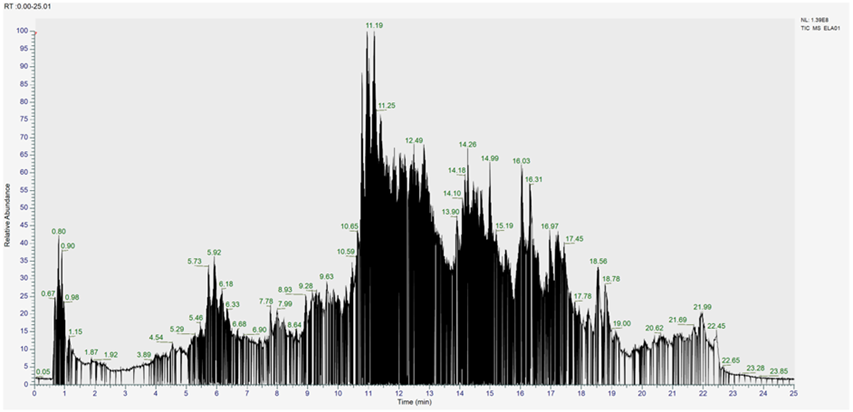
Based on the data presented in Supplementary Table 1, a total of 31 compounds were successfully annotated from the ethanolic extract of Ginggiang leaves. The identified compounds consisted of flavonoids (compounds 7, 8, 10, 11, 12, 13, 14, 15, and 16), carboxylic acids and their derivatives (compounds 1, 2, 5, 18, 20, 23, 27, and 29), terpenoids (compounds 19, 21, 22, and 31), amino acids (compound 4), phenolic and alcohol compounds (compounds 6 and 17), coumarins (compound 9), and purine bases (compound 3). Several of these compounds have previously been reported to possess pharmacological activities, including antidiabetic effects. Compounds reported to exhibit antidiabetic activity include rutin (14, 28), catechin derivatives (29), quercetin (30), kaempferol (31, 32), lupeol (33), and scopoletin (18).
LC-HRMS analysis also demonstrated that flavonoids were the predominant group of compounds identified in the extract. These compounds showed considerable diversity and collectively accounted for approximately 14% of the total relative abundance. This composition suggests that the ethanolic extract of Ginggiang leaves may serve as a promising source of antidiabetic lead compounds. Flavonoids have been widely reported to modulate glucose metabolism, inhibit carbohydrate-hydrolyzing enzymes, and exhibit antioxidant activity (14). Therefore, multitarget antidiabetic molecular docking studies were considered relevant to further evaluate the potential interactions of the identified metabolites with diabetes-related target proteins.
Molecular Docking
Determination of Test Molecules and Their Preparation
Not all compounds annotated from the LC-HRMS analysis shown in Supplementary Table 1 were included in the molecular docking study. Compounds suspected to be contaminants, plasticizers, or analytical artifacts were excluded from the list of docking candidates to improve metabolite selection reliability. The excluded compounds were Bis (2-ethylhexyl) adipate (compound 30), which is known as a plasticizer compound (34, 35); oleamide (compound 25), which was suspected to be a plastic-derived contaminant (36, 37); erucamide (compound 28), which is commonly used as a polymer additive (38); and stearamide (compound 26), which was considered a possible laboratory artifact (38). Compound 19 was also excluded because its mzCloud Best Match score was below 80%, indicating low confidence in compound annotation. The remaining annotated compounds were subsequently evaluated using Lipinski's parameters. Compounds that violated more than two of Lipinski’s Rules of Five were excluded from further analysis, as shown in Table 2. Compounds 7, 8, 10, 12, 13, and 15 did not meet these criteria and were therefore excluded. Molecular docking studies were subsequently performed on the remaining 20 selected compounds.
| No | MW | LogP | Hydrogen Bond Donor | Hydrogen Bond Acceptor |
|---|---|---|---|---|
| 1 | 137.138 | 0.8682 | 0 | 3 |
| 2 | 143.186 | 0.7326 | 2 | 2 |
| 3 | 267.245 | -1.9800 | 4 | 9 |
| 4 | 165.192 | 0.6410 | 2 | 2 |
| 5 | 187.198 | 2.2657 | 2 | 1 |
| 6 | 166.176 | 1.6034 | 1 | 3 |
| 7 | 726.637 | -3.2805 | 11 | 19 |
| 8 | 610.521 | -1.6871 | 10 | 16 |
| 9 | 192.170 | 1.5072 | 1 | 4 |
| 10 | 448.380 | -0.2445 | 7 | 11 |
| 11 | 442.376 | 2.5276 | 7 | 10 |
| 12 | 464.379 | -0.5389 | 8 | 12 |
| 13 | 580.495 | -1.7812 | 9 | 15 |
| 14 | 302.238 | 1.9880 | 5 | 7 |
| 15 | 594.522 | -1.3927 | 9 | 15 |
| 16 | 286.239 | 2.2824 | 4 | 6 |
| 17 | 317.514 | 3.1190 | 4 | 4 |
| 18 | 292.419 | 4.5293 | 1 | 2 |
| 20 | 294.435 | 5.0635 | 1 | 2 |
| 21 | 454.695 | 7.2977 | 1 | 2 |
| 22 | 454.695 | 6.5402 | 1 | 3 |
| 23 | 278.436 | 5.6605 | 1 | 1 |
| 24 | 255.446 | 4.9530 | 1 | 1 |
| 27 | 292.463 | 5.7489 | 0 | 2 |
| 29 | 270.457 | 5.6407 | 0 | 2 |
| 31 | 426.729 | 8.0248 | 1 | 1 |
Target Protein and Docking Method Validation
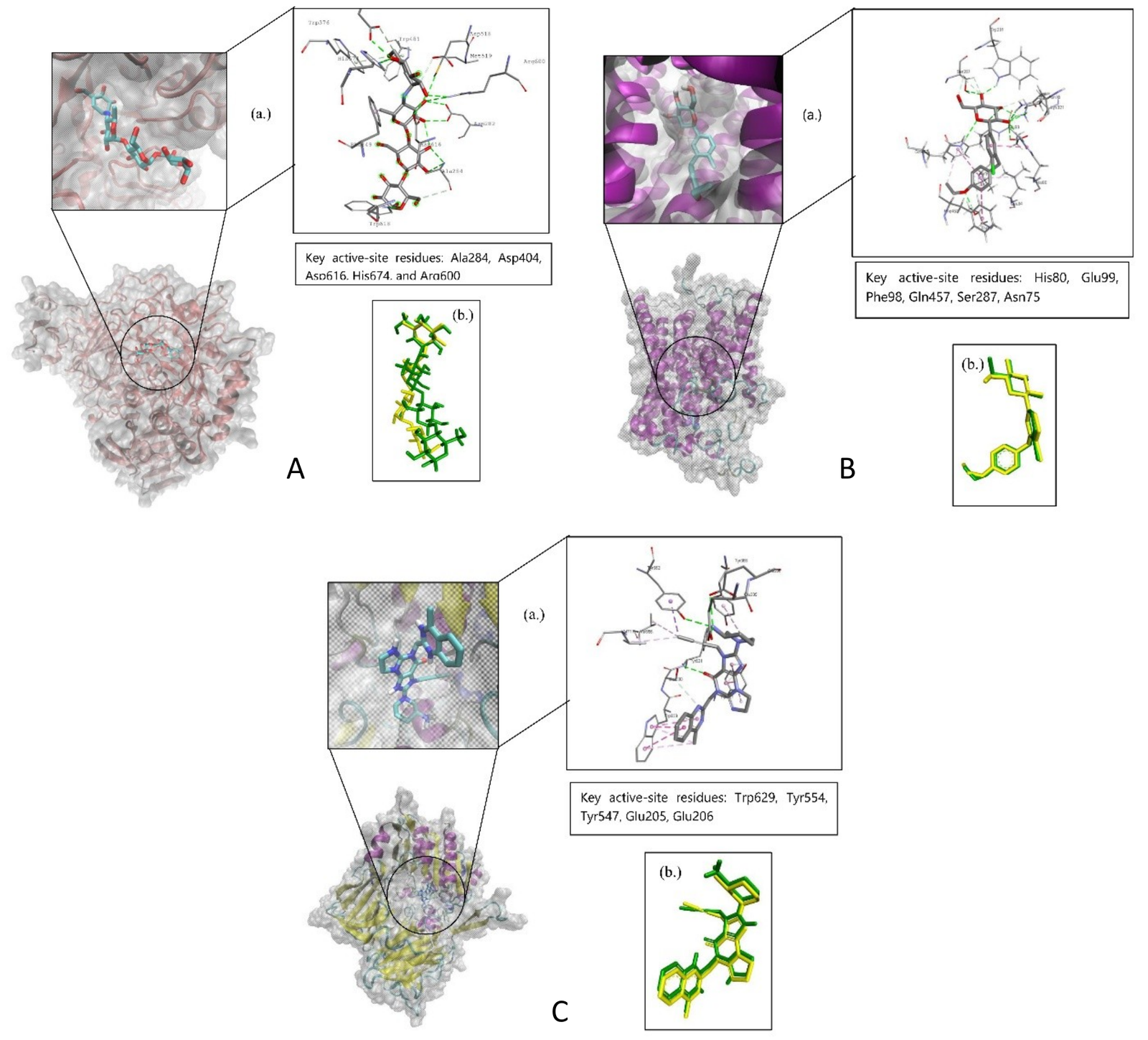
The target proteins used in this study were α-glucosidase (PDB ID: 5NN8) with acarbose as the native ligand, SGLT2 transporter protein (PDB ID: 8HEZ) with dapagliflozin as the native ligand, and DPP-4 enzyme (PDB ID: 5T4B) with 34a (2-[(3R)-3-aminopiperidin-1-yl]-3-(but-2-yn-1-yl)-5-[(4-methylquinazolin-2-yl)methyl]-3H-imidazo [2, 1-b]purin-4 (5H)-one) as the native ligand. Docking validation confirmed that the selected docking parameters were valid, and the coordinate and grid box parameters are presented in Table 3. The visualization of docking validation results is shown in Figure 2.
| PDB ID | Coordinate | Grid Box | Grid Spacing (Å) | RMSD | ||||
|---|---|---|---|---|---|---|---|---|
| x | y | z | x | y | z | |||
| 5NN8 | -8.284 | -33.342 | 90.637 | 52 | 76 | 52 | 0.375 | 1.479 Å |
| 8HEZ | 67.143 | 67.786 | 76.571 | 50 | 46 | 50 | 0.375 | 0.620 Å |
| 5T4B | 37.678 | 50.549 | 40.712 | 42 | 44 | 42 | 0.375 | 1.651 Å |
Docking of Test Compounds
The binding affinity values and key interacting residues of the test compounds against the three target proteins are shown in Supplementary Table 2. None of the identified compounds showed a binding affinity superior to that of the corresponding reference antidiabetic drugs. Data presented in Supplementary Table 2 showed that compound 11 (catechin gallate) and compound 17 (2-amino-1, 3, 4-octadecanetriol) exhibited moderate binding affinities toward α-glucosidase, SGLT2, and DPP-4. These findings suggest that both compounds may act as multitarget antidiabetic agents. The ability of these compounds to interact with multiple diabetes-related targets suggests the possibility of synergistic antidiabetic effects through several complementary mechanisms. Such mechanisms may involve modulation of carbohydrate digestion via α-glucosidase inhibition, reduction of renal glucose reabsorption through SGLT2 inhibition, and regulation of incretin metabolism through DPP-4 inhibition. α-Glucosidase inhibitors are known to delay carbohydrate hydrolysis and attenuate postprandial hyperglycemia (9), whereas SGLT2 inhibitors reduce blood glucose levels by suppressing renal glucose reabsorption (39). In addition, DPP-4 inhibition prolongs incretin activity and enhances glucose-dependent insulin secretion (40). Therefore, simultaneous modulation of these targets may provide complementary therapeutic benefits in diabetes management.
Catechin and its derivatives, including catechin gallate (compound 11), have been widely investigated for their potential antidiabetic properties. Previous studies have reported that these compounds may improve insulin sensitivity, reduce oxidative stress, and regulate glucose metabolism (29, 41). Furthermore, catechin-derived flavonoids have demonstrated α-glucosidase inhibitory activity, which may support the favorable docking interaction of catechin gallate with α-glucosidase observed in the present study (41). Nevertheless, the biological relevance of these docking predictions remains to be confirmed through experimental studies.
Compounds 22 and 31 exhibited strong binding affinities toward α-glucosidase and DPP-4. These findings suggest the potential role of both compounds in the regulation of postprandial glucose levels through dual-target mechanisms. Inhibition of α-glucosidase may delay carbohydrate hydrolysis and intestinal glucose absorption, thereby attenuating postprandial hyperglycemia (9). Meanwhile, inhibition of DPP-4 may prolong incretin hormone activity, resulting in enhanced glucose-dependent insulin secretion (11).
Compounds 14, 16, 18, and 23 exhibited potential multitarget antidiabetic activity against both the SGLT2 transporter protein and the DPP-4 enzyme. Meanwhile, compounds 2, 4, 6, 9, 20, 24, and 29 were predicted to selectively inhibit the SGLT2 protein.
This study was limited to metabolite annotation and molecular docking approaches, which remain predictive and are subject to false-positive outcomes. Despite these limitations, the results provide preliminary insight into the antidiabetic potential of Ginggiang leaf ethanol extract and highlight several compounds for further investigation. Molecular dynamics simulations and experimental validation through in vitro and in vivo studies are needed to confirm the stability and biological significance of the observed protein–ligand interactions.
Conclusion
LC-HRMS analysis of Ginggiang leaf ethanol extract revealed the presence of compounds belonging to flavonoid, phenolic, terpenoid, and fatty acid-derived compounds. Molecular docking studies suggested that several compounds identified in the extract may possess antidiabetic activity through multitarget mechanisms. Catechin gallate and 2-amino-1, 3, 4-octadecanetriol showed favorable docking scores against α-glucosidase, SGLT2, and DPP-4 and may therefore warrant further investigation as computationally predicted antidiabetic candidates. In addition, several other compounds displayed favorable predicted interactions with one or more antidiabetic targets. These findings provide preliminary computational evidence supporting further investigation of this extract as a source of bioactive metabolites with potential antidiabetic properties. Further studies, including molecular dynamics simulations of the potential compounds as well as in vitro and in vivo evaluations, are necessary to validate the antidiabetic activity of this extract.
Abbreviations
DPP-4 = Dipeptidyl peptidase-4; ESI = Electrospray ionization; GFN-xTB = Generalized Born–Fock Non-Dynamic Tight-Binding; LGA = Lamarckian Genetic Algorithm; LC-MS = Liquid chromatography-mass spectrometry; LC-HRMS = Liquid chromatography–high-resolution mass spectrometry; MW = Molecular weight; PDB = Protein Data Bank; RMSD = Root Mean Square Deviation; SGLT2 = Sodium-glucose cotransporter 2; TIC = Total ion chromatogram; T2DM = Type 2 diabetes mellitus; UHPLC = Ultra-high-performance liquid chromatography.
Declarations
Acknowledgment
-
Conflict of Interest
The authors declare no conflict of interest.
Data Availability
All data generated or analyzed during this study are included in this published article and its supplementary information files.
Ethics Statement
Not applicable.
Funding Information
This work received no external funding.
Supplemental Material
<b>Supplementary Table 1</b> and <b>Supplementary Table 2</b> are provided in a single Microsoft Word document. The file can be downloaded from the journal’s website via the following <a class="cursor-pointer" href="https://etflin.com/file/document/20260716021646_110739_1fcbe47e.docx">link</a>.
References
- International Diabetes Federation. IDF Diabetes Atlas 11th Edition. 2025. IDF Diabetes Atlas. Available from: https://diabetesatlas.org/
- Xie J, Wang M, Long Z, Ning H, Li J, Cao Y, et al. Global burden of type 2 diabetes in adolescents and young adults, 1990-2019: systematic analysis of the Global Burden of Disease Study 2019. BMJ. 2022;379:e072385. doi: https://doi.org/10.1136/bmj-2022-072385
- Shi Q, Nong K, Vandvik PO, Guyatt GH, Schnell O, Rydén L, et al. Benefits and harms of drug treatment for type 2 diabetes: systematic review and network meta-analysis of randomised controlled trials. BMJ. 2023;381:e074068. doi: https://doi.org/10.1136/bmj-2022-074068
- Zhao Y, Zhang X, Liang H, Wang L. Antidiabetic agents: Do they hit the right targets?. Frigid Zone Medicine. 2022;2(4):225-243. doi: https://doi.org/10.2478/fzm-2022-0030
- Chaudhury A, Duvoor C, Reddy Dendi VS, et al. Clinical Review of Antidiabetic Drugs: Implications for Type 2 Diabetes Mellitus Management. Front Endocrinol (Lausanne). 2017;8:6. doi:10.3389/fendo.2017.00006
- Galicia-Garcia U, Benito-Vicente A, Jebari S, Larrea-Sebal A, Siddiqi H, Uribe KB, et al. Pathophysiology of Type 2 Diabetes Mellitus. Ijms. 2020;21(17):6275. doi: https://doi.org/10.3390/ijms21176275
- Lu X, Xie Q, Pan X, Zhang R, Zhang X, Peng G, et al. Type 2 diabetes mellitus in adults: pathogenesis, prevention and therapy. Sig Transduct Target Ther. 2024;9(1):262. doi: https://doi.org/10.1038/s41392-024-01951-9
- Artasensi A, Pedretti A, Vistoli G, Fumagalli L. Type 2 Diabetes Mellitus: A Review of Multi-Target Drugs. Molecules. 2020;25(8):1987. doi: https://doi.org/10.3390/molecules25081987
- Kashtoh H, Baek KH. Recent Updates on Phytoconstituent Alpha-Glucosidase Inhibitors: An Approach towards the Treatment of Type Two Diabetes. Plants. 2022;11(20):2722. doi: https://doi.org/10.3390/plants11202722
- Chao EC. SGLT-2 Inhibitors: A New Mechanism for Glycemic Control. Clinical Diabetes. 2014;32(1):4-11. doi: https://doi.org/10.2337/diaclin.32.1.4
- Ahrén B. DPP-4 Inhibition and the Path to Clinical Proof. Front. Endocrinol. 2019;10:376. doi: https://doi.org/10.3389/fendo.2019.00376
- Gallwitz B. Clinical Use of DPP-4 Inhibitors. Front. Endocrinol. 2019;10:389. doi: https://doi.org/10.3389/fendo.2019.00389
- Purwaniati P, Insanu M, Iwo MI, Kartasasmita RE. The Antimicrobial activity of Ginggiang (Leea aequata L.) leaf extract as Preservative and Antiseptic. Rjpt. 2025;18(3):1154–1164. doi: https://doi.org/10.52711/0974-360x.2025.00166
- AL-Ishaq RK, Abotaleb M, Kubatka P, Kajo K, Büsselberg D. Flavonoids and Their Anti-Diabetic Effects: Cellular Mechanisms and Effects to Improve Blood Sugar Levels. Biomolecules. 2019;9(9):430. doi: https://doi.org/10.3390/biom9090430
- Hossain F, Mostofa MG, Alam AK. Traditional uses and pharmacological activities of the genus leea and its phytochemicals: A review. Heliyon. 2021;7(2):e06222. doi: https://doi.org/10.1016/j.heliyon.2021.e06222
- Tun NL, Hu DB, Xia MY, Zhang DD, Yang J, Oo TN, et al. Chemical Constituents from Ethanoic Extracts of the Aerial Parts of Leea aequata L., a Traditional Folk Medicine of Myanmar. Nat. Prod. Bioprospect. 2019;9(3):243-249. doi: https://doi.org/10.1007/s13659-019-0209-y
- Alrumaihi F, Almatroodi SA, Alharbi HOA, Alwanian WM, Alharbi FA, Almatroudi A, et al. Pharmacological Potential of Kaempferol, a Flavonoid in the Management of Pathogenesis via Modulation of Inflammation and Other Biological Activities. Molecules. 2024;29(9):2007. doi: https://doi.org/10.3390/molecules29092007
- Gao XY, Li XY, Zhang CY, Bai CY. Scopoletin: a review of its pharmacology, pharmacokinetics, and toxicity. Front. Pharmacol. 2024;15:1268464. doi: https://doi.org/10.3389/fphar.2024.1268464
- Prashith Kekuda TR, Raghavendra HL, Bharadwaj NA, Akhilesha S. Traditional uses, chemistry and pharmacological activities of Leea indica (Burm. f.) Merr. (Vitaceae): A comprehensive review. Int J Green Pharm. 2018;12(1):S71–80.
- Bhendarkar KR, Shrivastav M, Nimbekar T. In Vivo Antidiabetic Activity and Histopathological Safety Assessment of Leea asiatica Methanolic Extract in Streptozotocin-Induced Diabetic Rats. J Neonatal Surg. 2025;14(32):3041–7.
- Morris GM, Huey R, Olson AJ. Using AutoDock for Ligand‐Receptor Docking. CP in Bioinformatics. 2008;24(1). doi: https://doi.org/10.1002/0471250953.bi0814s24
- López-Camacho E, García-Godoy MJ, García-Nieto J, Nebro AJ, Aldana-Montes JF. A New Multi-objective Approach for Molecular Docking Based on RMSD and Binding Energy. Cham: Springer International Publishing; 2016. doi: https://doi.org/10.1007/978-3-319-38827-4_6
- Rana N, Solanki P, Mehra R, Manhas A. Identification of natural compound inhibitors for substrate-binding site of MTHFD2 enzyme: Insights from structure-based drug design and biomolecular simulations. Chemical Physics Impact. 2025;10:100809. doi: https://doi.org/10.1016/j.chphi.2024.100809
- Agu PC, Afiukwa CA, Orji OU, Ezeh EM, Ofoke IH, Ogbu CO, et al. Molecular docking as a tool for the discovery of molecular targets of nutraceuticals in diseases management. Sci Rep. 2023;13(1):13398. doi: https://doi.org/10.1038/s41598-023-40160-2
- Lee JE, Jayakody J, Kim JI, Jeong JW, Choi KM, Kim TS, et al. The Influence of Solvent Choice on the Extraction of Bioactive Compounds from Asteraceae: A Comparative Review. Foods. 2024;13(19):3151. doi: https://doi.org/10.3390/foods13193151
- Azzahra VO, Mardiana S, Suharyadi S, Sianipar RJ, Ramadhan DS. Effect of Solvent Polarity on Extraction Yield, Phytochemical Composition, and Antioxidant Activity of Curcuma xanthorrhiza Roxb. and Moringa oleifera Lam. Biomednatproch. 2025;14(2):1273-1284. doi: https://doi.org/10.14421/biomedich.2025.142.1273-1284
- Stefova M, Petkovska A, Ugarkovic S, Stanoeva JP. Strategy for optimized use of LC-MS for determination of the polyphenolic profiles of apple peel, flesh and leaves. Arabian Journal of Chemistry. 2019;12(8):5180-5186. doi: https://doi.org/10.1016/j.arabjc.2016.12.009
- Al-Dhabi NA, Arasu MV, Park CH, Park SU. An up-to-date review of rutin and its biological and pharmacological activities. EXCLI J. 2015;14(Table 1):59–63.
- Wen L, Wu D, Tan X, Zhong M, Xing J, Li W, et al. The Role of Catechins in Regulating Diabetes: An Update Review. Nutrients. 2022;14(21):4681. doi: https://doi.org/10.3390/nu14214681
- Niziński P, Hawrył A, Polak P, Kondracka A, Oniszczuk T, Soja J, et al. Potential of Quercetin as a Promising Therapeutic Agent Against Type 2 Diabetes. Molecules. 2025;30(15):3096. doi: https://doi.org/10.3390/molecules30153096
- Moore WT, Luo J, Liu D. Kaempferol improves glucose uptake in skeletal muscle via an AMPK-dependent mechanism. Food Science and Human Wellness. 2023;12(6):2087-2094. doi: https://doi.org/10.1016/j.fshw.2023.03.028
- Yao YX, Yu YJ, Dai S, Zhang CY, Xue XY, Zhou ML, et al. Kaempferol efficacy in metabolic diseases: Molecular mechanisms of action in diabetes mellitus, obesity, non-alcoholic fatty liver disease, steatohepatitis, and atherosclerosis. Biomedicine & Pharmacotherapy. 2024;175:116694. doi: https://doi.org/10.1016/j.biopha.2024.116694
- Lee HA, Kim MJ, Han JS. Alleviating effects of lupeol on postprandial hyperglycemia in diabetic mice. Toxicology Research. 2021;10(3):495-500. doi: https://doi.org/10.1093/toxres/tfab019
- Merck. LC-MS Contaminants: Avoid, Identify, Minimize. 2026.
- Keller BO, Sui J, Young AB, Whittal RM. Interferences and contaminants encountered in modern mass spectrometry. Analytica Chimica Acta. 2008;627(1):71-81. doi: https://doi.org/10.1016/j.aca.2008.04.043
- Jug U, Naumoska K, Metličar V, Schink A, Makuc D, Vovk I, et al. Interference of oleamide with analytical and bioassay results. Sci Rep. 2020;10(1). doi: https://doi.org/10.1038/s41598-020-59093-1
- Naumoska K, Jug U, Metličar V, Vovk I. Oleamide, a Bioactive Compound, Unwittingly Introduced into the Human Body through Some Plastic Food/Beverages and Medicine Containers. Foods. 2020;9(5):549. doi: https://doi.org/10.3390/foods9050549
- Mofokeng NN, Madikizela LM, Tiggelman I, Chimuka L. Chemical profiling of paper recycling grades using GC-MS and LC-MS: An exploration of contaminants and their possible sources. Waste Management. 2024;189:148-158. doi: https://doi.org/10.1016/j.wasman.2024.08.014
- Vivian E. Sodium-glucose co-transporter 2 (SGLT2) inhibitors: a growing class of antidiabetic agents. Dic. 2014;3:1-19. doi: https://doi.org/10.7573/dic.212264
- Nakamura K, Oe H, Kihara H, Shimada K, Fukuda S, Watanabe K, et al. DPP-4 inhibitor and alpha-glucosidase inhibitor equally improve endothelial function in patients with type 2 diabetes: EDGE study. Cardiovasc Diabetol. 2014;13(1). doi: https://doi.org/10.1186/s12933-014-0110-2
- Lam TP, Tran NVN, Pham LHD, Lai NVT, Dang BTN, Truong NLN, et al. Flavonoids as dual-target inhibitors against α-glucosidase and α-amylase: a systematic review of in vitro studies. Nat. Prod. Bioprospect. 2024;14(1). doi: https://doi.org/10.1007/s13659-023-00424-w