RESEARCH ARTICLE
Rethinking Promotion: Social Media, Influencers, and Local Brand Sales
Sustainable Economy|Vol. 1, Issue 1, pp. 14-19 (2025)
CC BY 4.0-2025 Authors
Views
Downloads
Shares

Received
Jun 13, 2025Revised
Aug 26, 2025Accepted
Nov 28, 2025Published
Dec 19, 2025
Abstract
Local brands in Indonesia face increasing competitive pressure within the digital marketplace, driving a shift from traditional promotional media toward more targeted online strategies. This study examines the influence of social media promotion and influencer marketing on consumer purchase intention toward Compass, a local footwear brand, with price perception tested as a moderating variable. A quantitative explanatory approach was used, analyzed through Partial Least Squares Structural Equation Modeling (PLS-SEM) using SmartPLS based on data from 150 respondents aged 18–35 in Makassar who actively use social media and are familiar with Compass products. The results show that both social media promotion and influencer marketing significantly increase purchase intention, while price perception moderates these relationships in different directions. High price perception weakens the effect of social media promotion, whereas influencer endorsements retain persuasive strength even under higher price evaluations. These findings highlight the importance of integrating price-sensitive strategies into digital promotional activities and demonstrate that influencer-based communication offers greater behavioral impact than general promotional exposure. Practical implications suggest that local brands should adopt data-driven digital marketing strategies aligned with consumer value assessments to enhance market competitiveness.
Introduction
Growing environmental concerns and the shift toward sustainable practices continue to influence marketing strategies in Indonesia (1-4). Conventional promotional media such as paper brochures, plastic banners, and printed advertisements are becoming less effective as consumers move toward digital channels. These traditional materials also generate non-biodegradable waste that contributes to urban pollution. This situation reinforces the need for marketing approaches that lower environmental impact and remain aligned with changing consumer behavior.
Within this broader transition, social media promotion and influencer marketing have emerged as prominent tools for targeted and cost-efficient communication (5-7). These strategies are particularly relevant for younger consumers who dominate digital activity in Indonesian cities. In the local footwear market, Compass, a Bandung-based brand, epresents a relevant case due to its strong digital presence and increasing market position among local sneaker brands. Despite competing with international products that remain preferred by 65.4 percent of Indonesian consumers, Compass continues to expand its reach through digital engagement (8). Its reliance on online visibility makes it an appropriate subject for examining how digital promotion shapes consumer responses.
Previous research highlights digital marketing as a more resource-efficient alternative to print-based promotion (9-13). However, consumers remain sensitive to price, and perceived value plays a crucial role in determining whether digital engagement leads to purchase intention (14-16). These findings suggest that price may influence how consumers interpret and respond to promotional cues, making it an essential variable to consider.
To address this gap, this study examines how social media promotion and influencer marketing influence purchase intention toward Compass, with price tested as a moderating factor. Drawing on the Theory of Planned Behavior, the study incorporates attitudinal and normative influences that arise from digital interactions and price evaluations. Using a quantitative approach with PLS-SEM, this research clarifies how different forms of digital promotion operate and how price perceptions strengthen or weaken their effects. The findings are intended to guide marketers and policymakers in developing digital strategies that are effective, competitive, and supportive of sustainability-oriented marketing practices.
Methodology
Study Design and Rationale
This study employed a quantitative explanatory design to examine how social media promotion and influencer endorsement influence purchase intention, with price included as a moderating variable. This approach allowed structured hypothesis testing and the analysis of directional relationships between constructs through structural equation modeling. The use of this design was appropriate because the research aimed to measure behavioral tendencies using clear and comparable indicators within a digital marketing context.
Population, Sample Size, and Sampling Criteria
The target population consisted of consumers in Makassar who were familiar with Compass footwear and had shown interest in local sneaker brands. Purposive sampling was used to ensure that respondents met specific digital engagement characteristics relevant to the study. Although purposive sampling may introduce selection bias, it was considered suitable because the research required participants who actively interacted with social media content related to local footwear.
Makassar was chosen as the study location due to its large and digitally active youth demographic, which aligns with Compass’s core market. The inclusion criteria required respondents to [1] actively use social media platforms such as Instagram or TikTok, [2] be between 18 and 35 years old, and [3] have purchased or considered purchasing local footwear within the past year. A total of 150 valid responses were obtained. While larger samples are often preferred in PLS-SEM, the sample size aligns with guidelines from SmartPLS and Hair’s recommendations, which indicate that 150 is adequate for models with a moderate number of indicators and reflective constructs.
Data Collection Instruments and Procedures
Data were collected using a structured questionnaire adapted from established marketing and consumer behavior scales. All items were measured using a five-point Likert scale (1 = strongly disagree to 5 = strongly agree), covering constructs such as social media promotion, influencer credibility, price perception, and purchase intention.
A pretest involving 30 respondents was conducted to assess clarity and comprehensibility. Feedback from this stage resulted in minor revisions to the wording of three items to enhance readability and ensure alignment with operational definitions.
The final questionnaire was distributed online through Google Forms over four weeks. Respondents were recruited based on the predefined inclusion criteria, and submissions were screened for completeness and internal consistency before being included in the dataset.
Data Analysis
Data were analyzed using Partial Least Squares Structural Equation Modeling (PLS-SEM) through SmartPLS version 4.0. This method was selected because it supports complex models, works well with non-normal data, and is suitable for studies with moderate sample sizes. Reliability was assessed through Cronbach’s alpha and composite reliability (CR). Validity was examined using Average Variance Extracted (AVE) and the Fornell–Larcker criterion to ensure adequate convergent and discriminant validity. Hypothesis testing was performed using a bootstrapping procedure with 5, 000 subsamples to evaluate the significance of each path.
Ethical Considerations
The study followed ethical research standards by obtaining informed consent, ensuring respondent anonymity, and maintaining data confidentiality. Ethical clearance was granted through an internal faculty-level review consistent with institutional guidelines for social science research.
Results
Descriptive Statistics and Respondent Characteristics
A total of 150 respondents participated in the study. Most were between 18 and 35 years old, actively used social media platforms such as Instagram and TikTok, and were familiar with local footwear brands. These characteristics indicate a digitally engaged consumer segment that fits the study’s focus on online promotion and influencer-driven marketing. Understanding these attributes helps contextualize the interpretation of the findings, especially in relation to price sensitivity and digital consumption patterns..
Measurement Model Evaluation (Outer Model)
The measurement model was evaluated through reliability, convergent validity, and discriminant validity. Most indicator loadings exceeded 0.70, with a few slightly above 0.60, which remains acceptable for exploratory PLS-SEM. Cronbach’s alpha and Composite Reliability (CR) values for all constructs surpassed the recommended 0.70 benchmark, demonstrating internal consistency. Each construct also achieved an Average Variance Extracted (AVE) above 0.50, confirming adequate convergent validity.
Although several values are close to minimum thresholds, they still fall within acceptable ranges for exploratory modeling and demonstrate consistency across indicators as presented in Table 1.
| Construct | Cronbach’s Alpha | CR | AVE | Interpretation |
|---|---|---|---|---|
| Social Media Promotion | 0.746 | 0.763 | 0.662 | Reliable & valid |
| Influencer | 0.769 | 0.785 | 0.685 | Reliable & valid |
| Price | 0.831 | 0.834 | 0.663 | Reliable & valid |
| Purchase Intention | 0.753 | 0.762 | 0.672 | Reliable & valid |
Structural Model Evaluation (Inner Model)
The R² value for Purchase Intention is 0.455, indicating that Social Media Promotion, Influencer Marketing, and Price collectively explain 45.5 percent of the variance. This level of explanatory power is considered moderate and is typical for consumer behavior research involving attitudinal and perceptual variables.
Hypothesis Testing
Hypothesis testing was conducted using a bootstrapping procedure with 5, 000 subsamples and a significance threshold of α = 0.05 as shown in Table 2.
| Hypothesis | Beta | t- value | p- value | Result |
|---|---|---|---|---|
| H1: Social Media Promotion → Purchase Intention | 0.186 | 2.817 | 0.005 | Supported |
| H2: Influencer → Purchase Intention | 0.294 | 3.267 | 0.001 | Supported |
| H3: Social Media Promotion * Price → Purchase Intention | - 0.165 | 2.083 | 0.037 | Supported |
| H4: Influencer * Price → Purchase Intention | 0.167 | 2.106 | 0.035 | Supported |
These results indicate that social media promotion and influencer marketing both contribute positively to purchase intention. In addition, price significantly moderates both relationships, although in different directions. Social media promotion becomes less persuasive when price perception is unfavorable, whereas influencer endorsements retain their effectiveness even at higher price levels. Collectively, these findings show that digital promotional efforts influence purchase intention and that price plays an important role in shaping the strength of these effects.
Discussion
This study analyzed the effects of social media promotion and influencer endorsement on consumers’ purchase intention toward Compass footwear, with price introduced as a moderating variable. The results offer a clearer understanding of how digital marketing mechanisms shape consumer decision-making, particularly within fashion-oriented markets that rely heavily on online engagement.
The Influence of Social Media Promotion on Purchase Intention
Social media promotion was found to positively influence purchase intention, indicating that digital exposure contributes to consumers’ attitudes toward Compass products. This aligns with the Theory of Planned Behavior, which explains that persuasive messages can shape attitudes and subsequently influence behavioral intentions (17-19). Prior research also highlights that interactive content, platform visibility, and brand engagement increase consumers’ willingness to explore products marketed through social channels (20, 21). Studies on content marketing further show that well-structured promotional materials enhance consumer interest, particularly when aligned with digital trends and community-driven interaction (22, 23).
Beyond informative value, social media operates as a social environment where identity and peer norms are constructed. As a result, promotional messages tend to be more influential among younger digital users. For Compass, a brand with strong youth appeal, exposure on platforms like Instagram and TikTok reinforces brand recall, social validation, and perceived exclusivity, all of which foster purchase intention.
The Influence of Influencers on Purchase Intention
Influencer endorsement demonstrated a stronger effect than general social media promotion. Influencers offer personalized communication and serve as credible sources, helping reduce perceived risk during product evaluation (24, 25). This supports the notion that trust, authenticity, and perceived expertise play important roles in shaping consumer responses, especially in fashion consumption, where community belonging and social approval influence decisions (26, 27).
Given the respondents’ age characteristics, they are more receptive to influencers whose lifestyle and digital personas resemble their own preferences. This increases message relevance and credibility, making influencer recommendations more persuasive than generic promotional content (28, 29).
The Moderating Role of Price
Price was shown to moderate both relationships, but in opposite directions. The negative moderation on social media promotion suggests that when consumers perceive prices as high, promotional messages lose persuasive strength. Although such promotions may attract attention, they become less effective if consumers do not see the price as justified.
In contrast, price positively moderated the influencer–purchase intention relationship. Influencers appear to help consumers rationalize higher prices by adding perceived value (30). Trusted influencers can reduce uncertainty and strengthen justification processes, particularly when products are positioned within premium or limited-release categories (31). This dynamic is consistent with sneaker market behavior, where scarcity and exclusivity often elevate consumers’ willingness to accept higher price points.
This nuanced role of price reflects real-world marketplace dynamics, especially in the sneaker resale market for Compass products, where limited availability often drives prices far above retail. Consumers accustomed to this scarcity-driven pricing may rely more heavily on influencer validation when purchasing at premium prices.
Theoretical and Practical Implications
Theoretically, the findings extend the Theory of Planned Behavior by integrating price perceptions into digital attitudinal processes. Price is shown to interact with social and emotional cues rather than functioning solely as a rational evaluation. Influencers, therefore, act as normative references that help contextualize price fairness and reduce uncertainty during judgment (32, 33).
Practically, the results demonstrate that digital-native consumers evaluate marketing messages differently depending on price conditions. General social media promotion becomes less effective under high price perceptions, whereas influencer-based communication retains its persuasive capacity. This is consistent with earlier studies showing that young consumers rely on trusted digital figures to validate price premiums and reduce cognitive dissonance when making purchase decisions (34).
For brands such as Compass, these insights suggest that visibility-driven promotions work best when prices align with perceived value. Conversely, higher-priced items require influencer-based strategies that emphasize authenticity, craftsmanship, and experiential value, factors known to strengthen perceived price fairness (35).
The results indirectly support the argument that digital marketing is more resource-efficient than traditional promotional tools. Printed banners, brochures, and other physical media contribute to material waste (36), whereas digital channels minimize reliance on physical materials and enable more targeted communication (37). However, since the study focuses on consumer behavior and not environmental metrics, sustainability should be interpreted as a practical implication rather than a measured outcome.
Figure 1 presents the structural relationships among variables, including their indicators and statistical significance values. All reflective indicators show strong loading values (0.747–0.890), demonstrating that each construct, social media promotion, influencer endorsement, price perception, and purchase intention, is measured consistently. This reinforces confidence that the behavioral patterns identified in this study reflect stable consumer responses rather than measurement errors.
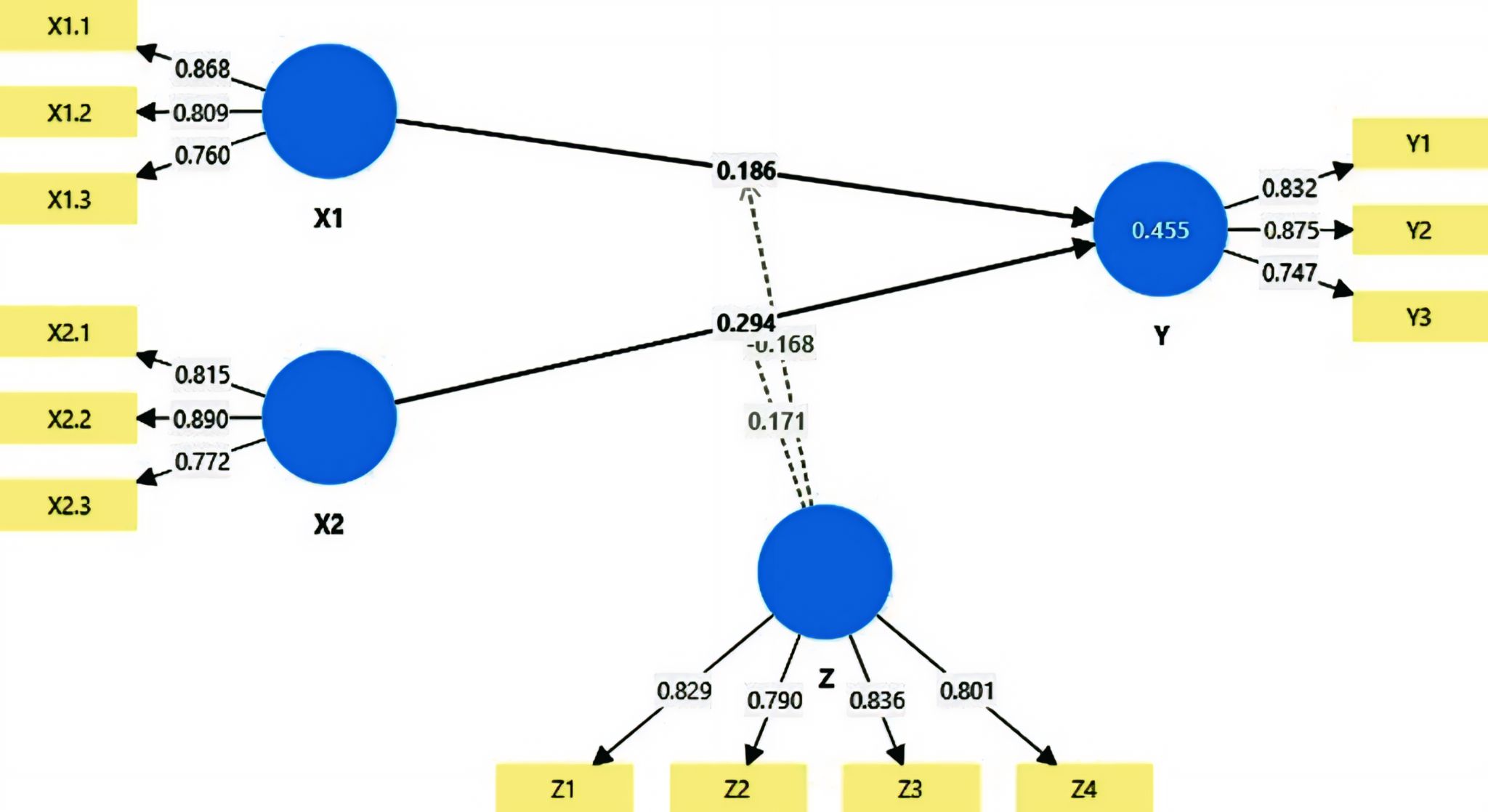
Overall, the findings highlight that effective digital marketing involves more than shifting from traditional to online channels. It requires understanding how consumers interpret value, how price interacts with social influence, and how credibility-based communication, especially from influencers, can offset limitations of general promotional content. This emphasizes that sustainable digital strategies must align with both psychological and social decision-making processes.
Conclusion
This study investigated the influence of social media promotion and influencer marketing on purchase intention toward the Compass footwear brand, with price examined as a moderating variable. The results indicate that both promotional strategies significantly shape consumer intention, although price modifies the strength and direction of these effects. These findings provide a clearer understanding of how digitally active consumers assess marketing messages and form value judgments within online purchasing environments.
However, the conclusions must be interpreted in light of several limitations. The sample size was relatively small and restricted to respondents in Makassar, which limits the generalizability of the results to broader populations. The use of self-report questionnaires may introduce response bias, and the purposive sampling technique reduces representativeness. These methodological constraints should be considered when evaluating the scope of the findings.
Additionally, although the study discusses sustainability in terms of the shift from printed promotion to digital communication, it does not measure environmental outcomes directly. Therefore, any sustainability implications should be understood as conceptual rather than empirical contributions.
Future research should involve larger and more diverse samples, extend the analysis across different regions, and compare results across various product categories. Methodological expansion, such as experimental designs, multi-group analysis, or behavioral tracking, would strengthen the understanding of how price interacts with digital promotional strategies. Replication in other industries would also help determine whether the observed patterns are consistent across different market contexts.
Declarations
Conflict of Interest
The authors declare no conflicting interest.
Funding Information
The author(s) declare that no financial support was received for the research, authorship, and/or publication of this article.
References
- Dash G, Sharma C, Sharma S. Sustainable marketing and the role of social media: an experimental study using natural language processing (NLP). Sustainability. 2023;15(6):5443.
- Abbas J, Mahmood S, Ali H, Ali Raza M, Ali G, Aman J, et al. The effects of corporate social responsibility practices and environmental factors through a moderating role of social media marketing on sustainable performance of business firms. Sustainability. 2019;11(12):3434.
- Minton E, Lee C, Orth U, Kim CH, Kahle L. Sustainable marketing and social media. J Advert. 2012;41(4):69–84.
- Mataracı P, Kurtuluş S. Sustainable marketing: the effects of environmental consciousness, lifestyle and involvement degree on environmentally friendly purchasing behavior. J Glob Scholars Mark Sci. 2020;30(3):304–18.
- Morton F. Influencer marketing: an exploratory study on the motivations of young adults to follow social media influencers. J Digit Soc Media Mark. 2020;8(2):156–165.
- Cruz A, Fenton A, Christov A. The art of influencer marketing. In: Digital and social media marketing. Routledge; 2024. 217–228.
- Sudnick KE. A philosophy of communication of social media influencer marketing: the banality of the social. Lanham: Rowman & Littlefield; 2023.
- Amelia S, Kusumah TH, Dedu M. The effect of brand ambassadors, online customer reviews and product quality on brand image of local shoes. Jurnal Riset Manajemen Sains Indonesia. 2021;16(1):66–83.
- Florek-Paszkowska A, Ujwary-Gil A. The digital-sustainability ecosystem: a conceptual framework for digital transformation and sustainable innovation. J Entrep Manag Innov. 2025;21(2):116–37.
- Raihan A. A review of the potential opportunities and challenges of the digital economy for sustainability. Innov Green Dev. 2024;3(4):100174.
- Henriques R, Figueiredo F, Nunes J. Product-services for a resource-efficient and circular economy: an updated review. Sustainability. 2023;15(15):12077.
- Hussein H, Albadry OM, Mathew V, Al-Romeedy BS, Alsetoohy O, Abou Kamar M, et al. Digital leadership and sustainable competitive advantage: leveraging green absorptive capability and eco-innovation in tourism and hospitality businesses. Sustainability. 2024;16(13):5371.
- Muduva M, Kiwa FJ. Artificial intelligence-driven green marketing strategies for a circular economy. In: Sustainable green marketing strategies for a circular economy: African realities and imperatives. Cham: Springer Nature Switzerland; 2025. 209–237.
- Mejía EMV, Pinzon OR, Berrio SR. Perceived value and pricing of digital products: the contribution of consumer perception to price setting. Int J Digit Commer. 2025;4(1):45–59.
- Pauwels K, D’Aveni R. The formation, evolution and replacement of price–quality relationships. J Acad Mark Sci. 2016;44(1):46–65.
- Hermawan D, Indayani L. Marketing strategies regarding price perceptions, product quality, and consumer satisfaction toward purchasing decisions for Gempol Citra Asri Housing. J Manajemen dan Bisnis. 2024;6(2):112–23.
- Chudry F, Foxall G, Pallister J. Exploring attitudes and predicting intentions: profiling student debtors using an extended theory of planned behavior. J Appl Soc Psychol. 2011;41(1).
- Polat M. Examining the effect of green marketing strategies on airline consumers’ purchasing behavior in the scope of Theory of Planned Behavior (TPB). Pazarlama Arastirmalari Derg. 2025;18(1):213–242.
- Riantini RE. The effect of omni channel marketing on the online search behavior of Jakarta retail consumers with theory of planned behavior (TPB) approach. In: 2019 International Conference on Information Management and Technology (ICIMTech). IEEE; 2019. 284–289.
- Rautela S. Social media for new product launch: a study of social media platforms across the RACE planning framework. Int J Interact Mob Technol. 2021;15(5).
- McKelvey F, Hunt R. Discoverability: toward a definition of content discovery through platforms. Soc Media Soc. 2019;5(1).
- Joan Isibor N, Attipoe V, Oyeyipo I, Christiana Ayodeji D, Apiyo Mayienga B, Alonge E, et al. Analyzing successful content marketing strategies that enhance online engagement and sales for digital brands. Int J Adv Multidiscip Res Stud. 2025;5(2):842–51.
- Riachi A. Role of social media marketing in building cause-oriented campaigns. Dutch J Finance Manage. 2023;5(2):23417.
- Söilen KS. The role of influencers, celebrity endorsements, and identifying opinion leaders. In: Digital Marketing. Cham: Springer; 2024. 171–185.
- Leite FP, Septianto F, Pontes N. ‘Meat’ the influencers: crafting authentic endorsements that drive willingness to buy cultured meat. Appetite. 2024;199:107401.
- Mandaki NM. The influence of online reviews, influencer credibility, celebrity endorsements on purchasing decisions for Scarlett skincare products. SEMB-J Sharia Econ Manag Business J. 2024;5(2):48–57.
- Koo IS. The effects of talent types on purchasing behavior of beauty-service products. Fashion Business. 2012;16(3):45–62.
- Duffek B, Eisingerich AB, Merlo O, Lee G. Authenticity in influencer marketing: how can influencers and brands work together to build and maintain influencer authenticity? J Mark. 2025.
- Sugiarto I, Simanjuntak M, Hasanah N. The role of e-marketing mix, influencer, and followers engagement toward product purchasing decisions. J Apl Bisnis Manaj. 2022;8(3):677–677.
- Son J, Jin B. Toward the deeper understanding of price and purchase intention relationship: the role of price fairness, consumer vanity, and consumer brand familiarity level. Int Text Apparel Assoc Annu Conf Proc. 2014;71(1).
- Al-Said A, Mohammed L. Investigating the impact of influencers’ content value on followers’ purchase intentions: evidence from YouTube influencers in developing countries. Int J Soc Sci Human Res. 2022;5(7):2944–51.
- Bazi S, Filieri R, Gorton M. Customers’ motivation to engage with luxury brands on social media. J Bus Res. 2020;112:223–35.
- Kinanti AS, Hadisiwi P, Wahyudin U. The influence of attitude, subjective norms, and perceived behavioral control on shopping decisions through purchase intention (a study on visitors of Margo City Mall Depok using the Theory of Planned Behavior). J Humanit Soc Stud. 2025;8(3):918–922.
- Yu J, Liang M, Jin CH. The effects of luxury brand influencer characteristics on self-brand connection: focused on consumer perception. Sustainability. 2023;15(8):6937.
- Shan Y, Chen KJ, Lin JS. When social media influencers endorse brands: the effects of self-influencer congruence, parasocial identification, and perceived endorser motive. Int J Advert. 2020;39(5):590–610.
- Gupta H, Kumar A, Wasan P. Industry 4.0, cleaner production and circular economy: an integrative framework for evaluating ethical and sustainable business performance of manufacturing organizations. J Clean Prod. 2021;295:126253.
- Mohamed NH, Khan S, Jagtap S. Waste 4.0: transforming medical waste management through digitalization and automated segregation. Discover Sustainability. 2024;5(1):353.