RESEARCH ARTICLE
Financing Sustainability: The Strategic Role of Green Sukuk ST007 in Advancing Indonesia’s Green Economy
Sustainable Economy|Vol. 1, Issue 1, pp. 7-13 (2025)
CC BY 4.0-2025 Authors
Views
Downloads
Shares

Received
Aug 29, 2025Revised
Nov 3, 2025Accepted
Nov 26, 2025Published
Dec 18, 2025
Abstract
Indonesia’s environmental challenges, such as vulnerability to climate-related disasters and increasing GHG emissions, demand urgent policy and financial solutions. This study examines the strategic role of Green Sukuk ST007 in supporting Indonesia’s green economy and its alignment with the United Nations' Sustainable Development Goals (SDGs). Using qualitative-descriptive analysis based on government and institutional data, the study explores the allocation of ST007 across 13 projects in four eligible sectors. Results show that ST007 raised IDR 5.42 trillion from 16,992 investors, achieving a GHG emission reduction of approximately 1.12 million tons, equivalent to planting 39,843 trees and supplying oxygen for over 34 million people. The majority of funds (61%) were directed to climate resilience projects. This confirms ST007’s strategic contribution to Indonesia’s sustainable financing agenda. In addition to its environmental impact, the findings highlight the policy relevance of expanding Green Sukuk as a key instrument for climate financing, particularly in strengthening national low-carbon strategies and enhancing stakeholder participation. However, further research is required to verify project-level impacts and long-term socio-economic outcomes.
Introduction
The global climate crisis has become one of the most urgent environmental challenges of the 21st century, with rising sea levels and increasing greenhouse gas (GHG) emissions indicating the need for systemic intervention (1-3). Indonesia, as the world’s largest archipelagic nation, faces heightened vulnerability to climate induced disasters (4-6). Projections by the Indonesian Institute of Sciences estimate a sea-level rise of 25–50 cm between 2050 and 2100 due to global warming (7). Indonesia is also the eighth-largest global emitter of GHGs, with the energy sector alone contributing 965.3 MtCO₂e, or 2% of global emissions (WRI, 2016). These conditions underscore the urgency of transitioning toward a green economy to safeguard long-term environmental and economic resilience (8).
Despite broad recognition of green-economy principles, financing remains a key constraint (9). Indonesia’s 2018 Second Biennial Update Report estimates that the country will require approximately US$247.2 billion to meet its 2030 emission-reduction targets (10). Given that public financing is insufficient, innovative and sustainable funding mechanisms are needed (11) Green Sukuk, a sharia-compliant instrument dedicated to environmentally beneficial projects, has emerged as one such mechanism. Since launching the world’s first sovereign Green Sukuk in 2018, Indonesia has positioned itself as a leader in Islamic climate finance (12). However, empirical assessments of the environmental impact of retail-based issuances, such as the ST007 series, remain limited.
Global research increasingly highlights Green Bonds and Green Sukuk as essential financial instruments for achieving climate targets, particularly in emerging economies. Countries such as Malaysia, the UAE, and the UK have demonstrated how sovereign green instruments mobilize large-scale financing for renewable energy, low-carbon transportation, and climate-adaptation initiatives. Integrating this broader perspective helps situate Indonesia’s Green Sukuk within global sustainable-finance trends and demonstrates how ST007 contributes to international best practices in green financial mobilization. Retail investor participation in ST007 reflects rising environmental awareness and the growing appeal of ethical and sharia-compliant investment options. Recent studies on green fixed-income instruments also highlight their role in mobilizing climate financing within broader sustainable-finance strategies. This study investigates the strategic contribution of the Green Sukuk ST007 series to Indonesia’s green-economy transition and sustainability agenda. While ST007 has demonstrated strong retail participation, its measurable environmental contributions have not been comprehensively analyzed. This research addresses that gap by evaluating the allocation of ST007 proceeds and their relationship to emission-reduction outcomes using a qualitative analysis of secondary data. To guide this inquiry, the study focuses on the following research questions: How does ST007 contribute to Indonesia’s emission-reduction goals? To what extent does ST007 support broader sustainability priorities, including climate resilience and alignment with the Sustainable Development Goals (SDGs)? What policy insights can be drawn to strengthen future Green Sukuk issuances? These guiding questions establish the scope of the qualitative investigation and justify the study’s relevance, supported by recent literature emphasizing the growing importance of green finance in emerging economies.
Methodology
Study Design and Rationale
This study employs a qualitative descriptive research design to evaluate the contribution of the Green Sukuk ST007 to Indonesia’s sustainability goals within the green-economy framework. A qualitative approach was chosen to enable a comprehensive analysis of policy documents, financial data, and environmental indicators related to green Islamic finance. This approach is especially appropriate given the limited availability of project-level primary data, making it necessary to assess sustainability outcomes, policy alignment, and implementation processes through qualitative interpretation. The study aims to identify underlying patterns and correlations between ST007 allocations and green-economy outcomes that may not be readily observable through quantitative metrics alone.
Data Sources and Selection Criteria
The study relied entirely on secondary data sourced from official government reports, regulatory documents, academic literature, and publications from international institutions. Key sources included the Ministry of Finance of the Republic of Indonesia, the Directorate General of Budget Financing and Risk Management (DJPPR), the Financial Services Authority (OJK), World Bank datasets, and peer-reviewed journal databases such as Scopus and DOAJ. Data were selected based on relevance to ST007 issuance and allocation, institutional credibility, and public accessibility. Document titles, publication years, and access information were recorded to ensure transparency and verifiability.
The analysis focuses on documents published between 2018 and 2023, corresponding to the period during which Indonesia began issuing sovereign Green Sukuk and when the ST007 retail series was introduced. Earlier Green Sukuk issuances were excluded because they differ in structure, target investors, and reporting mechanisms, placing them outside the scope of this study. The sample of 13 projects analyzed in this study was determined based on the official eligibility list reported in the Green Sukuk Allocation and Impact Report. These projects represent the complete set of activities financed under ST007, thereby justifying the fixed sample size and removing the need for additional sampling. The selection of the 13 projects was based on completeness of reporting and official inclusion in the Green Sukuk Allocation and Impact Report, ensuring both relevance and consistency.
Data Collection Procedures
Quantitative indicators, such as total emission reductions and energy savings, were incorporated to complement the thematic qualitative findings. Data collection involved categorizing documents thematically and extracting key variables, including issuance volume, investor distribution, sectoral fund allocation, and project types financed under the ST007 program. Additional attention was given to environmental indicators particularly projected emission reductions and policy frameworks guiding sukuk implementation. The study also examined alignment with the Sustainable Development Goals (SDGs), with emphasis on Goals 7, 11, and 13. A structured protocol was used to ensure traceability by recording source details and publication metadata for each document.
Data Analysis
Data analysis employed a combination of qualitative content analysis and comparative evaluation. Thematic coding was used to identify recurring narratives and patterns within the dataset. An open–axial coding strategy was applied to interpret policy–impact linkages and analyze sustainability narratives. Comparative evaluation was then used to position ST007 relative to other green-financing instruments in Indonesia. Effectiveness was assessed based on environmental additionality, fiscal absorption, and alignment with national sustainability strategies. Coding was conducted manually to maintain clarity and replicability, and triangulation across multiple independent sources was performed to enhance analytical validity and reduce bias. The study acknowledges that future assessments would benefit from a standardized evaluation framework to consistently measure the sustainability performance of Green Sukuk projects.
Results
The Link Between Green Economy, Green Sukuk, and the Achievement of the SDGs
The relationship between green-economy practices and the Sustainable Development Goals (SDGs) is deeply interconnected, as green-economy initiatives are inherently designed to advance multiple SDG targets. According to reports from the Directorate of Sharia Financing under DJPPR, the implementation of green economy principles particularly those financed through Green Sukuk directly supports several critical development goals.
Green economy strategies enhance access to clean water and sanitation by promoting efficient water management, wastewater treatment technologies, and water saving policies, thereby supporting SDG 6. In relation to SDG 7, green economy initiatives advance renewable-energy adoption, improve energy efficiency, and expand affordable access to clean energy. Inclusive and sustainable economic growth, as targeted in SDG 8, is strengthened through investments in green infrastructure, sustainable transport, and environmentally responsible waste-management systems.
Environmental protection objectives, including SDG 14 (Life Below Water) and SDG 15 (Life on Land), are addressed through conservation measures and efforts to reduce environmental degradation in terrestrial and marine ecosystems. With respect to SDG 13, Green Sukuk contribute by financing projects aimed at reducing greenhouse-gas emissions and supporting climate-adaptation strategies.
Through Green Sukuk issuance, the Indonesian government provides an inclusive and Sharia-compliant financing mechanism that accelerates green development. Funds raised through this instrument are allocated to projects that directly contribute to achieving SDG targets. This demonstrates the strategic role of Green Sukuk in supporting national and global sustainability agendas while addressing Indonesia’s pressing environmental and social challenges.
Overall, the descriptive patterns show a clear prioritization of sectors with the highest environmental leverage, particularly climate and disaster resilience. This trend indicates that the government’s allocation strategy aligns with national climate-adaptation priorities and reflects a risk-mitigation approach, given Indonesia’s high exposure to climate hazards. Concentrating funding in these sectors demonstrates an intentional effort to maximize environmental impact within limited fiscal space, positioning ST007 as a catalytic instrument in accelerating high-priority sustainability interventions.
Emission Reduction Achieved Through Green Sukuk ST007
This study assessed the contribution of Green Sukuk ST007 to greenhouse-gas (GHG) emissions reduction by examining its issuance characteristics and the scale of its environmental financing. Issued by the Indonesian Ministry of Finance, ST007 was offered to the public from 4 to 25 November 2020 with a floating coupon rate set at a minimum of 5.50%. Settlement was completed on 2 December 2020, and distribution was carried out through 31 appointed partners, including commercial banks, Islamic banks, securities firms, and financial-technology companies.
As the second retail Green Sukuk series following ST006 in 2019—ST007 was designed as both a financing and refinancing instrument for environmentally beneficial projects overseen by the Ministry of Transportation, the Ministry of Agriculture, and the Ministry of Public Works and Housing. The issuance underscored Indonesia’s broader commitment to climate-mitigation efforts through Islamic green finance.
ST007 set new records in terms of public participation and overall sales. It became the highest-selling Sukuk Tabungan series to date, attracting 16, 992 investors and raising Rp5.42 trillion. A notable feature of this issuance was the participation of 4, 276 first-time investors, with millennials comprising 56.71% of this group indicating a growing environmental and ethical investment awareness among younger demographics. Meanwhile, 43.34% of total investment volume came from the baby-boomer generation, suggesting continued preference among older investors for secure, government-backed, Sharia-compliant financial instruments.
The demographic distribution of investors reflects several underlying behavioral drivers. Millennial participation may be linked to higher digital literacy, widespread use of mobile-banking platforms, and increasing environmental awareness. In contrast, the dominance of baby boomers in investment volume reflects risk-averse preferences and trust in government-issued sukuk. Together, these patterns demonstrate that ST007 attracted investors through a combination of ethical motivations, technological accessibility, and financial security.
These findings align with green-finance theory, which posits that the effectiveness of green financial instruments depends not only on the amount of capital raised but also on the strategic alignment of financed projects with national sustainability priorities. Instruments such as Green Sukuk are considered most effective when funds are directed toward sectors that yield high environmental additionality where financial intervention produces measurable environmental improvements. The allocation patterns observed in ST007 strongly reflect this theoretical principle. Furthermore, a brief comparison with global Green Sukuk practices shows that Indonesia’s retail-oriented model is unique in mobilizing broad public participation.
In terms of geographic distribution, Western Indonesia (excluding Jakarta) recorded the highest number of investors and purchase volume, contributing 45.78% of total orders (Rp 2.48 trillion) and 56.30% of all investors (9, 566 individuals). Jakarta followed with Rp 2.40 trillion and 5, 908 investors, maintaining its consistent role as a major contributor to green sukuk uptake. Private-sector employees constituted the largest investor group (36.61%), while entrepreneurs contributed the highest investment value at Rp 1.89 trillion (34.91%). This regional concentration highlights disparities in green-finance participation, suggesting the need for further analysis to promote more equitable geographic engagement.
Mobile banking emerged as the most commonly used payment channel, accounting for 45.9% of transactions. Most investors subscribed at relatively modest amounts between Rp5 million and Rp100 million, representing 42.68% of the investor base. However, high-value investors purchasing more than Rp1 billion represented 47.80% of the total investment volume. Among distribution partners, Bank Central Asia achieved the highest sales among commercial banks (Rp 1.73 trillion), followed by Bank Syariah Mandiri for Islamic banks (Rp 133.62 billion), Mandiri Sekuritas for securities firms (Rp 11.60 billion), and Bareksa for fintech platforms (Rp 43.30 billion). The strong performance of fintech and securities platforms highlights the growing importance of digital financial channels in promoting green retail investment.
Collectively, these achievements positioned Green Sukuk ST007 as the sukuk series with the highest number of investors and the highest sales volume in the history of Sukuk Tabungan issuance in Indonesia. The results underscore its strategic value not only as a financing tool but also as a catalyst for expanding public engagement in environmentally sustainable investments. This achievement positioned Green Sukuk ST007 as the sukuk with the highest number of sales and investors in the history of Sukuk Tabungan issuance. The distribution of ST007-funded projects across eligible sectors is presented in Table 1.
| No | Sector | Project Name | Location | Budget | GHG Emission Reduction | Results | Related SDGs | Responsible Ministry |
|---|---|---|---|---|---|---|---|---|
| 1 | Sustainable Transport | Railway Infrastructure Support | South Sumatra, West Java | Rp 2.53 T | 1, 105, 491.6 tons | Increased passenger/freight transport, service frequency, and modal shift from road | 8, 9, 11, 13 | Ministry of Transport |
| 2 | Climate/Disaster Resilience | Dam and Retention Facilities Management | South Sumatra, West Java | Rp 118.92 B | N/A | 1 ha dam area, 4, 000 m³ water storage, protection for 2 villages, tourism benefit | 3, 5, 6, 8, 10, 11, 13 | Ministry of Public Works |
| 3 | Climate/Disaster Resilience | Irrigation Network Development | West Sumatra | Rp 48.63 B | N/A | Expanded irrigation coverage of 3, 273 ha | 3, 5, 6, 8, 10, 11, 14 | Ministry of Public Works |
| 4 | Renewable Energy | Airport Infrastructure Works | Multiple Provinces | Rp 1.18 T | 5, 823 tons (solar street lights), 4, 463 tons (PV) | Reduced energy intensity | 7, 13, 14 | Ministry of Transport |
| 5 | Renewable Energy | Marine Transport and Traffic Facilities | Jakarta | Rp 50.46 B | tbc | Efficient navigation operation | 7, 13, 14 | Ministry of Transport |
| 6 | Renewable Energy | Port and Dredging Activities | Jakarta | Rp 8.14 B | tbc | Efficient navigation operation | 7, 13, 14 | Ministry of Transport |
| 7 | Energy Efficiency | Maritime Transport Development | Jakarta | Rp 33.45 B | tbc | Fossil fuel savings, increased cargo/passenger volume, and inter-island connectivity | 7, 9, 13 | Ministry of Transport |
| 8 | Climate/Disaster Resilience | Agricultural Protection | Multiple Provinces | Rp 9.16 B | N/A | Organic farming and composting in 86 villages increased productivity | 1, 2, 8, 13 | Ministry of Agriculture |
| 9 | Climate/Disaster Resilience | Irrigation for Agriculture | Jambi, South Sumatra, etc. | Rp 80.82 B | N/A | Development of irrigation on 10, 000 ha of wetlands | 1, 2, 8, 14 | Ministry of Agriculture |
| 10 | Climate/Disaster Resilience | Cereal Crop Production | All Provinces except Riau Islands | Rp 836.76 B | N/A | Paddy cultivation across 876, 014 ha | 1, 2, 8, 15 | Ministry of Agriculture |
Source: Green Sukuk Allocation and Impact Report 2022
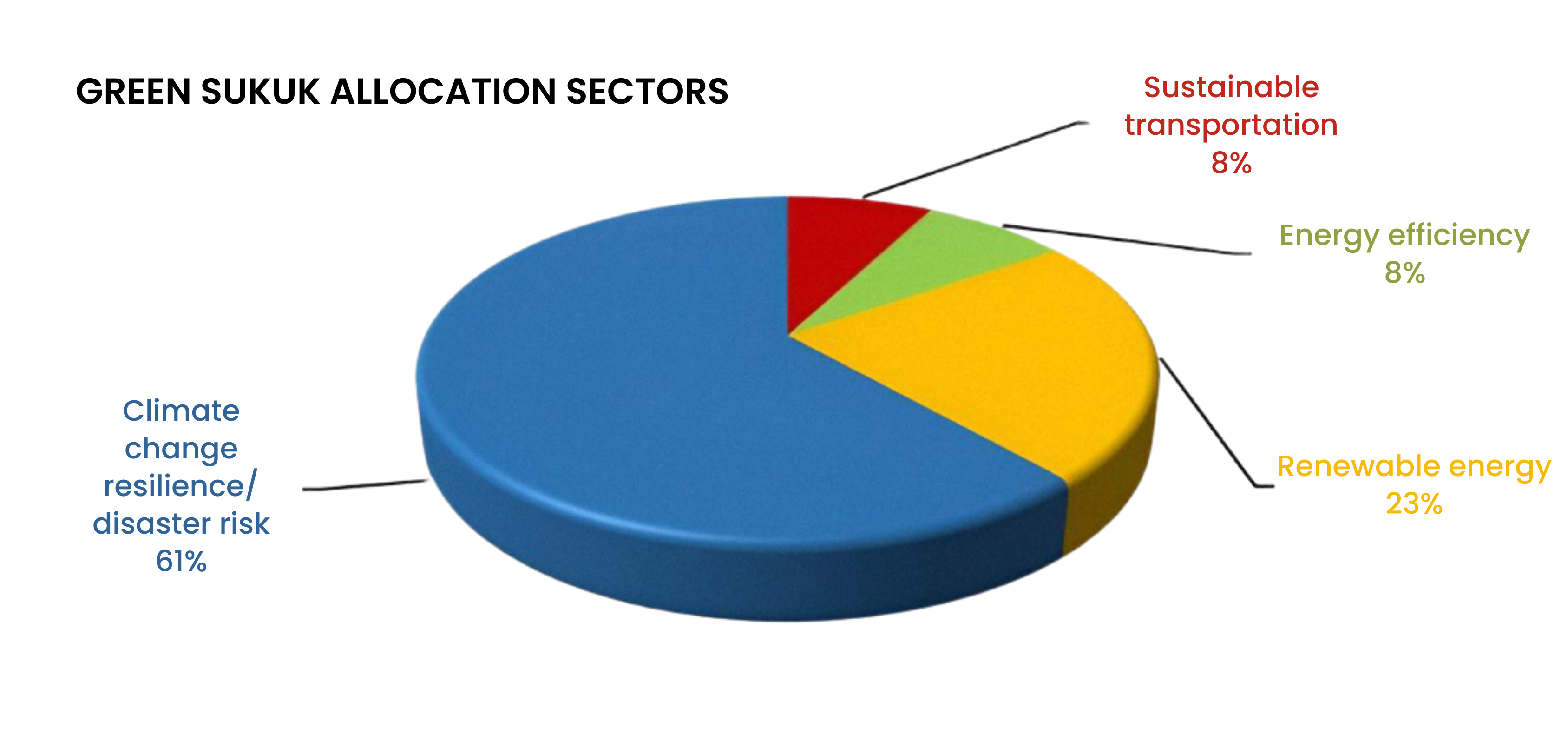
Based on the 2022 Green Sukuk Allocation and Impact Report, ST007 funds were allocated through two financing schemes new financing and refinancing covering a total of 13 sustainable development projects. New financing supported newly initiated infrastructure programs aimed at reducing greenhouse gas (GHG) emissions, while refinancing was used to continue or expand previously approved green projects that required additional investment. The portfolio of ST007-funded projects contributed to an estimated reduction of 1, 115, 777.6 tons of GHG emissions, equivalent to planting approximately 39, 843 trees and producing 17.45 million tons of oxygen. These environmental outcomes could meet the annual oxygen needs of more than 34 million people, assuming an average daily oxygen requirement of 0.5 kg. As shown in Figure 1, the climate and disaster resilience sector received the largest portion of the financing allocation.
When interpreted alongside the emissions data, these financial metrics demonstrate that ST007 investments are not only distributed across eligible sectors but also aligned with measurable environmental outcomes. The concentration of funds in climate and disaster resilience explains why emission-reduction results appear significantly higher in adaptation-focused projects. This pattern indicates that financial inputs translate into strong sustainability gains when strategically targeted, reinforcing the functional relationship between fiscal allocation and environmental impact. Although environmental objectives remain the core focus of ST007, its competitive yield structure continues to support Indonesia’s broader sustainable-finance strategy by attracting diverse categories of retail investors.
A quantitative interpretation of Figure 1 shows that the climate and disaster resilience sector received the largest share of ST007 funding, accounting for 61% of the total allocation. This proportion is significantly higher than the allocations for renewable energy (23%), energy efficiency (8%), and sustainable transport (8%). The dominance of resilience spending reflects Indonesia’s strategic focus on climate adaptation, which is critical given the country’s high exposure to climate risks.
This distribution also indicates that resilience projects such as irrigation development, agricultural protection, and dam management offer more immediate and measurable socio environmental benefits compared to mitigation projects that require more advanced technology and infrastructure. The relatively smaller allocation to renewable energy suggests that mitigation efforts may still face limitations in technological readiness, cost efficiency, and institutional capacity.
ST007’s funding distribution across the four sectors is depicted, along with the institutional mandates of the Ministry of Transportation, the Ministry of Agriculture, and the Ministry of Public Works and Housing. These ministries are responsible for implementing projects that support both national development priorities and Indonesia’s climate commitments.
Overall, the pattern not only identifies where ST007 funds were allocated but also explains why these sectors were prioritized. The concentration of funds in resilience and infrastructure indicates a strategic emphasis on interventions with rapid, broad-based impacts, while the more modest investment in renewable energy reflects structural and technological challenges. Together, these trends show how sector-specific characteristics shape the sustainability outcomes achieved by ST007-funded projects.
Contribution of Green Sukuk to Indonesia's Green Economy Sustainability
The green economy is an economic development framework that emphasizes environmental sustainability, resource efficiency, and inclusive economic growth. Its main objectives include reducing ecological degradation, optimizing the use of natural resources such as energy and water, and stimulating innovation in low-carbon technologies. By promoting these principles, the green economy helps lower emissions and waste while creating new employment opportunities in areas such as renewable energy, sustainable transportation, and waste management.
Aligned with these goals, Green Sukuk plays a critical role as a financing instrument dedicated to supporting environmentally sustainable development. As a Sharia-compliant tool, Green Sukuk channels capital exclusively into projects that reduce environmental impacts such as solar energy installations, renewable energy infrastructure, and integrated waste processing facilities. Through its inclusive investment structure, Green Sukuk broadens public participation in climate-aligned financing and enables investors to contribute directly to Indonesia’s low-carbon transition.
In addition, Green Sukuk operates under transparent and accountable reporting frameworks, ensuring that funds are allocated strictly to projects that meet predefined environmental criteria. This mechanism strengthens investor confidence and helps bridge the financing gap in green infrastructure an important challenge for developing countries like Indonesia, where access to sustainable financing remains limited.
Overall, the integration of green economy principles with Green Sukuk financing enhances the long-term sustainability of Indonesia’s development pathway. The synergy between the two not only supports environmental protection and climate mitigation but also contributes to building a more resilient, low-carbon, and environmentally conscious national economy.
Discussion
The Interconnection Between the Green Economy and the Green Sukuk in Achieving the SDGs
These findings align with theoretical frameworks on green finance effectiveness, which argue that the impact of green financial instruments depends not only on the volume of capital raised but also on the strategic alignment of financed projects with national sustainability priorities. According to green finance theory, instruments such as Green Sukuk are most effective when they channel funds into sectors with high environmental additionality that is, sectors where financial intervention generates measurable environmental improvements. The allocation patterns observed in ST007 demonstrate strong alignment with this theoretical perspective.
This study shows that projects funded through the issuance of Green Sukuk ST007 contribute directly to multiple Sustainable Development Goals (SDGs), including Goal 1 (no poverty), Goal 3 (good health and well-being), Goal 5 (gender equality), Goal 6 (clean water and sanitation), Goal 7 (affordable and clean energy), Goal 8 (decent work and economic growth), Goal 9 (industry, innovation and infrastructure), Goal 10 (reduced inequalities), Goal 11 (sustainable cities and communities), Goal 13 (climate action), Goal 14 (life below water), and Goal 15 (life on land).
These findings are consistent with the perspective expressed by Dr. Bandar Hajjar, President of the Islamic Development Bank, who emphasized the significant potential of Green Sukuk in mobilizing funding for environmentally sustainable projects. In addition, the Global Sustainable Finance Alliance has highlighted the complementary roles of Green Sukuk and the green economy in facilitating a smooth transition toward a sustainable, low-carbon economic system.
Previous research supports this connection, describing Green Sukuk as a government-issued financial instrument designed to support climate resilience and environmental restoration (13). One example of Indonesia’s commitment is the implementation of a Climate Budget Tagging system, a mechanism that tracks and labels budget allocations directly tied to climate change response initiatives (14). This system enhances fiscal transparency and accountability, aligning with sustainable development policies.
Emission Reduction Achieved Through ST007 Green Sukuk
The study finds that the ST007 Green Sukuk raised a total of IDR 5.42 trillion from 16, 992 investors, with all proceeds allocated to finance 13 green economy projects through both new financing and refinancing mechanisms. These projects collectively contributed to a reduction of 1, 115, 777.6 tons of greenhouse gas (GHG) emissions, an environmental impact equivalent to planting approximately 39, 843 trees and generating over 17.45 million tons of oxygen. Given that the average human requires approximately 0.5 kg of oxygen per day, these outcomes suggest potential support for the respiratory needs of more than 34 million people.
In terms of environmental integrity and reporting standards, ST007 complies with the Green Bond Principles (GBP) and has been independently assessed by CICERO (Center for International Climate Research). The CICERO Shades of Green framework categorizes green finance projects into Dark Green, Medium Green, and Light Green based on their environmental ambition (15). ST007’s “Medium Green” rating reflects its contribution to climate objectives while indicating that further improvements are required to align with deep decarbonization pathways. This classification helps stakeholders evaluate the environmental credibility and climate impact of ST007-financed projects.
The Contribution of Green Sukuk to Indonesia’s Green Economy Sustainability
This study confirms that the green economy plays a pivotal role in mitigating environmental degradation resulting from industrialization. Through resource efficiency, the adoption of renewable energy sources, waste reduction, emission control, and the use of environmentally friendly materials, the green economy aligns with the principles outlined by the United Nations Commission on Environment and Development (UNCED). These principles emphasize equitable welfare distribution and ecological preservation, asserting that economic growth must meet present needs without compromising the ability of future generations to meet their own needs (16). Thus, green economy initiatives are foundational to long-term sustainability.
Previous studies have emphasized the urgent need for such an approach in Indonesia, a country that faces serious environmental vulnerabilities. With approximately 80% of its territory at risk of natural disasters, 3.9 million people exposed to drought, a 3–5% increase in disease outbreaks, and 9.82% of the population living below the poverty line, the environmental and social stakes are high (17). In this context, the role of Green Sukuk emerges as a crucial financing mechanism to realize green economy ambitions.
According to the Second Biennial Update Report (BUR) 2018, Indonesia requires approximately USD 247.2 billion (IDR 3, 461 trillion) to meet its emission reduction targets by 2030. Cumulative data from the Green Sukuk Allocation and Impact Report indicate that as of 2021, the government had issued USD 4.3 billion (approximately IDR 64.5 trillion) in Green Sukuk. This means that within just three years, Green Sukuk financing has covered approximately 18.6% of Indonesia’s total funding needs for the green economy transition between 2018 and 2030. This contribution is expected to grow steadily, supported by the Global Islamic Finance Report (2018), which identified Indonesia as having exceptional potential for the development of Islamic finance, including Green Sukuk instruments (18).
Despite these positive findings, this study has several limitations. The analysis relies entirely on secondary data, which may not capture project-level variations in actual environmental performance. Field verification or primary data collection could yield different results, especially regarding emission reduction estimates that depend on modeling assumptions. Additionally, alternative interpretations are possible; for instance, the high allocation to climate resilience projects may reflect administrative convenience or existing infrastructure capacity rather than purely strategic environmental prioritization. Recognizing these limitations provides a more balanced understanding of the ST007’s contribution to Indonesia’s sustainability efforts.
Data constraints and reliance on modeled environmental estimates may introduce uncertainty, emphasizing the need for improved reporting standards. Future studies should also evaluate long-term socio-economic impacts to strengthen understanding of sustainability outcomes beyond short-term emission reductions.
Although the analysis relies on verified government reports, future studies should incorporate triangulation through field assessments, stakeholder interviews, and project-level audits to strengthen causal attribution between financial allocation and environmental outcomes. Incorporating stakeholder interviews and field-level assessments would further improve evaluation of project effectiveness.
In conclusion, Green Sukuk plays a substantial role in supporting the sustainability of Indonesia’s green economy by providing measurable financial support for environmentally focused projects. Its impact will be critical in helping Indonesia achieve its target of reducing greenhouse gas emissions by 314 million tons by 2030.
Conclusion
The findings of this study indicate that the ST007 Green Sukuk contributes not only to financing environmentally aligned projects but also to strengthening Indonesia’s strategic transition toward a low-carbon development model. Its role extends beyond emissions reduction, demonstrating how retail-based Islamic financial instruments can mobilize public participation, direct capital into high-priority sustainability sectors, and reinforce national commitments to the SDGs. These implications highlight the broader potential of Green Sukuk as a mechanism for enhancing environmental governance, improving fiscal transparency, and expanding inclusive climate financing.
Although ST007 has demonstrated measurable contributions, this study is limited by its reliance on secondary data and the absence of project-level verification, which constrains the assessment of long-term socio-economic outcomes. Future research should incorporate primary data, longitudinal analysis, and stakeholder perspectives to more accurately evaluate project effectiveness and community-level impacts across different regions.
From a policy standpoint, strengthening monitoring systems, improving regional equity in project allocation, and integrating clearer evaluation frameworks for green investment performance would enhance the long-term credibility and effectiveness of Green Sukuk. If further optimized and expanded, Green Sukuk can evolve into a foundational instrument within Indonesia’s climate-finance architecture and broader sustainability policy. Policymakers should also reinforce monitoring mechanisms and transparency measures to ensure continuous improvement in Green Sukuk implementation.
Declarations
Conflict of Interest
The authors declare no conflicting interest.
Data Availability
The unpublished data is available upon request to the corresponding author.
Funding Information
The author(s) declare that no financial support was received for the research, authorship, and/or publication of this article.
References
- Gills B, Morgan J. Economics and Climate Emergency. London: Routledge; 2022.
- Radunsky K, Cadman T. Addressing climate change risks: importance and urgency. In: Handbook of Climate Change Management. Cham: Springer International Publishing; 2021. 1–27.
- Marolla C. Climate Health Risks in Megacities: Sustainable Management and Strategic Planning. Cham: Springer; 2016.
- Santoso I, Sudiro A, Maryanto S. Assessing vulnerability in the face of multiple hazards: insights from a literature review on Indonesia’s disaster risk management. IOP Conf Ser Earth Environ Sci. 2025;1486(1):012041.
- Rasiah R, Kari F, Sadoi Y, Mintz-Habib N, editors. Climate Change Mitigation and Sustainable Development. Routledge; 2020.
- Kurniawan TA, Pasaribu B, Kusworo TD, Wibisono Y, Goh HH, Zhang D, Casila JCC. Building disaster resilience in Thousand Islands (Indonesia): unlocking climate adaptation strategies to navigate sea level rise in coastal regions while safeguarding crop productivity and local biodiversity. ACS ES&T Water. 2024;4(8):3213–24
- Nurhidayah L, McIlgorm A. Coastal adaptation laws and the social justice of policies to address sea level rise: an Indonesian insight. Ocean Coast Manag. 2019;171:11–8.
- BAPPENAS. Bappenas kampanyekan pembangunan berketahanan iklim (PBI) – LCDI. 2021.
- Ünüvar B. Financing the green economy. In: Handbook of Green Economics. 2019.
- Lestari D. Green Climate Fund Indonesia’s GCF Country Programme Document. 2021.
- Clark R, Reed J, Sunderland T. Bridging funding gaps for climate and sustainable development: pitfalls, progress and potential of private finance. Land Use Policy. 2018;71:335–46
- Sisdianto E, Robiansyah A, Razimi MSBA, Afifah AL. The role of green sukuk (Islamic bonds/Shariah-compliant bonds) in enhancing Indonesia economic development strategy in the new normal era. KnE Social Sci. 2024:608–25.
- Musari K. Integrating Green Sukuk and Cash Waqf Linked Sukuk, the blended Islamic finance of fiscal instrument in Indonesia: a proposed model for fighting climate change. International Journal of Islamic Khazanah. 2022;12(2).
- Mutiara ZZ, Krishnadianty D, Setiawan B, Haryanto JT. Climate budget tagging: amplifying sub-national government’s role in climate planning and financing in Indonesia. 2021. 265–80.
- PT Sarana Multi Infrastruktur. Second Opinion: Kerangka Green Bond dan Green Sukuk. 2018.
- Elsawy M, Youssef M. Economic sustainability: meeting needs without compromising future generations. International Journal of Economics and Finance. 2023;15(10).
- Haryanto B, Lestari F, Nurlambang T. Extreme events, disasters, and health impacts in Indonesia. In: Extreme Weather Events and Human Health. Cham: Springer International Publishing; 2020. 227–45.
- Latifah S. Peran Sukuk Surat Berharga Syariah Negara (SBSN) dalam pertumbuhan pembangunan ekonomi Indonesia. J Ilm Ekon Islam. 2020;6(3):421.