RESEARCH ARTICLE
From Theory to Practice BRONE as a Model for Digital Classroom Management in Southeast Asian Teacher Education
Academic Editor: Suci Wahyu Fajriani
Education and Learning|Vol. 2, Issue 1, pp. 11-21 (2026)
CC BY 4.0-2026 Authors
Views
Downloads
Shares

Received
Feb 11, 2026Revised
Apr 21, 2026Accepted
May 10, 2026Published
May 18, 2026
Abstract
Classroom management is a central concern in teacher education across Southeast Asia, where large class sizes, linguistic diversity, and varying resource availability create complex teaching environments. While theoretical frameworks ranging from behaviorist to constructivist and inclusive models are widely taught in pre-service programs, bridging these theories to practice remains a persistent challenge. This article presents the BRONE (Brawijaya Online Learning) initiative from Indonesia as a model of digital innovation that addresses this theory practice divide. Through a library research approach, the study analyzes instructional materials including syllabi, modules, and learning videos developed for a Classroom Management course under the BRONE 2025 program. Anchored in Seels and Richey’s educational technology framework and the TPACK model, the findings reveal that BRONE systematically integrates design, development, utilization, and evaluation to operationalize theoretical knowledge in authentic, practice-oriented learning tasks. Key features include classroom observation projects, reflective practice prompts, culturally embedded concepts such as love-based classroom management, and video-based simulations. These elements not only contextualize global theories within Indonesian classrooms but also provide transferable insights for other Southeast Asian contexts facing similar challenges. The article argues that BRONE exemplifies how digital platforms can create authentic learning environments that foster professional readiness, inclusivity, and reflective competence in pre-service teachers. By situating Indonesian innovation within the Asia-Pacific discourse, this study contributes to regional and global debates on how teacher education can reimagine the integration of theory and practice in the digital era.
Introduction
Classroom management remains a pivotal concern in teacher education across Southeast Asia, where educators often face complex challenges such as large class sizes, linguistic diversity, and uneven resource availability. Foundational studies on classroom management emphasize that effective practice requires not only control of student behavior but also the orchestration of classroom routines and instructional processes (1). This perspective is further reinforced by research highlighting the complexity of classroom environments as dynamic systems that demand adaptive decision-making from teachers (2). Despite the availability of comprehensive theoretical frameworks spanning behavioral, humanistic, and constructivist approaches, novice teachers frequently encounter difficulties translating these theories into effective classroom practices. This indicates that theoretical mastery alone is insufficient without structured opportunities for situated application.
Extant research has consistently highlighted a significant theory–practice gap in teacher education. Comparative analyses of teacher education systems show that many programs remain overly focused on conceptual knowledge rather than practice-based competence (3). Similarly, research on teacher preparation underscores the importance of integrating coursework with field experiences to support meaningful professional learning (4). Although teacher candidates acquire substantial theoretical knowledge, they often struggle to apply it in authentic classroom settings. Practice-based teacher education, supported by structured field experiences and reflective activities, has been shown to significantly enhance the integration of pedagogical theory and practice. This suggests that the gap is not merely a matter of insufficient practice, but of how practice is systematically designed and scaffolded within teacher education programs.
In the context of English Language Teacher Education (ELTE) in Indonesia, this gap becomes even more pronounced due to multilingual classroom settings, diverse learner backgrounds, and varying levels of student motivation. Studies on teacher readiness in multilingual environments highlight the challenges teachers face in adapting pedagogical strategies to linguistically diverse classrooms (5). Research on teacher agency further indicates that contextual constraints significantly shape how teachers enact their professional knowledge in practice (6). In addition, studies on teacher learning and identity formation demonstrate that pre-service teachers often undergo tensions when reconciling theoretical ideals with classroom realities (7). These contextual challenges highlight the need for pedagogical innovations that integrate reflective practice, context-based teaching, and practice-oriented learning environments. Such innovations are essential to ensure that theoretical knowledge is transformed into adaptive and context-responsive teaching competence.
The advancement of digital technology has transformed educational practices globally, including classroom management. The integration of digital learning platforms such as Learning Management Systems (LMS), blended learning, and Massive Open Online Courses (MOOCs) supports learner autonomy, communication, and effective monitoring of progress (8). At Universitas Brawijaya, this evolution is embodied in the development of BRONE (Brawijaya Online Learning), an LMS built on Moodle designed to enhance the quality and scalability of digital pedagogy. BRONE represents the latest digital ecosystem following earlier platforms, Virtual Learning Management 1 and 2, and offers an innovative and inclusive environment for online teaching and learning.
This article analyses BRONE as an innovative model that effectively bridges the gap between theory and practice in classroom management courses for pre-service teachers. Using a library research methodology, the study reviews BRONE-based instructional materials such as syllabi, interactive modules, and video learning objects developed as part of the 2025 program. The platform fosters authentic learning by promoting reflective practice, collaboration, and culturally sensitive content contextualized within Indonesian classrooms (9,10).
The distinctiveness of the BRONE model lies in its systematic and outcome-oriented design. It incorporates projects such as classroom observation, reflective assignments, and video simulations that prepare teacher candidates for managing multilingual and multicultural classrooms. This framework operationalizes instructional technology principles through the integration of digital tools and pedagogical practices, reflecting contemporary initiatives across Southeast Asia to align theoretical foundations with practical teaching applications. Recent studies highlight that technology-enhanced teacher education not only supports the development of pedagogical competence but also fosters sustainable and context-responsive innovations in higher education (11,12). Such approaches demonstrate how the incorporation of instructional technology can transform English Language Teacher Education (ELTE) programs into dynamic environments that promote both theoretical understanding and professional readiness.
From an instructional technology perspective, BRONE exemplifies the full cycle of design, development, implementation, and evaluation to support inclusive and socially-emotionally responsive classroom management. This design aligns with contemporary global trends emphasizing equity, cultural responsiveness, and holistic teacher competence, situating BRONE as a significant contributor to digital pedagogy debates internationally (13).
The article advances the academic discourse by presenting BRONE-based innovations as scalable and adaptable instruments designed to bridge the enduring theory-practice gap prevalent in teacher education. These contributions are situated within the ongoing digital transformation efforts at Universitas Brawijaya, offering a replicable model for other institutions within the region. Furthermore, the analysis deepens the understanding of how authentic, collaborative, and reflective learning experiences can be systematically constructed to foster the professional readiness of pre-service teachers. This is essential for preparing educators capable of navigating the complexities of diverse classroom environments and the evolving demands of contemporary education. In the Southeast Asian context, where teacher education programs grapple with rapid digitalization amid cultural diversity and resource constraints, initiatives like BRONE offer a promising pathway to cultivate contextually grounded classroom management competencies. Drawing on the TPACK framework (14), BRONE exemplifies the synergistic integration of technological, pedagogical, and content knowledge, enabling pre-service teachers to navigate both traditional and hybrid EFL classrooms prevalent in Indonesia and neighboring countries. Complementing Seels and Richey's instructional technology domains (10), this model not only designs and develops practice-oriented materials but also facilitates their utilization and evaluation through interactive LMS features. By addressing the theory-practice divide with culturally responsive elements—such as love-based management rooted in local values—BRONE positions Universitas Brawijaya as a leader in scalable digital innovations for regional teacher preparation.
This study’s objective is to investigate how BRONE functions as a digital mediator that transforms theoretical principles of classroom management into practical competencies among pre-service teachers. The aim is to substantiate BRONE’s potential in enhancing reflective teaching practices and contextualizing management theories to strengthen teacher education in Indonesia and across Southeast Asia.
Classroom Management: Building Supportive and Equitable Learning Environments
Recent academic discourse has seen classroom management evolve into a multifaceted concept that extends beyond mere order maintenance to encompass instructional quality, socio-emotional support, and inclusive educational practices. Recent research emphasizes the role of educators in fostering socially and emotionally supportive learning environments that accommodate diverse learners. Modern models integrate behavioral, cognitive, and ecological perspectives, favoring strategies that empower student agency while promoting positive relational dynamics. These approaches move away from traditional authoritarian frameworks, focusing instead on creating classrooms that are equitable and responsive to individual student needs, thereby improving both engagement and academic achievement (1,13). This shift indicates that classroom management is no longer a control mechanism but a pedagogical strategy embedded within broader learning processes.
In recent years, educators have increasingly viewed classroom management not merely as enforcing rules but as fostering a supportive and trusting environment where students feel respected and empowered. This perspective highlights the teacher’s role as a guide who nurtures empathy, encourages student autonomy, and cultivates meaningful relationships that promote growth and resilience. Such approaches prioritize understanding students’ experiences and building community, helping learners develop both academically and personally (13). Consequently, effective management practices are inseparable from relational and emotional dimensions of teaching.
A third perspective is the constructivist and ecological model, which situates classroom management within the broader dynamics of classroom ecology. This perspective emphasizes that student behavior and learning are mediated by social interactions, cultural contexts, and environmental factors. Evertson and Emmer note that effective classroom management must therefore integrate instructional planning, relationship-building, and cultural responsiveness into a holistic system (1). This suggests that isolated strategies are insufficient unless embedded within a coherent and context-sensitive classroom system.
In contemporary discourse, classroom management is increasingly framed in terms of inclusive and equity-driven pedagogy. Research highlights the importance of teacher–student relationships as predictors of academic achievement and behavioral outcomes, as well as the integration of social-emotional learning (SEL) into classroom management practices, positioning teachers not only as instructors but also as relational leaders and emotional coaches (13). This reinforces the argument that equitable learning environments depend on both instructional competence and relational awareness.
Together, these theoretical strands underscore that classroom management is not a monolithic skill but a multidimensional competence that blends structure, relationships, and inclusivity. For teacher education programs, the challenge lies in enabling students to grasp these theories while also equipping them with practical strategies for implementation.
The Theory–Practice Gap in Teacher Education
Despite the richness of theoretical perspectives, a persistent issue in teacher education is the theory–practice gap. Studies have shown that pre-service teachers often graduate with a strong theoretical understanding of classroom management but feel underprepared for the unpredictable realities of teaching (3,4). This gap reflects a systemic misalignment between how knowledge is taught and how it is expected to be applied in practice.
First, abstract exposure: Teacher education programs frequently rely on lectures, readings, and case studies to convey management theories. While these methods build conceptual understanding, they often fail to provide authentic contexts where students can experiment with strategies. Darling-Hammond argues that teacher preparation must therefore move beyond “talking about practice” to creating opportunities for “practice-based teacher education” (3). This highlights the necessity of embedding experiential components within curriculum design rather than treating practice as a supplementary element.
Second, contextual mismatch: Many theoretical models are derived from Western contexts, yet pre-service teachers in places like Indonesia face different realities, such as larger class sizes, multilingual learners, and limited resources. This mismatch contributes to novice teachers’ sense of inadequacy when entering schools. As a result, theoretical transfer becomes problematic when contextual variables are not adequately addressed within training programs.
Third, limited reflective integration: Even when teaching practicums are included in curricula, students may not receive structured opportunities to connect theory with their field experiences. Zeichner emphasizes that reflective practice must be intentionally scaffolded within teacher education; otherwise, practical experiences may remain fragmented and disconnected from theoretical learning (4). Without structured reflection, experience alone does not automatically translate into professional knowledge.
These issues highlight the urgency of developing pedagogical models and technological tools that actively bridge the gap, enabling teacher candidates to experience classroom management not only as a theoretical construct but also as an applied competence.
Digital Innovation and Teacher Education
The integration of educational technology has been identified as one of the most promising avenues for closing the theory–practice divide in teacher education. Digital platforms such as Learning Management Systems (LMS), blended learning, and online simulations provide environments in which students can engage in experiential learning without being in a physical classroom (8). This expands the possibilities for practice-based learning beyond traditional field placements.
Learning Management Systems (LMS)
LMS platforms such as Moodle, Blackboard, and Canvas have become ubiquitous in higher education, serving as repositories for instructional content, discussion forums, and assessment tools. Research indicates that LMS use fosters self-regulated learning, collaborative engagement, and access to diverse resources (8). Importantly, LMS environments enable structured interaction that supports both independent and collaborative knowledge construction.
Blended and Online Learning
Blended learning approaches combine online and face-to-face modalities, offering flexibility and greater student engagement. Such environments are particularly effective for teacher education because they enable both theoretical exploration and practice-based activities (11). This dual modality allows for iterative movement between conceptual understanding and applied experience.
Simulation and Video-Based Learning
Recent innovations include the use of video analysis and teaching simulations to prepare pre-service teachers. Video analysis enhances reflective practice by allowing students to observe, critique, and discuss classroom management strategies (15). Through this process, learners develop analytical skills that are essential for professional decision-making in real classrooms.
BRONE as a Contextual Innovation
Within this global landscape, Universitas Brawijaya has positioned itself at the forefront of digital transformation through its Brawijaya Online Learning (BRONE) platform. Developed on Moodle, BRONE functions as a comprehensive LMS tailored to the needs of Indonesian higher education.
In the context of the Classroom Management course, BRONE functions as an integrated platform that combines the syllabus, interactive modules, and instructional videos in alignment with Outcome-Based Education (OBE) principles and student-centered learning paradigms. Through this integration, BRONE effectively bridges the three dimensions of the theory–practice gap previously identified. This indicates that the resolution of the gap lies not only in adding practice, but in redesigning learning structures themselves.
Moreover, BRONE supports the development of inclusive classroom management by embedding content on socio-emotional learning, diversity, and equity, aligning with contemporary global discourses on inclusive pedagogy (13). This demonstrates how digital platforms can be used to operationalize inclusive values rather than merely deliver content.
Educational Technology Framework
The implementation of BRONE in classroom management can be examined through the lens of Seels and Richey’s domains of educational technology (10). This framework provides a systematic way to trace how theoretical principles are transformed into instructional practice.
Within the design domain, learning outcomes are systematically aligned with Outcome-Based Education (OBE) principles. The development domain involves transforming theoretical frameworks into practical modules and videos. The utilization domain is realized through the LMS environment, while the evaluation domain is reflected in reflective journals, collaborative projects, and classroom simulations. Such alignment ensures that each stage of instruction contributes to bridging theory and practice rather than reinforcing their separation.
Collectively, these components illustrate how BRONE transcends its role as a content repository and evolves into a pedagogical bridge that integrates theory, practice, and reflection in a holistic learning process.
Classroom Management Materials Developed through BRONE
The integration of digital innovation into teacher education must be evaluated not only in terms of theoretical alignment but also through the tangible learning materials produced for students. Within the BRONE 2025 framework, the Classroom Management course offers a clear example of how lesson plans, modules, and video-based resources can bridge the gap between theory and practice.
These materials reflect principles of authentic learning environments, where students engage in meaningful, context-based tasks that mirror real classroom situations (9). This authenticity is crucial for ensuring that learning experiences are transferable to professional contexts. From an educational technology perspective, the design and deployment of these materials align with Seels and Richey’s instructional technology domains (10), demonstrating a structured integration of theory, practice, and evaluation. This alignment confirms that effective innovation depends on coherence between pedagogical design and technological implementation.
Methodology
This study employs a library research methodology, which is particularly well-suited for conceptual and argumentative investigations in educational contexts. This approach involves a systematic review and critical interpretation of academic and institutional documents to develop fresh theoretical insights (16, 17). Library research is especially valuable in the initial phases of educational innovations, where empirical data may be limited while theoretical framing remains essential. Thus, this study conceptually validates the BRONE 2025 framework—comprising lesson plans, instructional modules, and video resources—prior to large-scale empirical testing.
Data sources include two main types: scholarly publications from 2018 to 2025 focused on classroom management, teacher education, and educational technology, particularly in relation to post-pandemic digital and hybrid learning (8), and institutional materials from the BRONE 2025 initiative such as the Classroom Management course syllabus (SPE 4121), inclusive learning modules, and related procedural guidelines. These institutional artifacts serve as textual evidence reflecting pedagogical intentions and theoretical underpinnings.
The analysis is guided by Seels and Richey’s educational technology framework, which encompasses design, development, utilization, management, and evaluation stages (10). This framework enables the study to trace how theoretical principles are operationalized into practice within the BRONE-based course, including the formulation of learning outcomes, development of multimedia instructional materials, utilization of the Learning Management System (LMS), and reflective evaluation processes.
Furthermore, this study employs principles of qualitative content analysis to identify key pedagogical patterns embedded in the instructional materials (17). Through systematic categorization and interpretation, the analysis highlights how instructional design elements facilitate the integration of theory and practice. This approach aligns with broader perspectives in teacher education that emphasize the importance of structured learning experiences in transforming theoretical knowledge into practical competence (3,4).
Ultimately, this methodological approach aims to demonstrate how digital learning environments such as BRONE can function as pedagogical mediators that support the transformation of theoretical frameworks into applied teaching competencies.
Results
Findings from Developed Materials
The integration of digital innovation into teacher education must be evaluated not only in terms of theoretical alignment but also through the tangible learning materials produced for students. Within the BRONE 2025 framework, the Classroom Management course developed by the English Language Education Program at Universitas Brawijaya offers an instructive case of how lesson plans (RPS), modules, and video-based learning resources can bridge the long-standing gap between theory and practice. Both the syllabus and the instructional modules are explicitly designed to embed Outcome-Based Education (OBE) principles and Student-Centered Learning (SCL), reflecting the institution’s pedagogical commitment to transformative and inclusive teacher preparation.
The syllabus establishes a structured roadmap that ensures theoretical learning outcomes are systematically linked to practice-based tasks. The specified course learning outcomes emphasize three key competences: the ability to analyze theories of classroom management, the capacity to classify the roles of students and teachers in English language teaching (ELT) classrooms, and the competence to evaluate both traditional and online learning modes to devise innovative solutions. These outcomes are not abstract goals but are operationalized through carefully planned assignments, such as classroom observation projects, article reviews, and reflective essays. By placing a significant portion of assessment weight—up to 50 percent—on observation-based projects, the syllabus directs students to engage directly with authentic classroom dynamics, thereby applying theoretical models to real-world contexts.
The instructional module complements this structure by offering a comprehensive progression of topics that expand the scope of classroom management beyond mere behavioral control. Organized into twelve chapters, the module begins with The Art of Teaching, emphasizing the dual nature of teaching as both a science and an art, and continues with chapters on cooperative climates, standards for conduct, classroom management strategies, inclusive practices, and socio-emotional learning. Notably, the module integrates both global theories—such as behaviorist, humanist, and constructivist approaches—and local cultural values. The explicit inclusion of “love and compassion” as a foundational principle of classroom management reflects an effort to localize theory in ways that resonate with Indonesian pedagogical traditions and contemporary discourses on inclusive education.
Each chapter in the module follows a consistent format of learning materials, summaries, and practice questions, designed to scaffold reflective engagement. For example, the chapter on A Favorable Climate for Cooperation topic not only outlines principles of cooperative learning but also poses reflective questions such as: “Do you think students should be involved in setting classroom rules? Why or why not?” These questions compel students to move beyond passive reception of knowledge and to critically examine how theories might inform their own future practice. Similarly, the module’s treatment of Student–Teacher Cooperative Relationships in Social Emotional Learning (SEL) reinforces current research trends that position SEL as central to effective classroom management (13). This emphasis highlights that effective classroom management depends not only on procedural strategies but also on the quality of interpersonal relationships established in the classroom. Through case-based prompts and reflection activities, students are guided to see classroom management as both a relational and an ethical practice.
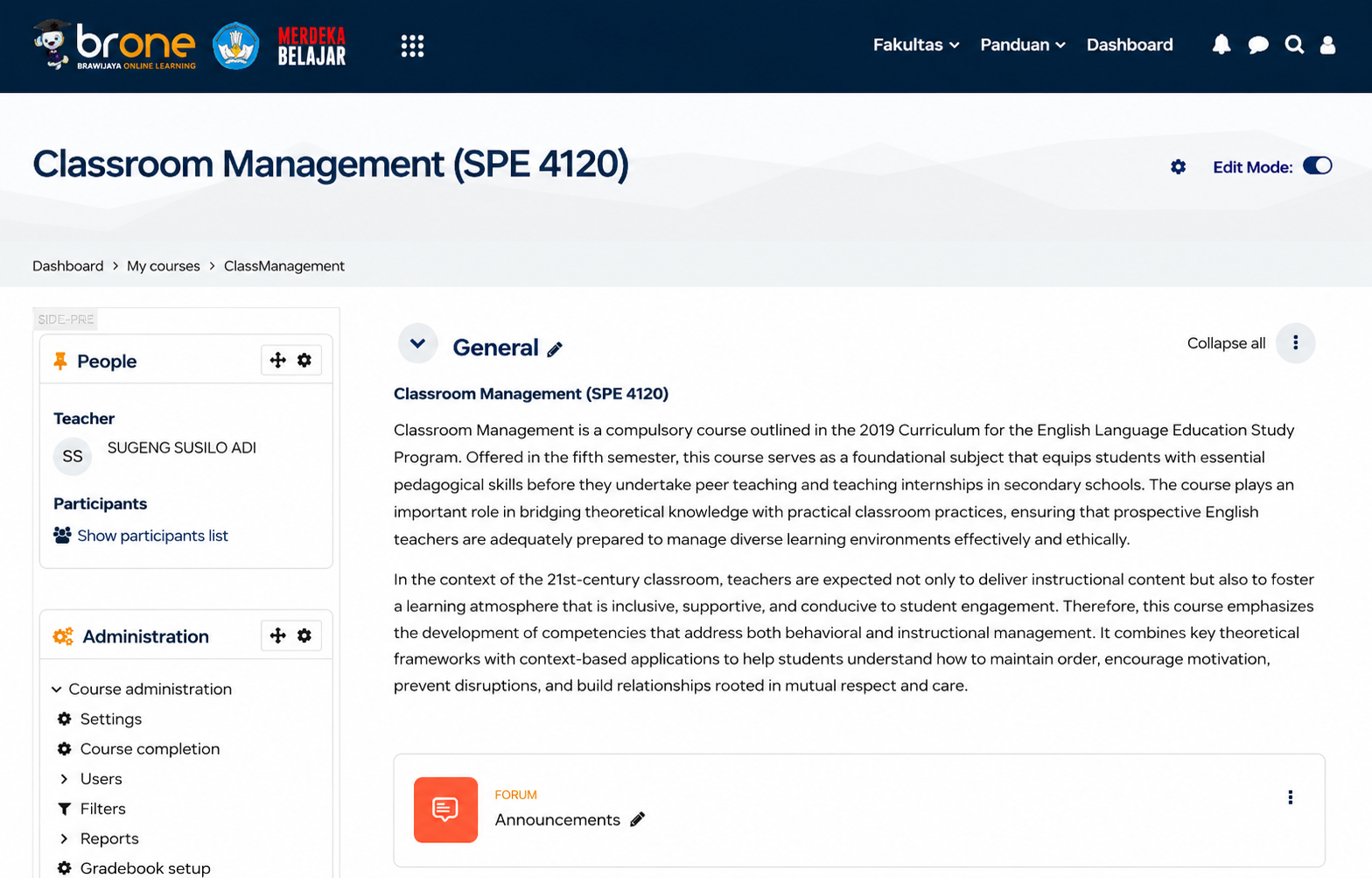
Within the BRONE 2025 framework, the Classroom Management course integrates Outcome-Based Education (OBE) principles and student-centered strategies. The syllabus establishes outcomes linked to authentic practice tasks, while the instructional module elaborates twelve chapters on both theoretical and practical aspects of classroom management, including socio-emotional learning and inclusive practices. Love-based classroom management emerges as a distinct local innovation. Rubrics further bridge theory and practice by explicitly mapping learning outcomes to classroom applications.
As illustrated in Figure 1 (BRONE Classroom Management Homepage), the course portal functions as a comprehensive digital gateway. In addition to displaying the course code and description, the platform provides full access to the lesson plan, weekly lecture schedule, video resources for each meeting, and a wide range of practice activities, including opinion questions, comprehension questions, and summarizing tasks. The system also integrates summative assessments, from mid-term to final examinations, thereby unifying instructional materials, formative practice, and evaluation in a single online environment. This integrated design reflects the principles of OBE, ensuring that students can monitor their progress across multiple learning dimensions within one accessible platform.
Meanwhile, Figure 2 illustrates the BRONE (Brawijaya Online Learning) interface for Topic 1: The Art of Teaching, which integrates multiple instructional components, including presentation files, textual materials, and embedded video content. The platform is structured to provide a sequential learning experience, beginning with downloadable resources and followed by interactive content that supports deeper engagement.
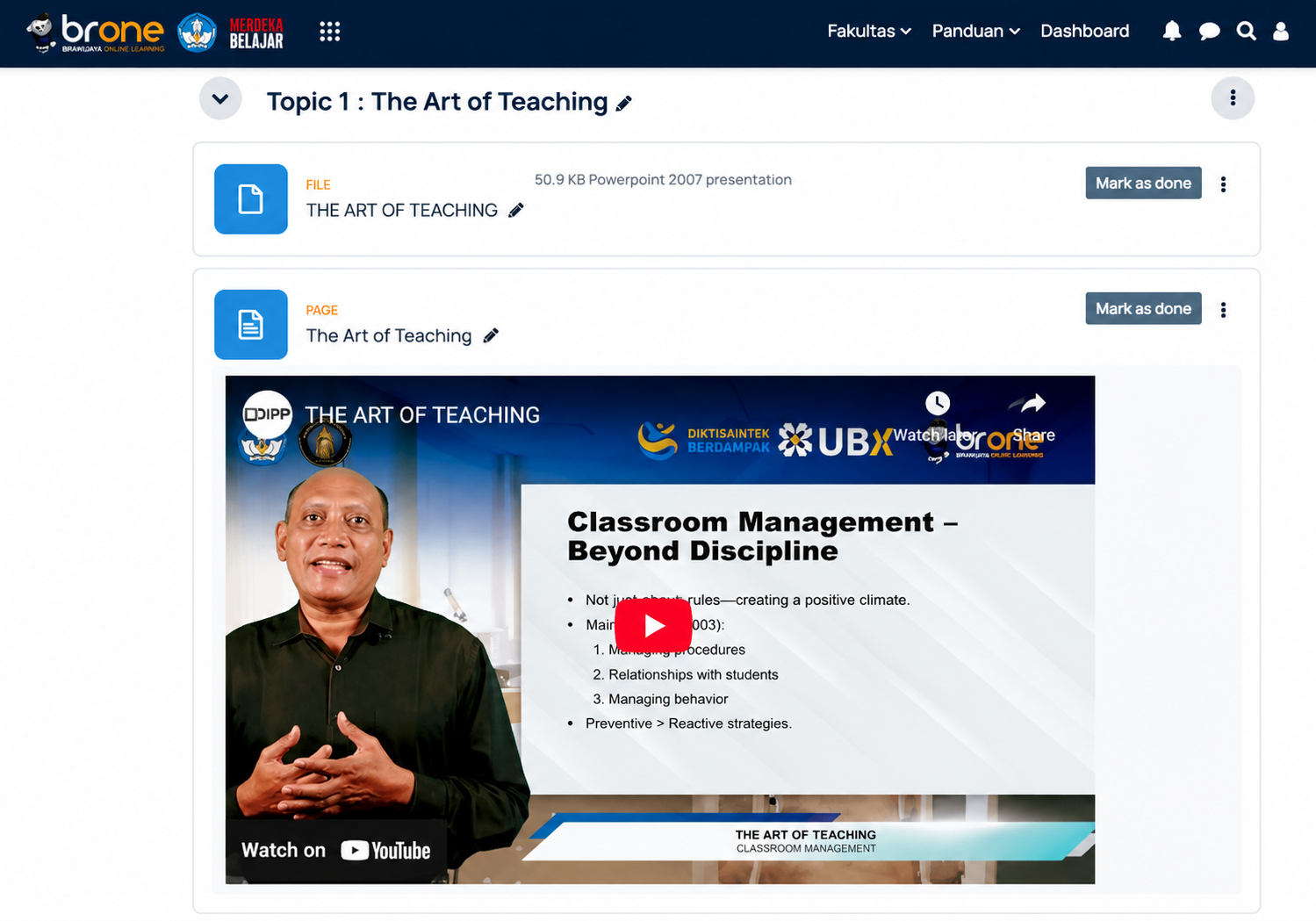
A key feature highlighted in this figure is the integration of a video lecture on Classroom Management – Beyond Discipline, which introduces students to classroom management as a multidimensional concept encompassing procedures, relationships, and behavioral strategies. The use of video-based materials enables learners to observe pedagogical explanations in a more concrete and contextualized manner, bridging the gap between theoretical concepts and practical classroom applications.
Furthermore, the interface demonstrates how BRONE facilitates self-paced and structured learning through clearly organized modules and completion indicators (e. g. , “mark as done”). This design encourages learner autonomy while maintaining alignment with course objectives. Overall, the figure exemplifies how digital platforms can function not merely as repositories of content, but as interactive environments that support reflective, multimodal, and practice-oriented learning experiences in teacher education.
BRONE integrates video-based learning materials via YouTube to enhance interactivity and support multimodal learning. Videos such as “Classroom Management – Beyond Discipline” and “Classroom Management Strategies” introduce essential concepts including classroom procedures, teacher–student relationships, and the balance between proactive and reactive management approaches. These materials promote inclusive and socio-emotional perspectives, encouraging pre-service teachers to view classroom management as a practice grounded in care, collaboration, and motivation rather than mere discipline.
By embedding theory into authentic teaching scenarios, these videos effectively operationalize abstract models and exemplify how management strategies are enacted in real classrooms. Research on video-based teacher education demonstrates that structured video analysis can significantly enhance teachers’ ability to notice, interpret, and evaluate classroom interactions (15). This suggests that video is not merely a delivery tool but a cognitive scaffold for professional learning.
Recent studies further highlight the power of video-based learning to foster reflective practice and strengthen the connection between theoretical frameworks and classroom realities (16–18). These findings indicate that video-supported environments enable iterative reflection, allowing learners to revisit and reinterpret teaching practices across multiple viewing cycles.
This integration of video-based learning not only enhances pre-service teachers' engagement with complex classroom management concepts but also fosters reflective practice and bridges the gap between theory and authentic teaching experience. In this sense, BRONE leverages digital media not simply for content dissemination, but as a structured pedagogical mechanism that transforms theoretical knowledge into observable and analyzable practice.
Finally, Figure 3 presents a video-based instructional resource on Classroom Management Strategies delivered through the BRONE platform. The video features a structured explanation of key classroom management concepts, emphasizing practical strategies that extend beyond disciplinary control toward the development of positive classroom environments. By presenting content through a lecturer-led format, the video provides learners with direct exposure to expert modeling, which enhances conceptual clarity and pedagogical understanding.
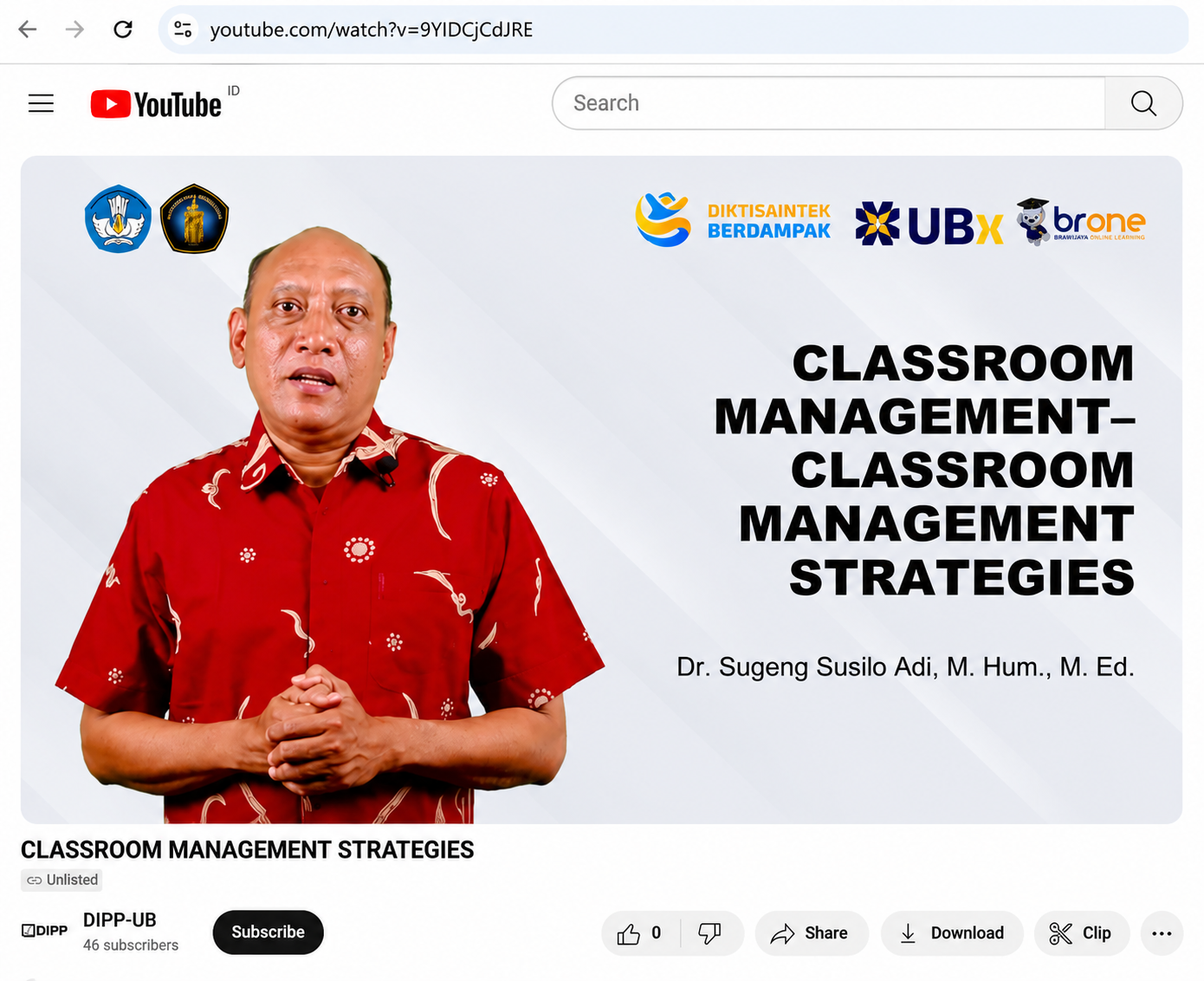
The integration of such video materials into the learning platform supports multimodal learning by combining visual, auditory, and textual elements. This approach enables pre-service teachers to better grasp abstract concepts through concrete demonstrations and explanations. In addition, video-based instruction allows learners to revisit complex topics at their own pace, reinforcing self-directed learning and reflective engagement.
Importantly, this figure illustrates how digital media can function as a bridge between theory and practice. By contextualizing classroom management strategies within real teaching scenarios, the video encourages students to critically analyze instructional decisions and consider their applicability in diverse classroom contexts. As such, BRONE not only delivers content but also facilitates experiential and reflective learning processes essential for teacher professional development.
These findings illustrate not only the variety of resources available within BRONE but also their potential to operationalize classroom management theories in authentic, accessible, and culturally relevant ways. By integrating textual materials, interactive tasks, and video-based simulations, the BRONE platform exemplifies how theory can be embedded into practice, thus setting the stage for a deeper argument about how such innovations bridge the persistent gap between theory and practice in teacher education.
Discussion
The Theory–Practice Gap as a Design Issue
The results show that the BRONE-based course does not present theory and practice as separate components. Instead, they are explicitly connected through structured elements such as observation-based assignments, reflective prompts, and assessment rubrics. For example, the strong emphasis on classroom observation projects—accounting for a significant portion of the course assessment—demonstrates how theoretical concepts are directly linked to real classroom situations.
This finding suggests that the theory–practice gap is not simply caused by a lack of practice opportunities, but by the absence of structured design that connects knowledge to application. In this case, the syllabus and modules act as mediating tools that guide students from conceptual understanding to practical interpretation.
This supports the view that learning is shaped by how it is organized and experienced (1). However, the present study adds that such organization can be intentionally built into digital environments. The BRONE design shows that bridging theory and practice depends on how learning is structured, not only on what content is delivered.
Learning as an Active and Self-Directed Process
The results also highlight that students are consistently engaged in tasks that require active thinking. The module design, with its combination of explanations, reflective questions, and practice activities, encourages students to interpret and apply concepts rather than simply understand them. For instance, reflective questions such as whether students should be involved in setting classroom rules require learners to connect theory with their own pedagogical beliefs. In addition, tasks such as video analysis and classroom observation reports require students to make decisions, evaluate situations, and justify their interpretations. These activities show that learning is not passive, but involves continuous engagement and self-direction. This pattern reflects a cyclical learning process where students move between experience, reflection, and application. Such processes are closely related to reflective and experiential learning traditions in teacher education (2,3).
This finding also aligns with sociocultural perspectives on teacher professional development, which emphasize that pre-service teachers develop agency through reflective participation and engagement in authentic learning contexts (19).
Digital Platforms as Spaces for Meaningful Learning
The findings from Figures 1–3 and the description of the platform interface show that BRONE functions as an integrated digital environment rather than a simple content repository. The homepage provides structured access to learning materials, assignments, and assessments, while the integration of video-based resources introduces real classroom scenarios into the learning process.
In particular, the use of video materials—such as classroom management strategy demonstrations—allows students to observe teaching practices that would otherwise be inaccessible. These videos are not presented in isolation but are connected to tasks that require analysis and reflection. Similar findings have been reported in teaching practicum studies, where reflective engagement with authentic classroom situations contributed to changes in pre-service teachers’ pedagogical beliefs and professional understanding (20). This design encourages students to interpret what they see and relate it to theoretical concepts. Previous studies confirm that video-based analysis strengthens reflective teaching and professional learning (4). Moreover, digital learning environments have been shown to support student engagement and meaningful interaction when designed appropriately (5).
Bringing Together Design, Knowledge, and Learning
The results indicate a clear alignment between instructional design, learning activities, and assessment. The syllabus defines learning outcomes, the modules provide structured content and reflection, and the assignments—particularly observation projects and rubric-based assessmentsconnect theory to practice. This alignment reflects the principles of instructional design, where learning is organized across stages of planning, development, implementation, and evaluation (6). At the same time, the integration of content, pedagogy, and technology illustrates the interaction described in the TPACK framework (7).
What emerges from the findings is not just the presence of these elements, but their coordination. Students are guided through a sequence of learning experiences that connect knowledge, action, and reflection. This pattern is consistent with previous research showing that practicum-based and reflective learning experiences play an important role in supporting pre-service teachers’ professional growth and classroom readiness (21). This supports the argument that effective teacher education depends on the integration of multiple knowledge domains rather than isolated competencies (7).
Cultural Values and a More Human View of Classroom Management
One of the most distinctive findings is the inclusion of love-based classroom management within the instructional module. The results show that this concept is not treated as an additional topic, but as a core principle that shapes how classroom management is understood. This approach emphasizes empathy, care, and relationships, offering an alternative to models that focus mainly on discipline and control. Research in classroom management has increasingly emphasized the importance of teacher–student relationships and emotional support in shaping learning outcomes (8).
The findings suggest that classroom management is not only about organizing behavior, but also about building supportive and respectful learning environments. In addition, the integration of culturally grounded concepts demonstrates that digital innovation can incorporate local values while remaining aligned with global pedagogical frameworks.
Regional Relevance: Extending the Model to ASEAN Contexts
The findings also indicate that the BRONE-based design holds relevance beyond its immediate institutional setting, particularly for teacher education systems across ASEAN. Many countries in the region face similar structural conditions, including large class sizes, multilingual classrooms, and uneven access to educational resources.
Within this landscape, the BRONE model offers a design-oriented approach that emphasizes structured learning sequences such as observation-based tasks, guided reflection, and video-based analysis. This aligns with broader global efforts to strengthen teacher education through scalable and practice-oriented models (5,9). Importantly, the inclusion of culturally grounded elements resonates with shared socio-cultural values across many ASEAN societies. This supports the argument that effective teacher education must integrate global knowledge with local realities (9).
Implications and Future Potential
The implications of this innovation extend beyond Universitas Brawijaya. For Indonesia and the wider ASEAN+3 region, BRONE-based classroom management instruction represents a scalable and adaptable model for teacher education. Future developments may include transforming these materials into open-access modules or MOOCs to support cross-institutional collaboration. Additionally, further empirical studies are needed to evaluate how pre-service teachers transfer these competencies into real classroom practice.
Recent meta-analytical evidence confirms that structured classroom management approaches significantly improve student engagement and reduce disruptive behavior (10). These findings reinforce the potential effectiveness of BRONE as a practice-oriented digital learning model. This study contributes to teacher education by proposing a design-mediated perspective on theory–practice integration. It demonstrates that the connection between conceptual knowledge and professional action can be deliberately constructed through instructional design.
Rather than functioning as passive delivery systems, digital platforms are positioned as structured environments that organize learning through sequences of experience, reflection, and application. By integrating instructional design principles, learning theories, and knowledge frameworks, this study shows how theory can be transformed into practice through guided engagement. Furthermore, the inclusion of culturally grounded perspectives extends existing models by emphasizing the importance of relational and ethical dimensions in professional learning.
Conclusion
This study has demonstrated that the integration of BRONE (Brawijaya Online Learning) into the Classroom Management course offers a design-based solution to the persistent theory–practice gap in teacher education. Rather than treating theory and practice as separate domains, the findings show that their connection can be systematically constructed through instructional design. By embedding observation-based tasks, reflective activities, and video-based learning within a structured digital environment, BRONE enables pre-service teachers to engage with classroom management not only as conceptual knowledge but as an applied and contextualized competence.
The analysis further highlights that effective teacher education depends not merely on the availability of practice opportunities, but on how learning experiences are organized to guide the transition from understanding to application. The integration of modules, syllabus design, and multimedia resources within BRONE demonstrates a coherent alignment between learning objectives, instructional processes, and assessment practices. This alignment ensures that students are actively involved in cycles of interpretation, reflection, and application, which are essential for developing professional judgment in real classroom settings.
In addition, the inclusion of culturally grounded perspectives—such as love-based classroom management—extends the relevance of the model by incorporating relational and ethical dimensions into pedagogical practice. This finding suggests that digital innovation in teacher education does not need to be culturally neutral; rather, it can serve as a medium for integrating local values with global theoretical frameworks. Such an approach is particularly important in contexts like Indonesia and the wider ASEAN region, where diversity and contextual variation play a central role in educational practice.
Overall, this study contributes to the field by proposing a design-mediated perspective on teacher learning, in which the transformation of theory into practice is achieved through structured, technology-supported learning environments. BRONE illustrates how digital platforms can function as pedagogical bridges that connect knowledge, action, and reflection in a coherent process. Future research should extend this work by examining how pre-service teachers transfer these competencies into real classroom settings, thereby providing empirical validation of the model’s long-term effectiveness.
Declarations
Conflict of Interest
The authors declare no conflicting interest.
Data Availability
All data generated or analyzed during this study are included in this published article.
Ethics Statement
Ethical approval was not required for this study.
Funding Information
The author(s) declare that no financial support was received for the research, authorship, and/or publication of this article.
References
- Lave J, Wenger E. Situated Learning. Cambridge University Press; 1991. doi: https://doi.org/10.1017/cbo9780511815355
- Vygotsky LS. Mind in society: The development of higher psychological processes. Cambridge (MA): Harvard University Press; 1978.
- Zeichner K. Rethinking the Connections Between Campus Courses and Field Experiences in College- and University-Based Teacher Education. Journal of Teacher Education. 2009;61(1-2):89-99. doi: https://doi.org/10.1177/0022487109347671
- Korthagen FAJ. Inconvenient truths about teacher learning: Towards professional development 3.0. Teach Teach Educ. 2017;23(4):387–405. https://doi.org/10.1080/13540602.2016.1211523
- Darling-Hammond L. Teacher education around the world: What can we learn from international practice?. European Journal of Teacher Education. 2017;40(3):291-309. doi: https://doi.org/10.1080/02619768.2017.1315399
- Doyle W. Classroom organization and management. In: Wittrock MC, editor. Handbook of research on teaching. 3rd ed. New York: Macmillan; 1986. p. 392–431.
- Evertson CM, Emmer ET. Classroom management for elementary teachers. 9th ed. Boston: Pearson; 2013.
- Hamre BK, Pianta RC, Downer JT, DeCoster J, Mashburn AJ, Jones SM, et al. Teaching through Interactions. The Elementary School Journal. 2013;113(4):461-487. doi: https://doi.org/10.1086/669616
- Mishra P, Koehler MJ. Technological Pedagogical Content Knowledge: A Framework for Teacher Knowledge. Teachers College Record. 2006;108(6):1017-1054. doi: https://doi.org/10.1177/016146810610800610
- Seels BB, Richey RC. Instructional technology: The definition and domains of the field. Washington (DC): Association for Educational Communications and Technology; 1994.
- Herrington J, Reeves TC, Oliver R. A guide to authentic e-learning. New York: Routledge; 2010.
- Bond M, Bedenlier S, Marín VI, Händel M. Emergency remote teaching in higher education: mapping the first global online semester. Int J Educ Technol High Educ. 2021;18(1):50. doi: https://doi.org/10.1186/s41239-021-00282-x
- Tripp TR, Rich PJ. The influence of video analysis on the process of teacher change. Teaching and Teacher Education. 2012;28(5):728-739. doi: https://doi.org/10.1016/j.tate.2012.01.011
- Bowen GA. Document analysis as a qualitative research method. Qual Res J. 2009;9(2):27–40. https://doi.org/10.3316/QRJ0902027
- Mayring P. Qualitative Content Analysis. 1 Oliver’s Yard, 55 City Road London EC1Y 1SP United States: SAGE Publications Ltd; 2022. doi: https://doi.org/10.4135/9781036231798
- George MW. The elements of library research: What every student needs to know. Princeton: Princeton University Press; 2019.
- Kothari CR. Research methodology: Methods and techniques. 4th ed. New Delhi: New Age International; 2019.
- Chow JC, Sayers R, Fu Y, Granger KL, McCullough S, Kingsbery C, et al. A Systematic Meta-Review of Measures of Classroom Management in School Settings. Assessment for Effective Intervention. 2023;49(2):60-74. doi: https://doi.org/10.1177/15345084231208671
- Nguyen HTM, Nguyen LT. Teacher agency and professional development in EFL contexts: A sociocultural perspective. Asia Pac J Educ. 2019;39(3):329–343. https://doi.org/10.1080/02188791.2019.1605521
- Yuan R, Lee I. Pre-service teachers' changing beliefs in the teaching practicum: Three cases in an EFL context. System. 2014;44:1-12. doi: https://doi.org/10.1016/j.system.2014.02.002
- Kabilan MK. A phenomenological study of an international teaching practicum: Pre-service teachers' experiences of professional development. Teaching and Teacher Education. 2013;36:198-209. doi: https://doi.org/10.1016/j.tate.2013.07.013