RESEARCH ARTICLE
Halal Supply Chain Analysis of a Micro-Scale Chicken Intestine Cracker Enterprise in Surabaya
Halal Science|Vol. 2, Issue 1, pp. 1-9 (2026)
CC BY 4.0-2026 Authors
Views
Downloads
Shares

Received
Feb 25, 2026Revised
Mar 30, 2026Accepted
May 12, 2026Published
May 20, 2026
Abstract
Limited integration of halal assurance across supply chain stages remains a critical challenge for Indonesian micro-scale food enterprises, particularly those processing high-risk animal-based products. Existing studies predominantly emphasize product-level certification, leaving a gap in understanding how halal supply chain management (HSCM) is operationalized at the micro-enterprise level. This study aims to analyze the implementation of HSCM in a micro-scale enterprise, Pak Rebo Chicken Intestine Crackers in Surabaya, Indonesia, using a qualitative case study approach. Data were collected through semi-structured interviews with five key participants (owner, supplier, employees, and consumer), direct observation, and documentation review. The analysis was guided by a halal supply chain framework covering production preparation, production processing, distribution, and consumption stages. Halal practices were evaluated using a five-point compliance scale adapted from prior halal supply chain studies, where scores range from 1 (very poor) to 5 (excellent) based on observable operational indicators. The findings indicate strong compliance in hygiene practices, material handling, transaction transparency, and distribution activities. However, weaknesses remain in documentation, traceability, halal labeling, and inventory control systems, indicating that halal compliance is primarily practice-based rather than system-based. This study contributes to halal supply chain literature by highlighting the gap between operational and institutional compliance in micro-scale enterprises and provides practical insights for strengthening traceability, labeling consistency, and governance mechanisms. The results offer implications for improving halal assurance systems in resource-constrained MSME contexts.
Introduction
Micro, Small, and Medium Enterprises (MSMEs) represent a pivotal driver of economic development in emerging economies, including Indonesia, where they significantly contribute to economic resilience and employment generation (1). In Indonesia, MSMEs account for approximately 60% of Gross Domestic Product, equivalent to Rp 8,573 trillion annually, and absorb around 97% of the national workforce (2, 3). However, despite the existence of approximately 64.2 million MSMEs, only about 1% have obtained halal certification (4, 5). Consequently, halal assurance has evolved beyond a purely religious obligation into a strategic economic and competitive requirement in modern trade practices (6).
From a theoretical perspective, halal supply chain management (HSCM) extends the concept of halal assurance beyond product compliance to encompass the entire supply chain process, including sourcing, processing, storage, transportation, and distribution. HSCM emphasizes the preservation of halal integrity through systematic control mechanisms designed to prevent contamination with non-halal elements across all operational stages. Unlike conventional supply chain management, HSCM requires specific design parameters, dedicated logistics systems, and integrated monitoring frameworks to ensure compliance with Islamic principles (7). Recent studies further indicate that halal supply chains often face limitations in integration, particularly in achieving end-to-end traceability and sustainability-oriented control systems (8). However, in practice, halal certification systems in Indonesia, regulated under Law No. 33 of 2014 on Halal Product Assurance, still predominantly focus on end-product verification rather than comprehensive supply chain control (9, 10). This limitation creates potential risks, particularly in food industries where contamination may occur during upstream and downstream processes (11).
Existing studies on halal supply chain implementation have primarily focused on sectors such as restaurants, markets, and urban MSMEs, with limited attention given to micro-scale enterprises processing high-risk animal-based products (12, 13). Moreover, prior research tends to emphasize general compliance factors or consumer perspectives rather than providing in-depth operational analysis at the micro-enterprise level. This indicates a clear research gap in understanding how halal supply chain principles are practically implemented in small-scale, resource-constrained businesses, particularly those handling animal by-products with higher contamination risks.
To address this gap, this study focuses on a micro-scale enterprise, Keripik Usus Ayam Pak Rebo Surabaya, which processes chicken intestines an animal by-product classified as highly susceptible to contamination during sourcing and processing stages. This case provides a unique analytical context to examine how halal integrity is maintained under limited technological, managerial, and financial capacities. By investigating operational practices across supply chain stages, this study offers insights into the practical challenges and adaptive strategies of halal implementation in micro-enterprises.
Accordingly, this study aims to analyze the implementation of halal supply chain management across three critical stages production preparation, production processes, and distribution within the selected MSME. The findings are expected to contribute to the development of halal supply chain literature by providing empirical evidence from a micro-level perspective and highlighting the specific constraints and improvement opportunities in small-scale halal food production systems.
Methodology
Study Design and Rationale
This study employed a descriptive qualitative case study design to examine the implementation of halal supply chain management within a micro-scale food enterprise. A qualitative descriptive approach was selected to obtain an in-depth understanding of operational practices and contextual dynamics rather than to test causal relationships (14). Descriptive research enables systematic examination of real-life phenomena in natural settings (15). Furthermore, the case study approach allows intensive investigation of a bounded system within its actual context (13).
The research was conducted at Pak Rebo Chicken Intestine Crackers, a micro-scale enterprise located in Wiyung District, Surabaya, Indonesia. Data collection was conducted over a one-month research period (June 2022), with intensive field observations and interviews carried out between 29 June and 2 July 2022. The enterprise was purposively selected due to its sustained growth since 2015 and its focus on processing chicken intestines, a high-risk animal-based product susceptible to halal contamination. The analysis focused on three operational stages: production preparation, production process, and distribution.
Population, Sample, and Sampling Criteria
The study population consisted of all actors involved in the halal supply chain of the enterprise. A purposive sampling technique was employed to ensure the inclusion of information-rich participants capable of providing detailed insights into operational and managerial processes. The selected participants included one business owner, one supplier, two production employees, and one consumer, all of whom were directly engaged in procurement, production, or distribution activities and had at least one year of experience within the enterprise. This composition reflects the key actors identified in the supply chain structure of the enterprise. Data collection was conducted iteratively and continued until data saturation was achieved, as indicated by the repetition of responses and the absence of new emerging themes. The unit of analysis in this study was the implementation of halal supply chain practices, while the unit of observation included operational activities, physical facilities, documentation records, and logistics mechanisms associated with halal compliance.
Data Sources and Instruments
Primary data were collected through semi-structured interviews and direct observation, while secondary data were obtained from academic literature and regulatory documents. Interviews lasted approximately 30–60 min and were audio-recorded with participant consent (16). The main instrument was a halal supply chain parameter framework adapted from prior studies (1), covering three dimensions: preparation, production, and distribution. These parameters were operationalized into observable indicators such as supplier verification, material inspection, hygiene practices, storage control, and logistics management.
A five-point compliance scale (1 = very poor to 5 = excellent) was applied. The scale was adapted from previous halal supply chain assessment frameworks and used as an analytical tool to standardize observations and reduce subjectivity through predefined indicators. The operational basis of the scoring system was determined according to the level of conformity between observed practices and halal supply chain principles. A score of 1 indicated the absence of halal compliance practices, 2 indicated minimal implementation with major deficiencies, 3 reflected partial compliance where several indicators had been fulfilled but inconsistently applied, 4 represented good compliance with only minor deficiencies, and 5 indicated full and consistent implementation of halal supply chain requirements across operational activities. The scoring assessment was conducted by comparing field observations, interview results, and supporting documentation against the predefined indicators within each operational stage.
Data Collection Procedures
Data were collected through three techniques: interviews, observation, and documentation. Interviews explored supplier selection, halal verification, sanitation practices, and distribution mechanisms. Observations were conducted directly at the production site to assess hygiene, contamination risks, and operational practices. Documentation included invoices, purchase records, and internal logs.
Data Analysis
Qualitative data analysis was conducted using a thematic content analysis approach. The process began with data reduction, where interview transcripts, observation notes, and documentation records were systematically organized and coded using open coding techniques to identify relevant concepts related to halal supply chain practices. Subsequently, the codes were grouped into categories based on the three main operational stages of the supply chain, namely preparation, production, and distribution, which were then developed into broader analytical themes reflecting compliance patterns and potential risk areas. The interpretation stage involved comparing these empirical findings with established halal supply chain principles to assess the level of compliance and identify deviations. Throughout this process, the analysis was conducted iteratively to ensure consistency and depth of interpretation.
Triangulation and Reliability
To enhance the credibility and reliability of the findings, this study employed a triangulation strategy by integrating multiple data sources and methods. Data triangulation was achieved through the inclusion of various informants, including the business owner, employees, supplier, and consumer, thereby capturing diverse perspectives within the supply chain. Method triangulation was implemented by combining interviews, direct observation, and documentation analysis to obtain comprehensive and corroborated data. In addition, source comparison was conducted by cross-verifying information obtained from interviews with observational findings and available documentation records to ensure consistency. This integrative approach allowed the researcher to validate findings systematically and reduce potential bias, thereby strengthening the internal validity of the study.
To enhance methodological transparency and replicability, the five-point halal compliance scoring framework used in this study can be applied in other MSME contexts by adapting the predefined indicators to specific operational conditions. Each score reflects observable criteria, where 1 indicates absence of compliance and 5 represents full adherence to halal supply chain principles. The assessment is conducted through direct observation, supported by interviews and documentation, ensuring consistency across evaluators. This structured approach allows other researchers and practitioners to systematically evaluate halal supply chain implementation in micro-scale enterprises while maintaining flexibility for contextual adaptation.
Ethical Considerations
All participants provided informed consent prior to data collection. Confidentiality of business information was maintained, and all data were used strictly for academic purposes. The study adhered to ethical standards for qualitative research.
Results
General Characteristics of the Enterprise
Pak Rebo Chicken Intestine Crackers is a micro-scale, individually owned enterprise specializing in the production of chicken intestine crackers (keripik usus ayam) located in Wiyung District, Surabaya. Established in 2015, the enterprise operates using private capital and maintains a single-product focus. The business has obtained halal certification from the Indonesian Ulema Council (MUI) of East Java through a municipal MSME empowerment program initiated during the administration of Tri Rismaharini. This certification status indicates formal recognition of product-level halal compliance, although operational practices remain predominantly traditional. Marketing activities rely mainly on word-of-mouth promotion and retail intermediaries, some of whom repackage the product under their own branding. This reflects a typical microenterprise model with limited market diversification but stable local demand.
Managerial Structure and Organizational Resources
The enterprise operates under a highly centralized management system, where all strategic and operational decisions are controlled directly by the owners. This absence of formal organizational structure reflects a flexible but informal governance model typical of household-scale enterprises. While five employees support production, packaging, and distribution activities, task allocation remains undocumented and relies on direct supervision.
From a resource perspective, the enterprise demonstrates adequate operational capacity but limited scalability, with production integrated into a residential facility. Physical resources, including frying equipment and transportation vehicles, are sufficient for current production levels but indicate constrained capital expansion. Technological adoption remains minimal, as production and inventory activities are conducted manually. The absence of digital systems limits traceability and systematic monitoring, which are critical components in halal supply chain management.
Human resource allocation shows basic functional specialization; however, hygiene practices and formal training are not consistently standardized. Overall, these findings suggest that while operational continuity is maintained, managerial and technological limitations may affect long-term efficiency and compliance robustness.
Structure of the Halal Supply Chain of the Enterprise
The halal supply chain structure of the enterprise consists of three primary actors: suppliers, the enterprise as the processing unit, and retailers, as illustrated in Figure 1. This structure forms a linear and relatively short supply chain that facilitates coordination and traceability.
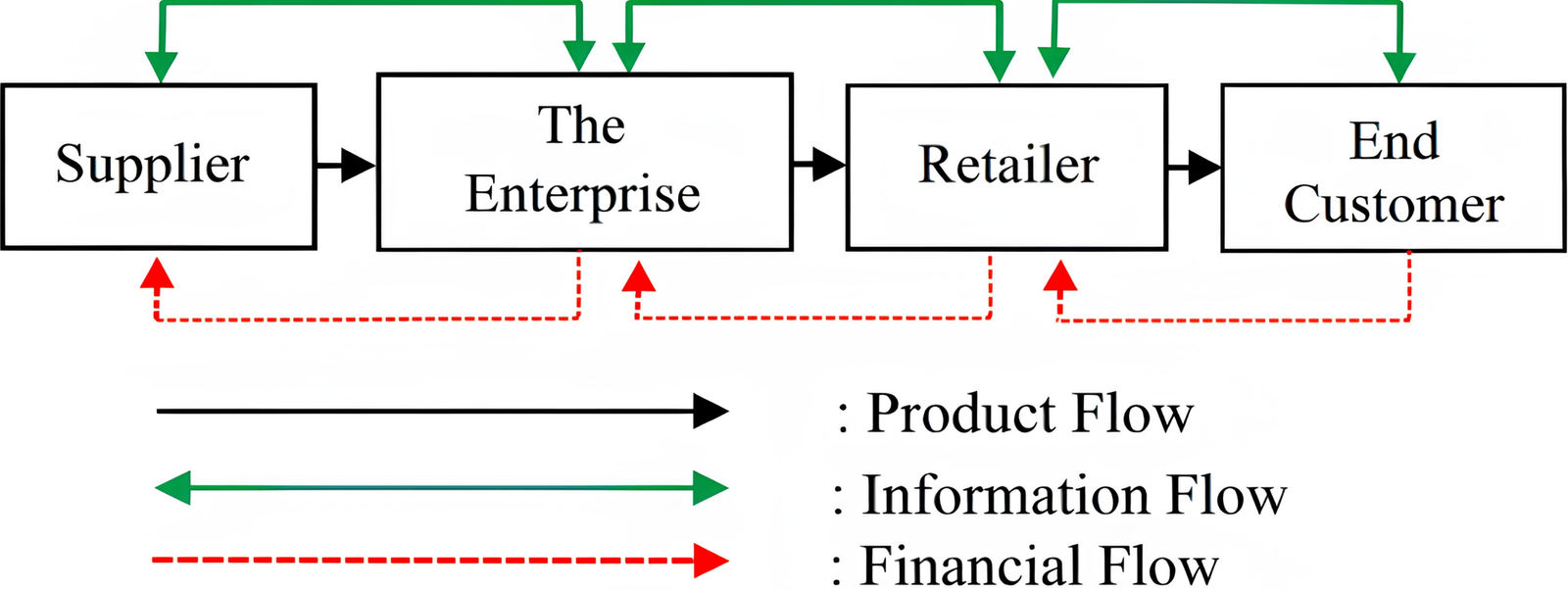
As shown in Figure 1, the supply chain operates through three integrated flows: product, financial, and information flows. The product flow moves downstream from suppliers to consumers, while financial flow moves upstream, and information flow occurs bidirectionally across all actors. This bidirectional information exchange aligns with the conceptual framework proposed by Syakur et al. (17), supporting coordination and transparency within the supply chain.
The enterprise sources its primary raw material, chicken intestines, from CV. Salamak Jaya, which in turn procures from halal-certified slaughterhouses (RPA Wonokoyo and RPA Turi Mulindo). This upstream structure strengthens halal assurance at the sourcing stage. Supporting materials are obtained from certified commercial brands, although the use of bulk cooking oil without clear halal labeling introduces a potential vulnerability.
The distribution system is relatively short, involving direct transactions between the enterprise and retailers. Financial transactions are conducted transparently and predominantly in cash, without complex contractual arrangements. Overall, the supply chain structure demonstrates simplicity, clear actor relationships, and functional integration, which support traceability but may limit scalability and formal control mechanisms.
Flow of the Halal Supply Chain of the Enterprise
The operational flow of the halal supply chain follows three main stages: production preparation, production processing, and distribution. Evaluation using a five-point Likert scale indicates varying levels of compliance across these stages.
In the production preparation stage, the enterprise demonstrates strong performance in raw material inspection, cleanliness verification, and transaction transparency, with most indicators scoring between 4 and 5. However, weaknesses are evident in supplier transportation hygiene (score 3), absence of formal budgeting (score 2), lack of systematic storage management such as labeling and stock recording (scores 2–3), and limited implementation of FIFO principles. These findings indicate that while basic control mechanisms exist, formalized management practices remain underdeveloped.
During the production processing stage, key strengths include high standards of washing procedures (score 5), equipment cleanliness (score 5), and absence of contamination with non-halal substances. The sequential production process is presented in Table 1.
| Stage | Description of Activity |
|---|---|
| Raw Material Preparation | Chicken intestines and supporting ingredients prepared for processing |
| Washing | Intestines washed repeatedly until clean and odor-free |
| Seasoning | Addition of spices and flavoring |
| Flour Coating | Coating with wheat flour and tapioca flour |
| Frying | Deep-frying in hot cooking oil |
| Oil Draining | Removing excess oil using draining equipment |
| Packaging | Product packed into plastic packaging |
| Final Product | Chicken intestine crackers ready for distribution |
Despite these strengths, several critical issues persist, including the reuse of cooking oil beyond recommended limits (score 2), absence of halal labeling on bulk oil (score 3), lack of material withdrawal recording (score 2), and inconsistent worker hygiene practices (score 3). These weaknesses indicate potential risks to both halal integrity and product quality if not properly controlled.
In the distribution stage, the enterprise demonstrates high compliance in packaging hygiene, product integrity, transaction fairness, and distribution practices, with most indicators scoring 5. However, two major weaknesses are identified: the absence of halal labeling on final product packaging (score 1) and the lack of inventory recording for finished products (score 1). These issues represent critical gaps in downstream halal assurance and traceability.
Overall, the findings indicate that the enterprise achieves relatively high compliance in operational practices, particularly in hygiene, material handling, and transaction integrity. However, systemic weaknesses persist in documentation, traceability systems, labeling consistency, and formal operational controls. These results suggest that halal compliance is primarily practice-based rather than system-based, reflecting the typical characteristics of micro-scale enterprises as described by Ardani (18).
Discussion
Halal Supply Chain Process of the Enterprise
The halal supply chain process implemented by the enterprise is illustrated in Figure 2, which presents the sequence of halal control activities from production preparation to consumption. The figure demonstrates how halal assurance is maintained throughout interconnected stages, including preparation, production, distribution, and consumer delivery.
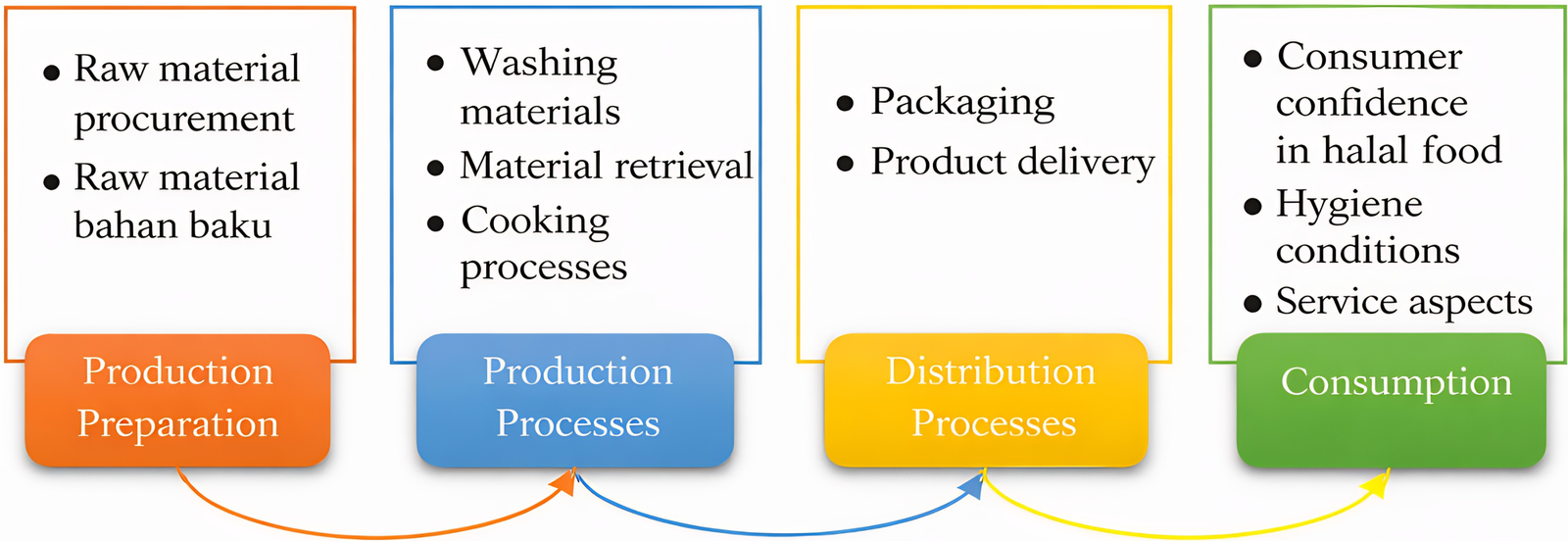
As shown in Figure 2, halal integrity in this enterprise is maintained through sequential control points across preparation, production, distribution, and consumption stages. The preparation stage ensures the acceptability of raw materials and supporting ingredients, while the production stage becomes the most critical point because chicken intestines are highly susceptible to contamination. Consequently, washing, handling, frying, and equipment sanitation serve as key mechanisms for maintaining halal and tayyib compliance. The distribution stage ensures that packaging, storage, and transportation preserve product integrity, whereas the consumption stage reflects halal assurance through consumer trust, product cleanliness, and ethical service.
The findings indicate that halal assurance in this microenterprise is primarily practice-based rather than system-based. No prohibited materials such as pork derivatives, carrion, blood, khamr, or other unlawful substances were identified during field observations, and operational activities generally followed Islamic principles. However, the absence of formal documentation and standardized monitoring suggests that halal compliance relies heavily on owner supervision, worker practices, and supplier trust. This condition reflects the characteristics of household-based microenterprises, where operational flexibility often substitutes for formal governance mechanisms. Therefore, Figure 2 represents not only the operational flow of the halal supply chain but also a functional yet informal halal assurance model at the microenterprise level.
Operational Assessment of Halal Supply Chain Management
Halal supply chain management in food processing requires coordinated control over procurement, production, inventory, logistics, and consumer delivery, integrating upstream and downstream actors within a single halal assurance system (12). In this study, the enterprise demonstrates substantial operational compliance, particularly in raw material inspection, washing procedures, equipment cleanliness, transparent transactions, and distribution integrity. Nevertheless, the findings also reveal several critical weaknesses related to documentation, traceability, oil management, stock recording, and halal labeling. These weaknesses show that the main challenge is not the presence of haram materials, but the limited institutionalization of halal control mechanisms.
Production Preparation Stage
The production preparation stage shows that halal assurance begins with supplier selection, raw material procurement, receiving procedures, and storage control. The primary raw material, chicken intestines, is obtained from CV. Salamak Jaya, which sources from certified poultry slaughterhouses, namely RPA Wonokoyo and PT Tera Multindo. This indicates that upstream sourcing has a relatively strong halal basis. Supporting ingredients are also largely obtained from packaged products bearing halal labels, as summarized in Table 2.
| No. | Raw Material | Halal Certification Number |
|---|---|---|
| 1 | Turmeric Powder “Desaku” | 07060013240312 |
| 2 | Coriander Powder “Desaku” | 07060013240312 |
| 3 | Chili Powder “Ladaku” | 07060013240312 |
| 4 | Wheat Flour “Payung” | 0220006410997 |
| 5 | Tapioca Flour “Gunung Agung” | 0220006009897 |
| 6 | Seasoning Powder “Masako” | 00060008910908 |
| 7 | Salt “Cap Kapal” | 868/SPKP/VII/2021 |
| 8 | Garlic Powder “Dapurbakita” | 15060034471018 |
| Note: The table indicates that most supporting raw materials used in production possess valid halal certification numbers, strengthening upstream halal assurance. However, uncertified inputs such as bulk cooking oil are not included in this table, reflecting a potential gap in traceability. | ||
Table 2 demonstrates that most supporting ingredients already have formal halal certification numbers, thereby strengthening the material assurance component of the supply chain. However, the reliance on supplier trust rather than direct verification of slaughterhouse documentation reflects a relational governance model. Although common in microenterprises, this approach weakens formal traceability and audit readiness. In halal supply chain theory, supplier verification is a key element because halal integrity must be protected from upstream sourcing rather than only during final production.
The use of bulk cooking oil is one of the most important risk points in this stage. Although bulk oil is generally plant-based and no direct halal violation was observed, its lack of explicit halal labeling reduces traceability. Moreover, repeated exposure to high temperatures may affect food quality and safety, which relates not only to halal permissibility but also to the tayyib dimension of halal food (19, 20). Therefore, the main concern relates to the documentation and control of oil sourcing and usage.
Storage and receiving practices also indicate gaps in formal supply chain governance. Although incoming materials are routinely inspected for freshness and suitability, the absence of stock records, FIFO implementation, written supplier evaluation, and pest monitoring limits the robustness of halal control. These findings suggest that the preparation stage is operationally compliant but administratively weak. Since traceability is a key component of halal supply chain integrity (21), strengthening inventory documentation and supplier verification would improve transparency and accountability without requiring major operational changes.
Production Process Stage
The production stage is the core point of halal risk control because it directly involves the transformation of chicken intestines into finished food products. The process includes raw material retrieval, washing, seasoning, flour coating, frying, and oil draining. The findings show that this stage has strong substantive compliance because raw materials are reinspected before processing, intestines are washed repeatedly, equipment is dedicated to halal production, and no non-halal materials are used. Repeated washing is essential because chicken intestines are highly susceptible to contamination.
From the perspective of halal supply chain management, the strongest aspect of this stage is the prevention of cross-contamination. Equipment is used exclusively for chicken intestine cracker production and is cleaned before and after production. This supports the principle that halal integrity must be preserved not only through ingredient selection but also through processing control. The absence of synthetic preservatives and artificial additives further strengthens the product’s compliance with halal and tayyib principles.
However, several weaknesses remain, including the absence of material withdrawal records, non-standardized washing duration, lack of formal water quality monitoring, and manual frying temperature control. These conditions indicate reliance on worker experience rather than standardized procedures, which may reduce operational consistency and limit auditability and scalability. The repeated use of cooking oil also represents a critical concern. Although no haram substances were identified, excessive oil reuse may reduce product quality and affect the tayyib aspect related to cleanliness, safety, and wholesomeness. Inconsistent worker hygiene practices may also increase contamination risk. Therefore, while the production stage demonstrates strong practical halal compliance, stronger formal operational controls are still required to improve reliability and consistency.
Distribution Process Stage
The distribution stage extends halal assurance from finished production to consumer access. In this enterprise, distribution includes oil draining, packaging, temporary storage, and delivery. The findings show that product handling during distribution is generally clean and transparent. Packaging materials are new, weighing is conducted using digital scales, and transactions are performed fairly. Vehicles used for distribution are not used to transport haram materials, reducing the risk of cross-contamination during logistics.
However, the absence of a halal logo on final packaging represents a significant downstream weakness. Although the enterprise holds halal certification, the lack of visible labeling may reduce formal consumer recognition and weaken market credibility. In halal supply chains, packaging also functions as a medium of halal assurance for consumers. Therefore, labeling has both regulatory and trust-building functions. This issue is particularly important because some retailers repackage the product under their own branding, which may further obscure the original halal assurance status.
Another important weakness is the absence of product inflow and outflow records. Without inventory documentation, the enterprise may face difficulty tracing product batches in the event of quality complaints or recall needs. This limits supply chain transparency and weakens downstream accountability. However, documentation remains necessary to ensure formal traceability. Furthermore, the absence of temperature or environmental monitoring during transportation may affect product quality, particularly in tropical conditions where oil-based snacks may be sensitive to heat exposure. The distribution stage generally demonstrates good compliance in hygiene, transaction fairness, and contamination prevention. However, weaknesses in halal labeling and inventory documentation indicate that halal assurance remains largely informal. Strengthening labeling, batch recording, and delivery monitoring would improve downstream traceability and consumer confidence.
Consumption Stage
The consumption stage reflects the final evaluation of halal supply chain performance through consumer trust and product acceptance. Interviews with regular consumers indicate that trust is primarily built through repeated purchasing experience, visible cleanliness, transparent transactions, and direct interaction with the owners. This suggests that halal credibility in micro-scale enterprises is often constructed through relational trust in addition to formal certification mechanisms. The findings also demonstrate a distinction between formal halal assurance and perceived halal assurance. Formal assurance is represented by certification, labeling, and documentation, whereas perceived assurance is shaped by consumer experience, product cleanliness, and business reputation. In this enterprise, consumer confidence remains relatively strong despite the absence of visible halal labeling on product packaging.
However, reliance on relational trust alone may limit broader market expansion, particularly in competitive halal markets that require stronger documentation and traceability systems. Therefore, improving halal labeling, documentation, and product traceability would strengthen consumer confidence and support long-term market competitiveness. In addition, ethical business practices, including fair pricing, transparent weighing, and clean packaging, contribute positively to consumer satisfaction and reinforce the overall integrity of the halal supply chain system.
Synthesis of Key Findings
Overall, the discussion shows that the enterprise has achieved functional halal compliance, meaning that its daily practices generally align with Islamic principles and halal food requirements. The strongest aspects are found in raw material inspection, repeated washing, dedicated equipment, transparent transactions, clean distribution, and consumer trust. However, the enterprise has not yet achieved system-based halal assurance, because formal documentation, supplier verification, inventory records, halal labeling, oil management standards, and hygiene procedures remain limited.
Theoretically, this study supports the argument that halal supply chain management differs from conventional supply chain management because it requires control over both material flow and religious compliance throughout the chain. The findings also extend previous halal supply chain studies by showing how micro-scale animal-based food enterprises maintain halal integrity under limited technological, managerial, and financial resources. Thus, the academic contribution of this study lies in demonstrating that halal compliance in microenterprises may be operationally strong but administratively fragile. Strengthening traceability, documentation, labeling, and standard operating procedures would improve halal governance without eliminating the adaptive flexibility that enables microenterprises to survive.
Conclusion
This study demonstrates that the implementation of halal supply chain management in the examined micro-scale enterprise generally complies with Islamic principles across the preparation, production, distribution, and consumption stages. The findings indicate strong operational compliance in raw material inspection, washing procedures, equipment cleanliness, transaction transparency, and distribution practices. Most raw materials used in the production process were also halal-certified, supporting the maintenance of halal integrity throughout the supply chain. However, several weaknesses remain, particularly in the use of bulk cooking oil, repeated oil usage beyond recommended limits, limited storage management, inadequate inventory documentation, and inconsistent worker hygiene practices. These findings suggest that halal compliance in the enterprise is primarily practice-based rather than supported by formalized management and traceability systems. This study contributes to halal supply chain management literature by providing empirical evidence from a micro-scale enterprise context, demonstrating that small enterprises are capable of maintaining halal integrity despite limited technological and managerial resources. The findings also highlight the importance of strengthening documentation systems, halal labeling, traceability, and standardized operational controls to improve the sustainability and competitiveness of halal MSMEs.
Declarations
Conflict of Interest
The authors declare no conflicting interest.
Data Availability
All data generated or analyzed during this study are included in this published article.
Ethics Statement
Ethical approval was not required for this study.
Funding Information
The authors declare that no financial support was received for the research and/or publication of this article.
References
- Kristiana BV, Indrasari A, Giyanti I. Halal Supply Chain Management dalam Optimalisasi Penerapan Sertifikasi Halal UMKM. Performa. 2020;19(2). doi: https://doi.org/10.20961/performa.19.2.46379
- Aziz F, Setyorini R, Hasanah YN. Analisis Halal Supply Chain pada Usaha Mikro Kecil Menengah (UMKM) Makanan di Kota Bandung. Jiei. 2021;7(1):293. doi: https://doi.org/10.29040/jiei.v7i1.1936
- Limanseto H. Biro Komunikasi, Layanan Informasi, dan Persidangan Kementerian Koordinator Bidang Perekonomian. 2021. UMKM Menjadi Pilar Penting dalam Perekonomian Indonesia.
- Kementerian Pendayagunaan Aparatur Negara dan Reformasi Birokrasi [Internet]. 2021. Menkeu: Sertifikasi Halal Gratis Wujud Pemihakan Pemerintah pada UMKM.
- Rohaeni Y, Sutawijaya AH. Pengembangan model konseptual manajemen rantai pasok halal studi kasus indonesia. Teknik Industri. 2020;15(3):177-188. doi: https://doi.org/10.14710/jati.15.3.177-188
- Pujiono A, Setyawati R, Idris I. Strategi pengembangan umkm halal di jawa tengah dalam menghadapi persaingan global. Indonesia Journal of Halal. 2018;1(1):1. doi: https://doi.org/10.14710/halal.v1i1.3109
- Tieman M, van der Vorst JG, Che Ghazali M. Principles in halal supply chain management. Journal of Islamic Marketing. 2012;3(3):217-243. doi: https://doi.org/10.1108/17590831211259727
- Kurniawati DA, Cakravastia A. A review of halal supply chain research: Sustainability and operations research perspective. Cleaner Logistics and Supply Chain. 2023;6:100096. doi: https://doi.org/10.1016/j.clscn.2023.100096
- Hasanah M, Fahruddin AR. Analisis Halal Supply Chain Management (SCM) Dalam Perspektif Maqashid Syariah. at. tasharruf. j. kaji. ekon. dan. n.a. syariah. 2021;2(2):73-80. doi: https://doi.org/10.32528/at.v2i2.5424
- Hasan Z. Making Indonesia as Integrated Halal Zone and World Halal Sector Hub Through the Implementation of Halal Supply Chain. Jiebr. 2021;1(1):1-14. doi: https://doi.org/10.18196/jiebr.v1i1.11529
- Dilla ZU, Fathurohman MS. Implementasi halal traceability supply chain dengan model supply chain operation reference (scor) industri makanan halal. Jestt. 2021;8(5):617. doi: https://doi.org/10.20473/vol8iss20215pp617-629
- Isnaeni A. Implementasi Halal Supply Chain Management pada Industri Pengolahan Makanan (Studi Kasus : Restoran Taman Pringsewu Yogyakarta). Universitas Islam Indonesia; 2020.
- Supriyanto A. Halal Supply Chain Management (HSCM) in Traditional Poultry Markets: A Case Study of Wonokromo and Asem, Surabaya. halal. 2025;1(2):37-42. doi: https://doi.org/10.58920/halal0102463
- Helaluddin H. Mengenal lebih Dekat dengan Pendekatan Fenomenologi: Sebuah Penelitian Kualitatif. 2019. doi: https://doi.org/10.31219/osf.io/stgfb
- Widagdyo KG. Analisis Pasar Pariwisata Halal Indonesia. Tauhidinomics J Islam Bank Econ. 2015;1(1):73–80.
- Siyoto S, Sodik MA. Dasar Metodologi Penelitian. 1st ed. Literasi Media Publishing; 2015.
- Syakur MA, Purnomo SH, Hertanto BS. Analisis Rantai Pasokan (Supply Chain) Daging Sapi dari Rumah Pemotongan Hewan sampai Konsumen di Kota Surakarta. Si.Pet. 2017;15(2):52. doi: https://doi.org/10.20961/sainspet.v15i2.11444
- Rahmy Ardani. Desain Integrasi Sistem Jaminan Halal Dan Cara Produksi Makanan Yang Baik Untuk Usaha Kecil (Studi Kasus di UKM Faza Grup). Institut Pertanian Bogor; 2014.
- Wicaksono A. CNN Indonesia. 2019. Mengenal Definisi Minyak Curah Versi Kementerian Perdagangan.
- Herman RS. Pengendalian Mutu dan Penerapan Konsep Hazard Analysis Critical Control Point (Haccp) dalam Proses Pembuatan Keripik Usus Ayam Di UKM Kampung Sewu Surakarta. Universitas Negeri Sebelas Maret; 2012.
- Sucipto S, Syahputri BE, Mulyarto AR, Tolle H. Building Transparency through Halal and Quality Traceability System for Beef Distribution in Malang City, Indonesia. IJTech. 2025;16(4):1253. doi: https://doi.org/10.14716/ijtech.v16i4.5984