RESEARCH ARTICLE
Detection of Porcine Fat in Olive Oil Based Facial Mask Formulations Using Fourier Transform Infrared (FTIR) Spectroscopy
Halal Science|Vol. 2, Issue 1, pp. 24-29 (2026)
CC BY 4.0-2026 Authors
Views
Downloads
Shares

Received
Mar 8, 2026Revised
Apr 25, 2026Accepted
Jun 8, 2026Published
Jun 28, 2026
Abstract
The authentication of lipid sources in cosmetic products is essential due to regulatory, ethical, and religious concerns, particularly regarding the potential presence of porcine-derived ingredients. This study aimed to evaluate the applicability of Fourier Transform Infrared (FTIR) spectroscopy combined with Principal Component Analysis (PCA) for differentiating lipid profiles in olive oil–based facial mask formulations. Reference lipids, including porcine fat and olive oil, as well as lipid extracts from five commercial cosmetic products, were analyzed using FTIR spectroscopy within the mid-infrared region (4000–650 cm⁻¹). Characteristic absorption bands corresponding to triglyceride structures were observed in all samples, while differences between lipid sources were primarily identified within the fingerprint region (1500–1000 cm⁻¹). PCA was applied to enhance spectral discrimination and revealed clear separation between porcine fat and olive oil along the principal components. Most cosmetic samples (HCN, LTL, NR, and QN) were positioned closer to the olive oil reference, whereas one sample (MDG) showed spectral proximity to porcine fat. However, these results reflect spectral similarity rather than definitive confirmation of lipid origin. The findings indicate that FTIR spectroscopy combined with chemometric analysis can provide a rapid and non-destructive approach for preliminary screening of lipid sources in cosmetic matrices. Nevertheless, due to the limited number of samples and the complexity of cosmetic formulations, further studies incorporating broader sample sets and confirmatory analytical methods are required to support its application in halal authentication and quality control.
Keywords:
Introduction
Reliable analytical methods such as FTIR spectroscopy combined with chemometric techniques have become important tools for differentiating halal and non-halal ingredients in complex cosmetic matrices (1, 2). Previous studies have demonstrated the successful application of FTIR-chemometrics in halal authentication of various products, including gelatine (3), toothpaste matrices (4), and edible oils (2). These approaches enable rapid and non-destructive screening of potential porcine-derived adulterants, supporting regulatory compliance and consumer protection (5).
The detection of non-halal ingredients in cosmetic products remains analytically challenging, particularly for lipid components such as porcine fat (lard), which exhibit physicochemical properties similar to other animal and vegetable lipids. This similarity makes discrimination difficult when using conventional analytical techniques. FTIR spectroscopy combined with chemometric analysis has been widely applied for authentication of edible oils and fats, allowing differentiation based on spectral characteristics in key regions such as 3100–2900, 1800–1700, and 1500–1100 cm⁻¹ (6). These methods utilize the fingerprint region to capture subtle molecular differences, even among compounds with similar functional groups (6, 7).
Although FTIR-based approaches have been applied in lipid authentication, studies specifically focusing on cosmetic products particularly olive oil–based facial mask formulations remain limited. In addition, cosmetic matrices often contain complex mixtures of emulsifiers, humectants, and other additives that may interfere with spectral interpretation. Therefore, further investigation is needed to evaluate the applicability of FTIR-chemometric techniques in real cosmetic samples within the context of halal authentication.
In response to this gap, the present study evaluates the use of FTIR spectroscopy combined with Principal Component Analysis (PCA) to assess lipid profiles in selected facial mask products labeled as containing olive oil. The objectives of this study are (1) to investigate potential spectral differences between reference lipids and cosmetic samples and (2) to examine clustering patterns based on chemometric analysis. This study is expected to provide preliminary insight into the potential of FTIR-chemometric methods as a rapid screening tool for lipid source evaluation in cosmetic products.
Methodology
Study Design and Rationale
This study employed an experimental analytical design integrating Fourier Transform Infrared (FTIR) spectroscopy with chemometric analysis to evaluate potential lipid source differences in commercially available facial mask products labeled as containing olive oil. FTIR spectroscopy was selected due to its established capability as a rapid, non-destructive, and environmentally friendly analytical technique for lipid characterization (8, 9).
Because triglycerides from different lipid sources share similar functional groups, particularly ester carbonyl and aliphatic C–H bonds, spectral discrimination in complex matrices requires multivariate statistical enhancement. Therefore, Principal Component Analysis (PCA) was applied to improve classification performance, especially within the fingerprint region (1500–1000 cm⁻¹), where characteristic differences associated with lipid composition have been reported (10, 11).
Sample Selection and Sampling Criteria
Five commercial facial mask products labeled as containing olive oil (Olea europaea L.) were selected using purposive sampling to represent products available in the market. Inclusion criteria included explicit labeling of olive oil, absence of verified halal certification at the time of sampling, and commercial availability.
Samples were coded as NR, HCN, LTL, QN, and MDG to maintain analytical objectivity. Reference materials consisted of pure olive oil and porcine fat (lard) prepared under controlled laboratory conditions. All measurements were conducted in triplicate to ensure reproducibility.
Materials and Instrumentation
Analytical-grade n-hexane (≥99% purity) was used for lipid extraction, and spectroscopy-grade potassium bromide (KBr) was used for pellet preparation. Spectral acquisition was performed using an FTIR spectrophotometer equipped with a deuterated triglycine sulfate (DTGS) detector.
Spectra were recorded over the mid-infrared range of 4000–650 cm⁻¹ with a resolution of 4 cm⁻¹ and 32 scans per sample to ensure adequate signal quality. Instrument calibration and background correction were performed prior to analysis.
Experimental Procedures
Porcine fat reference material was prepared by rendering adipose tissue at 90–100 °C until complete liquefaction, followed by filtration and storage at 4 °C prior to analysis, consistent with established protocols (12, 13).
Cosmetic samples (5.00 g) were subjected to Soxhlet extraction using 150 mL of n-hexane for six h at approximately 60 °C to isolate lipid fractions. Extracts were concentrated using a rotary evaporator at 40 °C and dried to constant weight before analysis.
FTIR analysis was performed using two sampling approaches depending on sample characteristics. The KBr pellet method was applied for solid or semi-solid extracts (Samples NR, HCN, and LTL), where approximately 1 mg of lipid was mixed with 100 mg of dry KBr and pressed into a pellet. The ATR (Attenuated Total Reflectance) method was used for liquid samples (Samples QN, MDG, pure olive oil, and porcine fat reference) to allow direct measurement without additional preparation. To ensure cross-method spectral comparability, key absorbance peaks of a control sample were cross-verified using both methods, showing no significant shift in key wavenumbers within the analyzed range.
Spectral interpretation focused on key absorption bands, including the ester carbonyl (~1745 cm⁻¹), C–H stretching (2850–2950 cm⁻¹), and the fingerprint region (1500–1000 cm⁻¹), where characteristic patterns associated with lipid composition have been reported (8, 10).
Data Processing and Chemometric Analysis
Spectral data were preprocessed using baseline correction and normalization to minimize instrumental variation. In selected cases, s-derivative transformation was applied to improve resolution of overlapping peaks.
Principal Component Analysis (PCA) was conducted using multivariate analysis software to reduce spectral dimensionality and identify clustering patterns among samples. The PCA model was constructed using spectral variables within the fingerprint region, which has been widely reported as the most informative region for lipid discrimination (14, 15).
Score plots were used to evaluate the relative positioning of cosmetic samples with respect to reference lipids, while loading plots were examined to identify wavenumbers contributing to separation. Interpretation of clustering was performed cautiously, where proximity to reference samples was considered indicative of spectral similarity rather than definitive compositional confirmation.
Variables and Quality Control
The independent variable was the lipid source (olive oil, lard, and cosmetic extracts), while the dependent variable was the infrared absorbance across the measured wavenumber range.
Controlled variables included extraction conditions, solvent type, instrumental parameters, and environmental conditions. All measurements were performed in triplicate, and repeatability was evaluated using relative standard deviation (RSD), with values below 5% considered acceptable.
Results and Discussion
FTIR Characterization of Reference Lipids
The FTIR spectra of porcine fat and olive oil are presented in Figure 1. Both samples exhibited characteristic absorption bands typical of triglyceride structures, including peaks at approximately 2928 cm⁻¹ and 2854 cm⁻¹ corresponding to asymmetric and symmetric C–H stretching vibrations, as well as a strong band at 1747 cm⁻¹ attributed to ester carbonyl (C=O) stretching.
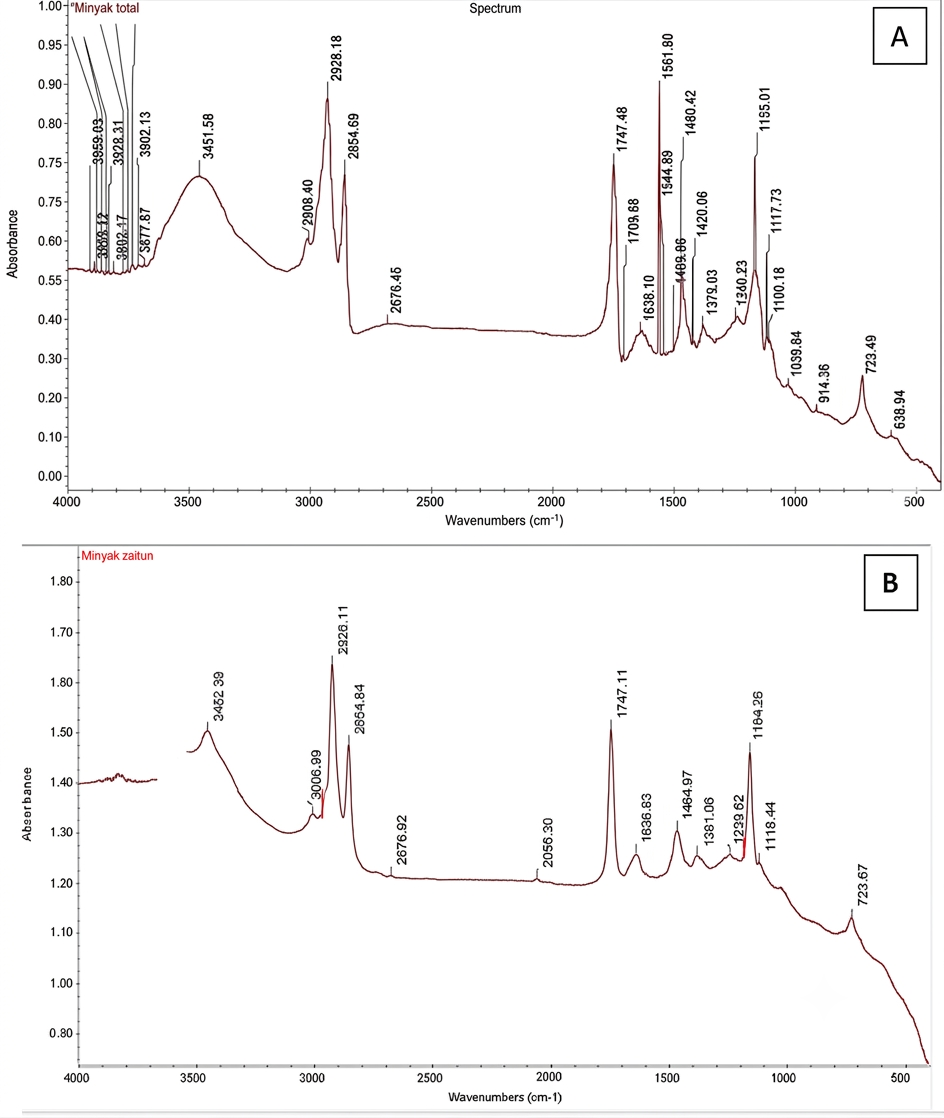
Despite these similarities, differences were observed in specific spectral regions. Olive oil showed an additional absorption band near 3006 cm⁻¹, associated with cis C=C–H stretching, indicating a higher degree of unsaturation. More pronounced differentiation between the two lipid sources was observed within the fingerprint region (1500–1000 cm⁻¹), where porcine fat exhibited characteristic absorption patterns distinct from olive oil. These findings are consistent with previous FTIR-based lipid authentication studies, which indicate that discrimination is primarily based on subtle variations in this region rather than major functional group differences (8).
Spectral Evaluation of Cosmetic Samples
All extracted cosmetic samples exhibited spectral features consistent with lipid-based matrices, including absorption bands in the regions of 2928–2854 cm⁻¹ and 1747 cm⁻¹. However, variations in peak intensity and distribution were observed within the fingerprint region.
Samples HCN, LTL, NR, and QN displayed spectral patterns more closely resembling those of olive oil, particularly within the 1200–1000 cm⁻¹ range. In contrast, sample MDG showed spectral characteristics that appeared more similar to the porcine fat reference in certain regions.
It is important to note that cosmetic formulations contain complex mixtures of ingredients, including emulsifiers, humectants, and stabilizers, which may influence FTIR spectral profiles. Therefore, visual spectral similarity alone cannot be used as definitive evidence of lipid origin but should be interpreted as indicative of compositional resemblance within the analyzed spectral range.
Chemometric Discrimination by PCA
To enhance objectivity and reduce subjective interpretation, Principal Component Analysis (PCA) was applied to the FTIR spectral dataset. The PCA score plot (Figure 2) demonstrated separation between porcine fat and olive oil along the first principal component (PC1), suggesting that the primary variance in the dataset is associated with differences in lipid composition
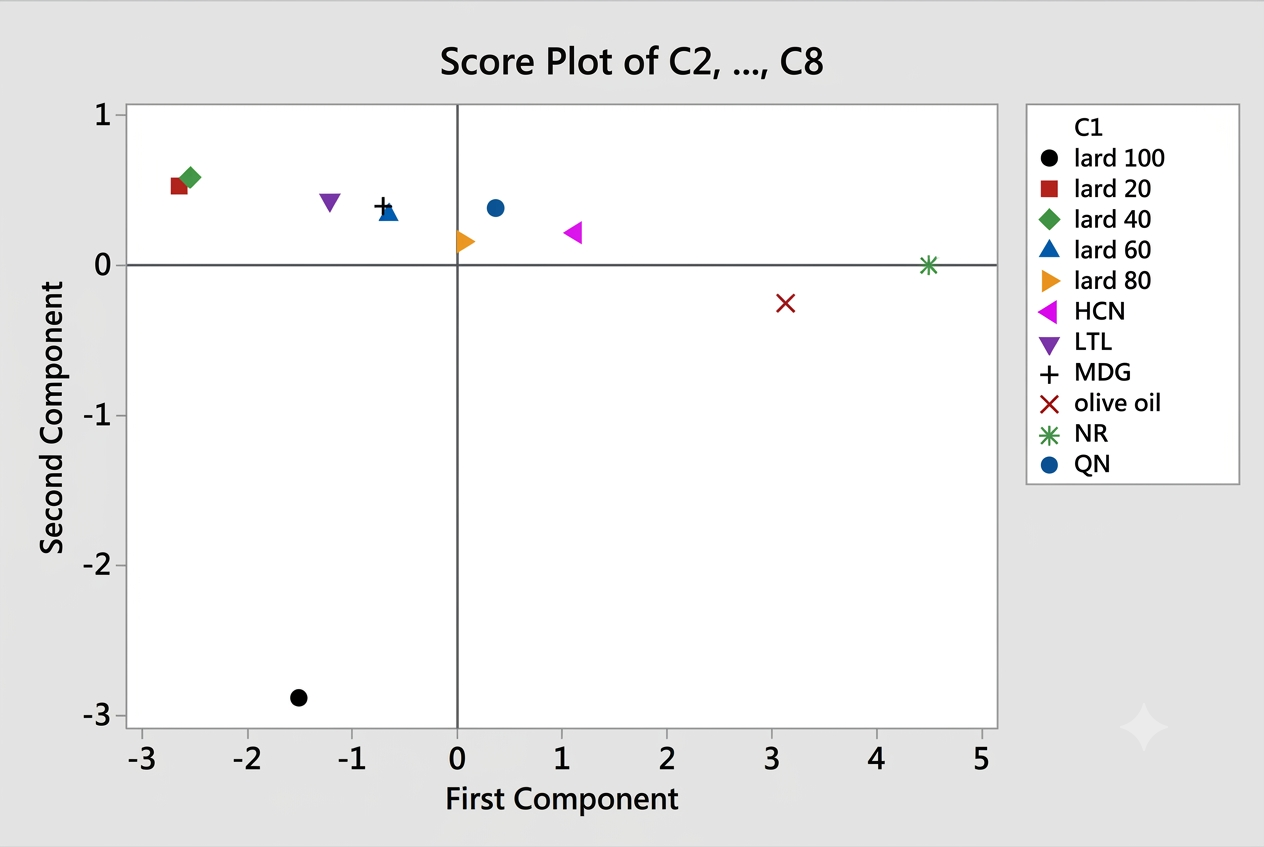
Cosmetic samples were distributed in the score plot according to their spectral proximity to the reference materials. Samples HCN, LTL, NR, and QN were located closer to the olive oil cluster, whereas sample MDG was positioned nearer to the porcine fat reference.
However, it should be emphasized that PCA is an exploratory multivariate technique that identifies patterns and clustering based on variance in the dataset but does not provide direct chemical confirmation of sample composition. The observed proximity of sample MDG to the porcine fat cluster therefore indicates spectral similarity rather than definitive evidence of porcine-derived content. The observed proximity of sample MDG to the porcine fat cluster therefore indicates spectral similarity rather than definitive evidence of porcine-derived content. This spectral proximity could alternatively be attributed to matrix effects from cosmetic additives or the presence of non-porcine saturated fatty acid components (such as stearic acid or palmitic acid) commonly used as thickening agents or emulsifiers in facial masks, which may overlap with the lipid profile within the fingerprint region.
The separation observed in the PCA model is primarily influenced by variables within the fingerprint region (1500–1000 cm⁻¹), which is widely recognized as a critical region for lipid discrimination due to variations in C–O stretching and ester-related vibration (16–21). These spectral differences reflect underlying variations in fatty acid composition and molecular structure between lipid sources.
Overall, the integration of FTIR spectroscopy with PCA provides a useful approach for preliminary differentiation of lipid profiles in cosmetic samples. Nevertheless, due to the complexity of cosmetic matrices and potential spectral overlap, confirmatory analytical techniques such as chromatographic or mass spectrometric methods are recommended for definitive identification.
Conclusion
The present study demonstrates that FTIR spectroscopy combined with Principal Component Analysis (PCA) can be applied to differentiate lipid profiles of porcine fat and olive oil based on spectral variations, particularly within the fingerprint region (1500–1000 cm⁻¹). The chemometric approach enabled visualization of clustering patterns among reference lipids and cosmetic samples, indicating varying degrees of spectral similarity. Although several cosmetic samples showed closer proximity to olive oil, one sample (MDG) exhibited spectral characteristics more comparable to the porcine fat reference. However, these findings should be interpreted cautiously, as PCA is an exploratory technique and does not provide definitive confirmation of lipid origin. Overall, the integration of FTIR spectroscopy and chemometric analysis shows potential as a rapid and non-destructive screening method for preliminary evaluation of lipid sources in cosmetic products. Further validation using a larger sample set and confirmatory analytical techniques is recommended to strengthen its applicability in halal authentication and regulatory assessment.
Declarations
Conflict of Interest
The authors declare no conflict of interest.
Data Availability
The datasets generated and/or analyzed during the current study are available upon reasonable request to the corresponding author.
Ethics Statement
Not applicable.
Funding Information
This work received no external funding.
References
- Nawwaruddin HH, Rohman A, Laksitorini MD. Porcine Derived Ingredients in Cosmetic Products and its Halal Authentication Method within Complex Matrices. Journal of Food and Pharmaceutical Sciences. 2024 Dec 28;241–65. doi:10.22146/jfps.17717
- Salamah N, Mahendra MR, Guntarti A, Ahda M. Halal authentication of sesame oil (Sesamum indicum L.) in market using GC-MS and FTIR spectrometry combination of chemometrics. Journal of Research in Pharmacy. 2025 Jul 5;29(4):1532–41. doi:10.12991/jrespharm.1734658
- Salamah N, Jufri SL, Susanti H, Jaswir I. Analysis of Gelatin on Soft Candy using a Combination of Fourier Transform Infrared Spectroscopy (FTIR) with Chemometrics for Halal Authentication. Indonesian Journal of Halal Research. 2023 Aug 31;5(2):90–8. doi:10.15575/ijhar.v5i2.25682
- Wiranti Sri Rahayu by. Halal Authentication of Toothpaste with FTIR Combine with Chemometrics. Indonesian Journal of Chemometrics and Pharmaceutical Analysis. 2021;1(2):78–82.
- Lestari D, Hamzah H, Pramesthi A, Syamsul E, Safitri P, Nurjunnah R, et al. <b>The employment of FTIR-ATR spectroscopy and GC-MS combined with chemometrics for rapid detection of adulteration of pork oil in Gabus fish oil (<i>Channa striata</i>) for halal authentication</b> Open Vet J. 2025;(0):1. doi:10.5455/OVJ.2025.v15.i2.13
- Ye Q, Meng X. Highly efficient authentication of edible oils by FTIR spectroscopy coupled with chemometrics. Food Chem. 2022 Aug;385:132661. doi:10.1016/j.foodchem.2022.132661
- Özdikicierler O, Akcan T, Ergönül PG, Karacan E. Rapid detection of virgin olive oil adulteration via chemometric analysis of raw differential scanning calorimetry data and pretreated fourier transform infrared spectroscopy. European Food Research and Technology. 2025 Sep 5;251(9):2617–31. doi:10.1007/s00217-025-04803-0
- Rohman A, Che Man YB. Authentication of Extra Virgin Olive Oil from Sesame Oil Using FTIR Spectroscopy and Gas Chromatography. Int J Food Prop. 2012 Nov;15(6):1309–18. doi:10.1080/10942912.2010.521607
- Musfiroh I, Nurhaliza M, Maharani A. Review: Metodologi Deteksi Bahan Tidak Halal pada Kosmetik dan Makanan. Majalah Farmasetika. 2025 Aug 9;10(4):184–205. doi:10.24198/mfarmasetika.v10i4.65072
- Megawati DS, Fauziyah B, Maimunah S, Wafi A. Profil FTIR Minyak Ikan dan Lemak Babi serta Perbandingannya sebagai Dasar Penentuan Autentifikasi Halal. ALCHEMY. 2020 Mar 31;8(1):9. doi:10.18860/al.v8i1.9818
- Windarsih A, Indrianingsih AW, Apriyana W, Rohman A. Rapid detection of pork oil adulteration in snakehead fish oil using FTIR-ATR spectroscopy and chemometrics for halal authentication. Chemical Papers. 2023 May 14;77(5):2859–70. doi:10.1007/s11696-023-02671-0
- Choe E, Min DB. Chemistry of Deep‐Fat Frying Oils. J Food Sci. 2007 Jun;72(5). doi:10.1111/j.1750-3841.2007.00352.x
- Irnawati, Putri RN, Lestari LA, Rohman A. Quantitative analysis and discrimination of lard in chicken fat using FTIR spectroscopy and chemometrics for halal authentication. Food Res. 2022 Jul 26;6(4):211–7. doi:10.26656/fr.2017.6(4).459
- Windarsih A, Jatmiko TH, Anggraeni AS, Rahmawati L. Machine learning-assisted FT-IR spectroscopy for identification of pork oil adulteration in tuna fish oil. Vib Spectrosc. 2024 Sep;134:103715. doi:10.1016/j.vibspec.2024.103715
- Bunaciu AA, Vu DH, Aboul-Enein HY. Edible Oil Discrimination by Fourier Transform Infrared (FTIR) Spectroscopy and Chemometrics. Anal Lett. 2024 Feb 11;57(3):445–55. doi:10.1080/00032719.2023.2211697
- Rohman A, Gupitasari I, Purwanto P, Triyana K, Rosman AS, Shuhel Ahmad SA, et al. Quantification of Lard in the Mixture with Olive Oil in Cream Cosmetics Based on FTIR Spectra and Chemometrics for Halal Authentication. J Teknol. 2014 Jun 20;69(1). doi:10.11113/jt.v69.2062
- Tachie CYE, Obiri-Ananey D, Alfaro-Cordoba M, Tawiah NA, Aryee ANA. Classification of oils and margarines by FTIR spectroscopy in tandem with machine learning. Food Chem. 2024 Jan;431:137077. doi:10.1016/j.foodchem.2023.137077
- Ahda M, Guntarti A, Kusbandari A, Safitri A. Identification of Lard Adulteration of Cooking Oil Products Using Fourier Transform Infrared Spectroscopy Combined with Chemometrics. Food Anal Methods. 2024 Mar 17;17(3):366–72. doi:10.1007/s12161-024-02576-y
- Gaikwad O, Gandhi K, Shivanna SK, Sharma R, Bajaj RK. Detection of buffalo body fat in ghee using ATR-FTIR spectroscopy coupled with chemometrics. Discover Food. 2025 Dec 18;6(1):47. doi:10.1007/s44187-025-00768-x
- Prihandiwati E, Rohman A, Fadzillah NA, Betania K, Nurani LH, Ahda M, et al. A review of the developed methods for the analysis of lard and pork in food and pharmaceutical products for halal authentication. Food Res. 2024 May 3;8(3):14–27. doi:10.26656/fr.2017.8(3).095
- Ragucci S, Landi N, Di Maro A. Myoglobin as a molecular biomarker for meat authentication and traceability. Food Chem. 2024 Nov;458:140326. doi:10.1016/j.foodchem.2024.140326