RESEARCH ARTICLE
The Influence of Sustainable Tourism on SDG 11 Achievement in the Lake Toba Area, Indonesia
Sustainable Economy|Vol. 2, Issue 1, pp. 20-26 (2026)
CC BY 4.0-2026 Authors
Views
Downloads
Shares

Received
Apr 15, 2026Revised
May 11, 2026Accepted
May 25, 2026Published
Jun 12, 2026
Abstract
Rapid tourism development often generates environmental and socio-economic challenges, particularly in emerging destinations where governance and stakeholder coordination remain limited. In the Lake Toba area, concerns persist regarding the alignment of tourism growth with Sustainable Development Goal 11 (SDG 11). This study analyzes the influence of sustainable tourism, community participation, and non-state actor participation on SDG 11 achievement in Parapat City. A quantitative approach was employed using Structural Equation Modeling Partial Least Squares (SEM-PLS). Data were collected from 20 expert-based stakeholders selected through purposive sampling, including representatives from government, tourism businesses, NGOs, and academia. The measurement model demonstrated acceptable validity and reliability, with AVE values above 0.50 and composite reliability values exceeding 0.70. The findings show that sustainable tourism has a positive and significant effect on SDG 11 achievement (β = 0.264; t = 2.152; p = 0.031), while non-state actor participation demonstrates the strongest positive influence (β = 0.655; t = 3.318; p = 0.001). Community participation shows a positive but statistically insignificant effect (β = 0.061; t = 0.276; p = 0.782). The model explains 88.5% of the variance in SDG 11 achievement (R² = 0.885), although the findings should be interpreted as exploratory due to the limited sample size and localized study scope. The study highlights the importance of collaborative governance in sustainable tourism development, particularly through the active involvement of non-state actors, while indicating the need to strengthen the effectiveness of community participation in tourism planning and implementation.
Introduction
Sustainable tourism has become a key instrument in advancing the global development agenda, particularly within the framework of the Sustainable Development Goals (SDGs), where Goal 11 emphasizes the creation of inclusive, safe, resilient, and sustainable cities and communities. The tourism sector plays a strategic role in driving economic growth and regional development. However, its rapid expansion often generates significant environmental, social, and economic challenges when not managed sustainably. Recent studies highlight that tourism activities contribute to environmental degradation, resource depletion, and increased carbon emissions, especially in developing destinations with limited governance capacity (1).
In recent years, tourism has also been viewed as a strategic sector for promoting inclusive development and improving community well-being (2). In Indonesia, the Lake Toba area, designated as a National Tourism Strategic Area, has experienced rapid tourism growth. Despite its economic potential, questions remain regarding whether current tourism development has been implemented in line with sustainable development principles and the targets of SDG 11. Most tourism initiatives in Lake Toba still emphasize destination growth and economic competitiveness, while the integration of stakeholder participation and governance aspects into sustainability policies remains limited. This issue is increasingly important because previous studies show that governance quality and stakeholder collaboration are key factors in achieving sustainable tourism outcomes.
Several studies have explored different approaches to tourism sustainability in Indonesia. Research on Artificial Intelligence (AI) highlights its potential to support more measurable tourism sustainability practices (3). Other studies emphasize the growing role of tourists and tourism industries in preserving natural resources and environmental quality (4). At the policy level, sustainable tourism development in Indonesia has increasingly shifted toward green tourism, community-based tourism, and local empowerment approaches (5). These developments indicate that sustainable tourism should not only focus on environmental protection, but also on how different stakeholders participate in the governance and development process.
Despite these efforts, important challenges remain. Sustainable tourism policies are often implemented without strong community engagement or integrated governance mechanisms (6, 7). In addition, the specific roles and responsibilities of tourism stakeholders in supporting the achievement of the UN SDGs are still not clearly understood. Research on eco-tourism policies in the ASEAN region also suggests that stakeholder coordination remains one of the major challenges in tourism sustainability (7). Previous studies in Indonesia, including those related to Lake Toba, generally examine sustainable tourism, community participation, or governance as separate issues. As a result, limited studies have analyzed how these dimensions interact within a unified sustainability framework linked directly to SDG achievement. Previous studies in Indonesia, including those related to Lake Toba, generally examine sustainable tourism, community participation, or governance as separate issues. As a result, limited studies have analyzed how these dimensions interact within a unified sustainability framework linked directly to SDG achievement.
Sustainable tourism theory emphasizes that tourism development should balance environmental protection, economic growth, and social inclusion to support long-term sustainability outcomes (8). Within this perspective, stakeholder participation becomes an essential component of tourism governance because sustainable development depends on collaboration among governments, local communities, private sectors, and civil society organizations (8). In this study, sustainable tourism represents environmentally and socially responsible tourism practices, while community participation reflects local involvement in tourism planning and implementation processes. Non-state actor participation refers to the contribution of private sectors, NGOs, and other non-governmental institutions in supporting tourism governance and sustainability initiatives. These three variables were selected because they are considered important dimensions influencing sustainable tourism governance and regional sustainability outcomes.
This condition reflects the broader theoretical gap between sustainable development discourse and tourism practices that has been highlighted for more than two decades (8). Existing studies tend to focus either on tourism competitiveness or environmental management, while empirical research connecting sustainable tourism, stakeholder participation, and SDG achievement remains limited. At the same time, the growing adoption of supporting systems such as clean energy technologies has strengthened the need for integrated sustainability models within tourism-related industries (9). Based on these considerations, the present study proposes an integrated framework examining the relationships among sustainable tourism, community participation, non-state actor participation, and the achievement of SDG 11 using an SEM-PLS approach in the Lake Toba area.
Methodology
Research Design
This study employed a quantitative research design using an associative approach to examine the relationships among variables. Quantitative research utilizes numerical data obtained from surveys and analyzed using statistical techniques. The associative approach was applied to identify and analyze the relationships between two or more variables, allowing for the examination of systematic relationships among constructs (10). The variables examined in this study include sustainable tourism (X1), community participation (X2), and non-state actor participation (X3) as independent variables, and the achievement of Sustainable Development Goal 11 (SDG 11) as the dependent variable.
Study Area and Period
The study was conducted in Parapat City, Girsang Sipangan Bolon District, Simalungun Regency, North Sumatra, Indonesia. The research was carried out starting from December 2024 until the completion of the study.
Population, Sample, and Sampling Technique
The population of this study consisted of individuals residing in Parapat City who are directly or indirectly involved in tourism activities. This includes key stakeholders such as local government representatives, tourism business actors, non-governmental organizations (NGOs), academics, and tourism practitioners with knowledge of sustainable tourism development.
The sample represents a subset of the population selected based on characteristics relevant to the research objectives. This study employed purposive sampling, a non-probability sampling technique that selects respondents according to specific criteria aligned with the research focus. The respondents were selected based on their experience, involvement, and understanding of sustainable tourism practices in the Lake Toba tourism area. Based on these criteria, a total of 20 respondents were included in the study.
Although the sample size is relatively small, its use is considered methodologically acceptable within the context of PLS-SEM. Previous methodological studies indicate that PLS-SEM is suitable for exploratory research involving small samples and complex models because it prioritizes prediction and variance explanation rather than covariance estimation (11, 12). In addition, the minimum sample requirement in PLS-SEM can be assessed using the “10-times rule,” which suggests that the sample size should be at least ten times the largest number of structural paths directed at a construct or the largest number of indicators used to measure a construct (13, 14). Since the present study includes three structural paths directed toward one endogenous construct, the minimum sample requirement has been fulfilled.
This study also involved expert-based respondents representing key tourism stakeholders, including government representatives, tourism business actors, NGOs, and academics. In exploratory studies with expert-oriented samples, smaller sample sizes are still considered acceptable because respondents are selected based on their relevance and expertise rather than population representation alone. To improve the robustness of the analysis, the bootstrapping procedure in SmartPLS 4 was applied during hypothesis testing. Nevertheless, the limited sample size remains a limitation of this study, particularly regarding statistical generalizability.
Data Collection Techniques
Data collection was conducted using questionnaires and observation. The questionnaire consisted of structured statements designed to measure respondents’ perceptions regarding the variables examined in this study. The questionnaire items were developed based on previous sustainable tourism and SDG-related studies, then adjusted to the context of tourism development in Lake Toba. A five-point Likert scale was used for all indicators, ranging from 1 = strongly disagree to 5 = strongly agree. This scale was selected because it allows subjective perceptions and attitudes to be quantified systematically for statistical analysis.
The questionnaire was divided into four main sections corresponding to the study variables, namely sustainable tourism, community participation, non-state actor participation, and SDG 11 achievement. Each construct was measured using multiple indicators adapted from previous literature related to tourism sustainability, stakeholder participation, and sustainable urban development.
In addition to questionnaires, observation was conducted to obtain contextual information regarding tourism activities and environmental conditions in the study area. The observation process was carried out systematically to identify phenomena relevant to sustainable tourism implementation in Parapat City.
Operational Definition of Variables
Operational definitions were established to ensure clarity in measuring each research variable. Sustainable tourism (X1) was measured through indicators such as cultural preservation, waste management, environmental conservation, and the use of environmentally friendly energy. Community participation (X2) was assessed based on involvement in planning, implementation, and monitoring of sustainable development activities. Non-state actor participation (X3) was measured through the roles of the private sector, contributions of non-governmental organizations, and partnerships with government institutions.
The dependent variable, SDG 11 achievement (Y), was operationalized through indicators including access to adequate housing, sustainable transportation, environmental management, disaster risk reduction, and inclusive public spaces. All variables were measured using a Likert scale.
Data Analysis Techniques
The data were analyzed using Structural Equation Modeling (SEM) with the Partial Least Squares (PLS) approach, implemented using SmartPLS version 4. This method does not require strict assumptions regarding data distribution and is suitable for analyzing complex models with relatively small sample sizes (15).
The analysis consisted of two stages: evaluation of the measurement model and evaluation of the structural model. The measurement model was assessed to examine construct validity and reliability using outer loading values, Average Variance Extracted (AVE), Composite Reliability (CR), and Cronbach’s Alpha. Convergent validity was considered acceptable when AVE values exceeded 0.50, while reliability was confirmed when Composite Reliability values exceeded 0.70.
The structural model was evaluated using R-square values to determine the explanatory power of the model. Hypothesis testing was conducted using the bootstrapping procedure to estimate the significance of relationships among variables. The significance level was determined based on t-statistics, where values greater than 1.96 at a 5% significance level indicate statistically significant relationships.
Results and Discussion
The data were analyzed using Structural Equation Modeling Partial Least Squares (SEM-PLS) with SmartPLS version 4 to examine the relationships among sustainable tourism, community participation, non-state actor participation, and the achievement of Sustainable Development Goal 11 (SDG 11).
Measurement Model Evaluation
The measurement model was subjected to a rigorous evaluation focusing on two primary dimensions: convergent validity and internal consistency reliability. This phase is critical as it establishes the fundamental quality of the latent constructs (X1, X2, X3, and Y) before any structural relationships are tested. Convergent validity—the extent to which a measure correlates positively with alternative measures of the same construct—was assessed using the Average Variance Extracted (AVE). This metric quantifies the amount of variance a construct captures from its indicators relative to the amount of variance due to measurement error.
In addition, internal consistency reliability was evaluated through composite reliability. In the context of Partial Least Squares Structural Equation Modeling (PLS-SEM), composite reliability metrics are generally preferred over Cronbach’s alpha because they do not assume equal indicator loadings. Therefore, both ρcρc (Jöreskog’s rho) and ρaρa (Dijkstra-Henseler’s rho) were examined to ensure a more robust and accurate reliability assessment.
As presented in Table 1, all constructs demonstrate satisfactory convergent validity, with their respective AVE values exceeding the universally recommended threshold of 0.50. This indicates that more than 50% of the variance in the indicators is accounted for by the latent construct itself rather than by measurement error. Furthermore, the composite reliability values (ρcρc and ρaρa) for all constructs are well above the 0.70 benchmark, indicating strong internal consistency. These high values demonstrate that the indicators are highly cohesive in representing their respective constructs. Collectively, these empirical results confirm that the measurement model is both valid and reliable, meeting the established methodological standards for further structural analysis (15).
However, given the small sample size employed in this study (n = 20), several critical limitations must be acknowledged regarding the generalizability of these findings. With a limited sample, the stability of parameter estimates—including indicator loadings and weights—is highly susceptible to sample-specific characteristics and potential outliers. Small samples can lead to inflated standard errors and an increased risk of Type II errors, which may mask true structural relationships. Consequently, while the initial results show promising indicators of validity and reliability, the measurement outcomes should be interpreted strictly as preliminary or exploratory evidence rather than a definitive validation. Future studies utilizing a larger, more representative sample are imperative to replicate these findings and establish a more generalized and robust measurement framework.
| Construct | AVE | Composite Reliability ( ρcρc ) | Composite Reliability ( ρaρa ) |
|---|---|---|---|
| Sustainable Tourism (X1) | 0.718 | 0.953 | 0.944 |
| Community Participation (X2) | 0.823 | 0.965 | 0.957 |
| Non-State Actor Participation (X3) | 0.739 | 0.971 | 0.967 |
| SDG 11 Achievement (Y) | 0.729 | 0.980 | 0.978 |
Structural Model Evaluation
As shown in Figure 1, non-state actor participation (X3) exhibits the strongest relationship with SDG 11 achievement, followed by sustainable tourism (X1), while community participation (X2) shows a relatively weaker relationship.
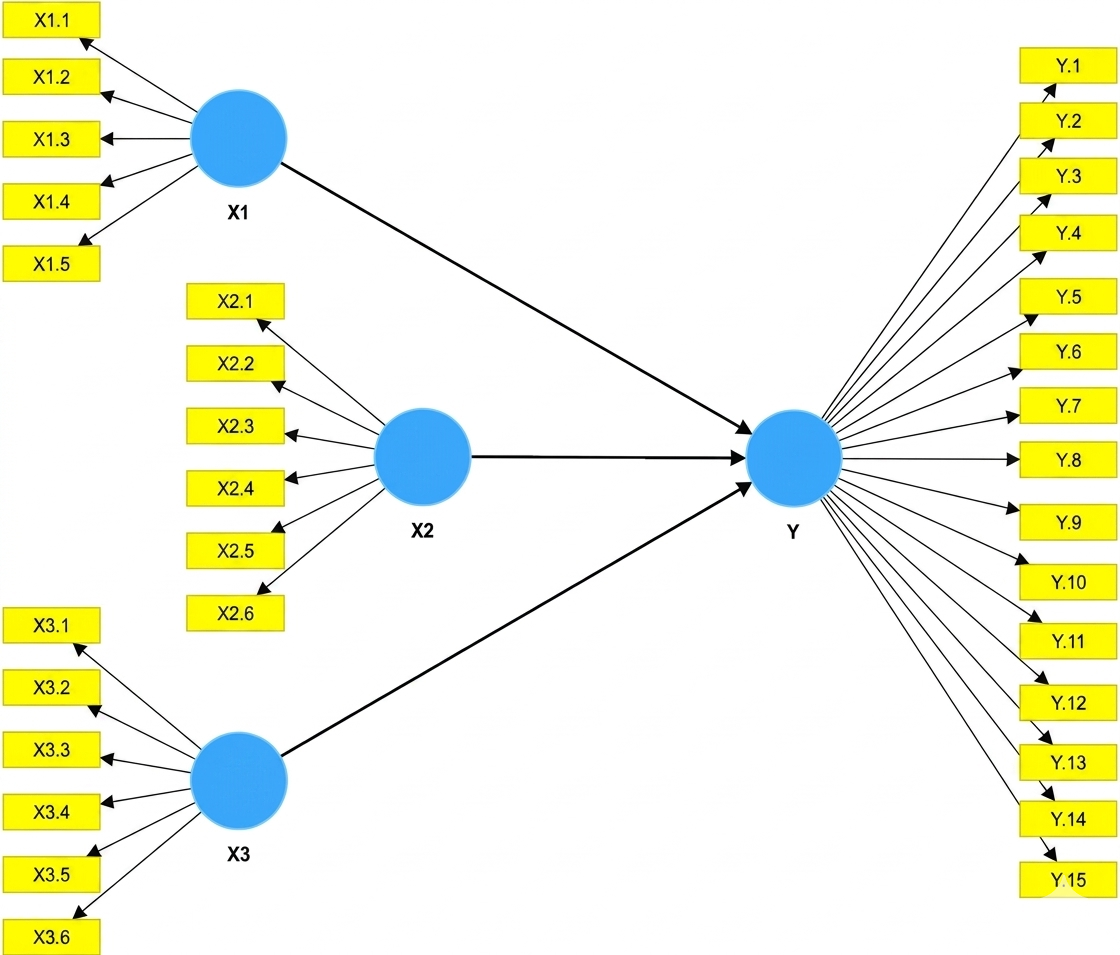
The results of hypothesis testing are presented in Table 2. Sustainable tourism (X1) has a positive and statistically significant effect on SDG 11 achievement, indicating that sustainability-oriented tourism practices contribute to sustainable urban development outcomes. This finding is consistent with previous studies emphasizing the role of integrated tourism planning in supporting sustainability goals.
In contrast, community participation (X2) shows a positive but statistically insignificant effect. Meanwhile, non-state actor participation (X3) demonstrates a strong positive and statistically significant effect, indicating its dominant influence within the model.
| Hipotesis | Original sample (O) | Sample mean (M) | Standard deviation (STDEV) | T statistics (|O/STDEV|) | P values |
|---|---|---|---|---|---|
| Sustainable Tourism (X1) > Achieving SDG Goal 11 (Y) | 0.264 | 0.233 | 0.123 | 2.152 | 0.031 |
| Community Participation (X2) > SDG Achievement Goal 11 (Y) | 0.061 | 0.129 | 0.221 | 0.276 | 0.782 |
| Non-State Actor Participation (X3) > Achievement of SDGs Goal 11 (Y) | 0.655 | 0.62 | 0.197 | 3.318 | 0.001 |
The explanatory power of the model is presented in Table 3 through the coefficient of determination (R²), which indicates how well the independent variables explain SDG 11 achievement.
| Variabel | R-square | R-square adjusted |
|---|---|---|
| Y | 0.885 | 0.878 |
Although the R² value indicates strong explanatory power, this result should be interpreted with caution considering the small sample size and the study’s localized context. The high value may partly reflect characteristics of the specific respondent group rather than a stable predictive pattern. As a result, the model should be viewed as context-bound and primarily exploratory in nature.
Discussion
The results indicate that sustainable tourism and non-state actor participation have a significant effect on SDG 11 achievement, while community participation does not reach statistical significance.
Sustainable tourism contributes positively through environmental management, cultural preservation, and the integration of economic activities within the tourism sector, all of which support broader urban sustainability outcomes. This is consistent with studies in the Lake Toba context that highlight how sustainable tourism performance depends on balancing ecological protection with local cultural values (16, 17).
Among the variables, non-state actor participation shows the most pronounced effect in the model. This pattern, however, is closely tied to the study context and the limited sample composition, so it should not be interpreted as a universal hierarchy of influence. In this setting, private sector actors and NGOs are more directly engaged in tourism development activities than local communities, which naturally shapes the observed results. This aligns with literature on collaborative governance in tourism (18, 19), while also suggesting that non-state actors often take a more operational role in early-stage tourism development compared to community groups.
The stronger influence of non-state actors may also be linked to differences in resources and capacity. Private entities generally possess better access to funding, networks, and implementation capabilities, which enables them to contribute more quickly to sustainability initiatives. Still, this should be understood as a contextual outcome rather than a general rule, since it reflects how stakeholder roles are structured in the studied area.
On the other hand, community participation does not show a significant relationship with SDG 11 achievement. Rather than treating this purely as a statistical outcome, it is important to consider the nature of participation in practice. In Parapat City, community involvement tends to remain at a consultative level, with limited influence over decision-making and implementation processes. Prior research suggests that community participation becomes impactful only when it is supported by institutional mechanisms and capacity-building that enable meaningful engagement (20).
This limited effect may also reflect a gap between formal participation frameworks and actual empowerment. Although communities are included in planning activities, their role in shaping outcomes remains constrained. Such a condition reflects broader findings in tourism governance studies, where participation is often formalized but not fully translated into substantive influence.
Overall, the model demonstrates strong explanatory capability. However, given the small sample size (n = 20) and the localized nature of the study, the results should be viewed as exploratory rather than broadly generalizable. The relatively high R² value (0.885) may also be influenced by the specific characteristics of the respondent group, rather than indicating stable predictive strength across wider populations.
Conclusion
This study shows that sustainable tourism and non-state actor participation play a significant role in supporting the achievement of SDG 11, with non-state actors demonstrating the strongest influence. In contrast, community participation does not show a significant effect, suggesting that its current implementation has not yet translated into measurable contributions within the model.
The results point to differences in how each stakeholder group contributes to tourism governance, largely shaped by their capacity, access to resources, and level of involvement in decision-making processes. In this context, community participation appears to remain limited to formal engagement rather than substantive influence.
For policy and practice in the Lake Toba region, these findings suggest the need to strengthen collaborative governance by improving coordination among government, private sector actors, NGOs, and local communities. Particular attention should be given to enhancing the quality of community involvement so that participation extends beyond consultation toward more active roles in planning and implementation.
The study is limited by its small sample size and focus on a single tourism area, which means the findings should be interpreted as exploratory. Future research could broaden the scope to other destinations and apply mixed or longitudinal approaches to better capture stakeholder dynamics in sustainable tourism development.
Overall, the study underscores that progress toward SDG 11 in tourism contexts depends not only on sustainability initiatives, but also on how effectively different stakeholders are integrated within governance structures.Declarations
Conflict of Interest
The author(s) declare no conflict of interest.
Data Availability
The datasets generated and/or analyzed during the current study are available in the published article.
Ethics Statement
Not applicable.
Funding Information
This work received no external funding.
References
- Baloch QB, Shah SN, Iqbal N, Sheeraz M, Asadullah M, Mahar S, et al. Impact of tourism development upon environmental sustainability: a suggested framework for sustainable ecotourism. Environmental Science and Pollution Research. 2023 Jan 19;30(3):5917–30.
- Boluk KA, Rasoolimanesh SM. Introduction to the special issue on “Deepening our understandings of the roles and responsibilities of the tourism industry towards the United Nations Sustainable Development Goals (SDGs).” Tour Manag Perspect. 2022 Jan;41:100944.
- Hariyanto H, Susanto E, Aji B, Goeltom ADL, Widyastuti SU. Strategic Roadmap for AI-Driven Sustainable Tourism Development in Indonesia: An Expert-Based MCDM Approach. Jurnal Kepariwisataan Indonesia: Jurnal Penelitian dan Pengembangan Kepariwisataan Indonesia. 2025 Jun 30;19(1):1–14.
- Prihadi DJ, Dhahiyat AP, Kristiadhi F, Pamungkas W. Sustainable Tourism in 2024: The Role of Tourists and Industry in Preserving Marine Nature. MSJ : Majority Science Journal. 2024 Nov 27;2(4):112–8.
- Risfandini A. Sustainable Tourism Implementation In Indonesia: Emphasizing Green Tourism, Community-Based Tourism, and Local Empowerment. Barista : Jurnal Kajian Bahasa dan Pariwisata. 2024 Jun 7;11(01):58–67.
- Fadli Moh, Susilo E, Puspitawati D, Ridjal AM, Maharani DP, Liemanto A. Sustainable Tourism as a Development Strategy in Indonesia. Journal of Indonesian Tourism and Development Studies. 2022 May 31;10(1):23–33.
- RAFEE A, Ramadhani R. Advancing Sustainable Tourism: A Study on Eco-Tourism Policies in Indonesia and Brunei Darussalam. ASEAN Journal on Hospitality and Tourism. 2024 Aug 31;22(2):118–40.
- Sharpley R. Tourism, sustainable development and the theoretical divide: 20 years on. Journal of Sustainable Tourism. 2020 Nov 1;28(11):1932–46.
- Rezk H, Olabi AG, Abdelkareem MA, Alami AH, Sayed ET. Optimal Parameter Determination of Membrane Bioreactor to Boost Biohydrogen Production-Based Integration of ANFIS Modeling and Honey Badger Algorithm. Sustainability. 2023 Jan 13;15(2):1589.
- Burns AC., Veeck Ann. Marketing research. Pearson Education; 2020.
- Hair J, Alamer A. Partial Least Squares Structural Equation Modeling (PLS-SEM) in second language and education research: Guidelines using an applied example. Research Methods in Applied Linguistics. 2022 Dec;1(3):100027.
- Purwanto A, Sudargini Y. Partial Least Squares Structural Squation Modeling (PLS-SEM) Analysis for Social and Management Research : A Literature Review. Journal of Industrial Engineering & Management Research. 2021;2(4).
- Ali Memon M, Ting H, Cheah JH, Thurasamy R, Chuah F, Huei Cham T. Journal of Applied Structural Equation Modeling SAMPLE SIZE FOR SURVEY RESEARCH: REVIEW AND RECOMMENDATIONS. Vol. 4, Journal of Applied Structural Equation Modeling. 2020.
- Wagner R, Grimm MS. Empirical Validation of the 10-Times Rule for SEM. In 2023. p. 3–7.
- Ghozali Imam. Aplikasi analisis multivariate dengan program SPSS. Badan Penerbit Universitas Diponegoro; 2006. 315 p.
- Lumbanbatu HA. The Batak Toba Tribe’s Cultural Capital in the Context of Protecting Natural Resources from Environmental Threats. Journal of Socio-Cultural Sustainability and Resilience. 2025 Jan 31;2(2).
- Sinulingga S, Marpaung JL, Sibarani HS, Amalia A, Kumalasari F. Sustainable Tourism Development in Lake Toba: A Comprehensive Analysis of Economic, Environmental, and Cultural Impacts. International Journal of Sustainable Development and Planning. 2024 Aug 29;19(8):2907–17.
- Basyar MR, Mardiyanta A, Setijaningrum E. Multi-Stakeholder Analysis in Building Tourism Resilience: Collaborative Governance Implementation in the Majapahit House Heritage Area, Indonesia. Tourism and Hospitality. 2025 Jan 4;6(1):5.
- Rochmatin L, Slamet Muchsin, Sunariyanto. Colllaborative Governance dalam Tata Kelola Pariwisata Berkelanjutan di Desa Wisata Kertosari. Kebijakan : Jurnal Ilmu Administrasi. 2025 Jun 30;16(02):74–89.
- Rahaju T, Megawati S, Prabawati I, Suprapto FA, Muzaqi AH, Ardiyansyah A. Role of Local Tourism Governance Policies in Achieving Sustainable Tourism Development: A PLS-SEM Modeling Study. International Review of Management and Marketing. 2026 Feb 1;16(2):455–67.