RESEARCH ARTICLE
Tadika and Cultural Resilence in Marginalized Malay-Muslim Communities in Southern Thailand
Unity Lens|Vol. 2, Issue 1, pp. 13-19 (2026)
CC BY 4.0-2026 Authors
Views
Downloads
Shares

Received
Apr 15, 2026Revised
Jun 14, 2026Accepted
Jun 28, 2026Published
Jun 30, 2026
Abstract
Marginalization and assimilation policies in Southern Thailand have weakened the transmission of Islamic knowledge and Malay-Muslim identity, creating an urgent need for culturally responsive educational alternatives. This study analyzes the role of Tadika Nadwatul Islammiah Dala—a community-based Islamic kindergarten in Pattani, Southern Thailand—in sustaining religious values, cultural identity, and social cohesion within marginalized Malay-Muslim communities. We employed a qualitative case study design incorporating targeted ethnographic techniques, involving 28 participants (10 students, 6 teachers, 8 parents, and 4 community leaders) selected through purposive sampling. Data were collected over a three-week period (1-20 August 2024) through participant observation (4-6 hours daily), in-depth interviews (45-90 minutes), and document analysis, and analyzed using the Miles and Huberman interactive model. The findings reveal that Tadika plays a multidimensional role as a center for religious education, cultural transmission, identity preservation, and community support. It significantly improves children’s religious literacy, strengthens social solidarity, and provides an affordable educational alternative for low-income families. However, Tadika faces persistent challenges, including limited government support, inadequate facilities, and socio-political pressures affecting Muslim minorities. Despite these constraints, Tadika remains a resilient and strategic institution in preserving Islamic values and Malay cultural identity. In conclusion, Tadika serves not only as an educational space but also as a critical mechanism for cultural resilience and identity formation in marginalized Muslim communities.
Keywords:
Introduction
The sociocultural and sociopolitical landscape of Southern Thailand reflects a persistent tension between state-led national identity formation and the preservation of minority religious traditions (1). While Thailand is constitutionally pluralistic, its institutional structure remains heavily influenced by Theravāda Buddhism, which informs the state’s approach to national cohesion (2). Within this context, the Malay-Muslim communities in provinces such as Pattani, Yala, and Narathiwat—historically linked to the Sultanate of Pattani—represent a distinct minority whose linguistic and cultural identities have often stood in friction with centralist policies (3, 4). Decades of assimilationist strategies, particularly those aimed at educational standardization, have marginalized the Malay language and Jawi script, leading to what many scholars describe as an erosion of the intergenerational transmission of Islamic knowledge and a subsequent fragmentation of identity among younger generations (5, 6).
However, much of the existing scholarship on this region remains predominantly descriptive, focusing on the historical grievances of the Malay-Muslim minority or the pedagogical deficiencies of religious schools under state pressure (7–9). While prior studies have acknowledged the existence of Taman Didikan Kanak-kanak (Tadika) as community-based initiatives, they often treat these institutions as peripheral actors in the broader educational landscape (10). Consequently, there is a significant scholarly gap in theorizing Tadika not merely as a site of basic religious instruction, but as a sophisticated manifestation of socio-cultural agency and institutional resilience. There is a need to move beyond "deficit-based" narratives to understand how these grassroots spaces actively navigate structural constraints to sustain cultural continuity.
This study addresses this gap by critically analyzing the role of Tadika as a culturally embedded mechanism for sustaining religious values and Malay-Muslim identity amidst systemic marginalization. Moving beyond isolated analyses of Islamic education, this research adopts an integrative perspective that positions Tadika as a form of social agency operating within—and in response to—the limitations of the national education system (11). To ground this investigation empirically, we examine a specific, representative case: Tadika Nadwatul Islammiah Dala in Pattani province. By employing a qualitative design involving field observations and in-depth interviews, this study explores how institutional practices and community-led adaptive strategies foster cultural resilience. In doing so, this research contributes to the international discourse on minority education by offering a nuanced framework for understanding how non-formal educational spaces can serve as vital "counter-spaces" for identity preservation in centralized states.
Methodology
Study Design and Rationale
This study adopted a qualitative case study design employing ethnographic techniques to examine how Taman Didikan Kanak-Kanak (Tadika) sustains religious values and Malay-Muslim identity within marginalized communities in Southern Thailand (12, 13). Given the intensive three-week fieldwork (1–20 August 2024), this design serves as a compressed, rapid qualitative assessment rather than a traditional, prolonged ethnography. To ensure robust data saturation, the primary researcher conducted high-density daily participant observations (4–6 hours) alongside tri-generational stakeholder interviews. This approach provides an in-depth, contextualized understanding of Tadika as a culturally embedded institution within the complex, historically marginalized sociopolitical environment of Pattani province (14).
Study Population and Sampling
The study population consisted of individuals directly involved in or affected by Tadika education within marginalized Malay-Muslim communities. We purposively selected Tadika Nadwatul Islammiah Dala based on three distinct institutional criteria: (1) its long-standing operational history of over two decades independent of state educational management; (2) its geographic position within a highly marginalized socio-economic enclave experiencing acute assimilation pressures; and (3) its robust community relationships, which granted the primary researcher immediate, unrestricted access for high-density daily fieldwork.
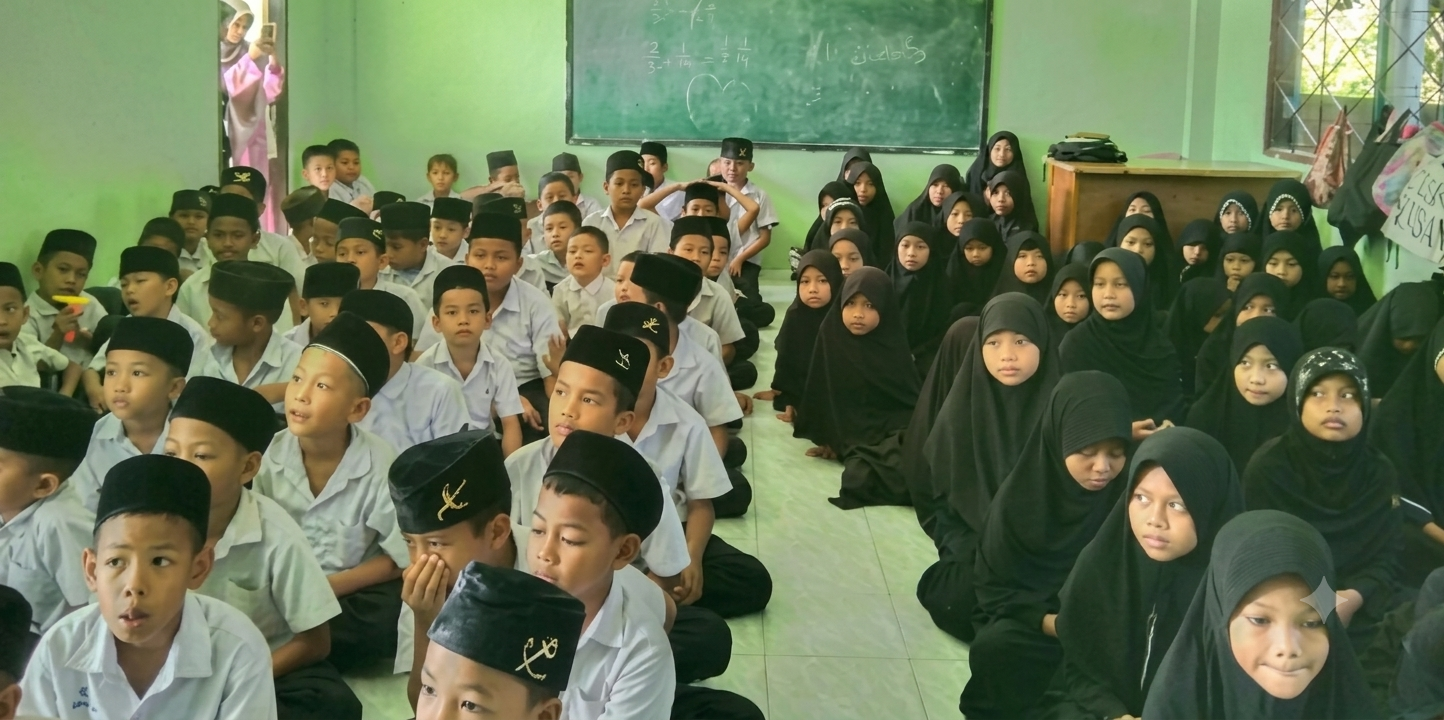
A purposive sampling strategy was used to select information-rich participants aligned with the research objectives, requiring a minimum of one year of active engagement with Tadika activities (15). The final sample comprised 28 participants, consisting of 10 students aged 6 to 12 years, 6 teachers and staff, 8 parents or guardians, and 4 community and religious leaders. Students joined the event can be seen in Figure 1. This multi-stakeholder composition ensured comprehensive data triangulation across distinct community perspectives.
Data Collection Methods
Data were gathered through three integrated qualitative methods: participant observation, semi-structured in-depth interviews, and document analysis. Participant observation involved direct engagement in daily Tadika activities—focusing on instructional practices, language use, religious teaching, and social interactions—which were recorded using structured field notes (16). Semi-structured in-depth interviews were conducted with all participants using an objective-derived guide to explore perceptions of Tadika’s role, experiences of marginalization, and challenges in identity preservation. These interviews were audio-recorded with consent, conducted in Malay or Thai, and subsequently transcribed and translated into English. Finally, document analysis was undertaken to review relevant materials, including curricula, teaching resources, community records, and educational policy documents, to provide contextual support and enable cross-validation of findings.
Instruments and Research Procedures
The primary researcher served as the main instrument of data collection. To ensure rigor, preparatory steps included developing and pilot-testing interview protocols, identifying key informants, and preparing recording tools. Field procedures involved systematic scheduling of observations and interviews, daily documentation of field notes, and ongoing reflexive journaling to minimize researcher bias. Data collection and preliminary analysis were conducted iteratively, allowing emerging insights to inform subsequent fieldwork and deepen the exploration of developing issues (17).
Data Analysis
Data were analyzed manually using the interactive model proposed by Miles and Huberman, which dictates that data analysis be conducted simultaneously with data collection to refine interview questions, address data gaps, and minimize preconception bias (18, 19). This iterative process involved continuous review of data from observations, interviews, and documentation to capture participants’ perspectives within their natural context. To ensure strict coding reliability and systematic rigor during manual analysis without qualitative software, a three-step protocol was implemented. First, the primary researcher and an external qualitative peer independently open-coded an initial subset of interview transcripts. Second, code definitions were harmonized to reconcile discrepancies and establish a unified coding frame. Third, the primary researcher coded the remaining data using this verified template, continuously cross-validating the emerging codes against observational field notes and participant member-checking to anchor thematic consistency.
Results and Discussion
This study demonstrates that Tadika Nadwatul Islamiah Dala Pattani, Thailand plays a multidimensional role in sustaining religious identity, cultural continuity, and social cohesion among Muslim marginal communities, despite structural, institutional, and socio-political constraints (see Figure 2).
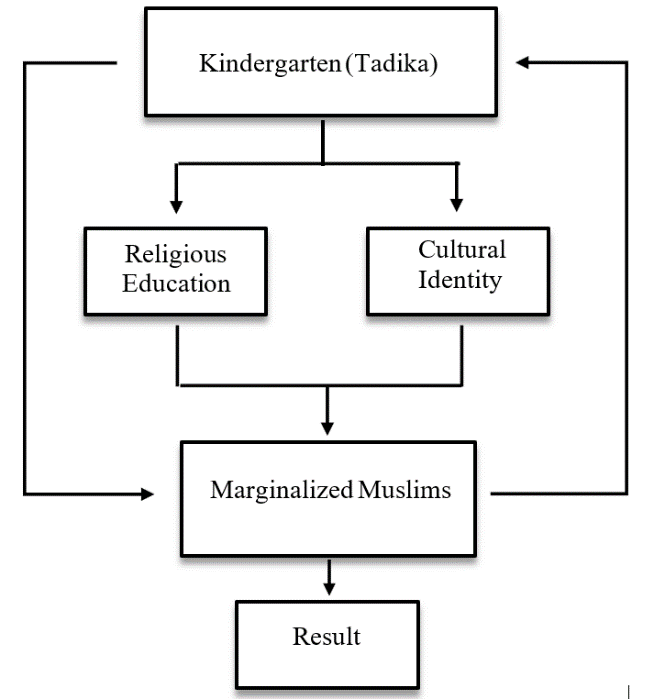
Role of Tadika in Muslim Marginal Communities
Religious Education
Tadika serves as a central institution for early Islamic education, delivering instruction in Qur’anic recitation, fiqh, akhlaq, and Islamic history. The pedagogical approach is developmentally appropriate, emphasizing moral formation alongside ritual practice. As explained by Yahya ben Ahmad:
“Pendidikan keagamaan di Tadika bertujuan membentuk nilai moral seperti kasih sayang, kejujuran, tanggung jawab, dan rasa hormat, selain mengajarkan ritual agama, melalui kegiatan yang sesuai usia anak. ” [Religious education at Tadika aims to cultivate moral values such as compassion, honesty, responsibility, and respect, in addition to teaching religious rituals, through age-appropriate activities] (Yahya ben Ahmad)
Religious teaching is integrated with general learning and supported by parental involvement, ensuring balanced cognitive, social, and spiritual development.
Socialization of Local Cultural Values
Findings indicate that Tadika actively integrates Islamic teachings with local Malay-Pattani cultural values. Cultural transmission occurs through language use, customs, traditional attire, and symbolic representations.
As stated by Yahya ben Ahmad:
“Proses ini tidak hanya penting untuk pemahaman budaya, tetapi juga untuk membentuk identitas dan rasa kebanggaan terhadap warisan budaya mereka. Di tingkat taman didik kanak-kanak, nilai-nilai budaya lokal diajarkan dengan cara yang mudah dipahami dan menarik bagi anak-anak, melalui berbagai kegiatan yang mencerminkan kebudayaan. ” [This process is vital not only for cultural understanding but also for shaping identity and fostering a sense of pride in their cultural heritage. At the kindergarten level, local cultural values are taught in an accessible and engaging manner through various activities that reflect their culture. ] (Yahya ben Ahmad)
These practices embed cultural identity within religious education and daily behavior.
Strengthening Community Identity
Tadika plays a crucial role in preserving Islamic identity amid assimilation pressures and state policies favoring Thai-Buddhist culture (4). It functions as a space for maintaining religious values, language, and traditions. By protecting independent linguistic and religious transmission, Tadika acts as a primary locus of assimilation resistance, directly expanding the counter-space frameworks established in the wider minority education literature (1, 6). While conventional research often labels peripheral religious schools as pedagogically or structurally deficient (7, 9), our findings challenge this deficit narrative by demonstrating that Tadika generates autonomous cultural capital that effectively counterbalances centralized state hegemony (11).
A community youth leader explained:
“Tadika dianggap sebagai tempat utama untuk mengenalkan nilai-nilai Islam kepada generasi muda. Hal ini mencakup pengajaran Al-Qur’an, hadits, doa, dan adab sehari-hari sesuai ajaran Islam. Selain itu, Tadika menjadi wadah untuk melestarikan bahasa Melayu sebagai bahasa ibu, yang juga merupakan bagian dari identitas kultural komunitas Muslim Pattani Thailand. ” [Tadika is regarded as a primary institution for introducing Islamic values to the younger generation. This encompasses the instruction of the Qur'an, Hadith, supplications, and daily Islamic etiquette (adab). Furthermore, Tadika serves as a vital platform for preserving the Malay language as a mother tongue, which constitutes an integral component of the cultural identity of the Pattani Muslim community in Southern Thailand. ] (Muslim Community Youth Leader in Pattani, Thailand)
Additionally, teachers emphasized the importance of collective activities:
“Identitas komunitas ini dikuatkan melalui berbagai kegiatan bersama yang melibatkan seluruh warga tadika. Misalnya, acara perayaan budaya, gotong royong, bersatu padu atau kegiatan rutin seperti senam pagi, di mana semua orang merasa menjadi bagian dari satu keluarga besar. ” [This communal identity is further fortified through collaborative activities that engage the entire Tadika community. Examples include cultural celebrations, gotong royong (mutual assistance), unity-building initiatives, and routine activities like morning exercises, all of which cultivate a profound sense of belonging to a single extended family. ] (Teacher at Tadika Nadwatul Islammiah Dala Pattani Thailand)
Social and Community Services
Tadika also functions as a community support center, addressing social and economic challenges in marginalized Muslim populations.
Bung Aladi, a community leader, stated:
“Tadika ini berfungsi sebagai wadah untuk mengajarkan anak-anak tentang Islam dan identitas Melayu, meskipun mereka harus berhadapan dengan kebijakan yang mengarah pada pengurangan identitas budaya tersebut. ” [Tadika functions as a vital platform for educating children about Islam and Malay identity, even as they confront state policies aimed at eroding this cultural heritage. ] (Muslim Community Youth Leader in Pattani, Thailand)
He further added:
“Rumah Nusantara adalah yayasan bagi masyarakat Muslim Pattani yang menghadapi berbagai tantangan, seperti kemiskinan, keterbatasan pendidikan, dan akses yang minim terhadap layanan sosial. Di Rumah Nusantara kami berupaya memberikan pendidikan dan layanan sosial yang layak bagi anak-anak. Melalui Tadika membantu mereka mendapatkan pendidikan yang memadai. ” [Rumah Nusantara is a foundation dedicated to supporting the Pattani Muslim community, who confront multifaceted challenges such as poverty, educational barriers, and minimal access to social services. The foundation strives to provide children with proper education and essential social services, utilizing Tadika as a critical vehicle to help them secure an adequate education. ] (Mr. Aladi, Chairman of the Pattani Archipelago House, Thailand)
Challenges Faced by Tadika
Limited Government Support
Tadika faces significant institutional neglect, particularly when compared to state-supported Buddhist institutions.
As noted by a community figure:
“Agama Buddha di Thailand mendapat dukungan lebih besar dari pemerintah dibandingkan Islam, terlihat dari alokasi anggaran, kebijakan, dan fasilitas keagamaan. Pembangunan kuil Buddha didukung pemerintah, sementara masjid di wilayah Muslim seperti Pattani sering bergantung pada swadaya masyarakat. ” [Buddhism in Thailand enjoys significantly greater state support than Islam, as evidenced by disparities in budget allocation, policy frameworks, and religious infrastructure. While the construction of Buddhist temples is heavily subsidized by the government, mosques in Muslim-majority regions like Pattani frequently rely on community self-funding and grassroots initiatives. ] (Youth Leader in Pattani, Thailand)
Inadequate Facilities
Observations confirm severe infrastructural limitations affecting learning conditions.
Marina benti Ahmad explained:
“Tadika adalah lembaga penting dalam pendidikan keagamaan anak Muslim, tetapi sering menghadapi tantangan fasilitas yang minim, seperti ruang kelas, perpustakaan, dan sarana pendukung lainnya. Masalah ini diperparah oleh minimnya dukungan dana dari pemerintah dan donatur lokal, sehingga sulit melakukan perbaikan atau pengembangan. ” [Tadika serves as a vital institution for the religious education of Muslim children, yet it frequently confronts challenges stemming from inadequate facilities, including limited classrooms, libraries, and supporting infrastructure. This issue is further exacerbated by a lack of financial support from both the government and local donors, thereby hindering efforts to undertake necessary renovations or institutional development. ] (Secretary General Tadika Pattani Thailand)
Similarly, the head of Tadika stated:
“Tadika Nadwatul Islammiah tetap menjadi pilar tradisi Islam dan budaya lokal masyarakat Muslim Pattani meskipun menghadapi kesulitan. Para pengajar berdedikasi meski bergaji minim, dengan harapan dukungan lebih dari pemerintah, NGO, dan komunitas internasional untuk meningkatkan fasilitas dan kualitas pendidikan. ” [Despite encountering ongoing adversities, Tadika Nadwatul Islammiah remains a cornerstone of Islamic tradition and local culture for the Pattani Muslim community. Its educators exhibit profound dedication despite receiving minimal compensation, holding onto the hope for expanded support from the government, non-governmental organizations (NGOs), and the international community to enhance both institutional facilities and the overall quality of education. ] (Mudir Tadika Pattani Thailand)
Students also highlighted these limitations:
“Keterbatasan fasilitas menunjukkan berbagai perspektif menarik murid sering merasa kesulitan ketika ingin bermain atau belajar dengan alat-alat yang seharusnya mendukung kegiatan mereka. Banyak dari mereka mengeluhkan kurangnya mainan edukatif, buku bergambar, dan alat tulis yang memadai. ” [The limitations in facilities highlight several nuanced perspectives; students frequently face difficulties when attempting to play or learn with materials intended to support their development. Many of them express frustration over the shortage of educational toys, illustrated books, and adequate stationery. ] (Student of Tadika Nadwatul Islamiah in Pattani)
Field observations further confirm that, despite these infrastructural limitations, Tadika Nadwatul Islammiah remains a fundamental institution in sustaining religious values and Muslim identity among marginalized communities in Pattani. The local community's active navigation of these material constraints demonstrates a powerful manifestation of socio-cultural agency. Rather than yielding to state-enforced structural marginalization, grassroots actors mobilize local solidarity and undercompensated labor to maintain the school. Within the theoretical framework of minority education, this continuous spatial preservation transforms Tadika into an active 'counter-space' where marginalized communities operationally resist assimilationist state policies and reclaim educational self-determination.
Socio-Political Pressure
Muslim communities face systemic discrimination and marginalization.
A local resident stated:
“Wilayah Thailand Selatan yang mayoritas penduduknya beragama Islam, masyarakat Muslim sering kali menghadapi perlakuan diskriminatif dalam berbagai aspek kehidupan, termasuk akses terhadap pendidikan, lapangan kerja, dan sistem peradilan. ” [In Southern Thailand, a predominantly Muslim region, the Muslim population frequently faces discriminatory treatment across various facets of life, including access to education, employment, and the judicial system. ] Tanyong village community, Pattani, Thailand)
Positive Impacts of Tadika
Improvement in Religious Literacy
Tadika significantly enhances children’s understanding and practice of Islam.
A student reported:
“Pembelajaran di Tadika Nadwatul Islammiah memberikan banyak manfaat positif. Peserta didik diajarkan pemahaman yang lebih mendalam tentang Islam, termasuk tata cara salat yang benar, membaca Al-Qur’an, serta doa-doa yang digunakan dalam kehidupan sehari-hari. Meskipun terdapat kesulitan pada awal proses belajar, para pendidik dengan sabar membimbing peserta didik. ” [Education at Tadika Nadwatul Islammiah yields significant positive benefits. Students develop a deeper understanding of Islam, encompassing the correct performance of rituals (salat), Qur'anic recitation, and essential daily supplications. Although the initial learning process presents certain difficulties, the educators patiently guide the students through their development. ] (Student of Tadika Nadwatul Islamiah in Pattani)
Strengthening Social Solidarity
Tadika fosters cooperation, empathy, and collective identity.
An imam stated:
“Tadika memiliki dampak positif yang signifikan dalam penguatan solidaritas sosial. Tadika tidak hanya berfungsi sebagai lembaga pendidikan tetapi juga sebagai pusat pembentukan karakter dan nilai-nilai sosial. ” [Tadika exerts a significant positive impact on reinforcing social solidarity. It functions not only as an educational institution but also as a vital locus for character formation and the cultivation of social values. ] (Village Ustadz in Pattani Thailand)
Students added:
“Anak-anak yang berpartisipasi di Tadika merasa bahwa mereka lebih mampu berinteraksi dan bekerja sama dengan teman-teman sebaya dari latar belakang yang berbeda. ” [Children participating in Tadika report an enhanced ability to interact and collaborate with peers from diverse backgrounds. ] (Student of Tadika Nadwatul Islamiah in Pattani)
A youth leader emphasized:
“Tadika membuka peluang bagi anak-anak dari berbagai latar belakang untuk belajar bersama, mengurangi sekat sosial, dan memperkuat solidaritas melalui nilai kebersamaan. ” [Tadika provides opportunities for children from diverse backgrounds to learn together, thereby diminishing social barriers and strengthening solidarity through shared communal values. ] (Youth Figure from Pattani, Thailand)
Parents also confirmed:
“Tadika tidak hanya sebagai institusi pendidikan anak usia dini, tetapi juga sebagai wadah interaksi sosial yang mempererat hubungan antar individu. ” [Tadika functions not merely as an early childhood education institution, but also as a vital platform for social interaction that fosters stronger interpersonal bonds. ] (Parent of student at Tadika in Pattani, Thailand)
Affordable Educational Alternative
Tadika provides accessible education for economically disadvantaged families.
A parent stated:
“Biaya pendidikannya murah, jadi tidak memberatkan keluarga kami. Banyak anak-anak sekarang sudah bisa membaca huruf Arab dan hafal beberapa doa harian. Selain itu, anak-anak menjadi lebih sopan dan rajin beribadah setelah belajar di Tadika. ” [The educational cost is affordable, so it does not burden our family. Many children can now read Arabic script and have memorized several daily supplications. Furthermore, the children have become more polite and diligent in their worship after studying at Tadika. ] (Parents of students at Tadika Nadwatul Islamiah in Pattani, Thailand)
Field observations further indicate that parents generally hold positive perceptions of Tadika as an affordable educational alternative. They emphasize that Tadika makes a significant contribution to their children’s development, not only in basic academic skills but also in moral and religious values. The relatively low cost enables families with limited financial resources to access quality foundational education without experiencing economic burden, thereby reinforcing Tadika’s role as an inclusive and community-supported institution.
Conclusion
Tadika functions as a vital non-formal Islamic educational institution that strengthens religious understanding, moral values, and community solidarity through Qur’anic teachings and religious activities. It plays a strategic role in preserving Malay-Islamic traditions while fostering a resilient sense of identity among marginalized Muslim communities in Southern Thailand. Amid globalization and external socio-cultural pressures, Tadika serves as a protective space that sustains local values and religious continuity, effectively integrating grassroots education with cultural preservation.
By operating independently of the central state apparatus, this grassroots model enriches the international discourse on minority education. It provides compelling empirical evidence of how localized 'counter-spaces' can mitigate the systemic pressures of linguistic and cultural assimilation. Ultimately, this case demonstrates that for global subaltern and minority populations facing centralized state integration, non-formal, community-led educational infrastructure serves as a vital, strategic mechanism for autonomous identity formation and cultural resilience.
From a global educational policy perspective, these findings indicate that international development actors and policymakers should move beyond state-centric educational models when supporting marginalized populations. Instead, stakeholders should practically invest in and validate local, non-formal grassroots infrastructure. This structural recognition offers a sustainable blueprint for minority populations worldwide trying to maintain dual-identity fluency—balancing necessary civic integration with the preservation of subaltern heritage under centralized regimes.
Declarations
Conflict of Interest
The authors declare no conflict of interest.
Data Availability
Data supporting the findings of this study are available from the corresponding author upon reasonable request.
Ethics Statement
Not applicable.
Funding Information
This work received no external funding.
References
- Gumilar S, Rahman MT, Truna DS, Waehama MR. Unveiling unity: how Thailand’s Muslim minorities weave a multicultural society. Cogent Arts & Humanities. 2025;12(1). doi: https://doi.org/10.1080/23311983.2025.2579170
- Larsson T. Religion, political parties, and Thailand’s 2019 election: Cosmopolitan royalism and its rivals. Mod. Asian Stud. 2022;57(2):582-612. doi: https://doi.org/10.1017/s0026749x22000038
- Irfan F, Suryanti, Selvia Santi. Islamisasi di thailand: dinamika sejarah pendidikan islam abad 13 m-21 m. history. 2025;8(2):170-179. doi: https://doi.org/10.33772/essxdd44
- Yako K, Dahlan D. Kontribusi persatuan mahasiswa islam patani (selatan thailand) di indonesia (pmipti) wilayah sumatera barat tahun 2017-2022 dalam penyelesaian konflik di patani thailand selatan. Pi. 2022;1(2). doi: https://doi.org/10.31958/pi.v1i2.8099
- Jehwae P, Manyunu M. Problems of Malay Language Education in Patani Southern Thailand. Proceedings of the Proceedings of The 1st EAI Bukittinggi International Conference on Education, BICED 2019, 17-18 October, 2019, Bukititinggi, West Sumatera, Indonesia. 2019. doi: https://doi.org/10.4108/eai.17-10-2019.2289738
- Abdi Ardiansyah Sihotang, Nurmawati. Relevansi pemikiran k.h.a.wahid hasyim dengan pendidikan agama islam di era kontemporer. pendas. j. ilm. pendidik. dasar. 2026;11(01):216-238. doi: https://doi.org/10.23969/jp.v11i01.41967
- Paramitha DI. Peran Pemerintah Dalam Perdamaian Dan Manajemen Konflik : Studi Kasus Konflik Thailand Selatan. Journal of Interntional Relations (JoS) . 2022;1(2022):22–7.
- Situmeang A, Rusdiana S, Trinh H, Agustianto A, Tan W. Blasphemy Laws and Their Implications for Religious Freedom and Expression: A Tri-Country Southeast Asian Perspective. Jurnal Hukum. 2024;40(1):156. doi: https://doi.org/10.26532/jh.v40i1.36893
- Astri Azani, Mislaini Mislaini, Sus Rahma Yuni, Sahronia Rambe. Sistem Pendidikan di Thailand. Karakter. 2024;2(1):243-259. doi: https://doi.org/10.61132/karakter.v2i1.424
- Jory P. Islam, Education and Reform in Southern Thailand: Tradition and Transformation. The Asia Pacific Journal of Anthropology. 2013;14(3):284-286. doi: https://doi.org/10.1080/14442213.2013.787908
- Ulath S, Zulkifli Z. Analysis of the Government of Thailand's Policy Against Malay Islamic Minorities in Southern Thailand: A Review of Liliweri's Discrimination Theory. Juspi. 2024;7(2):100. doi: https://doi.org/10.30829/juspi.v7i2.16671
- Rusandi, Muhammad Rusli. Merancang Penelitian Kualitatif Dasar/Deskriptif dan Studi Kasus. Aujpsi. 2021;2(1):48-60. doi: https://doi.org/10.55623/au.v2i1.18
- Sari MP, Wijaya AK, Hidayatullah B, Sirodj RA, Afgani MW. Penggunaan Metode Etnografi dalam Penelitian Sosial. Jpsk. 2023;3(01):84-90. doi: https://doi.org/10.47709/jpsk.v3i01.1956
- Sharp H, Dittrich Y, de Souza CRB. The Role of Ethnographic Studies in Empirical Software Engineering. IIEEE Trans. Software Eng. 2016;42(8):786-804. doi: https://doi.org/10.1109/tse.2016.2519887
- Palinkas LA, Horwitz SM, Green CA, Wisdom JP, Duan N, Hoagwood K. Purposeful Sampling for Qualitative Data Collection and Analysis in Mixed Method Implementation Research. Adm Policy Ment Health. 2013;42(5):533-544. doi: https://doi.org/10.1007/s10488-013-0528-y
- Pribadi R, Lustyatie N, Zuriyati Z. Menyoal Penelitian Analisis Wacana Kritis di Indonesia: Meninjau Aspek Jenis Penelitian, Subjek Penelitian, dan Model Analisis. Jh. 2024;8(2):202-209. doi: https://doi.org/10.30998/jh.v8i2.3393
- Neale J. Iterative categorization (IC): a systematic technique for analysing qualitative data. Addiction. 2016;111(6):1096-1106. doi: https://doi.org/10.1111/add.13314
- Engle M. Qualitative Data Analysis: An expanded Sourcebook (2nd Ed.) Matthew B. Miles and A. Michael Huberman. Thousand Oaks, CA: Sage publications, 1994, 336 pp. The American Journal of Evaluation. 1999;20(1):159-160. doi: https://doi.org/10.1016/s1098-2140(99)80125-8
- Snowden A, Martin CR. Concurrent analysis: towards generalisable qualitative research. Journal of Clinical Nursing. 2010;20(19-20):2868-2877. doi: https://doi.org/10.1111/j.1365-2702.2010.03513.x