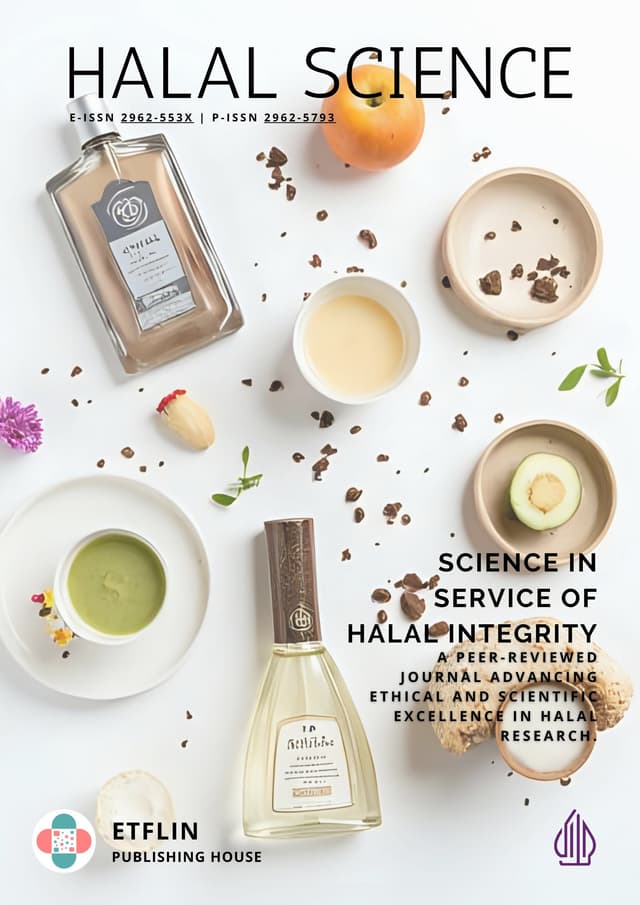
Halal Science

Editorial Board
Demography
editor-in-chief
sectional-editor
Section: Halal Food, Pharmaceuticals, and Cosmetics
Section: Halal Analytical Methods
Section: Halal Regulatory, Quality Assurance, and Management
Section: Halal Marketing and Tourism
managing-editor
Alifah Safira Aulia
ETFLIN Internal Editor, Indonesia
Journal Key Facts
Publishing Fee (APC)
No Charge
Open Access License
CC BY 4.0
Language
English
Overview
Halal Science is an international, peer-reviewed journal published by ETFLIN dedicated to advancing scientific knowledge and innovation in areas related to Halal products and practices. The journal provides a platform for researchers, industry professionals, and policymakers to share original research, reviews, and case studies that support the integrity, safety, and compliance of Halal goods and services. This journal is affiliated with Faculty of Pharmacy, Universitas Islam Sultan Agung.
Latest Articles
Recently published research articles, review papers, and technical notes from the current volume of the journal.
- research article
Halal Tourism Development Strategies in Semarang City: The Role of the Department of Culture and Tourism
Erwin Ahmadi, Abdul Choliq, Ariana Suryorini
Halal tourism development in Indonesia has strong economic potential; however, its implementation remains uneven across regions due to fragmented governance and limited stakeholder integration. This study aims to analyze halal tourism development in Semarang City by examining institutional roles, supporting and inhibiting factors, and implementation mechanisms. A qualitative descriptive approach was applied using purposive sampling, with data collected through in-depth interviews, field observations, and document analysis. The findings, derived from interviews with government officials, tourism stakeholders, and field observations of tourism services, show that halal tourism development in Semarang is supported by inter-agency collaboration, cross-sectoral coordination, and digital promotion strategies. Field evidence indicates that coordination between tourism and food-related agencies plays a key role in accelerating SME halal certification support, while tourism sites have gradually integrated Muslim-friendly services such as prayer facilities and halal food information systems. However, challenges remain, particularly related to differing perceptions of halal tourism among industry actors, uneven institutional coordination, and limited human resource capacity. These findings highlight that implementation gaps are not only structural but also shaped by stakeholder understanding and operational readiness at the local level. In addition, SME halal certification support and the strengthening of halal value chains remain important determinants of tourism performance in the city. The study contributes to halal tourism governance literature by emphasizing the role of micro-level coordination and stakeholder perception in shaping policy implementation outcomes, while practically suggesting stronger inter-agency coordination, clearer communication of halal tourism concepts, and targeted capacity-building programs for tourism actors.
Halal Science
28 Jun 20266 pages - research article
Halal Cosmetic Knowledge and Purchasing Decisions Among Indonesian Muslim Students
Eneng Chynta Zahra Syaripudin, Abdul Hakim, Ria Ramadhani Dwi Atmaja
This study evaluated the association between halal cosmetic knowledge and purchasing decisions among pharmacy students at UIN Malang. Utilizing a quantitative cross-sectional design, survey data were collected via purposive sampling from 105 respondents (following instrumentation testing, n = 35) and analyzed using descriptive statistics and simple linear regression. Descriptively, 72.38% of respondents possessed high knowledge, and 84.76% demonstrated high purchasing decision levels. Regression analysis revealed a significant positive relationship between halal cosmetic knowledge and purchasing choices (β = 0.502, p = 0.001). The model fit was robust (F = 34.697, p = 0.001) with a coefficient of determination (R2 = 0.252), proving that knowledge accounts for 25.2% of the variance in purchasing decisions. Although the non-probability sampling and cross-sectional nature limit broader geographic generalizability, the findings confirm that cognitive literacy is a vital indicator in guiding compliant product selection. In conclusion, halal cosmetic knowledge significantly influences consumer choices. These insights offer baseline evidence for regulators and industries to expand targeted educational frameworks that foster transparent, halal-conscious behavior among highly educated populations.
Halal Science
13 Jun 20267 pages - research article
The Influence of Knowledge Level, Perception, and Religiosity among Working Women in Semarang City on Halal Cosmetics Use
Sheilanita Aulia Primahana, Abdur Rosyid, Rissa Maharani Dewi, Nisa Febrinasari, Ika Buana Januarti, Farroh Bintang Sabiti
This study examined the associations of knowledge level, perception, and religiosity with halal cosmetics use among working women in Semarang City. A quantitative cross-sectional design was used, involving 111 respondents selected via snowball sampling. Data collected through a structured online questionnaire were analyzed using multiple linear regression. Results showed that knowledge (β = 0.070), perception (β = 0.077), and religiosity (β = 0.034) significantly and positively influenced halal cosmetics use (all p < 0.05), with perception emerging as the strongest predictor. The model explained a substantial proportion of variance (R2 = 0.469). Respondents with positive perceptions were more likely to use halal-certified cosmetics consistently, indicating that usage is driven not only by religious values and knowledge but also by practical factors like accessibility, quality, safety, and consumer confidence. Although the cross-sectional design and non-probability sampling may limit generalizability, these findings offer valuable insights. Future studies should involve larger, more geographically diverse populations and explore additional marketing variables. Ultimately, these insights can guide cosmetic manufacturers, certification authorities, and policymakers in developing targeted educational strategies, transparent communication, and consumer-oriented promotional approaches within Indonesia’s competitive urban halal personal care market.
Halal Science
13 Jun 20267 pages - research article
Detection of Porcine Fat in Olive Oil Based Facial Mask Formulations Using Fourier Transform Infrared (FTIR) Spectroscopy
Leli Wulandari, Nur Syamsi Dhuha, Gemy Nastity Handayani
The authentication of lipid sources in cosmetic products is essential due to regulatory, ethical, and religious concerns, particularly regarding the potential presence of porcine-derived ingredients. This study aimed to evaluate the applicability of Fourier Transform Infrared (FTIR) spectroscopy combined with Principal Component Analysis (PCA) for differentiating lipid profiles in olive oil–based facial mask formulations. Reference lipids, including porcine fat and olive oil, as well as lipid extracts from five commercial cosmetic products, were analyzed using FTIR spectroscopy within the mid-infrared region (4000–650 cm⁻¹). Characteristic absorption bands corresponding to triglyceride structures were observed in all samples, while differences between lipid sources were primarily identified within the fingerprint region (1500–1000 cm⁻¹). PCA was applied to enhance spectral discrimination and revealed clear separation between porcine fat and olive oil along the principal components. Most cosmetic samples (HCN, LTL, NR, and QN) were positioned closer to the olive oil reference, whereas one sample (MDG) showed spectral proximity to porcine fat. However, these results reflect spectral similarity rather than definitive confirmation of lipid origin. The findings indicate that FTIR spectroscopy combined with chemometric analysis can provide a rapid and non-destructive approach for preliminary screening of lipid sources in cosmetic matrices. Nevertheless, due to the limited number of samples and the complexity of cosmetic formulations, further studies incorporating broader sample sets and confirmatory analytical methods are required to support its application in halal authentication and quality control.
Halal Science
28 Jun 20266 pages - research article
Halal Supply Chain Analysis of a Micro-Scale Chicken Intestine Cracker Enterprise in Surabaya
Fatimah Sari Dewi, Lilik Rahmawati
Limited integration of halal assurance across supply chain stages remains a critical challenge for Indonesian micro-scale food enterprises, particularly those processing high-risk animal-based products. Existing studies predominantly emphasize product-level certification, leaving a gap in understanding how halal supply chain management (HSCM) is operationalized at the micro-enterprise level. This study aims to analyze the implementation of HSCM in a micro-scale enterprise, Pak Rebo Chicken Intestine Crackers in Surabaya, Indonesia, using a qualitative case study approach. Data were collected through semi-structured interviews with five key participants (owner, supplier, employees, and consumer), direct observation, and documentation review. The analysis was guided by a halal supply chain framework covering production preparation, production processing, distribution, and consumption stages. Halal practices were evaluated using a five-point compliance scale adapted from prior halal supply chain studies, where scores range from 1 (very poor) to 5 (excellent) based on observable operational indicators. The findings indicate strong compliance in hygiene practices, material handling, transaction transparency, and distribution activities. However, weaknesses remain in documentation, traceability, halal labeling, and inventory control systems, indicating that halal compliance is primarily practice-based rather than system-based. This study contributes to halal supply chain literature by highlighting the gap between operational and institutional compliance in micro-scale enterprises and provides practical insights for strengthening traceability, labeling consistency, and governance mechanisms. The results offer implications for improving halal assurance systems in resource-constrained MSME contexts.
Halal Science
20 May 20269 pages