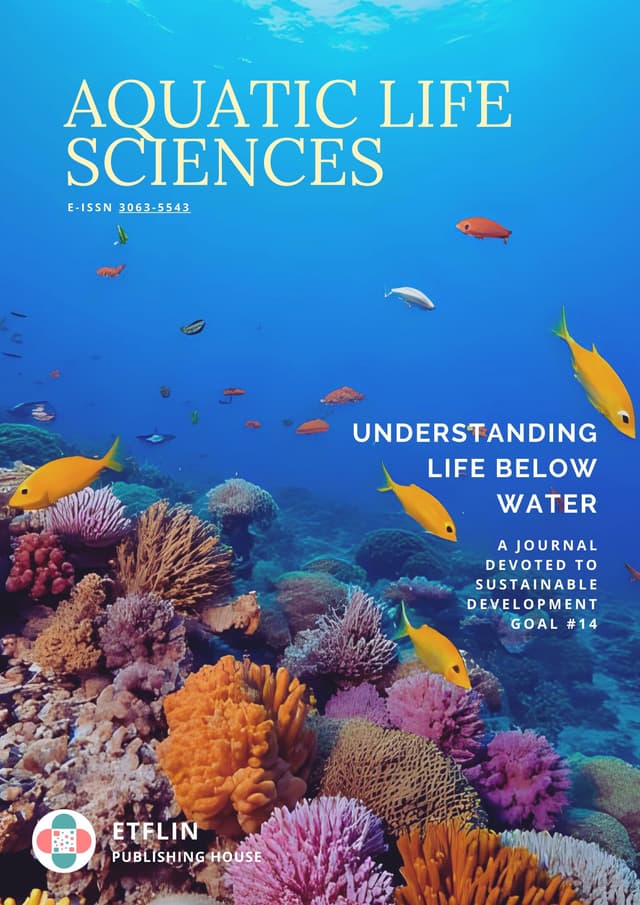
Aquatic Life Sciences
Official Affiliation

Published by ETFLIN
Volume 3 Issue 1
Showing 6 Articles
RESEARCH ARTICLE
- research article
Ecological and Economic Significance of Mangroves: A Comprehensive Review
Abduljaleel K, P S Prakash, Manjula KT, Mini PV
Mangrove ecosystems, distributed across tropical and subtropical coastlines, are globally recognized for their exceptional biodiversity and multifunctional ecological roles. They sustain coastal fisheries by serving as breeding and nursery habitats, support diverse terrestrial and aquatic fauna, enhance shoreline stability through wave attenuation and erosion control, and improve water quality via nutrient recycling and pollutant filtration. Mangroves are also among the most efficient blue carbon sinks, contributing significantly to climate-change mitigation. From a socio-economic perspective, they provide timber and non-timber resources, support artisanal fisheries, enable ecotourism-based livelihoods, and hold high potential for carbon-credit revenue and bioprospecting. The review synthesizes evidence from 135 studies published between 1990 and 2024, retrieved from Web of Science, Scopus, Google Scholar, and institutional repositories, based on their relevance to mangrove ecology, ecosystem services, and community-level economic benefits. Only peer-reviewed articles, technical reports, and case studies with clear methodological descriptions were included. The synthesis reveals that the ecological and economic functions of mangroves are strongly interdependent, with degradation of habitat quality directly reducing fisheries productivity, carbon storage efficiency, and livelihood security. The review highlights the urgent need for integrated management approaches, including hydrological restoration, community-based conservation, and policy-supported payment-for-ecosystem-services mechanisms, to enhance ecosystem resilience under accelerating anthropogenic and climate pressures.
Aquatic Life Sciences
13 Jan 202611 pages - research article
Occurrence and Abundance of Vibrio spp. in Traditional Shrimp Ponds of Tarakan, Indonesia: Implications for Aquaculture Biosecurity
Muhammad Yusron, Diana Maulianawati
Shrimp aquaculture faces recurrent challenges from Vibrio spp., opportunistic pathogens that threaten production sustainability, particularly in traditional farming systems with limited management inputs. Although Vibrio levels in traditional ponds are generally assumed to remain below pathogenic thresholds, information on their persistence and relationship with water quality remains limited. This study aimed to isolate and quantify Vibrio spp. in traditional shrimp ponds in Tarakan, Indonesia, and evaluate their relationship with key water quality parameters. Water samples were collected biweekly from week 0 to week 10 at three stations in each of two ponds. Vibrio spp. were isolated using Thiosulfate Citrate Bile Salt Sucrose Agar (TCBSA), and Total Vibrio Counts (TVC) were expressed as CFU/mL. Physicochemical parameters (temperature, pH, salinity, and dissolved oxygen) were measured concurrently. Vibrio colonies were consistently detected throughout the culture period, ranging from 1.5 × 10¹ to 2.6 × 10³ CFU/mL in Pond 1 and 2.4 × 10¹ to 1.2 × 10³ CFU/mL in Pond 2, remaining below the pathogenic threshold (1 × 10⁴ CFU/mL). Water quality remained within optimal ranges. Pearson correlation analysis showed weak, non-significant relationships between Vibrio abundance and environmental variables. These findings indicate that Vibrio persistence in traditional shrimp ponds may be influenced by factors beyond physicochemical water quality, highlighting the importance of continuous monitoring to support disease prevention and biosecurity management.
Aquatic Life Sciences
9 Apr 20268 pages - research article
Prevalence and Intensity of Endoparasites in Ribbonfish (Trichiurus lepturus) from (Lamongan) and Tamperan (Pacitan) Fish Landing Sites (TPI)
Nur Afidatul Himma
Parasitic infections in marine fish pose economic and public health risks, particularly when zoonotic species are involved. Ribbonfish (Trichiurus lepturus), a commercially important species in Indonesia, is highly susceptible to endoparasites that may reduce fish quality and threaten human consumers. This study aimed to identify the types, prevalence, and intensity of endoparasites infecting ribbonfish landed at Paciran (Lamongan) and Tamperan (Pacitan). A total of 56 fish samples were examined through necropsy and microscopic observation of internal organs. Two nematode species, Anisakis sp. and Camallanus sp., were detected in the intestine, stomach, and muscle tissues. Prevalence was 0.2% at Paciran and 0.4% at Tamperan, while intensity reached 1.3 and 1.9 ind/individual, respectively. Infected fish were typically larger, with body weights ranging from 100–400 g and lengths of 60–80 cm, and often contained undigested small fish and crustaceans that may serve as intermediate hosts. Although infection levels were classified as low, the detection of zoonotic Anisakis sp. underscores the need for continued monitoring to prevent potential health risks and safeguard fishery resources.
Aquatic Life Sciences
5 Jan 20268 pages - research article
Study of the Habitat Preferences of Kima Clams in the Waters of Bama, Baluran National Park, Situbondo Regency, East Java
Assifa Dina Aisyah
Giant clams (Tridacnidae) play an important ecological role in coral reef ecosystems; however, their populations continue to decline due to habitat degradation and overexploitation. Despite increasing conservation efforts, site-specific information on habitat preference, particularly related to substrate composition, remains limited in many Indonesian reef systems, including Bama Waters, Baluran National Park. This study aimed to assess the community structure and substrate habitat preferences of giant clams in this area. Field surveys were conducted at four stations using belt transect and quadrat methods, complemented by underwater photo transect analysis for substrate characterization and measurement of key environmental parameters. Community structure was analyzed using density and the Shannon Wiener diversity index, while habitat preference was evaluated using Ivlev’s electivity index. A total of three giant clam species were recorded with Tridacna crocea dominating with a density of 0.52 ind/ha. Diversity was categorized as low to moderate and varied spatially in relation to substrate composition. Stations with mixed substrates, particularly hard coral and rubble, supported higher diversity values. Electivity analysis revealed species-specific habitat preferences, with T. crocea favoring rocky substrates, T. maxima associated with hard coral and rubble, and T. squamosa showing weaker habitat specialization. This finding shows that substrate composition plays an important role. It also influences species distribution. This study provides site-specific ecological information that may support more effective conservation and management strategies for giant clams in coral reef ecosystems.
Aquatic Life Sciences
20 May 20268 pages - research article
Comparative Study on the Nutritional Profile of Cultured and Captured African Catfish (Clarias gariepinus)
Ijeoma Patience OBOH, Nkonyeasua Kingsley EGUN, Ukpamufo Cyril OLOWO
Aquaculture contribution to human nutrition, consumers’ preferential bias towards capture fisheries and concerns on food safety has necessitated the need for information on the nutritional composition of fish species from diverse settings such as geographical locations and aquaculture rearing facilities. This study determined the nutritional profile and associated human health risk of adult size African catfish (Clarias gariepinus) cultured in plastic tanks with those harvested from the wild. Results showed the mean protein (18.04%) and lipid (8.71%) values of cultured C. gariepinus were significantly higher than reported values in C. gariepinus from the wild, which makes them of more nutritional value to consumers. Captured fishes reported higher ash, mineral and trace metal contents, which was attributed to the elevated levels of these elements in their habitat waters due to water pollution. Low metal pollution index (MPI) values in cultured and captured fishes indicated an insignificant bioaccumulation of trace metals, and the absence of non – carcinogenic (HI <1) and carcinogenic (ICR < 1 × 10⁻⁶) risk associated with their consumption. Although the captured fishes at present poses no health risk to consumers; their recorded higher contents of trace metals, MPI, HI and CPI values is a cause for concern on the safe consumption of capture fishes. With increasing concerns on aquatic food safety, this study has shown that the consumption of cultured C. gariepinus provides more nutritional quality to consumers. The need for more monitoring studies on different culturing methods and settings on the nutritional composition and food safety is recommended.
Aquatic Life Sciences
28 Apr 20269 pages
REVIEW
 review
Not Updated Since 2000? A Review of Biodiversity Assessments in Silot Bay, Liloan, Cebu, Philippines
Karl Cirilson Ellema Angulo
Coastal ecosystems support high levels of marine biodiversity and provide essential services, including shoreline protection, carbon sequestration, and fisheries production. Silot Bay, Liloan, Cebu, Philippines, is an ecologically and socio-economically important embayment; however, biodiversity assessments in the area remain sparse and temporally fragmented. This study presents a narrative review with structured literature search elements to synthesize available ecological studies on major taxonomic groups, including mangroves, fish, meiofauna, and algae, and to evaluate methodological consistency among studies retrieved from Google Scholar, ScienceDirect, Philippine E-Journals, and institutional repositories from local universities. A total of nine studies met the inclusion criteria, the majority of which were conducted prior to 2000, with post-2000 research limited to a single study on algal communities. Substantial variation in sampling methods, effort, spatial coverage, and taxonomic resolution constrains direct comparison across studies and limits interpretation of temporal patterns. Differences in reported species richness and community composition are evident across taxa; however, these patterns cannot be confidently attributed to ecological change due to methodological inconsistencies and limited data availability. The small number of studies and reliance on partially inaccessible historical data further restrict the establishment of a reliable biodiversity baseline for Silot Bay. Overall, this review highlights significant knowledge gaps and emphasizes the need for standardized, multi-taxa biodiversity assessments to support long-term monitoring and evidence-based coastal management.
Aquatic Life Sciences
20 Apr 20267 pages
Journal Key Facts
Publishing Fee (APC)
No Charge
Open Access License
CC BY 4.0
Language
English

Overview
Aquatic Life Sciences is an international, peer-reviewed journal focused on advancing knowledge of living systems in aquatic environments. The journal covers all biological aspects of life in freshwater, marine, and brackish ecosystems, including molecular, organismal, ecological, and evolutionary perspectives. The journal is affiliated with the Faculty of Fisheries and Marine Sciences, Mulawarman University.
Latest Articles
Recently published research articles, review papers, and technical notes from the current volume of the journal.
- research article
Comparative Study on the Nutritional Profile of Cultured and Captured African Catfish (Clarias gariepinus)
Ijeoma Patience OBOH, Nkonyeasua Kingsley EGUN, Ukpamufo Cyril OLOWO
Aquaculture contribution to human nutrition, consumers’ preferential bias towards capture fisheries and concerns on food safety has necessitated the need for information on the nutritional composition of fish species from diverse settings such as geographical locations and aquaculture rearing facilities. This study determined the nutritional profile and associated human health risk of adult size African catfish (Clarias gariepinus) cultured in plastic tanks with those harvested from the wild. Results showed the mean protein (18.04%) and lipid (8.71%) values of cultured C. gariepinus were significantly higher than reported values in C. gariepinus from the wild, which makes them of more nutritional value to consumers. Captured fishes reported higher ash, mineral and trace metal contents, which was attributed to the elevated levels of these elements in their habitat waters due to water pollution. Low metal pollution index (MPI) values in cultured and captured fishes indicated an insignificant bioaccumulation of trace metals, and the absence of non – carcinogenic (HI <1) and carcinogenic (ICR < 1 × 10⁻⁶) risk associated with their consumption. Although the captured fishes at present poses no health risk to consumers; their recorded higher contents of trace metals, MPI, HI and CPI values is a cause for concern on the safe consumption of capture fishes. With increasing concerns on aquatic food safety, this study has shown that the consumption of cultured C. gariepinus provides more nutritional quality to consumers. The need for more monitoring studies on different culturing methods and settings on the nutritional composition and food safety is recommended.
Aquatic Life Sciences
28 Apr 20269 pages - research article
Study of the Habitat Preferences of Kima Clams in the Waters of Bama, Baluran National Park, Situbondo Regency, East Java
Assifa Dina Aisyah
Giant clams (Tridacnidae) play an important ecological role in coral reef ecosystems; however, their populations continue to decline due to habitat degradation and overexploitation. Despite increasing conservation efforts, site-specific information on habitat preference, particularly related to substrate composition, remains limited in many Indonesian reef systems, including Bama Waters, Baluran National Park. This study aimed to assess the community structure and substrate habitat preferences of giant clams in this area. Field surveys were conducted at four stations using belt transect and quadrat methods, complemented by underwater photo transect analysis for substrate characterization and measurement of key environmental parameters. Community structure was analyzed using density and the Shannon Wiener diversity index, while habitat preference was evaluated using Ivlev’s electivity index. A total of three giant clam species were recorded with Tridacna crocea dominating with a density of 0.52 ind/ha. Diversity was categorized as low to moderate and varied spatially in relation to substrate composition. Stations with mixed substrates, particularly hard coral and rubble, supported higher diversity values. Electivity analysis revealed species-specific habitat preferences, with T. crocea favoring rocky substrates, T. maxima associated with hard coral and rubble, and T. squamosa showing weaker habitat specialization. This finding shows that substrate composition plays an important role. It also influences species distribution. This study provides site-specific ecological information that may support more effective conservation and management strategies for giant clams in coral reef ecosystems.
Aquatic Life Sciences
20 May 20268 pages - research article
Microplastic Distribution and Dynamics Between Riparian Vegetation and Alaknanda River in the Himalayan Region
Vaishali Bhatt, Prasant Arya, Jaspal Singh Chauhan
Microplastic (MP) contamination in freshwater ecosystems is an emerging environmental concern, yet interactions between MPs and riparian macrophytes remain poorly understood, particularly in Himalayan river systems. This study provides a baseline assessment of MP surface entanglement across riparian macrophyte species, along with associated surface water and sediment, from River Alaknanda, Srinagar, Uttarakhand, India, sampled in June 2023. A total of 30 macrophyte, surface water, and sediment samples were collected and processed using extraction protocols integrating washing, oxidative digestion, density separation, stereomicroscopic analysis, and polymer characterization through ATR-FTIR spectroscopy. MPs were extensively detected on macrophyte surfaces, with species-specific normalized burdens ranging from 16.47 ± 2.59 to 273.86 ± 26.21 MPs/g dry weight. Kruskal-Wallis analysis revealed significant interspecific variation in normalized MP abundance (H = 25.73, p = 0.0023), with Chenopodium ambrosioides exhibiting significantly higher MP burdens than Conyza sp. and Equisetum sp. No MPs within the analytical detection range of 100 µm-5 mm were detected in digested plant tissues. Fibres were the dominant MP type in macrophytes and water, whereas fragments predominated in sediments, with white particles being most abundant across all matrices. Polymer analysis identified polyester, polyethylene, polypropylene, polyterephthalate, and polyethylene-vinyl acetate as dominant polymers. Strong compositional correlations among macrophytes, water, and sediment indicated similarities in MP characteristics across environmental matrices. These findings suggest riparian macrophytes as complementary matrices for freshwater MP monitoring. Despite methodological and spatial limitations, this study establishes a preliminary framework for incorporating riparian vegetation into freshwater MP monitoring and highlights the need for further investigations.
Aquatic Life Sciences
10 Jul 202610 pages - review
Not Updated Since 2000? A Review of Biodiversity Assessments in Silot Bay, Liloan, Cebu, Philippines
Karl Cirilson Ellema Angulo
Coastal ecosystems support high levels of marine biodiversity and provide essential services, including shoreline protection, carbon sequestration, and fisheries production. Silot Bay, Liloan, Cebu, Philippines, is an ecologically and socio-economically important embayment; however, biodiversity assessments in the area remain sparse and temporally fragmented. This study presents a narrative review with structured literature search elements to synthesize available ecological studies on major taxonomic groups, including mangroves, fish, meiofauna, and algae, and to evaluate methodological consistency among studies retrieved from Google Scholar, ScienceDirect, Philippine E-Journals, and institutional repositories from local universities. A total of nine studies met the inclusion criteria, the majority of which were conducted prior to 2000, with post-2000 research limited to a single study on algal communities. Substantial variation in sampling methods, effort, spatial coverage, and taxonomic resolution constrains direct comparison across studies and limits interpretation of temporal patterns. Differences in reported species richness and community composition are evident across taxa; however, these patterns cannot be confidently attributed to ecological change due to methodological inconsistencies and limited data availability. The small number of studies and reliance on partially inaccessible historical data further restrict the establishment of a reliable biodiversity baseline for Silot Bay. Overall, this review highlights significant knowledge gaps and emphasizes the need for standardized, multi-taxa biodiversity assessments to support long-term monitoring and evidence-based coastal management.
Aquatic Life Sciences
20 Apr 20267 pages - research article
Prevalence and Intensity of Endoparasites in Ribbonfish (Trichiurus lepturus) from (Lamongan) and Tamperan (Pacitan) Fish Landing Sites (TPI)
Nur Afidatul Himma
Parasitic infections in marine fish pose economic and public health risks, particularly when zoonotic species are involved. Ribbonfish (Trichiurus lepturus), a commercially important species in Indonesia, is highly susceptible to endoparasites that may reduce fish quality and threaten human consumers. This study aimed to identify the types, prevalence, and intensity of endoparasites infecting ribbonfish landed at Paciran (Lamongan) and Tamperan (Pacitan). A total of 56 fish samples were examined through necropsy and microscopic observation of internal organs. Two nematode species, Anisakis sp. and Camallanus sp., were detected in the intestine, stomach, and muscle tissues. Prevalence was 0.2% at Paciran and 0.4% at Tamperan, while intensity reached 1.3 and 1.9 ind/individual, respectively. Infected fish were typically larger, with body weights ranging from 100–400 g and lengths of 60–80 cm, and often contained undigested small fish and crustaceans that may serve as intermediate hosts. Although infection levels were classified as low, the detection of zoonotic Anisakis sp. underscores the need for continued monitoring to prevent potential health risks and safeguard fishery resources.
Aquatic Life Sciences
5 Jan 20268 pages